Lead Generation for Technology Companies: 10 Tools for 2026

Andrea López
Partager
Key Takeaways (TL;DR)
The Best Overall Lead Generation for Technology Companies: Enginy builds tech-company lists from technology stack, hiring, and funding signals, then runs the email, social, and calling sequences off the same enriched record. It is designed so a sales rep can operate it without a GTM engineer sitting behind them.
Why You Need It: Technical buyers ignore generic outreach and rarely announce themselves, so the teams that win reach the right account in the week something changed rather than the week a list was bought.
Who It's For: B2B software vendors, IT services companies and managed service providers, cybersecurity firms, and technology founders running outbound into the UK and Europe.
How to Choose the Right One: Decide first whether you're buying software or an agency, then judge tools on whether they carry technographic and hiring signals natively, and on whether one tool covers finding, enriching, and contacting without a second purchase.
Price Range: Enginy is quoted per account on a credit model across four tiers, from Basic to Enterprise. Across the rest of this list, published entry prices run from free on a limited tier, through $47 to $167 a month for self-serve tooling, up to $3,333 a month for signal tools sold on annual contracts.
Top Lead Generation Tools for Technology Companies in 2026 at a Glance
Company | Best For | Key Strengths | Pricing |
Enginy | Tech sales teams that want data, signals, and outreach in one place | Waterfall enrichment across 30+ providers, technology stack and hiring filters, multichannel campaigns, CRM sync | Custom quote, credit-based across four tiers |
Apollo.io | Small software teams that need volume at a low entry price | Large self-serve database, built-in sequences, free tier, published per-seat pricing | Free, then $49 to $119 per seat a month billed annually |
Cognism | Technology companies selling into the UK and Europe by phone | Phone-verified mobiles, European coverage, do-not-call screening, shared credit pool | Standard, Pro, and CRM Enrichment packages, quoted per account |
Clay | Technical GTM teams building their own enrichment logic | Waterfall across many sources, AI research columns, flexible tables | Free tier, then $167 and $446 a month on annual billing |
Common Room | Product-led software companies acting on product and community signals | Signal capture across product, community, and web, AI research credits, prospecting credits | From $2,500 a month, higher tiers custom |
UserGems | Enterprise software teams following buyers who change jobs | Job-change and champion tracking, warm-account alerts, published annual pricing | $3,333, $6,250, or $12,500 a month, billed annually |
Leadfeeder | Tech companies converting anonymous website traffic into accounts | Company-level visitor identification, intent filters, CRM and alerting workflows | Free Lite tier, then €79, €369, and €599 a month on annual billing |
Lemlist | Teams running multichannel sequences on a fixed monthly budget | Multichannel sequencing, deliverability tooling, pay-per-success data credits | $55 or $87 a month on annual billing, Enterprise custom |
Instantly | High-volume cold email that needs sending infrastructure | Mailbox warm-up, deliverability infrastructure, large lead database, technology and funding enrichment | Bundles at $94, $194, and $555 a month |
HubSpot Sales Hub | Technology companies standardising inbound handling and CRM | Inbound forms and routing, sequences, reporting, native CRM | Free for up to 2 users, then $90 and $150 per seat a month |
What Is Lead Generation for Technology Companies?
Lead generation for technology companies is the work of finding accounts that fit your product, identifying the people inside them who influence a technical purchase, and starting conversations that end in a booked meeting. The mechanics are the same as any B2B motion. What changes is the buying committee, the signals that tell you when to move, and how quickly a generic message gets deleted.
Enginy's help centre documents how each of these fields is stored and filtered inside a live list, and our guide to what lead generation is covers the underlying stages.
Three things make the technology sector distinct.
The committee is technical and it self-serves: an engineer or security reviewer forms a view long before procurement appears, and they do it by reading documentation rather than by asking a vendor.
The signals are unusually visible: the software an account runs, the roles it's hiring, and the funding it has raised are all observable from the outside, which isn't true in most sectors.
The channel is crowded: every vendor with a database is contacting the same CTOs, so relevance is the only thing left that separates one message from another.
Software Companies and IT Services Companies Sell Differently
The top-ranking guides for this keyword treat the technology sector as one audience, which is where the advice starts to go wrong. A software vendor and an IT services firm are looking for different accounts, and their lists are built on opposite logic.
A software company sells a repeatable product to a global ideal customer profile, so it prospects wide and filters hard, usually on headcount, sector, and the tools an account already runs. Volume matters because the product is the same for everyone.
An IT services company, a managed service provider, or a consultancy sells capacity and expertise into a smaller regional universe, often within reach of an engineer. Lead generation for IT services companies is therefore about depth on a shorter list, because the same 400 accounts will be worked for years.
Advice written for software vendors rarely transfers, which is why lead generation for IT company sales teams leans on hiring activity and technology change rather than on raw list size.
That split decides which of the tools further down this guide will fit you. Before picking one, it's worth pricing what the current setup already costs.
Why Do You Need Lead Generation for Technology Companies?
Because the alternative is a sales team that spends most of the week not selling. Salesforce's State of Sales research puts the split at 60% not selling, with the rest of the week going to admin, planning, and manual data entry. Every hour a rep spends assembling a list is an hour that never becomes a conversation.
The second problem is that the technology stack meant to fix this often causes it. The same Salesforce survey found that 42% of sales reps are overwhelmed by too many tools, that only about a third of teams use an all-in-one system while the rest run an average of eight standalone tools, and that 84% of teams without an all-in-one system plan to consolidate.
Tech companies are especially prone to this, because buying another tool is the reflex the whole team is trained on.
Then comes decay. ZeroBounce's list-decay research found that at least 23% of an email list degrades yearly, and technology has the churn to prove it. Titles change and teams reorganise, so the champion who chose your product last quarter now works three companies away.
Timing is the part most teams underestimate. RAIN Group's prospecting research found it takes an average of 8 touchpoints to secure a first meeting, so a single well-written email into a perfect account still fails more often than it works.
Signal-based sequencing is what makes those touches land, which is why B2B buying signals do more for a tech pipeline than another 10,000 records. The sequence that carries them is the same one used to generate B2B leads in any sector, applied to a narrower list.
Speed matters once a lead does raise a hand. The MIT and InsideSales lead response study found the odds of qualifying a lead drop 21 times when the call happens at 30 minutes instead of five. For a software company with a free trial, that's the difference between catching a developer while the product is still open on their screen and catching them after they closed the tab.
Get the inputs right and the numbers move the other way. Factorial, an HR software company, replaced manual sourcing with automated lists in Enginy and went from one person producing around ten leads a day to 5,000 leads a month, with reply rates rising from 10% to 45% and conversion doubling from 4% to 8%.
Who Needs Lead Generation for Tech Companies?
Every technology business generates leads. The test each one applies is different, and the five profiles below feel the problem most sharply.
Heads of Sales at B2B Software Companies
Sales leaders at software vendors own a number that assumes outbound work, and they inherit the consequences when it doesn't. Flat pipeline, reply rates that fall every quarter, and reps who look busy while missing quota all trace back to the list.
What they want is a predictable pipeline without another headcount request, so they judge B2B lead generation for technology companies on cost per booked meeting rather than on the size of a database.
That figure only exists if you already measure sales performance consistently, and it's the number that settles most tooling arguments.
IT Services Companies and Managed Service Providers
An IT services provider sells capacity into a defined regional market, which makes every account worth researching properly. The problem is that the same accounts are contacted by every competing provider, usually with the same message about reducing downtime.
Their deciding factor is trigger quality. Lead generation for IT companies works when outreach lands in the week an account posted a systems role, changed a core tool, or opened a second site, and produces nothing the rest of the time. That makes B2B lead generation for IT services a timing problem more than a volume one.
Cybersecurity Vendors Selling into Enterprise IT
Security vendors sell to CISOs and security engineers, who are the hardest technical audience to reach cold and the most likely to check a claim before replying. Their committees are large, and a single unverifiable line loses the account.
They need targeting built on the tools an account already runs, plus multi-stakeholder sequences that reach the security lead, the infrastructure owner, and the executive sponsor together rather than one at a time.
Founders at Early-Stage Technology Companies
A founder selling their own product has no GTM engineer and no time to configure enrichment logic. They need a list they can act on today, and they need to find out quickly whether a new segment replies at all.
Speed beats configurability here. Founders doing lead generation for software companies are usually testing three markets at once, and the tool that produces a working sequence the same afternoon wins. What they automate first matters more than how much they automate, which is the practical starting point for sales automation in a small team.
Sales Operations and RevOps Teams
RevOps owns the plumbing, which in a technology company means list building, deduplication, enrichment, CRM hygiene, and routing. They are usually the team already paying for a database, a verifier, and a sequencer that don't share a schema.
They evaluate on match rates, integration depth, and how much of the weekly workflow disappears once a tool is connected. Consolidation is often their stated goal for the year, and in technical teams it increasingly extends to MCP for sales teams so an AI assistant can read the same records the reps do.
Best Lead Generation for Technology Companies: In-Depth Review and Comparison
Rankings of IT lead generation companies and tools rarely agree, because the honest answer depends on which half of the sector you sit in and how your buyers evaluate.
The ten tools below cover four different jobs, which are finding accounts, enriching them, detecting a trigger, and running the outreach, and they overlap only partly with the general lead generation tools most rankings cover.
We start with the one built to do all four in a single workflow.
1. Enginy

Overview
Enginy is an AI-native B2B sales tool covering prospect discovery, data enrichment, and multichannel outreach in one place.
Rather than selling access to one static database, it pulls contact data from 30+ enrichment providers in real time and applies waterfall logic, so each field is filled by whichever source actually holds it. That is data enrichment run as a chain rather than a single lookup.
For technology companies, the useful part is what the lists can be built from. Filters cover technology stack, hiring activity, funding rounds, job changes, past employers, event attendance, and engagement with a specific social post, which are the signals that tell you an account is moving rather than merely a good fit.
The problem it targets is tool sprawl. Most tech teams buy a database, then a sequencer, then something to clean the exports between them, and lose rep hours to the joins.
Enginy runs the full sequence of scrape, clean, enrich, clean, import, and assign inside one workflow, then syncs into HubSpot, Salesforce, Pipedrive, Dynamics 365, Zoho, or Attio.
Ideal For
B2B software vendors running structured SDR and AE teams
IT services companies and managed service providers working a defined regional patch
Cybersecurity firms that need to reach a full technical committee at once
Technology founders without a GTM engineer to operate a data workflow
Sales operations teams consolidating a database, a cleaner, and a sequencer
Why Do We Stand Out?
Two things separate Enginy from the data-only and outreach-only tools around it.
Signals and outreach on one record: a technology stack filter is only worth something if you can act on it the same day, and most tools hand you a CSV at exactly that point. Enginy carries the enriched record straight into email, social, and calling sequences, so nothing is re-keyed between the trigger and the first touch.
Complete without needing a specialist: tools that combine this much depth usually assume a dedicated operator. Enginy is built so an SDR can construct, enrich, and launch a list without writing a formula, which is what makes the coverage usable rather than theoretical.
AI research fields add the context that makes a technical opener land, pulling company news and role summaries into the message rather than leaving reps to do AI sales research by hand.
The multi-stakeholder layer matters in tech specifically. Sequences can contact several people at the same account in parallel, including a senior identity warming the CTO ahead of an SDR call, so the whole committee has heard of you before anyone picks up the phone.
Pros
Technology stack, hiring, funding, and job-change filters are native rather than a paid add-on
Waterfall enrichment across 30+ providers fills fields a single database leaves blank
Verified emails and direct phone numbers on the same record, with cleaning before and after enrichment
Multichannel campaigns across email, social, and calling tasks, with AI reply handling
Five structured onboarding sessions, so configuration isn't left to the customer
Cons
Pricing is quoted after a qualification call rather than published, which slows a purely self-serve evaluation
Teams that only want a raw data feed for their own systems will pay for outreach features they won't use
Engineering teams who want a pure API to build their own data product are better served elsewhere
Pricing
Enginy uses a credit-based model across four tiers, which are Basic, Smart, Business, and Enterprise. Credits are consumed by company and contact extraction, email and phone enrichment, verification, technology stack and job-posting data, and AI research fields.
Plans differ by monthly credits, contact volume, sender identities, and included onboarding, and every plan is quoted after a short call so seats, credit volume, and phone data match what you'll use.
Final Verdict
Enginy suits technology companies whose real problem isn't finding a database but turning a signal into a booked meeting without a specialist operating the machinery.
It combines the multi-source coverage you would normally assemble in an orchestration tool with the campaign layer you would normally buy separately, and it's built for the people doing the selling rather than for a data team.
2. Apollo.io
Overview
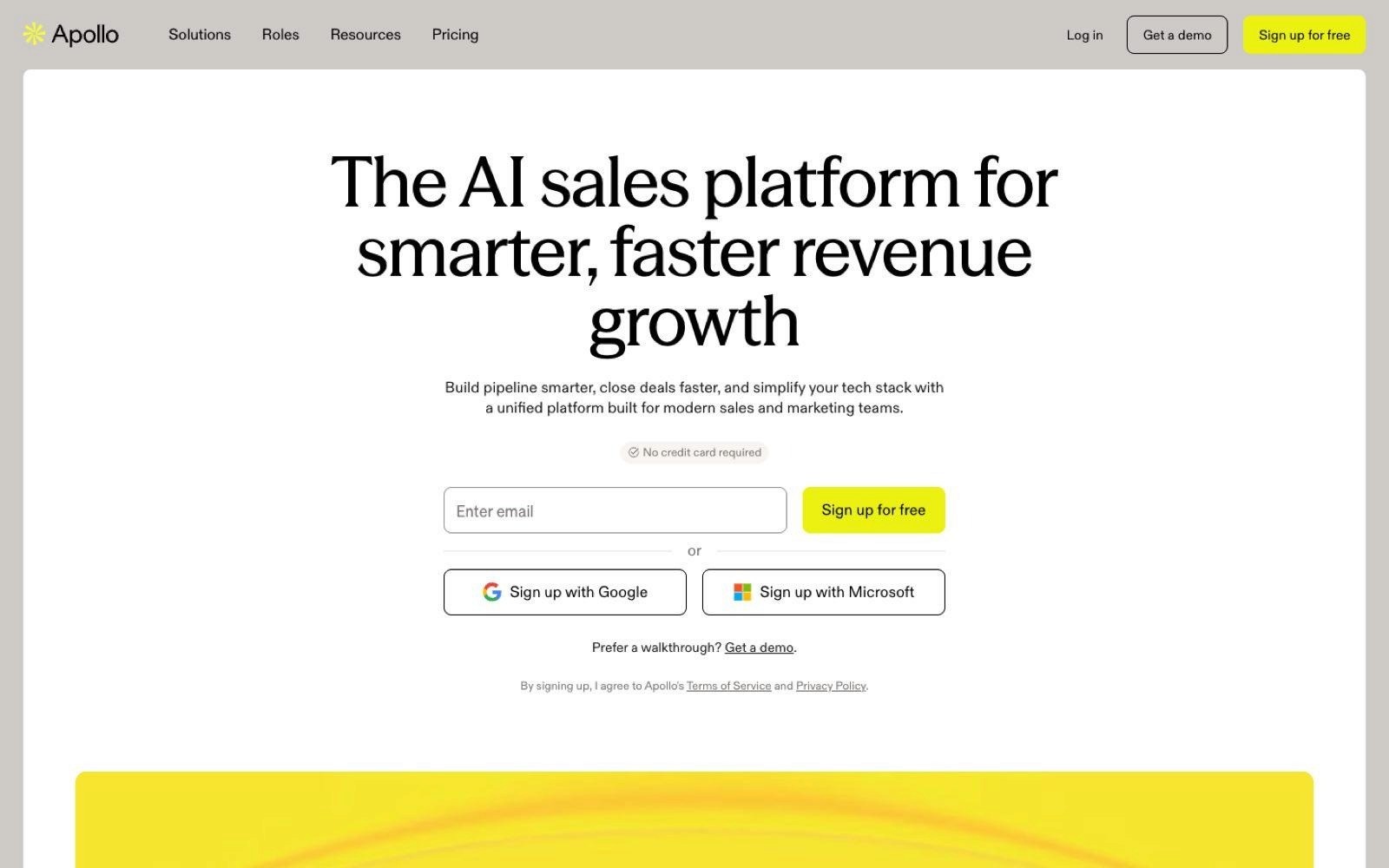
Apollo.io combines a large self-serve contact database with sequencing, dialling, and deal tracking, and it's the price reference point most technology buyers start from. Its free tier and low per-seat cost make it the default first purchase for small software teams.
It targets small and mid-sized sales teams that want to search, export, and send from one login without a procurement process, and it sells largely self-serve.
Ideal For
Early-stage software companies making a first outbound hire
Small teams that want database access and sequencing on one bill
Sales teams testing a new segment before committing budget
Founders who want to start prospecting the same day
Why Do They Stand Out?
Apollo publishes its pricing in full, which is unusual in this category and makes budgeting straightforward. Its own pricing page sets out a free tier at $0, then Basic at $49, Professional at $79, and Organization at $119 per seat a month on annual billing, with annual billing marked as a 24% saving.
The credit model is published at the same level of detail. Accessing a contact's email uses one credit, a phone number uses eight, and data enrichment uses up to nine credits per record, which lets a team model the true cost of a phone-led campaign before signing.
Pros
Free tier at $0 with 900 credits per seat per year, granted monthly
Published per-seat pricing across four tiers, so budgets can be modelled upfront
Database, sequences, and dialler in one login
Chrome and Gmail extensions plus a 14-day trial on paid plans
Credit costs per action are documented publicly
Cons
Phone numbers cost eight credits each against one for an email, so phone-led outbound consumes allowances quickly
Website visitor identification on the free tier is limited to 20 companies monthly
Intent coverage on the free tier is limited to a single intent topic
CRM enrichment on the free tier is capped at 100 records a month
The self-serve model means configuration and deliverability setup sit with you
Pricing
Apollo publishes four tiers, which are Free at $0, Basic at $49, Professional at $79, and Organization at $119 per seat a month when billed annually. Credits are granted per seat, at 900 a year on Free and 30,000 a year upfront on Basic, and additional credits can be bought mid-cycle. Paid plans open with a 14-day trial that includes 100 credits.
Final Verdict
Apollo is a sensible starting point for a software company running its first outbound motion, where transparent per-seat pricing matters more than depth of coverage. Teams selling by phone into Europe should model the credit maths carefully first, since a phone number costs eight times an email.
Its published tier limits on visitor identification, intent topics, and CRM enrichment also mean the free plan works better as an evaluation than as a working setup.
3. Cognism
Overview
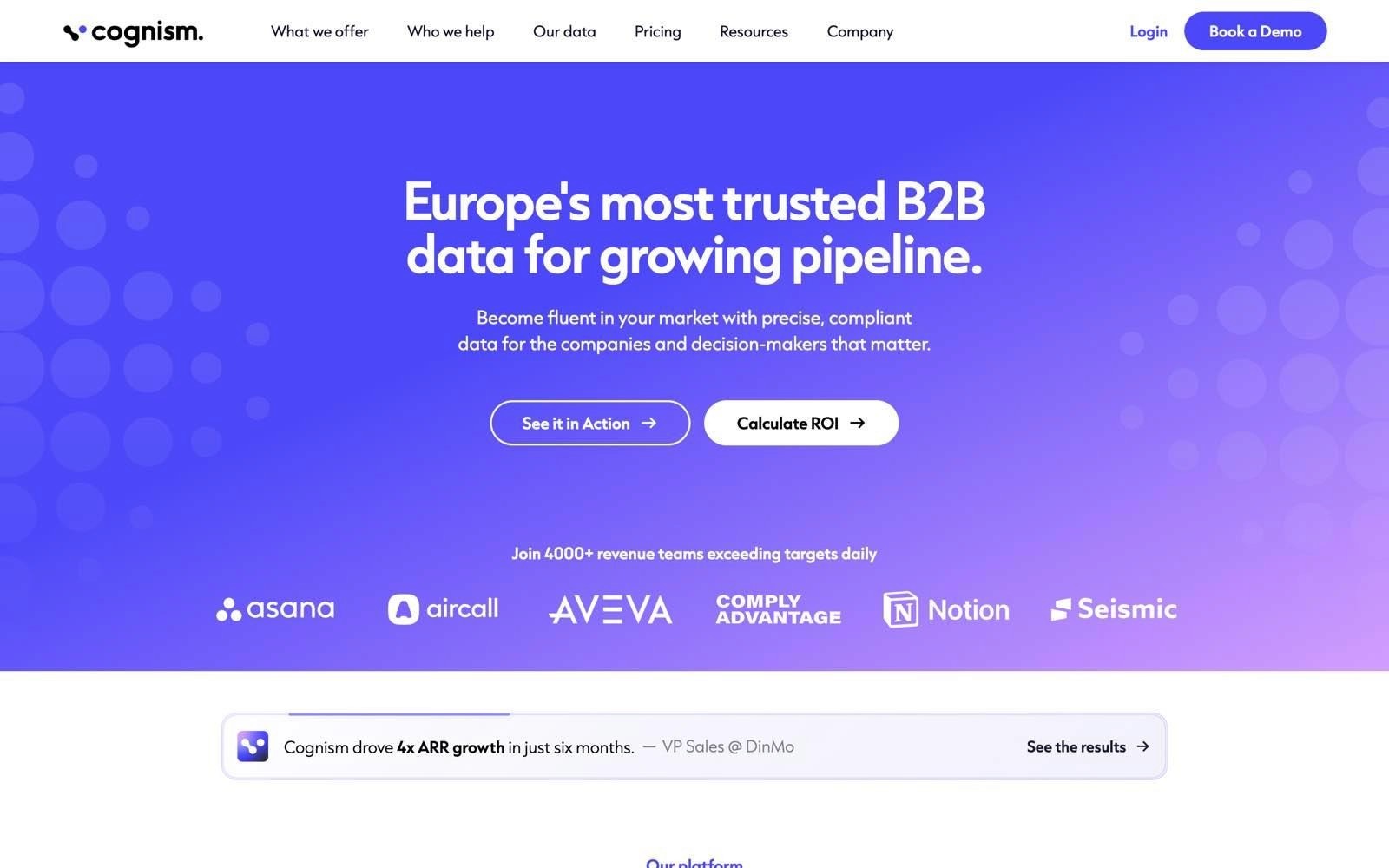
Cognism is a sales intelligence tool focused on European coverage, with phone-verified mobile numbers as its central promise. It is bought by outbound teams whose motion depends on reaching a decision-maker directly rather than on email volume.
The buyers it's built for sell into the UK, DACH, and wider EMEA, where United States-centric databases thin out sharply and mobile coverage decides whether a calling team hits its numbers.
Ideal For
Technology companies prospecting into the UK and Europe
Calling teams that need verified direct dials rather than switchboards
Sales teams operating where do-not-call screening is part of the process
RevOps teams enriching an existing European database
Why Do They Stand Out?
Cognism sells against regional coverage rather than headline record counts, which is the more useful axis for anyone selling outside North America. Its homepage leads with Europe's most trusted B2B data, and its pricing page describes three packages, which are Standard, Pro, and CRM Enrichment, with five seats included on Standard and Pro and pricing that scales with seats and shared credits.
The credit design is worth noting for teams that use data in more than one place. Cognism's page states that one credit equals one revealed contact, that each seat includes an allowance, and that the same credits work across the prospecting tool, Enrich, and the API without extra cost, so one pool stretches across prospecting and enrichment.
Pros
European and UK coverage is the product's stated focus rather than an afterthought
Phone-verified mobile numbers for calling teams
One credit equals one revealed contact, with a single pooled allowance
The same credits cover the prospecting tool, enrichment, and the API
A free data sample is offered before purchase
Cons
No pricing figures are published, so evaluation starts with a sales conversation
Pricing scales with seats as well as credits, which raises the cost of giving access to a wider team
Additional credits are purchased on top rather than included without limit
It sells data and enrichment, so sequencing and deliverability still need a separate purchase
Pricing
Cognism doesn't publish figures. Its pricing page lists Standard, Pro, and CRM Enrichment packages, each including five seats, states that pricing scales with seats and shared credits, and invites buyers to book a demo, with a free data sample available first. Credits are consumed one per revealed contact, each seat carries an allowance, and additional credits can be purchased at any point.
Final Verdict
Cognism fits technology companies whose pipeline depends on reaching European decision-makers by phone, where verified mobile coverage is worth paying for. It is a weaker fit for teams that want a published price before a first call, or for a small team where per-seat scaling makes broad access expensive.
Because it stops at data and enrichment, you should also budget for the sequencing tool that sits after it.
4. Clay
Overview
Clay is an enrichment and research tool built around a spreadsheet-style table, where each column can call a different data provider or an AI research step. It is well regarded among technical go-to-market operators for exactly that flexibility.
The buyer is a RevOps or GTM engineering team that wants to define its own waterfall logic rather than accept a vendor's, and that has someone in-house to maintain it.
Ideal For
RevOps teams building custom enrichment waterfalls
GTM engineers running research at scale across many providers
Technology companies with unusual qualification criteria
Teams that want AI research columns rather than fixed fields
Why Do They Stand Out?
Clay's model prices the work rather than the seat, which suits teams whose volume changes month to month. Its pricing page publishes a free tier with 500 actions a month, then Launch at $167 a month starting at 15,000 actions and Growth at $446 a month starting at 40,000, both on annual billing, with monthly billing raising those to $185 and $495.
Actions and data credits sit on two separate published sliders, each with its own price ladder, so the plan figure moves as you expand either one.
The flexibility is genuine. Because each column can call a different source, a team can chain providers until a field is filled and pay only for the calls that succeed, which is difficult to replicate inside a fixed-schema database.
Pros
Free tier with 500 actions a month and 100 data credits a month
Published action and credit tiers, expandable as volume grows
Any column can call a different provider or an AI research step
Role-based access control includes workbook-level credit budgets
Actions and data credits expand on separate published sliders, each with its own price ladder
Cons
The free plan doesn't include phone number enrichment
Sending to an external sequencer requires a paid plan
Action and credit budgets are separate lines, so total cost takes modelling
It assumes someone in-house will own and maintain the enrichment logic
Paying monthly rather than annually raises Launch from $167 to $185 and Growth from $446 to $495
Pricing
Clay publishes a free tier with 500 actions and 100 data credits a month, then Launch at $167 a month from 15,000 actions and Growth at $446 a month from 40,000 actions, both billed annually, plus an enterprise tier quoted separately. Monthly billing raises those figures to $185 and $495. Actions and data credits are expanded on two separate sliders, each carrying its own published ladder, so the final figure depends on where you set both.
Final Verdict
Clay is a strong fit for technology companies that employ a GTM engineer and want enrichment logic they control rather than inherit. Teams without that person tend to buy a licence nobody drives, since the value is in the logic somebody builds.
The two separate sliders, the paid-plan requirement for external sequencing, and the absence of phone enrichment on the free tier all mean the headline figure isn't the full cost.
5. Common Room
Overview
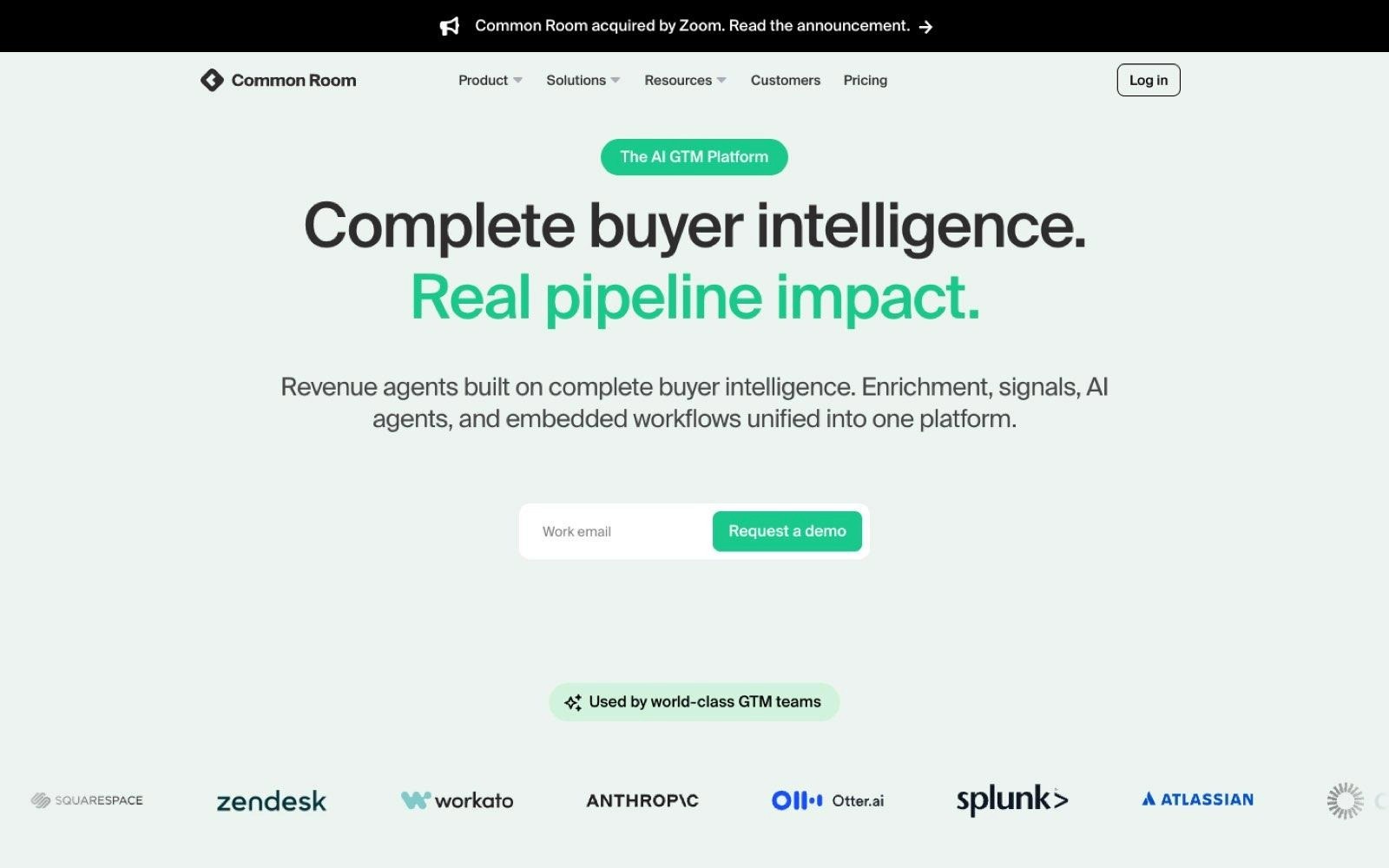
Common Room captures signals from places most sales tools ignore, including product usage, developer communities, documentation visits, and social engagement, then turns them into prospecting actions. It is shaped for the way product-led software companies actually acquire customers.
It targets software companies where the first contact with a buyer is a signup, a repository star, or a question in a community rather than a form fill, and where the sales team needs to know which of those signals is worth a call.
One piece of context matters before you evaluate it. Zoom announced an agreement to acquire Common Room on 2 July 2026 and states that the transaction closed that month, with the stated intention of combining Common Room's buyer intelligence with Zoom Revenue Accelerator. The announcement doesn't say how the standalone product continues, and Common Room still sells and prices it directly.
Ideal For
Product-led software companies with a free tier or trial
Developer tools tracking documentation and community activity
Sales teams that need to prioritise self-serve signups
RevOps teams consolidating signals from several sources
Why Do They Stand Out?
Common Room is built around signal aggregation rather than record count, which matches how technical buyers behave. Its pricing page sets out an entry tier from $2,500 a month including 5,000 AI research credits and 2,500 prospecting credits, with higher tiers quoted and additional prospecting credits sold as an add-on.
For a product-led business the appeal is coverage of the pre-form stage. A buyer who reads your documentation, joins your community, and starts a trial has told you a great deal before any marketing system would have recorded a lead.
Pros
Signal capture across product usage, community, and web activity
Entry pricing published, at $2,500 a month
AI research credits and prospecting credits included in each tier
Custom signals and custom product entities on higher tiers
Automated workflows and custom reporting for RevOps teams
Cons
Entry pricing at $2,500 a month puts it out of reach for early-stage teams
Higher tiers are quoted rather than published, so scaling costs are unclear upfront
Additional prospecting credits are an add-on rather than included
It depends on having product or community signals to capture, which not every technology company has
IT services firms and consultancies have little to feed it
Zoom's acquisition closed in July 2026 and the announcement doesn't set out how the standalone product continues, so a long commitment carries roadmap uncertainty
Pricing
Common Room publishes an entry tier from $2,500 a month, including 5,000 AI research credits and 2,500 prospecting credits, with two higher tiers quoted on request that include larger credit allowances. Additional prospecting credits are available as an add-on.
Final Verdict
Common Room fits product-led software companies where trials, documentation, and community activity are the earliest evidence of intent, and where nobody currently acts on it. It's a poor fit for IT services companies and managed service providers, who have no product signals to read.
The published $2,500 entry point and the quote-only higher tiers make it a considered purchase rather than a tool a small team tests on a whim, and the July 2026 acquisition is worth raising directly with their team before signing a multi-year contract.
6. UserGems
Overview
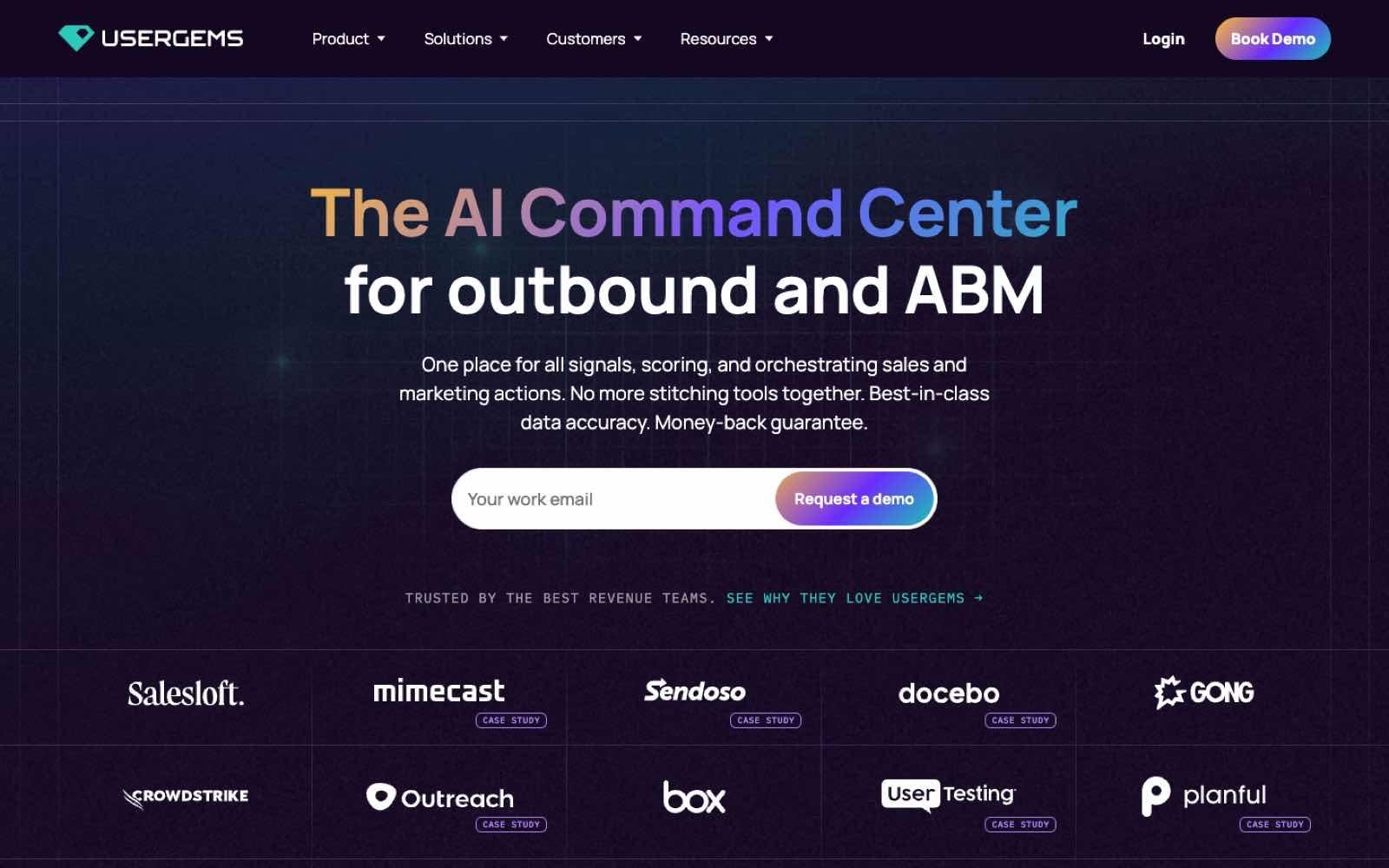
UserGems tracks the people who already know your product and alerts you when they move to a new company, turning a job change into a warm account. For technology companies with high customer churn between employers, that's a repeatable source of pipeline.
The fit is an enterprise software sales team with an installed base large enough that former champions and users keep appearing at new accounts.
Ideal For
Enterprise software companies with a large installed base
Sales teams that win on relationships with named champions
Account-based teams tracking movement inside target accounts
RevOps teams routing warm alerts to the right owner
Why Do They Stand Out?
UserGems publishes annual pricing openly, which is rare for tools sold at this level. Its pricing page lists three tiers at $3,333, $6,250, and $12,500 a month, described as $40,000, $75,000, and $150,000 a year, with implementation and customer success priced separately at $3,000, $5,000, and $10,000.
The signal itself is the differentiator. A champion arriving at a new company is one of the few triggers that carries an existing relationship with it, which shortens the first conversation considerably.
Pros
Annual pricing published in full, including implementation fees
Job-change and champion tracking as the core product
Warm-account alerts that carry an existing relationship
Credits and custom integrations included in the published tiers
Implementation and customer success scoped and priced explicitly
Cons
Entry pricing of $40,000 a year rules it out for most small and mid-sized teams
Implementation is charged separately, starting at $3,000
The product depends on having a sizeable installed base to track
Early-stage software companies have too few former users for the signal to fire
It covers one signal type, so a broader prospecting tool is still needed
Pricing
UserGems publishes three tiers at $3,333, $6,250, and $12,500 a month, billed annually at $40,000, $75,000, and $150,000 a year. Implementation and customer success are priced separately at $3,000, $5,000, and $10,000 depending on tier.
Final Verdict
UserGems suits established enterprise software companies with enough customer history that champion movement is a steady stream rather than an occasional event. Its published entry point of $40,000 a year, plus separate implementation from $3,000, makes it a line item that needs a business case.
Because it reports one signal rather than building lists, it works as an addition to a prospecting setup rather than as the setup itself.
7. Leadfeeder
Overview
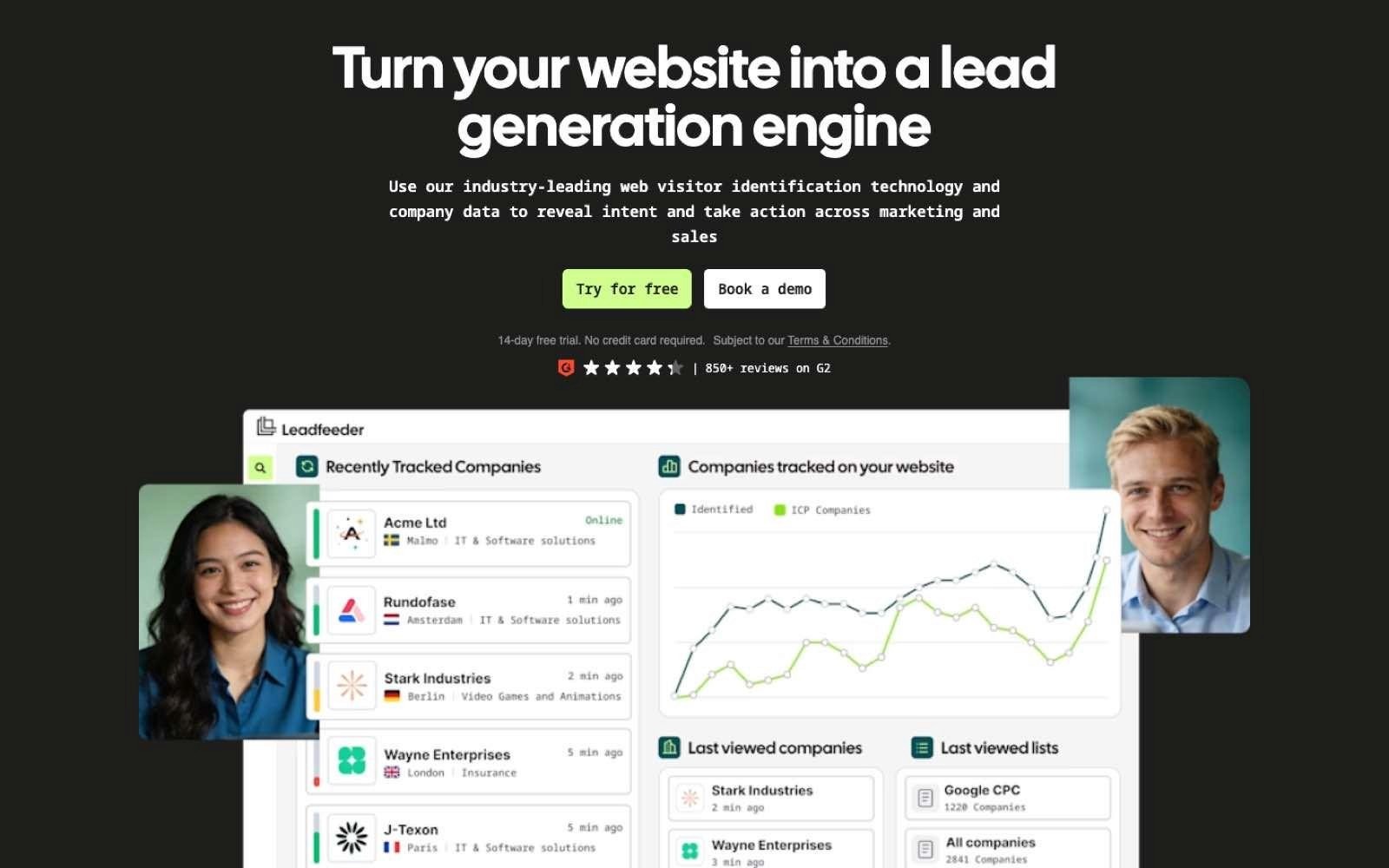
Leadfeeder identifies the companies visiting your website and scores them on the pages they read, which fills the gap between anonymous traffic and a form fill. Its own blog carries a post titled Dealfront is now Leadfeeder, and dealfront.com redirects to the Leadfeeder site, so the competitor roundups that call it Dealfront have the rename backwards.
It targets technology companies whose buyers research quietly, arriving through content or documentation and leaving without identifying themselves.
Ideal For
Technology companies with steady inbound content traffic
Sales teams that want to follow up on pricing-page visits
Marketing teams measuring which accounts content reaches
Teams selling into Europe where account-level identification is the norm
Why Do They Stand Out?
Leadfeeder publishes a complete price ladder with a genuinely usable free tier, which is uncommon in visitor identification. Its pricing page lists Lite at €0, described as free forever with the last 100 companies a month, then Discover starting at €79, Activate at €369, and Scale at €599 per month billed annually, with Scale annual only and an enterprise tier quoted separately.
Every paid plan opens with a 14-day trial that needs no card, and the tiers are honest about the boundary between a visit and a contact. Activate is the tier positioned for turning identified companies into qualified contact leads, and it's where verified emails and phones appear, which tells you the visit resolves to a company while the contact details come from enrichment.
Pros
Free Lite tier described as free forever, covering the last 100 companies a month
Published price ladder starting at €79 and rising to €599 a month
14-day full-product trial on every paid plan, with no card required
Leadfeeder's own pages claim identification of up to 45% of the companies visiting your site
Intent filters, real-time account alerts, and CRM push across the paid tiers
Cons
Identification resolves to a company, so verified emails and phones arrive with the Activate tier
Scale at €599 a month is billed annually only
The free Lite tier caps identified companies at 100 a month
It reads existing traffic, so it produces nothing for a company without inbound visitors
Discover costs €113 a month billed monthly against €79 billed annually
Pricing
Leadfeeder publishes Lite at €0 covering the last 100 companies a month, Discover starting at €79, Activate at €369, and Scale at €599 per month on annual billing, with Scale annual only and a quoted enterprise tier. Paying monthly raises Discover to €113. Each paid plan starts with a 14-day trial requiring no card.
Final Verdict
Leadfeeder is a sensible pick for technology companies that already earn inbound traffic and want to know which accounts are reading before anyone fills in a form. Teams with little organic traffic will find the product has nothing to work with, since it reports on visitors rather than sourcing them.
The company-level resolution and the annual-only Scale tier are the two limits to plan around.
8. Lemlist
Overview
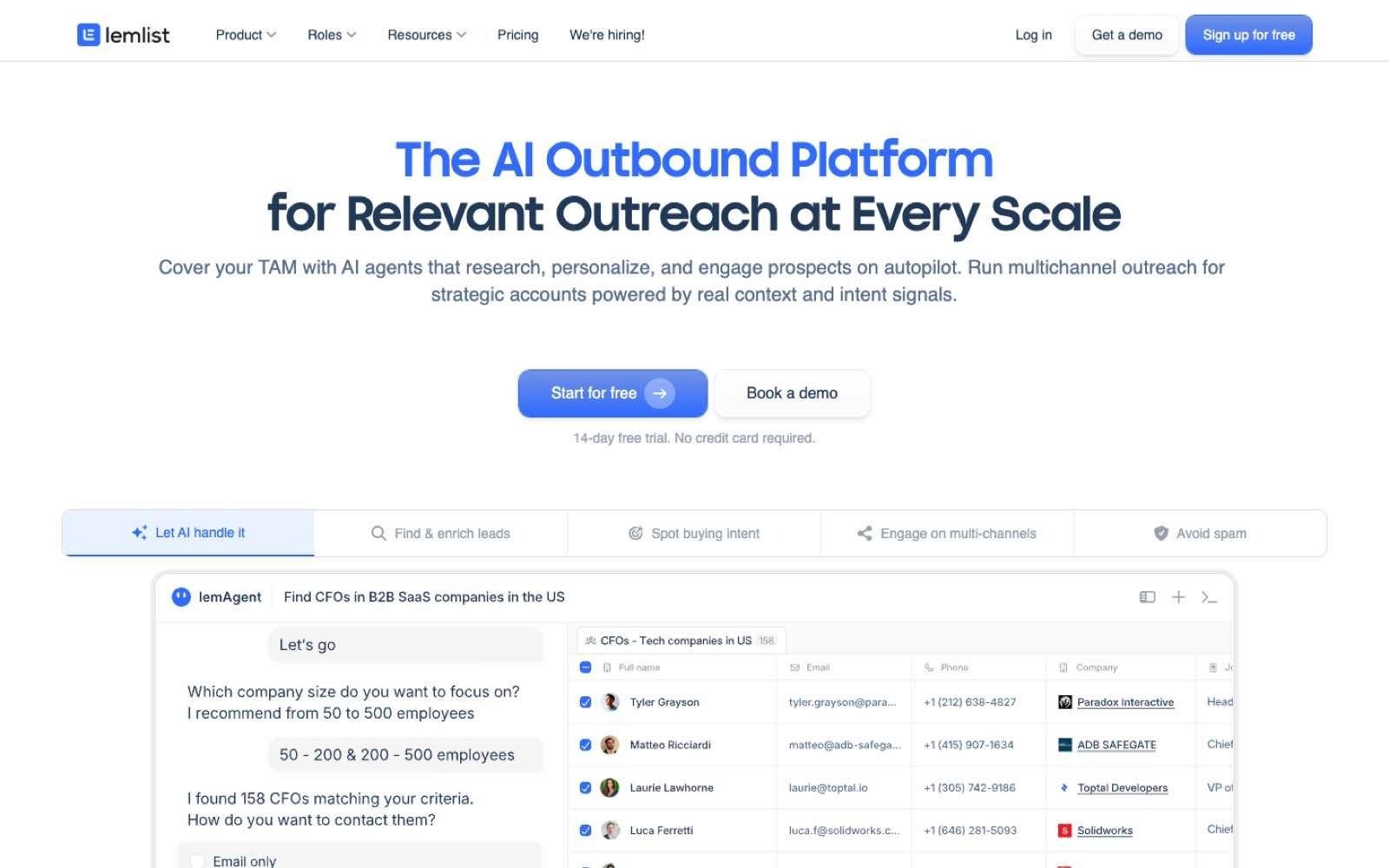
Lemlist is an outbound sequencing tool covering email, social, and calling, with deliverability tooling and a pay-as-you-go data layer attached. It sits in the execution half of the stack rather than the data half.
Its buyers are small and mid-sized sales teams that already know who they want to contact and need a reliable way to run sequences without an enterprise contract.
Ideal For
Small outbound teams running multichannel sequences
Technology companies that want sequencing on a predictable monthly bill
Teams needing mailbox warm-up and deliverability monitoring
Sales teams that prefer to buy contact data per success
Why Do They Stand Out?
Lemlist prices data by outcome rather than by subscription, which keeps costs proportional for teams with uneven volume. Its pricing page sets credits at one credit for $0.01, with a verified email costing five credits and a phone number twenty, and publishes a worked example of 1,000 credits buying 200 emails or 50 phones for $10.
The plan structure is straightforward. An email tier runs at $55 a month on annual billing, a multichannel tier at $87, and an enterprise tier is quoted, with a 14-day trial on paid plans and intent signals priced individually per signal.
Pros
Published tiers at $55 and $87 a month on annual billing
Data priced per success, at five credits for an email and twenty for a phone number
Multichannel sequencing across email, social, calling, and messaging
Deliverability tooling and mailbox warm-up included
14-day free trial before commitment
Cons
Intent signals are charged per signal on top of the subscription, from 20 credits upward
Buying data by credit becomes expensive at high volume compared with a pooled allowance
Contact data is bought as credits rather than included in the plan allowance
Enterprise features such as single sign-on sit only on the quoted tier
Multichannel steps sit on the higher tier, since the entry plan covers email only
Pricing
Lemlist publishes an email tier at $55 a month on annual billing, rising to $69 billed monthly, and a multichannel tier at $87 rising to $109, with an enterprise tier quoted for teams of five or more. Data is bought with credits at $0.01 each, costing five credits for a verified email and twenty for a phone number, and intent signals are priced separately per signal.
Final Verdict
Lemlist works for small technology sales teams that have their targeting sorted and want multichannel execution on a published monthly price. Teams doing heavy phone-led outbound should model the credit cost first, since twenty credits per number adds up against a pooled allowance.
Because intent signals are charged individually and contact data is bought by the credit, the monthly figure moves with volume rather than holding steady.
9. Instantly
Overview
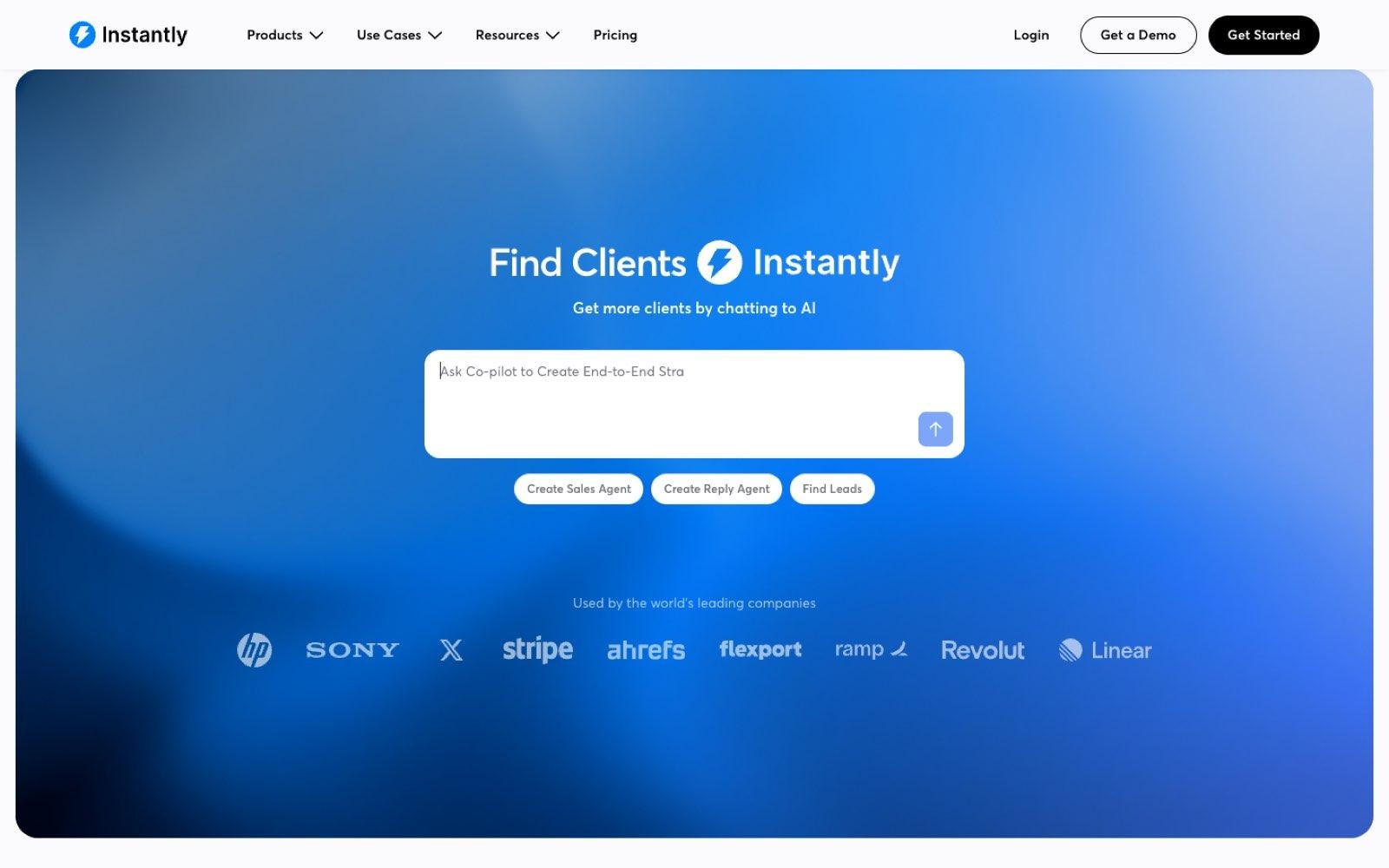
Instantly is built around cold email at volume, with mailbox warm-up, sending infrastructure, and inbox placement monitoring as the core of the product. A lead database and enrichment sit alongside it.
It targets teams whose constraint is sending capacity rather than targeting, including agencies and software companies running large parallel campaigns across many mailboxes.
Ideal For
Teams sending high volumes of cold email across many mailboxes
Software companies that have burned a sending domain before
Agencies running campaigns for several clients at once
Teams that want warm-up and deliverability handled in the same tool
Why Do They Stand Out?
Instantly treats deliverability as infrastructure rather than a setting. Its pricing page publishes bundles at $94, $194, and $555 a month, covering 5,000, 100,000, and 500,000 emails monthly, and describes a server and IP sharding system on the higher tier that assigns private server and IP blocks and swaps out flagged IPs.
The enrichment layer is more relevant to technology sellers than its positioning suggests. Its published plan detail includes job posting, news, technology, and funding enrichment alongside a database it describes as 450 million or more B2B leads.
Pros
Published bundles at $94, $194, and $555 a month
Unlimited email accounts and unlimited warm-up on its outreach plans
Technology, job posting, news, and funding enrichment included in bundles
Private server and IP handling on higher tiers to protect deliverability
Standalone outreach plans from $47 a month for teams that skip the credits
Cons
The plans split into bundles, outreach tiers, and credits, so comparing options takes work
Volume caps are tied to the bundle, at 5,000 emails monthly on the entry tier
Bundle allowances are counted in emails, so the product is scoped around email volume
Uploaded contact limits start at 1,000 a month on the entry bundle
The volume-led design suits teams that have already validated their targeting
Pricing
Instantly publishes bundles at $94, $194, and $555 a month, covering 5,000, 100,000, and 500,000 emails monthly with 1,500, 5,000, and 10,000 credits respectively, plus a custom tier. Standalone outreach plans are published separately from $47 a month, and credits can be bought on their own.
Final Verdict
Instantly is a reasonable choice for technology companies whose bottleneck is sending capacity and domain health rather than knowing who to contact. Teams that need social and calling steps in the same sequence will find the email scoping limiting.
The split between bundles, outreach plans, and credit packs also means the real monthly cost depends on which combination you land on, so it pays to model it before committing.
10. HubSpot Sales Hub
Overview
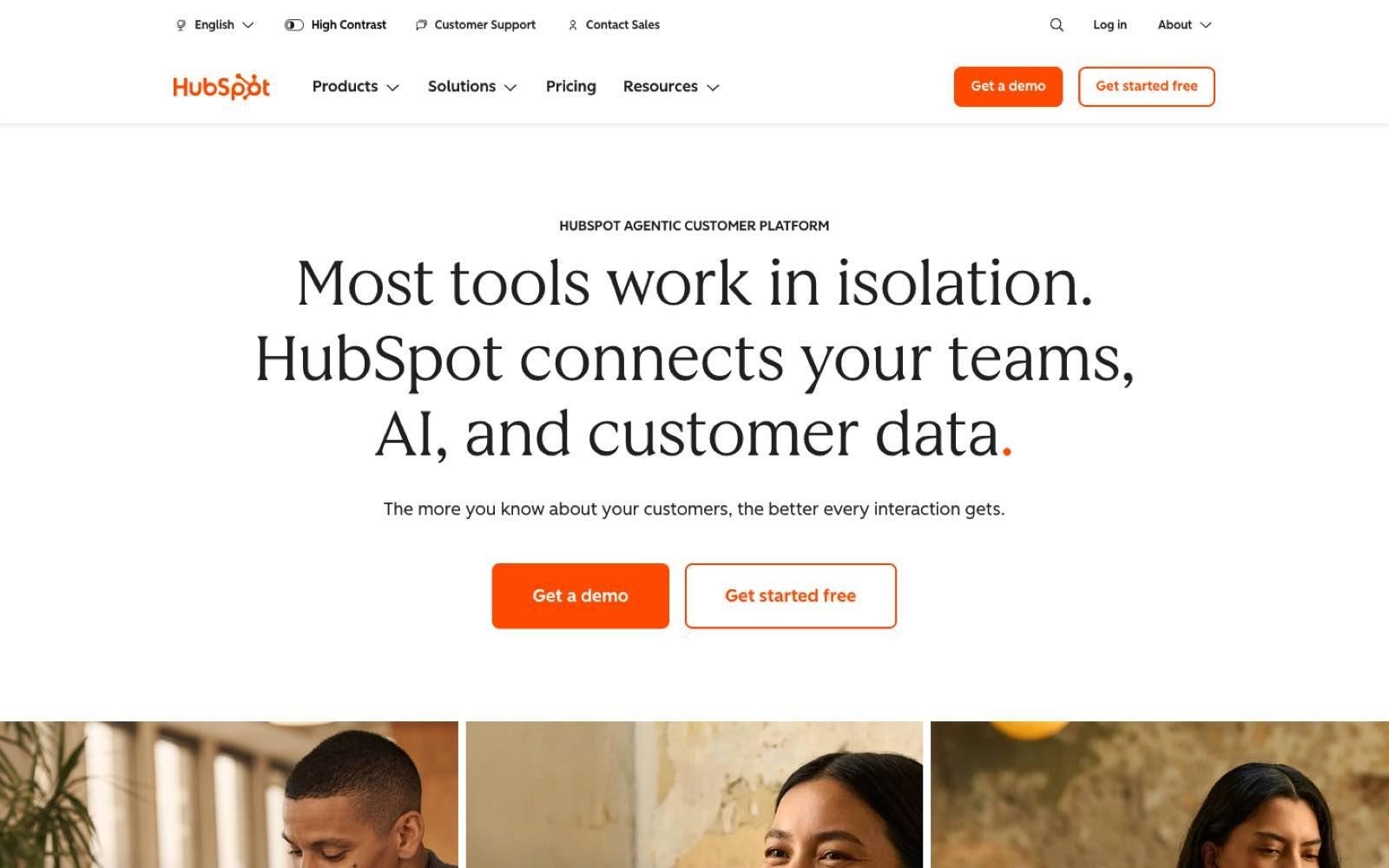
HubSpot Sales Hub is the sales half of a wider customer system, combining a CRM, inbound forms and routing, sequences, and reporting. It is bought as the system of record more often than as a prospecting tool.
The teams that buy it want inbound handling, pipeline management, and reporting standardised in one place, particularly where marketing and sales share a database.
Ideal For
Technology companies standardising CRM and inbound handling together
Marketing and sales teams that need a shared contact record
Sales leaders who want pipeline reporting without a data project
Teams routing trial signups and demo requests to owners quickly
Why Do They Stand Out?
HubSpot publishes its full price ladder including the fees most vendors leave out. Its sales pricing page lists a free tier for up to two users, a Professional tier from $90 per seat a month billed annually, and an Enterprise tier from $150, and states plainly that Professional requires a one-time onboarding fee of $1,500 and Enterprise one of $3,500.
The reason technology companies choose it is usually reporting and routing rather than sourcing. When a trial signup needs to reach an owner in minutes, having the form, the record, and the sequence in one system removes the handoff where speed is normally lost.
Pros
Free tier for up to two users, with no card required
Published per-seat pricing at $90 and $150 a month billed annually
Onboarding fees stated openly on the pricing page
Inbound forms, routing, sequences, and reporting in the same system as the CRM
Credits included with each tier, at 500 on Starter and 5,000 on Enterprise
Cons
Professional and Enterprise carry mandatory one-time onboarding fees of $1,500 and $3,500
Per-seat pricing at $90 and above becomes expensive for a large SDR team
Prospecting data and enrichment are bought as credits on top of the subscription
It's built as a system of record, so outbound sourcing sits outside its core design
Monthly billing costs more per seat than committing annually
Pricing
HubSpot publishes a free tier for up to two users, a Starter tier, Professional from $90 per seat a month billed annually or $100 monthly, and Enterprise from $150 per seat a month. Professional requires a one-time onboarding fee of $1,500 and Enterprise one of $3,500, both stated on the pricing page.
Final Verdict
HubSpot Sales Hub is the right pick for technology companies that need one system holding inbound leads, pipeline, and reporting, especially where marketing and sales must share a record. It's a weaker fit as an outbound engine, since sourcing and enrichment are bought as credits on top.
The mandatory onboarding fees of $1,500 and $3,500 also mean the first-year cost is higher than the per-seat figure suggests.
How to Choose the Best Lead Generation for Technology Companies
With ten tools and their published prices on the table, the shortlist comes down to seven questions asked in order.
The checks below are the ones that predict whether a purchase will still be earning its cost in six months, and the first decides everything after it.
1. Decide Between Software and a Lead Generation Agency for IT Companies
Before comparing tools, work out whether you're buying capability or capacity. Software gives you a repeatable motion your own team runs and owns. A lead generation agency for IT companies gives you an outsourced team and a monthly appointment target, usually on a retainer.
Agencies suit a company with budget but no sales team, or one entering a market where it has no network at all. The trade-off is that the learning stays with the agency, so you're renting a motion rather than building one. Lead generation companies for IT services commonly work to a booked-meeting target, which also means the definition of a qualified meeting is worth negotiating in detail before signing.
Software suits any company that intends to keep an SDR function. It costs less per meeting once the motion works, and the targeting knowledge stays in-house, which compounds as your B2B lead generation strategies get tested against real replies.
If you're weighing IT lead generation companies against tooling, the honest test is whether you'll have someone to run the sequences in ninety days. If not, hire that person first or buy the retainer.
2. Check Whether Technographic and Hiring Signals Are Native
For technology sellers, the tools an account already runs and the roles it's advertising are the two highest-value filters available. They tell you whether an account has bought in your category before and whether it's under the kind of pressure that makes a purchase likely.
The hiring signal carries more weight in this sector than in most. Eurostat found that 57.5% of EU enterprises that recruited or tried to recruit ICT specialists in 2023 had difficulties filling those vacancies, and that the share recruiting was much higher in information and communication activities.
An unfilled systems role is a live problem, and it's public, which is what separates signal-led prospecting methods from list-led ones. Ask whether these filters are included or sold as an add-on, because a signal behind a second contract changes the price of the whole purchase.
3. Confirm the Data Can Be Actioned Without a Second Tool
This is the check buyers skip most often. An export isn't pipeline, and the gap between a file and a booked meeting is filled by cleaning, deduplication, CRM import, ownership assignment, and campaign setup.
Work out what you'll still have to buy after the database, which for most teams means a sequencer, a verifier, and someone to run them. Comparing B2B data list providers on record count alone hides that second invoice entirely.
CRM data enrichment belongs in that sum too, since records that never reach the CRM cleanly recreate the reporting problem you were trying to fix. Where discovery, enrichment, and outreach share one record, that whole layer disappears and the comparison between two quotes changes shape.
4. Test Coverage on Your Own Segment, Not the Demo's
Category-wide accuracy claims hide large regional variation, and a database that performs well in the United States can be thin in Southern Europe. The same is true by seniority and company size, where 30-person engineering firms are far patchier than enterprises.
Run your own test before signing. Pull one hundred records from your exact ideal customer profile, run the emails through an independent verifier, and dial twenty of the numbers yourself, using the same discipline you would apply to targeted email lists for a live campaign.
Coverage gaps show up fastest at the contact layer, which is why teams selling into Europe usually keep separate email finder tools in the mix. One afternoon of testing tells you more than any figure on a pricing page.
5. Check How Each Tool Protects Email Deliverability
Sending rules tightened in ways that punish volume without hygiene. Google's sender guidelines require senders to keep spam rates reported in Postmaster Tools below 0.3%, require SPF or DKIM authentication for all senders, and set out stricter requirements for anyone sending more than 5,000 messages a day to Gmail accounts.
That makes list quality a deliverability question before it's a copy question. Ask how a tool verifies addresses before sending, whether mailbox warm-up is included or extra, and how sending is spread across domains.
Dedicated email verification tools still earn their place where a list arrives from outside your own enrichment, and marketing sends need separate email automation tools on separate domains because most of their terms prohibit cold sending.
Our guide to email deliverability covers the setup, and the best cold email software comparison covers which tools handle it natively.
6. Get the UK and EU Compliance Position in Writing
If you prospect in the UK or Europe, you're the data controller for what you do with a list, and a regulator's interest doesn't stop at your supplier. In December 2024 France's regulator fined a contact-data vendor €240,000 for collecting details people had chosen to hide, and its customers lost the records they had bought.
The UK position on business email is more permissive than the position on consumer email. The ICO's guidance on electronic mail marketing states that you can send marketing emails or texts to companies, while individuals need specific consent, and it notes that sole traders and some partnerships are treated as individuals.
Ask any supplier where records are sourced, what lawful basis is claimed, how notification is handled, and how opt-outs propagate back. Treat this as general guidance rather than legal advice.
7. Decide Who Will Operate It Every Week
The most capable tools in this category assume a dedicated operator, and a licence nobody drives returns nothing. Before signing, decide honestly whether you have a person who will own enrichment logic and sequence performance weekly.
If you don't, weigh the decision toward tools a sales rep can run unaided, and check what onboarding is included rather than charged. This is also where AI sales assistant software changes the maths, since an agent handling replies removes some of the weekly load a human operator would carry.
If you do, the flexible orchestration options become attractive, because you can get value from them that the average buyer cannot.
Everything You Need to Know About Lead Generation for Technology Companies
Category | Key Considerations |
Top 3 tools | Enginy for signals and outreach in one place, Cognism for European phone-verified coverage, Leadfeeder for identifying anonymous website visitors |
Who is it for | Software vendors, IT services companies and managed service providers, cybersecurity firms, technology founders, and RevOps teams |
Use cases | Building lists from technology stack and hiring signals, reaching a full technical committee, converting trial signups, enriching CRM records, entering a new market |
How to choose | Settle the software or agency question first, check that technographic and hiring filters are native, test coverage on your own segment, and price the deliverability and compliance work |
Mistakes to avoid | Buying on database size, ignoring credit costs for phone numbers, sending volume without warm-up, treating an export as pipeline, and skipping the compliance position |
Pricing starts | Free tiers at Apollo, Clay, Leadfeeder, and HubSpot; paid entry from $47 to $167 a month for self-serve tooling; signal tools from $2,500 a month; Enginy quoted per account |
Build a Sales Strategy for Technology Companies with Enginy
In most technology teams the signal sits in one tool, the contact data in another, and the sequence in a third. Reps lose their mornings moving records between them, and the trigger goes cold while they work.
Enginy closes that gap. Lists are built from technology stack, hiring, funding, and job-change filters, enriched through a waterfall across 30+ providers, then carried straight into email, social, and calling sequences and synced to your CRM, with no GTM engineer required to operate it.
Factorial used it to lift reply rates from 10% to 45% and double conversion from 4% to 8%. Bring your hardest segment and see what the list looks like before you commit. New accounts get 100 free B2B leads. Book a Demo
FAQs About Lead Generation for Technology Companies
What is the best lead generation for technology companies in 2026?
The best lead generation for technology companies in 2026 is Enginy for teams that want signals, contact data, and outreach on one record, because technology stack, hiring, and funding filters run straight into multichannel sequences. Cognism is the stronger pick for phone-led selling into Europe, and Leadfeeder for identifying anonymous website visitors on a free tier covering 100 companies a month. There is no single winner across every job, since a database, a signal tool, and a sequencer solve different problems. Choose by the part of your motion that's currently broken.
What should I consider when choosing the right lead generation for technology companies?
When choosing lead generation for technology companies, settle whether you're buying software or an agency retainer first, then check whether technographic and hiring filters are native rather than add-ons. Test coverage on your own segment by pulling one hundred records from your ideal customer profile and dialling twenty of the numbers yourself. Price the whole stack, including the sequencer, the verifier, and the person who runs it, since published per-seat figures rarely include those. Then confirm the compliance position in writing before any money changes hands.
How does Enginy differ from similar alternatives?
Enginy differs from most tools on this list by covering discovery, enrichment, and outreach in one workflow rather than one layer of it. Apollo and Cognism sell data you then export, Clay gives you enrichment logic that needs a technical operator, and Lemlist and Instantly run the sending after someone else has built the list. Enginy runs waterfall enrichment across 30+ providers and carries the same record into email, social, and calling sequences, with technology stack, hiring, and funding filters included rather than charged separately. It is built so a sales rep can operate it without a GTM engineer.
How do I get started with Enginy?
Getting started with Enginy begins with a short qualification call, then a demo built around your own ideal customer profile rather than a sample dataset, and new accounts receive 100 free B2B leads. Pricing is quoted after that call, because credits, seats, and phone data are matched to your actual volume across the Basic, Smart, Business, and Enterprise tiers. Onboarding includes five structured sessions covering CRM connection, AI configuration, list building, and campaign setup. Most teams have a first enriched list running inside those sessions.
How easy is it to switch to Enginy?
Switching to Enginy runs alongside your current setup rather than replacing it overnight, and the five included onboarding sessions cover the migration directly. Existing CRM records can be imported and re-enriched, which is usually the fastest way to see the difference, since poorly enriched contacts you already own get filled in without new sourcing. Native integrations with HubSpot, Salesforce, Pipedrive, Dynamics 365, Zoho, and Attio keep your CRM as the system of record. Most teams run both setups for one cycle and compare reply rates directly.
Is a lead generation agency for IT companies better than software?
A lead generation agency for IT companies is better when you have budget but no sales team, or when you're entering a market where you hold no network, because the agency supplies the people as well as the process. Software costs less per booked meeting once the motion works, and the targeting knowledge stays with your team rather than leaving when the contract ends. Most IT lead generation companies work to a monthly appointment target, so the definition of a qualified meeting decides whether the retainer pays back. The practical test is whether you'll have someone to run sequences within ninety days.
How much does B2B lead generation for IT services cost?
B2B lead generation for IT services costs between roughly $50 and $150 a month per seat for self-serve tooling, while signal tools sold on annual contracts start at $2,500 a month and agency retainers are typically quoted per booked meeting or as a fixed monthly fee. Published entry prices on this list run from free tiers at Apollo, Clay, Leadfeeder, and HubSpot through to $40,000 a year for champion tracking. The larger cost is usually hidden, since phone numbers consume eight credits against one for an email on Apollo, and HubSpot adds one-time onboarding fees of $1,500 and $3,500. Model the full stack, not the sticker price.
About the Author
Andrea López is a B2B sales and go-to-market writer at Enginy, covering outbound strategy, prospecting data, and sales automation for revenue teams across the UK and Europe. She writes from the workflows Enginy's own sales team runs daily, from list building and waterfall enrichment through to multichannel campaigns and CRM hygiene. Follow Enginy's work on Instagram.