Best Demand Generation Tools in 2026 (Top-Rated Software Reviewed & Compared)

Andrea López
Compartir
Key Takeaways (TL;DR)
The Best Overall Demand Generation Tools: We built Enginy to combine prospect discovery, data enrichment and multichannel outreach in one workspace, so demand doesn't stall between the moment someone shows intent and the moment a rep actually reaches them. It's the only tool on this list built to run the outreach itself, not just flag who's worth calling.
Why Do You Need It?: Most B2B buyers research quietly for months before ever speaking to sales, and by the time a lead fills out a form, several competitors have already reached them first. Demand generation software closes that gap by surfacing buying signals early and acting on them before the window closes.
Who It's For?: This guide is for Heads of Marketing, RevOps and GTM Engineers, and founders at SMBs and startups who need a sales pipeline without a huge team behind it. It also suits sales managers and reps who are tired of chasing cold leads with no context.
How to Choose the Right One?: Weigh how the tool actually detects intent, whether it acts on that intent or just reports it, and how well it fits your existing CRM and outreach stack. Pricing structure matters too, since some tools charge per seat while others charge for volume of signals or contacts.
Expected Price: We keep Enginy's pricing custom and credit-based, scoped to what each team actually needs. Across this list, monthly plans run from around $35 (Extrovert) to several thousand dollars a month for enterprise ABM platforms like 6sense and Demandbase, with most tools sitting somewhere in between.
Top Demand Generation Tools in 2026: at a Glance
Tool | Best For | Key Features | Pricing |
Enginy | Teams that want prospect discovery, enrichment and outreach in one workspace | AI Finder, layered intent signals, multichannel sequences, AI SDR agents | Custom, credit-based |
6sense | Enterprise account-based marketing at scale | Trillion-plus intent signals, account scoring, orchestration | Free plan; custom beyond that |
Clay | Technical teams building custom enrichment workflows | Data waterfall across 50+ providers, AI research agents | Free plan; $167 to $446/month, custom Enterprise |
Knock AI | Converting inbound website visitors into qualified conversations | Real-time visitor identification, AI qualification agent | From $1,000/month |
Salesloft | Structured, rep-led outbound cadences | Multi-touch cadences, conversation intelligence, forecasting | Custom, sales-quoted |
Apollo.io | Budget-conscious teams wanting data and sequencing together | Large contact database, built-in sequencer, dialer | Free plan; $49 to $119/seat/month |
Lemlist | Cold email and multichannel deliverability | Email warmup, multichannel sequencing, deliverability tools | $39 to $99/user/month, custom Enterprise |
Gong | Revenue teams wanting conversation-driven pipeline insight | Call recording and analysis, deal risk signals, coaching | Custom, per-user licensing |
Demandbase | Unifying intent data, sales intelligence and advertising | Native ad network, intent data, sales intelligence | Custom, platform plus per-user fee |
Extrovert | Warm engagement on professional social platforms | Curated activity feed, AI-assisted commenting, relationship tracking | $35 to $99/seat/month |
What Are Demand Generation Tools?
Demand generation tools are software built to identify, engage and convert the buyers already showing interest in what you sell, before a competitor gets there first.
That's a slightly different job to lead generation. Lead generation is about finding new names to add to a list.
Demand generation is about reading the signals a market is already sending out: someone researching a category, a company hiring for a role your product supports, a visitor lingering on a pricing page. The job is acting on those signals while they're still warm.
The category spans a few distinct approaches. Some tools for demand generation focus on intent data at the account level, flagging which companies are actively in-market.
Others focus on engagement, turning that intent into an actual conversation through email, calls or social outreach.
The strongest demand generation software tools do both: they surface the signal and act on it, rather than leaving a marketer to interpret a dashboard and hand it off manually.
Why Do You Need Demand Generation Software?
Most B2B buyers do a large share of their research before they ever speak to a salesperson. By the time someone fills out a form, they've usually already compared several options, and whoever reaches them first with something relevant tends to win the meeting.
That timing gap is where most pipeline gets lost:
A prospect shows a buying signal, a funding round, a new hire in a relevant role, weeks of research on a competitor's site, and nobody on the sales team notices until it's cold again
Sellers end up chasing generic lists instead of the accounts that are actually ready to talk
Marketing spends budget on traffic that never converts because nobody follows up while the interest is fresh
Demand generation tools exist specifically to close that timing gap. Instead of waiting for a form fill, the right software surfaces intent the moment it appears and routes it to a rep, or triggers outreach automatically, before the buyer moves on to a competitor.
One of Enginy’s customers, Factorial saw reply rates jump from 10% to 45% and conversion rates double from 4% to 8% once that loop was automated.
Who Needs Demand Generation Tools?
Every role on a revenue team feels the pressure for pipeline differently, which changes what each of them actually needs from a demand generation tool.
Here's who typically needs demand generation tools, and why:
1. Heads of Marketing and Demand Gen Leaders
Anyone accountable for pipeline volume feels the pressure first when marketing-sourced leads don't convert into real opportunities.
Demand generation software gives them a way to prove that spend is reaching buyers who are actually in-market, rather than just driving traffic that never turns into revenue.
2. Sales Operations, RevOps and GTM Engineers
This is the person who owns the technical layer connecting intent data, enrichment and outreach automation.
They're often already stitching together several point tools, an intent platform here, a sequencing tool there, and are actively looking to consolidate that stack into something that talks to itself.
3. Founders and CEOs at SMBs and Startups
Founders running sales alongside everything else need a pipeline without hiring a dedicated demand gen team to generate it.
Startups don't have the budget to run enterprise ABM platforms priced for teams ten times their size, so the tools that matter most here are the ones that stay usable and affordable at an early stage while still surfacing real buying signals.
4. Sales Managers and Team Leads
Anyone managing a small team of reps cares about one thing above all else: whether the leads reaching their team are worth calling.
Tools for demand generation that filter for genuine intent mean fewer wasted calls and more time spent on conversations that actually have a chance of closing.
5. SDRs and Account Executives
The people making the calls and sending the messages are the ones who feel the difference between a cold list and a warm signal first.
Reaching a prospect while they're actively researching, rather than months later, changes how that first conversation lands entirely.
Best Demand Generation Tools: In-Depth Review & Comparison
1. Enginy

Overview
We built Enginy as an AI-native, end-to-end GTM platform that combines prospect discovery, data enrichment and multichannel outreach in a single workspace, so a buying signal doesn't sit unactioned while a marketer works out who should follow it up.
The platform tracks layered intent signals: recent hires, funding rounds, technology stack changes, job changes and social post engagement, then routes matching contacts straight into a personalised outreach sequence across email, social and calling.
Unlike demand generation software tools that stop at a dashboard, Enginy is built so any sales rep can act on a signal without needing a GTM engineer to configure the workflow first. That matters most for SMBs and startups running lean, and for larger teams tired of paying for intent data nobody actually acts on in time.
Ideal For
Sales teams that want intent detection and outreach handled in one workspace
Founders and small teams who need pipeline without a dedicated demand gen function
RevOps and GTM Engineers consolidating several point tools into one workflow
Top Features
Layered intent signals covering recent hires, funding rounds, technology stack changes and job changes
AI Finder for natural-language prospect search, removing the need to configure complex filters manually
Multichannel sequences combining email, social outreach and cold calling automatically
AI SDR agents that handle reply management around the clock
Why We Stand Out?
Most demand generation tools give you a signal and leave the outreach to someone else.
We built Enginy so the same workspace that flags a buying signal also acts on it: contacting a CEO, founder and relevant department heads at the same account together, so the whole organisation has heard from you before the first call happens.
On top of that, our AI SDR agents keep the follow-ups moving round the clock, which ensures that your pipeline still grows without proportional headcount growth.
Pros
Detects intent and acts on it in the same workspace, without a handoff
Multi-stakeholder outreach contacts several decision-makers at once
AI SDR agents handle reply management without adding headcount
Built for direct rep use, not just a technical GTM operator
Cons
Pricing isn't published upfront; you'll need a qualification call to get a quote
New teams benefit from structured onboarding rather than a self-serve start
Teams testing on a very small budget may want a lighter, single-purpose tool first
Pricing
We keep Enginy's pricing custom-quoted, scoped to what a team actually needs during a qualification call.
The structure is credit-based: credits cover actions like data extraction, enrichment and AI-generated fields, across four tiers from Basic through to a fully customised Enterprise plan.
Final Verdict
If your team already has intent data sitting in a dashboard nobody acts on fast enough, Enginy is built specifically to close that gap.
It won't suit a team that wants to self-serve a plan online in five minutes, but for anyone ready to connect detection and outreach into one workflow, Enginy is one of the more complete demand generation tools available.
2. 6sense
Overview
6sense is one of the more established names in account-based marketing, built around a large intent data network that claims to track buying signals across a trillion or more daily data points.
The platform scores accounts against your ideal customer profile and surfaces which ones are actively researching relevant topics, then orchestrates outreach across advertising, email and sales touchpoints based on that score.
For enterprise marketing and sales teams running a coordinated ABM motion, that scale of intent coverage is genuinely hard to match. The trade-off is complexity: getting real value out of 6sense typically means a dedicated RevOps function configuring scoring models and orchestration rules, rather than a rep logging in and acting on a signal directly.
Ideal For
Enterprise marketing and sales teams running coordinated account-based motions
Companies needing account-level intent data at a very large scale
RevOps teams building orchestration rules across advertising, email and sales
Top Features
Large-scale intent data network scoring accounts against your ideal customer profile
Account orchestration that coordinates advertising, email and sales touchpoints
Explainable AI scoring showing why an account is flagged as in-market
Why They Stand Out?
6sense's intent data scale is one of the largest (claimed) in the category, which gives enterprise teams a genuinely wide view of which accounts are actively in-market.
Its explainable scoring also means marketing and sales can see the reasoning behind an account's score, rather than trusting a black-box number.
Pros
Very large intent data network for account-level buying signals
Explainable AI scoring builds trust in the account prioritisation
Strong orchestration across advertising, email and sales channels
Cons
Configuration and scoring model setup typically requires a dedicated RevOps resource
Pricing sits well above what most SMBs or startups can justify
Value depends heavily on having a coordinated ABM motion already in place
Pricing
6sense offers a flexible pricing model for its intent data and sales intelligence tools, including a free plan with 50 credits a month.
Beyond that free tier, pricing is scoped through a conversation with the 6sense team based on account volume and which modules a team needs.
Final Verdict
6sense is a strong choice for enterprise teams already running a coordinated ABM programme and needing intent data at scale.
It's a weaker fit for a smaller team without the RevOps capacity to configure and maintain the scoring and orchestration layer properly.
3. Clay
Overview
Clay has built a strong reputation among technical GTM operators for the flexibility of its data waterfall, running enrichment requests across more than 50 providers in sequence until it finds a match.
That approach pushes contact and firmographic coverage higher than relying on any single data source, and Clay's AI research agents can pull company news, funding updates or technographic detail on demand as part of the same workflow.
Where Clay fits into demand generation specifically is enrichment and signal detection: once a workflow flags a company hiring for a relevant role or raising funding, Clay can build the enriched account and contact record automatically.
The tool is extremely powerful for building highly custom logic - though it is built explicitly for people comfortable configuring workflows versus reps who want to start prospecting immediately.
Ideal For
Technical GTM operators and RevOps teams building custom enrichment workflows
Teams that want maximum data coverage through a multi-provider waterfall
Companies running highly specific, non-standard intent detection logic
Top Features
Data waterfall across 50+ providers to maximise contact and firmographic match rates
AI research agents that pull custom data points like funding or hiring signals on demand
Highly configurable workflow builder for non-standard enrichment and scoring logic
Why They Stand Out?
Clay's flexibility is unmatched among the tools on this list.
Most demand generation software tools give you a fixed set of signals.
Clay lets a technical operator build almost any detection and enrichment logic instead, which is why it's become the default choice for RevOps and GTM Engineer personas.
Pros
Best-in-class data waterfall across a large number of providers
Highly flexible, custom workflow logic for intent detection
Strong AI research capability for contextual account data
Cons
Requires genuine GTM engineering skill to operate well
Not designed for direct use by a rep without technical support
Pricing can scale quickly once usage climbs beyond entry tiers
Pricing
Clay offers a free plan, with paid plans starting at $167 a month (Launch) and $446 a month (Growth), while Enterprise pricing is custom.
Plans scale based on annual actions and data credits, with higher tiers adding CRM sync, automation and dedicated support.
Final Verdict
Clay is a smart pick for a team with a GTM engineer who wants to build custom intent and enrichment logic from scratch.
It's a poor fit for a small team that wants to log in and start acting on demand signals without a configuration project first.
4. Knock AI
Overview
Knock AI takes a different angle on demand generation entirely: rather than finding new accounts to target, it focuses on converting the demand already arriving at your website that would otherwise leak through a slow contact form.
The platform identifies anonymous visitors in real time, resolves their identity, and hands them to an AI agent that runs a live qualification conversation rather than a scripted chatbot flow.
For teams whose real bottleneck is inbound follow-up speed rather than finding new accounts, that immediacy is the whole value proposition.
A visitor showing high intent on a pricing page gets engaged before the moment passes. That's a real difference from waiting hours or days for a human to respond to a form submission.
Ideal For
Teams whose bottleneck is converting existing website traffic, not finding more of it
Sales-led B2B companies wanting instant qualification on high-intent pages
Revenue teams frustrated with slow follow-up on inbound form submissions
Top Features
Real-time identification of anonymous website visitors showing buying intent
AI qualification agent that runs a live conversation instead of a scripted flow
Instant routing to a human rep once a visitor is qualified
Why They Stand Out?
Knock AI's speed to engagement is its clearest advantage. Most inbound workflows still involve a form, a wait, and a delayed follow-up.
This tool compresses that gap to seconds, which matters most on high-intent pages like pricing or demo requests, where interest cools fast if nobody responds.
Pros
Engages high-intent visitors in real time, before interest cools
AI qualification feels closer to a real conversation than a scripted chatbot
Reduces manual SDR workload on inbound follow-up
Cons
Focused entirely on inbound; it doesn't find new accounts or generate outbound signals
Less useful for teams whose main challenge is generating more top-of-funnel traffic
Newer entrant with a smaller track record than more established platforms on this list
Pricing
Knock AI's pricing starts at $1,000 a month for the Pipeline Foundation plan, with Pipeline Acceleration from $3,000 a month and custom Enterprise pricing above that.
Plans scale based on messaging channels, AI qualification depth, enrichment coverage, activated contacts and support level.
Final Verdict
Knock AI is a strong pick for a team whose website already gets meaningful traffic but loses too much of it to slow follow-up.
It's the wrong tool if your actual problem is a lack of top-of-funnel demand in the first place, since it converts existing interest rather than generating new interest.
5. Salesloft
Overview
Salesloft is a category leader in sales engagement, built around structured, multi-touch cadences that give reps a repeatable sequence to follow across email, calls and social touchpoints.
Beyond cadences, the platform layers in conversation intelligence that analyses call recordings for deal risk and coaching opportunities, plus forecasting tools that give sales leaders visibility into pipeline health.
The platform fits into demand generation as the execution layer: once an account is flagged as worth pursuing, Salesloft standardises how a rep actually works that account over time.
It's built for larger sales organisations, especially those having the process maturity to define and enforce a consistent cadence.
Ideal For
Larger sales organisations wanting standardised, repeatable outbound cadences
Revenue leaders needing conversation intelligence and coaching data from calls
Teams with existing process maturity looking to enforce consistency at scale
Top Features
Multi-touch cadence builder standardising outreach across email, calls and social
Conversation intelligence analysing calls for deal risk and coaching signals
Forecasting tools giving sales leadership pipeline visibility
Why They Stand Out?
Salesloft's conversation intelligence is a genuine differentiator beyond pure cadence management.
Being able to analyse what's actually said on a call, not just whether a touchpoint happened, gives sales leaders a much clearer read on deal health than activity metrics alone.
Pros
Strong cadence management for standardising outbound at scale
Conversation intelligence surfaces deal risk before it becomes a lost deal
Mature coaching and analytics features for larger sales teams
Cons
Built for larger, more process-mature sales organisations than early-stage teams
Doesn't handle intent detection or account scoring on its own
Pricing requires a sales conversation, with no published starting point
Pricing
Salesloft's pricing is custom-tailored to your requirements, and you'll need to connect with their sales team directly for a quote.
Costs typically scale with seat count and which modules, cadence management, conversation intelligence, forecasting, a team needs.
Final Verdict
Salesloft is a strong choice for a larger sales team that already has a defined process and wants to enforce it consistently across every rep.
It's a weaker fit for a smaller team still working out its outreach strategy, since Salesloft standardises an existing process rather than helping you build one from scratch.
6. Apollo.io
Overview
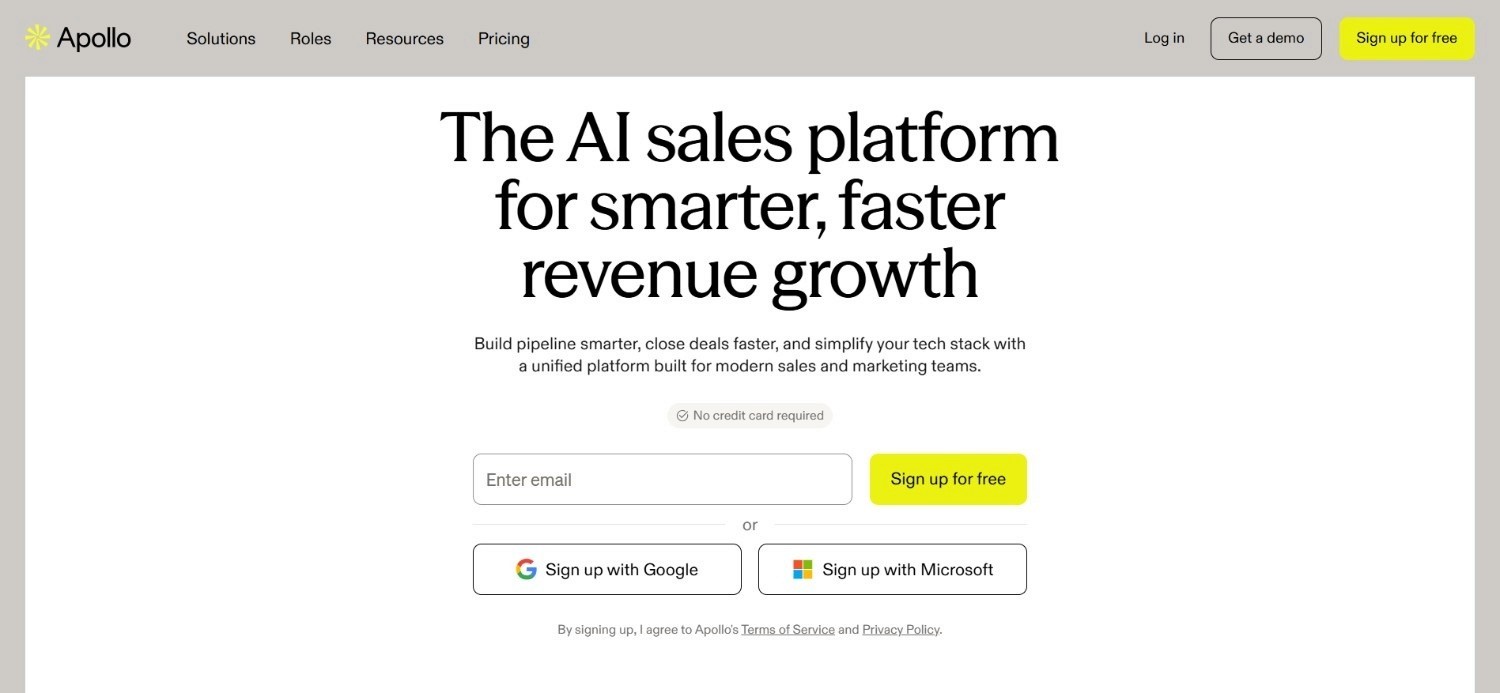
Apollo.io pairs a very large self-serve contact database with basic sequencing and dialer functionality, positioning itself as an affordable, all-in-one entry point into demand generation software rather than a pure data provider.
The database is searchable through firmographic filters and a browser extension, and the built-in sequencer lets a team move from a filtered list straight into outreach without a separate tool. For teams that need volume and an accessible price point more than deep intent signals, Apollo is a natural starting point.
That said, data accuracy is the trade-off. Independent testing shows meaningfully higher bounce rates here than among more accuracy-focused providers on this list.
Ideal For
Budget-conscious teams that need database volume more than intent depth
High-volume outbound teams running large-scale, lower-touch campaigns
Solo founders and small teams testing demand generation for the first time
Top Features
Large self-serve contact and company database covering most industries
Built-in sequencer and dialer for running outreach without a separate tool
Browser extension for quick contact lookups while researching accounts
Why They Stand Out?
Apollo's biggest strength is accessibility. The free plan is genuinely usable, and paid tiers stay affordable compared to enterprise ABM platforms.
That's why it's become the default reference point buyers compare every other tool against, packing database access, sequencing and calling into one low-cost package.
Pros
Generous free plan and low-cost entry tiers
Very large contact database across most verticals
Combines data, sequencing and calling in one tool
Cons
Data accuracy is inconsistent, with independent tests showing higher bounce rates than specialised competitors
Limited genuine intent signals compared to dedicated demand generation platforms
Shared sending infrastructure can create deliverability issues at scale
Pricing
Apollo.io offers a free plan plus paid tiers billed annually: Basic at $49 per seat per month, Professional at $79 per seat per month, and Organization at $119 per seat per month.
Extra credits, advanced email domains and additional integrations are priced separately as add-ons.
Final Verdict
Apollo makes sense for a team that needs volume and an affordable entry point into demand generation without a big budget yet.
It's a weaker fit for teams where genuine buying-intent detection matters more than raw contact volume.
7. Lemlist

Overview
Lemlist has built its reputation specifically around cold email deliverability, a problem that undermines a lot of demand generation software if messages never reach the inbox in the first place.
The platform combines multichannel sequencing across email and social touchpoints with built-in warmup tools that gradually build sender reputation before a real campaign launches.
Lemlist fits into a demand generation stack as the outreach execution layer once an account or contact has been identified elsewhere.
It doesn't do intent detection or account scoring itself, which makes the platform a natural pairing with a data or signal tool rather than a standalone solution for finding who to contact in the first place.
Ideal For
Teams whose main constraint is email deliverability rather than list building
Sales teams running multichannel sequences across email and social touchpoints
Companies pairing Lemlist with a separate data or intent tool
Top Features
Email warmup that gradually builds sender reputation before campaigns launch
Multichannel sequencing combining email and social outreach in one flow
Deliverability tooling designed to keep messages out of spam folders
Why They Stand Out?
Lemlist's deliverability focus solves a problem most demand generation tools treat as an afterthought.
A perfectly targeted list is worthless if the emails land in spam, and Lemlist's warmup and sending infrastructure are built specifically to prevent that outcome.
Pros
Strong, dedicated deliverability and warmup tooling
Straightforward multichannel sequencing across email and social
Credit bundles included with predictable per-user pricing
Cons
No native intent detection or account scoring; needs pairing with a data tool
Smaller contact database than dedicated data providers on this list
Additional channels like phone dialling are priced as separate add-ons
Pricing
Lemlist's pricing is tiered per user and billed annually: Email Starter at $39, Email Pro at $69, and Multichannel Expert at $99, with Enterprise at custom pricing.
Credit bundles are included at each tier, with additional credits and channels like phone dialling available as add-ons.
Final Verdict
Lemlist is a strong pick for a team whose outreach already has good targeting but struggles with deliverability and reply rates.
It's not a fit for a team that needs intent detection built in, since Lemlist assumes you already know who to contact.
8. Gong
Overview
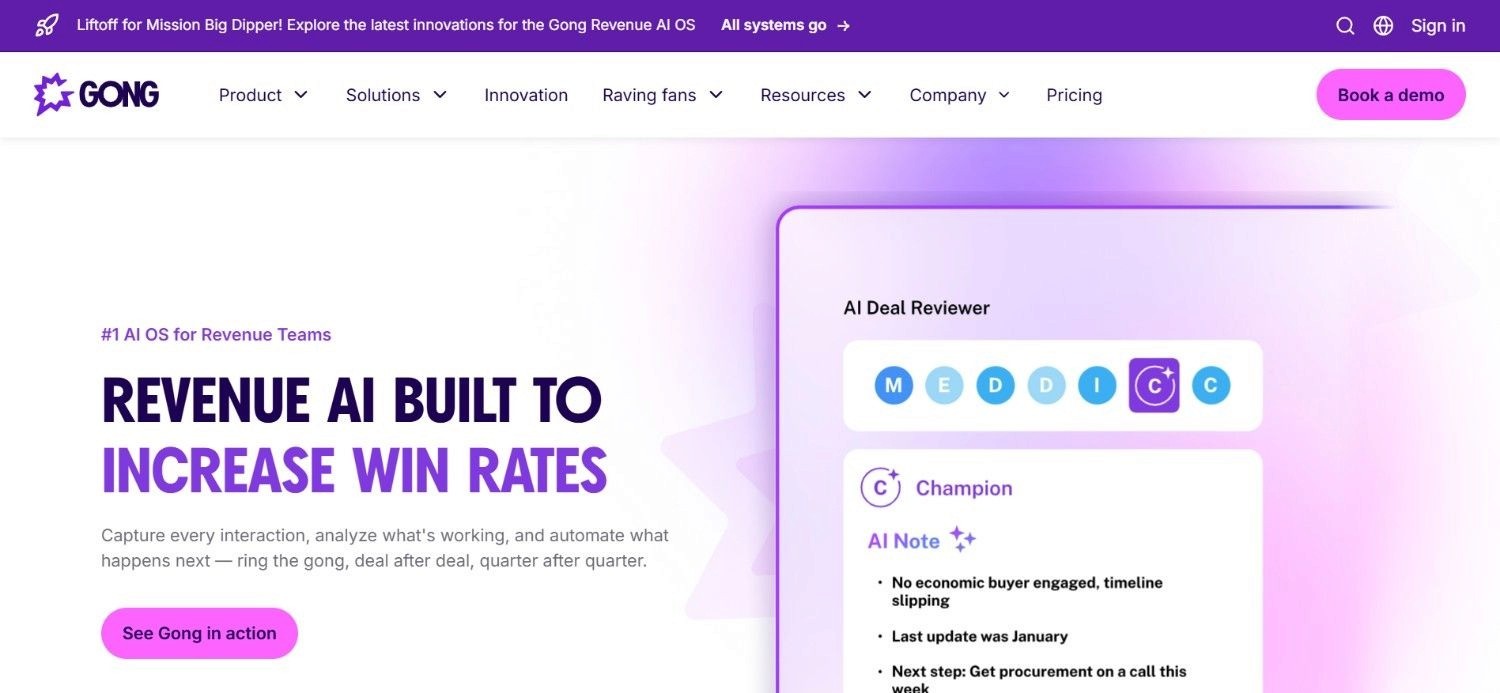
Gong built its name in conversation intelligence, recording and analysing sales calls to surface coaching opportunities and deal risk that would otherwise go unnoticed until a deal was already lost.
That analysis has expanded into a broader revenue intelligence approach, where patterns across thousands of calls inform which messaging and objection handling actually correlates with closed deals.
Gong's role in demand generation is indirect but real: by showing which talking points and outreach angles convert in the deals you've already won, it helps a team refine what a demand generation campaign should actually say once a prospect is engaged.
Ideal For
Revenue teams wanting conversation-level insight into what actually drives deals
Sales leaders needing objective coaching data rather than rep self-reporting
Teams with meaningful call volume to analyse for patterns
Top Features
Call recording and analysis surfacing deal risk before it becomes a lost deal
Pattern detection across calls showing which messaging correlates with closed deals
Coaching tools built on actual conversation data rather than self-reported activity
Why They Stand Out?
Gong's conversation-level insight is genuinely difficult to replicate with a smaller tool.
Seeing which specific phrases and objection responses show up across your best closed deals gives a team a factual basis for refining outreach messaging, rather than guessing.
Pros
Deep, data-backed insight into what messaging actually converts
Strong deal risk detection based on real conversation signals
Coaching built on objective data rather than manager intuition alone
Cons
Doesn't generate new demand or identify accounts on its own
Most valuable once a team already has meaningful call volume to analyse
Pricing requires a sales conversation with no published starting point
Pricing
Gong does not publish fixed pricing. Sales prospecting pricing is customised based on team size, with per-user licensing and a platform fee.
Integrations are included at no extra cost, and organisations receive a tailored quote through the sales process.
Final Verdict
Gong is a strong addition for a team that already generates meaningful call volume and wants to sharpen what happens once a conversation starts.
It's the wrong starting point if your actual problem is generating enough conversations in the first place, since Gong analyses demand rather than creating it.
9. Demandbase
Overview
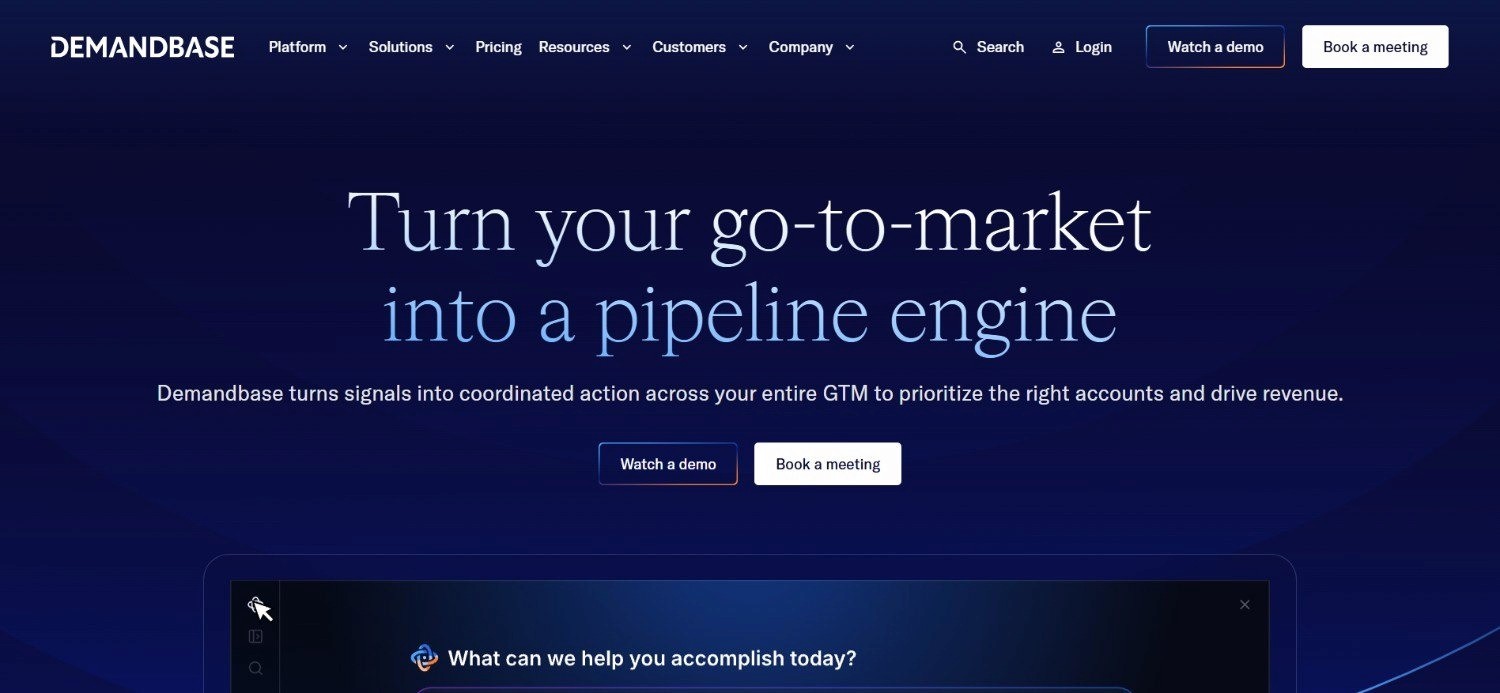
Demandbase positions itself as a unified account-based platform, bringing intent data, sales intelligence and B2B advertising together rather than treating them as separate purchases.
The advertising component is a genuine differentiator: Demandbase runs its own native ad network, which means intent data and ad targeting sit inside the same system instead of being exported and re-imported between separate tools.
That breadth suits enterprise marketing teams running coordinated campaigns across advertising, sales outreach and account scoring simultaneously.
It's a heavier commitment than most tools on this list, both in cost and in the internal coordination needed to actually use all three components well, which makes Demandbase a poor fit for a smaller team.
Ideal For
Enterprise marketing teams running coordinated advertising and sales campaigns
Companies wanting intent data and B2B advertising inside one connected system
Teams needing sales intelligence layered on top of account-level targeting
Top Features
Native B2B ad network integrated directly with intent and account data
Account-level intent data flagging in-market buying signals
Sales intelligence layered on top of advertising and account targeting
Why They Stand Out?
Demandbase's native advertising network is the clearest differentiator here.
Most demand generation software tools require exporting intent data into a separate ad platform; Demandbase keeps targeting, intent and advertising inside one connected system instead.
Pros
Advertising, intent data and sales intelligence unified in one platform
Native ad network avoids exporting data between separate tools
Strong fit for coordinated, multi-channel enterprise ABM campaigns
Cons
Requires significant internal coordination to use all three components well
Pricing sits well above what most SMBs or startups can justify
Steep learning curve for teams without a dedicated ABM function
Pricing
Demandbase does not publish fixed monthly pricing. Demandbase One uses custom pricing based on a platform fee plus a flat per-user fee, letting cost scale with team size.
Advertising and Data solutions are available separately, with plans tailored through its sales team.
Final Verdict
Demandbase is a strong choice for an enterprise team ready to run advertising, intent data and sales intelligence as one coordinated motion.
It's a heavier commitment than most SMBs or startups need at this stage, both in cost and in setup complexity.
10. Extrovert
Overview
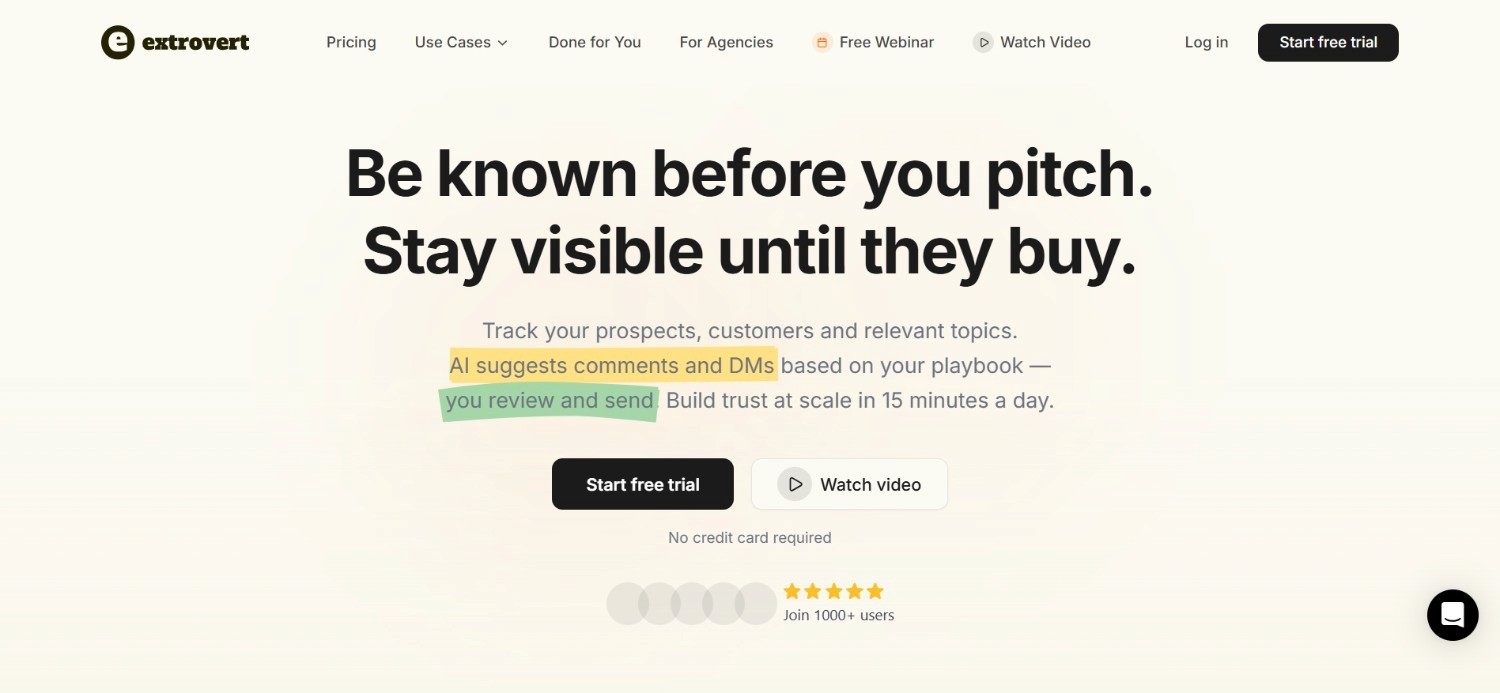
Extrovert takes a narrower, relationship-first approach to demand generation, focused entirely on building warm recognition on professional social platforms before a cold outreach message ever gets sent.
The tool curates a feed of a defined list of target accounts and contacts, then suggests AI-drafted comments and messages based on what those people are actually posting, so engagement looks genuine rather than automated.
Where most tools on this list optimise for reach, more accounts flagged, more contacts found, Extrovert optimises for familiarity with a smaller, named set of accounts.
That makes Extrovert a natural pairing with a data or intent tool rather than a replacement for one, since it doesn't identify new accounts on its own.
Ideal For
Teams wanting warm social recognition before outbound outreach begins
Sales professionals and marketers targeting a defined, named account list
Companies pairing Extrovert with a separate intent or data tool
Top Features
Curated activity feed showing posts only from a defined target list
AI-assisted comment and message drafting based on real, recent posts
Relationship tracking across a named set of accounts over time
Why They Stand Out?
Extrovert's focus on familiarity rather than volume is a genuine point of difference.
Building recognition with a smaller set of named accounts before ever sending a cold message means that outreach, when it finally happens, lands warmer than a first-touch cold email would.
Pros
Builds genuine familiarity with target accounts before outreach begins
AI-drafted comments stay grounded in what a contact actually posted
Straightforward, accessible pricing for smaller teams
Cons
Doesn't identify new accounts or generate intent data on its own
Works best paired with a separate tool for finding who to target
Limited usefulness for teams running high-volume, low-touch campaigns
Pricing
Extrovert's monthly pricing starts at $35 per seat for Light, $69 per seat for Business and $99 per seat for Pro, supporting 250, 500 and 1,000 prospects respectively.
Annual billing reduces those prices to $29, $49 and $75 per seat a month.
Final Verdict
Extrovert is a smart addition for a team that already knows exactly which accounts it wants and needs to build recognition before reaching out.
It's not a fit for a team that still needs help finding which accounts to target in the first place.
How to Choose the Best Demand Generation Tools (What to Consider)?
Every tool on this list solves a slightly different piece of the same problem.
Here's what actually matters when you're choosing demand generation software for your own team:
1. How the Tool Actually Detects Intent
Some tools track account-level signals, funding, hiring, technology changes. Others track individual behaviour, website visits, content engagement.
Match the detection method to what your buyers actually do before they're ready to talk, rather than assuming more signals automatically means better ones.
2. Whether It Acts on Intent or Just Reports It
A dashboard flagging in-market accounts is only useful if someone actually follows up fast.
Decide whether you want a tool that triggers outreach automatically, or one that hands a signal to a rep who still has to build the message themselves.
3. Fit With Your Existing Stack
Some tools for demand generation are built to sit inside a CRM you already use. Others are standalone platforms that need their own integration work.
Confirm how much setup is required before a signal reaches the person who needs to act on it.
4. Pricing Model Fit
Per-seat pricing is predictable but can feel wasteful if only a few people act on signals directly.
Credit or volume-based pricing rewards efficient use but can climb fast as a team scales. Match the model to how your team actually works, not just the sticker price.
5. Technical Skill Required to Operate It
Tools like Clay and 6sense reward a dedicated GTM engineer or RevOps function configuring workflows and scoring models.
If your team doesn't have that skill set in-house, a tool built for direct use by reps will get more value out of the same budget.
6. Whether It Covers Inbound, Outbound, or Both
Some tools, like Knock AI, focus entirely on converting existing inbound traffic.
Others generate outbound signals from scratch. Be honest about which side of that equation is actually your bottleneck before committing a budget to either one.
7. Proof of Results, Not Just Feature Lists
Look for concrete numbers from real customers, not just a feature comparison table.
A vendor willing to share specific reply rate or pipeline growth figures has more evidence behind its claims than one relying on generic marketing language.
Everything You Need to Know About Demand Generation Software
Tool | Pros | Cons | Ease of Use | Integrations | Support | Affordability |
Enginy | Detection and outreach in one workspace, multi-stakeholder outreach, no engineer needed | Custom pricing only, onboarding needed to unlock full value | ⭐⭐⭐⭐ | ⭐⭐⭐⭐⭐ | ⭐⭐⭐⭐⭐ | ⭐⭐⭐⭐ |
6sense | Very large intent network, explainable scoring, strong orchestration | Requires dedicated RevOps setup, enterprise pricing | ⭐⭐ | ⭐⭐⭐⭐ | ⭐⭐⭐ | ⭐⭐ |
Clay | Best-in-class waterfall, highly flexible, strong AI research | Requires GTM engineering skill, costs scale fast | ⭐⭐ | ⭐⭐⭐⭐ | ⭐⭐⭐ | ⭐⭐⭐ |
Knock AI | Real-time engagement, genuine AI qualification, fast setup | Inbound-only, no outbound signal generation | ⭐⭐⭐⭐ | ⭐⭐⭐ | ⭐⭐⭐ | ⭐⭐⭐ |
Salesloft | Strong cadence management, conversation intelligence, mature coaching | Built for larger teams, no intent detection built in | ⭐⭐⭐ | ⭐⭐⭐⭐ | ⭐⭐⭐⭐ | ⭐⭐ |
Apollo.io | Large database, low entry price, built-in sequencer | Inconsistent accuracy, shallow intent signals | ⭐⭐⭐⭐⭐ | ⭐⭐⭐⭐ | ⭐⭐⭐ | ⭐⭐⭐⭐⭐ |
Lemlist | Strong deliverability, straightforward multichannel sequencing | No intent detection, needs pairing with a data tool | ⭐⭐⭐⭐ | ⭐⭐⭐ | ⭐⭐⭐ | ⭐⭐⭐⭐ |
Gong | Deep conversation insight, strong deal risk detection | Doesn't generate demand, needs existing call volume | ⭐⭐⭐ | ⭐⭐⭐⭐ | ⭐⭐⭐⭐ | ⭐⭐ |
Demandbase | Unified advertising and intent data, strong ABM fit | Heavy coordination needed, enterprise pricing | ⭐⭐ | ⭐⭐⭐⭐ | ⭐⭐⭐ | ⭐⭐ |
Extrovert | Builds genuine warmth, accessible pricing, AI-assisted drafting | No account discovery, works best paired with another tool | ⭐⭐⭐⭐ | ⭐⭐⭐ | ⭐⭐⭐ | ⭐⭐⭐⭐ |
Turn Demand Into Pipeline with Enginy
Enginy isn't another dashboard that tells you who's in the market for your product or service. We built it as an end-to-end GTM platform that takes a buying signal all the way through to a sent message, without a rep switching between three separate tools to make that happen.
Layered intent signals feed straight into multichannel outreach across email, calling and social touchpoints, and social prospecting builds warm familiarity with an account before a cold message ever gets sent.
If your team is done watching intent data sit unactioned in a dashboard, book a demo with the Enginy team and see what a connected workflow actually looks like.
FAQs About Demand Generation Tools
What are the best demand generation tools in 2026?
Enginy is the best demand generation tool for teams that want intent detection and outreach handled in one workspace rather than three separate platforms. Its layered intent signals and multi-stakeholder outreach set it apart from data-only tools like Apollo or intelligence-only tools like Gong. The right choice for your team still depends on whether your bottleneck is finding accounts, engaging them, or converting inbound traffic.
What should I consider when choosing the right demand generation tools for me?
Choosing the right demand generation tools starts with confirming how the tool detects intent and whether it acts on that signal automatically or just reports it. Check whether it covers inbound, outbound, or both, since most tools specialise in one side. Pricing model and how much technical skill your team has in-house both matter just as much as the feature list.
How does Enginy differ from similar alternatives?
Enginy differs from similar alternatives by combining intent detection, enrichment and multichannel outreach in one workspace, rather than making you pair a signal tool with a separate outreach platform. Most tools on this list, 6sense, Demandbase, Gong, specialise in one layer of the process alone. Enginy also supports multi-stakeholder outreach, contacting several decision-makers at once, which most point solutions don't offer.
How do I get started with Enginy?
Getting started with Enginy begins with a qualification call, where we scope your credit volume, seat count and specific needs before quoting a plan. From there, five structured onboarding sessions configure your AI Playbook, intent criteria and outreach sequences together, rather than leaving the setup entirely to your team. Most teams see their first campaigns live within that onboarding window.
How easy is it to switch to Enginy?
Switching to Enginy is designed to be straightforward, since it integrates directly with HubSpot, Salesforce, Pipedrive, Zoho and several other CRMs rather than asking you to migrate data manually. Existing CRM contacts with poor enrichment can be re-imported and enriched with fresh data rather than discarded. The structured onboarding sessions exist specifically to make that switch faster than doing it alone.
Do I need separate tools for demand generation and outbound sales, or can one platform do both?
You don't necessarily need separate tools for demand generation and outbound sales, though most platforms on this list specialise in one side. Gong and Salesloft assume intent already exists and focus on execution, while 6sense and Demandbase focus on detection. Enginy covers both layers in one workspace, so a signal and the outreach that follows it don't need two logins.
How is demand generation different from lead generation?
Demand generation differs from lead generation because it focuses on buyers already showing genuine interest, rather than simply collecting new names to contact. Lead generation adds volume to a list; demand generation reads signals, a funding round, a relevant hire, active research, and acts on them while still warm. The two work together in practice.
Can a small startup realistically use enterprise demand generation software like 6sense or Demandbase?
A small startup can technically use enterprise demand generation software like 6sense or Demandbase, but pricing and setup complexity rarely make sense at that stage. Both platforms are built around dedicated RevOps capacity to configure scoring models properly. Startups are usually better served by an accessible, self-contained tool covering detection and outreach together without needing a specialist to run it.