Best Lead Generation for Recruitment Agencies in 2026

Andrea López
Partilhar
Recruitment agencies are usually better at filling roles than at winning them. Your consultants trained for delivery, and new business ends up depending on whoever happens to be free to pick up the phone that week.
Lead generation for recruitment agencies is how you stop depending on that.
This guide reviews ten options, splits the software from the done-for-you services, and shows which signals predict a live brief rather than a wasted call.
Key Takeaways (TL;DR)
The Best Overall Lead Generation for Recruitment Agencies: Enginy finds the companies that are hiring, pulls the hiring manager's verified email and direct phone number from 30+ enrichment providers, then runs the outreach from that same record. A recruitment consultancy, Talent Match, now sources around 30% of its new leads through it.
Why You Need It: Recruitment business development runs on relationship capital that takes years to build and stops producing the moment your consultants get busy on delivery.
Who It's For: Agency owners, business development managers, and solo search consultants who need a repeatable way to reach hiring decision-makers, whether they bill perm, contract, or executive search.
How to Choose the Right One: Judge tools on whether they detect a real hiring need rather than any job posting, on whether they cover the countries you bill in, and on whether the data can be actioned without buying a second tool to send from.
Price Range: Enginy is quoted per account on a credit model across four tiers, from Basic through Enterprise. Elsewhere on this list, published software runs from genuinely free plans to entry tiers of roughly $49 to $167 a month, with metered tools climbing from there, while fully managed lead generation companies for recruitment agencies start at roughly £3,000 a month.
Top Lead Generation Tools for Recruitment Agencies at a Glance
Company | Best For | Key Strengths | Pricing |
Enginy | Agencies that want hiring signals and outreach on one record | Waterfall enrichment across 30+ providers, hiring and job-change signals, multi-channel campaigns, CRM sync | Custom quote, credit-based across four tiers |
eGrabber JobGrabber | Desks that prospect straight off job postings | Filters out rival agencies' postings, flags ghost and reposted jobs, 8 job boards, decision-maker contacts | Quoted on request, 350 free credits to trial |
Agency Leads | Staffing firms that want a ready-made account list | Over 225,000 leads from companies that use staffing agencies, updated daily, hiring manager contacts | From $486 a month on an annual plan |
Cognism | UK and European desks that lead with the phone | Phone-verified mobiles, hiring, funding and M&A alerts, technographics, Bombora intent | Quote only, five seats included per tier |
Apollo.io | Small agencies on a tight software budget | Large self-serve database, built-in sequences, dialler, free tier | Free tier, then $49 per seat a month billed annually |
Sopro | Owners who want the outreach run for them | Managed multi-channel campaigns, in-house data team, staffing named as a served sector | From around £3,000 a month, no minimum contract |
Clay | Agencies with someone who owns the data workflow | Multi-provider waterfalls, job-change tracking, AI research columns | Free tier, then $167 a month |
Lemlist | Desks that already have data and need to send | Multi-channel sequences, deliverability tooling, pay-per-signal hiring alerts | From $55 per month billed yearly |
Leadfeeder | Agencies with traffic they can't currently name | Company-level website visitor identification, intent filters, CRM push | Free tier, then from €79 a month billed annually |
Lusha | Desks that need a data and signals layer under their own sending tool | Browser extension, per-action credit pricing, hiring and funding signals, MCP access | Free plan, then annual tiers priced by credit volume |
What Is Lead Generation for Recruitment Agencies?
Lead generation for recruitment agencies is the work of finding companies that need to hire, identifying the person who signs off on external recruitment spend, and getting a conversation started before a competitor does.
The output is a brief, a terms-of-business conversation, or a slot on a preferred supplier list, never a candidate.
That distinction gets lost constantly, because recruitment tooling talks about "leads" on both sides of the desk. Sourcing tools help you find people to place, while client lead generation helps you find companies to place them with, and the two need different data, different messaging, and usually different software.
If the term itself is new to you, our primer on what lead generation is covers the wider definition. If you want the sourcing side of the story, our roundup of tools for recruitment leads covers it separately.
Software Tools Versus Lead Generation Companies
Two things get sold under the same heading, and the choice between them is the first real decision you'll make.
Software: you buy access to data, signals, and sending tools, and your own team runs the campaigns. Cheaper per lead, but it needs someone in the building who owns the process every week.
Managed services: lead generation companies for recruitment agencies plan the targeting, write the copy, and run the outreach as an outsourced business development function, then hand you replies to work.
Software wins when you have a business development resource and want control over the list. A managed service wins when your consultants are billing and nobody has an hour a day to spare, which is the same calculation we walk through for lead generation for agencies more broadly.
Plenty of agencies eventually run both, using the service to cover a new sector while the in-house desk works the core market.
Where the Leads Actually Come From
Four sources produce almost every client lead a recruitment agency ever works, and good targeting layers them rather than picking one.
Job postings: the loudest signal available, and the noisiest, because a posting tells you a role exists without telling you whether the company will pay an agency fee for it.
Firmographics: sector, headcount, revenue band, and location, which decide whether an account can afford your fee and fits the desks you run.
Growth signals: funding rounds, new senior hires, office openings, and headcount trajectory, which say a hiring wave is coming before any advert appears.
Your own web traffic and network: companies researching your sector pages, plus lapsed clients and former candidates who have since moved into hiring roles, which is one of the most reliable of the B2B prospecting methods available to an agency.
The gap most agencies fall into is treating source one as the whole job. A posting is the moment the market found out, which means every competitor saw it too.
Layering the other three is what gets you in front of a hiring manager before the brief goes out to five agencies. Enginy's help centre documents how each of these fields is stored and filtered inside a live list.
Why Do You Need Lead Generation for Recruitment Agencies?
Because relationship capital doesn't scale and it doesn't survive a busy quarter. When a desk is full, prospecting stops, and the pipeline you needed in eight weeks was supposed to be built today.
The market has made that cycle more expensive. UK recruitment activity fell 5.3% in real terms in 2025 and is forecast to grow 4.4% in 2026, according to REC's industry report, which puts the sector's contribution at £40.6 billion. A market that shrinks and then recovers rewards whoever has live conversations running when budgets unfreeze, not whoever starts calling once the recovery is obvious.
The second problem is that the signal most agencies prospect off is unreliable. Greenhouse's job-hunting report found that in any given quarter, 18% to 22% of the jobs posted on Greenhouse are ghost jobs, positions advertised with no intent to hire. Build your week around raw job-board volume and roughly a fifth of your calls are aimed at roles nobody is authorised to fill.
Then there's timing. The MIT lead response study found the odds of qualifying a lead if called in 5 minutes versus 30 minutes drop 21 times. A hiring signal decays the same way, only over days instead of minutes, because a brief that goes out on Monday is usually spoken for by Thursday.
There's also the send itself. Recruitment outreach runs at high volume on blunt templates, and a domain that starts bouncing quietly suppresses every campaign that follows, so email deliverability becomes a data problem before it's a copy problem.
The last cost is the one nobody budgets for. Salesforce's State of Sales report has reps spending 60% of the working week not selling, with 42% of them overwhelmed by too many tools. In an agency, that time comes directly out of billing, because the person building the list is also the person who would have been on the phone.
Get the inputs right and the arithmetic changes. Talent Match, a recruitment and talent consultancy, moved its prospecting into Enginy and now attributes 25% to 30% of all new leads to it, at four to five times return on what it pays. That wasn't more hours. It was better targeting and a shorter path from signal to first call.
Who Needs Lead Generation for Recruitment Agencies?
Every agency needs client leads, but what each one is actually buying differs. The five profiles below feel the problem most sharply.
Recruitment Agency Owners and Founders
Owners of small and mid-sized agencies carry business development on top of running the firm, and it's the first thing that slips when a placement goes sideways. They've usually grown on referrals and a personal network, and they can feel that engine flattening.
What they need is a system that produces conversations without their diary in it, and one a consultant can operate rather than a data specialist. Speed to a first meeting matters more to them than filter depth, which is why most owners start from a shortlist of B2B lead generation strategies rather than a feature comparison.
Business Development Managers at Staffing Firms
A dedicated business development manager lives on volume and consistency, working a defined territory or sector with a weekly account target. Their frustration is rarely finding companies. It's finding the right contact, reaching them, and knowing which accounts are worth a fourth attempt.
They judge tools on contact accuracy, on whether hiring activity is a native filter, and on whether the sequence, the call task, and the notes sit in one place. Reporting matters too, because they're measured on activity as well as outcome.
Solo Recruiters and Boutique Search Consultants
A solo consultant or a two-person search firm can't absorb a £400 monthly software bill against a handful of placements a year, and they don't need 200,000 accounts. They need thirty right ones and a mobile number that connects.
Their calculation is per-lookup cost against fee value, so credit-based tools, free tiers, and standalone email finder tools all do real work here. What they cannot afford is a tool that requires setup time they'd rather spend on a shortlist.
Contract and Temp Desks
Contract and temporary desks live on repeat volume rather than one-off wins, which makes account penetration worth far more than new logos.
One client with a rolling requirement can produce placements every month for years, so the goal of a first conversation is a standing arrangement.
They need reliable detection of repeat hiring patterns, multiple contacts inside the same account, and a suppression discipline that keeps client-side outreach separate from candidate outreach. A single tool that holds both sides of that boundary is worth more than two that don't.
Agencies Entering a New Sector or Country
Opening a new desk is the hardest version of this problem, because there's no network, no reputation, and no referral flow to lean on. Everything has to be built from a cold list, fast enough that the desk is billing before the investment stops making sense.
Here, coverage in the specific market decides everything, and a tool that performs well in the United States can be thin across Southern Europe, which is worth checking against any shortlist of B2B data providers before you commit.
Being able to test a segment in a fortnight, then abandon it cheaply, is worth more than any single feature.
Best Lead Generation for Recruitment Agencies: Reviewed
The ten options below do different jobs, and reading them as a straight ranking will mislead you.
Some find hiring companies, some supply the contact data, some send the messages, one runs the whole thing for you. We start with the one built to do all four from a single record.
1. Enginy
Overview
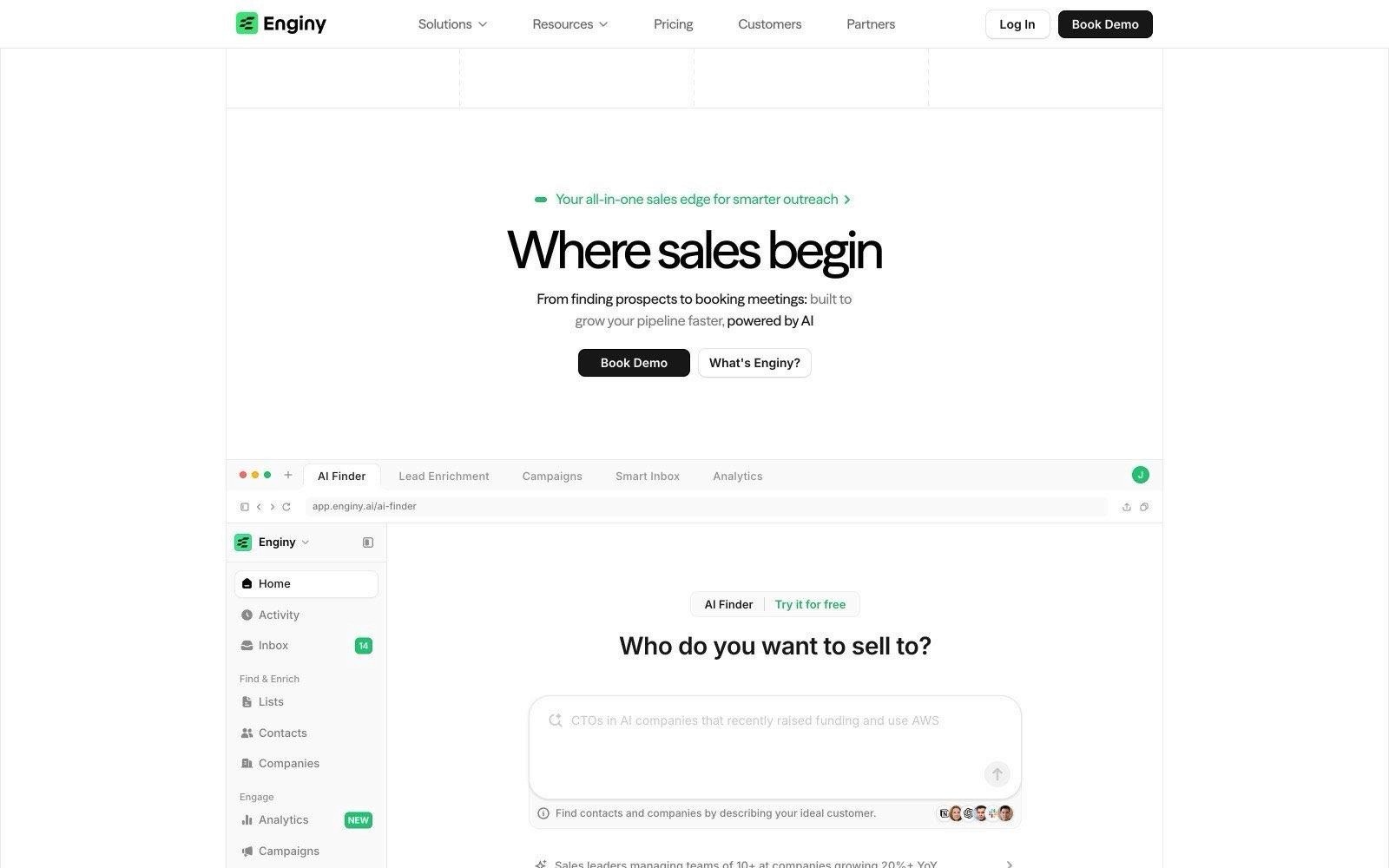
Enginy is an AI-native B2B sales tool that covers prospect discovery, data enrichment, and multi-channel outreach in one place. For a recruitment agency, that means building a list of companies showing hiring intent, pulling the decision-maker's verified email and direct number, and running the follow-up sequence without exporting anything.
Rather than reselling one static database, it pulls contact data from 30+ enrichment providers in real time and applies waterfall logic, so each field is filled by whichever source actually holds it.
Lists can be defined by hiring activity, recent senior hires, job changes, funding events, technology stack, event attendance, or engagement with a specific social post, then refreshed on a schedule so they don't quietly rot.
Everything syncs to HubSpot, Salesforce, Pipedrive, Dynamics 365, Zoho, or a custom CRM, which matters when your applicant tracking system holds candidates and your client pipeline needs to live somewhere else.
Ideal For
Recruitment and staffing agencies running client-side business development
Agency owners who need pipeline without hiring a data specialist
Business development managers working a defined sector or territory
Contract and temp desks that need multiple contacts inside one account
Agencies opening a new sector or country from a cold start
Why Do We Stand Out?
Two things separate Enginy from the point tools further down this list.
Signals and sending on one record: the gap where most recruitment business development dies is between the spreadsheet and the first call. Enginy carries the same enriched contact into email, social, and calling tasks, so a hiring signal spotted on Tuesday morning is a sequence running Tuesday afternoon rather than a CSV somebody will clean on Friday.
Complete without needing a technical operator: the tools that combine data depth with workflow flexibility usually assume a dedicated operations person. Enginy is built so a consultant can construct, enrich, and launch a list without writing a formula, which is what makes the coverage usable in an agency that bills by the hour.
The multi-stakeholder layer is what recruitment desks tend to notice first. A hiring decision rarely sits with one person, so campaigns can reach the hiring manager, the HR lead, and the finance or procurement contact in parallel, which is how you get past a preferred supplier list rather than around it. A senior identity can warm the account before a consultant ever dials.
Pros
Waterfall enrichment across 30+ providers, which fills emails and direct phone numbers a single database would leave blank
Hiring activity, senior hires, job changes, and funding available as native filters rather than a paid add-on
Multi-channel campaigns across email, social, and call tasks, with AI handling replies
Recurring lists that refresh themselves, so a sector desk starts each week with new accounts
Native CRM sync, so leads arrive assigned to a consultant instead of sitting in an export
Cons
Pricing is quoted after a qualification call rather than published, which slows a purely self-serve evaluation
Agencies that only want a raw contact feed for their own systems will pay for outreach features they won't use
It manages client-side business development, so you'll still run your applicant tracking system alongside it
Pricing
Enginy uses a credit-based model across four tiers, Basic, Smart, Business, and Enterprise. Credits are consumed by company and contact extraction, email and phone enrichment, verification, technology and job-posting data, and AI research fields, and the tiers differ by monthly credits, contact volume, sender identities, and included onboarding.
Every plan is quoted after a short qualification call, so seat count, credit volume, and phone data are matched to the desks you actually run.
Final Verdict
Enginy suits recruitment agencies whose real constraint isn't finding companies but turning hiring signals into booked meetings without pulling a consultant off billing.
It combines the multi-source coverage you'd normally assemble across two or three vendors with the campaign layer you'd usually buy separately, and it's designed to be run by the person doing the selling.
2. eGrabber JobGrabber
Overview
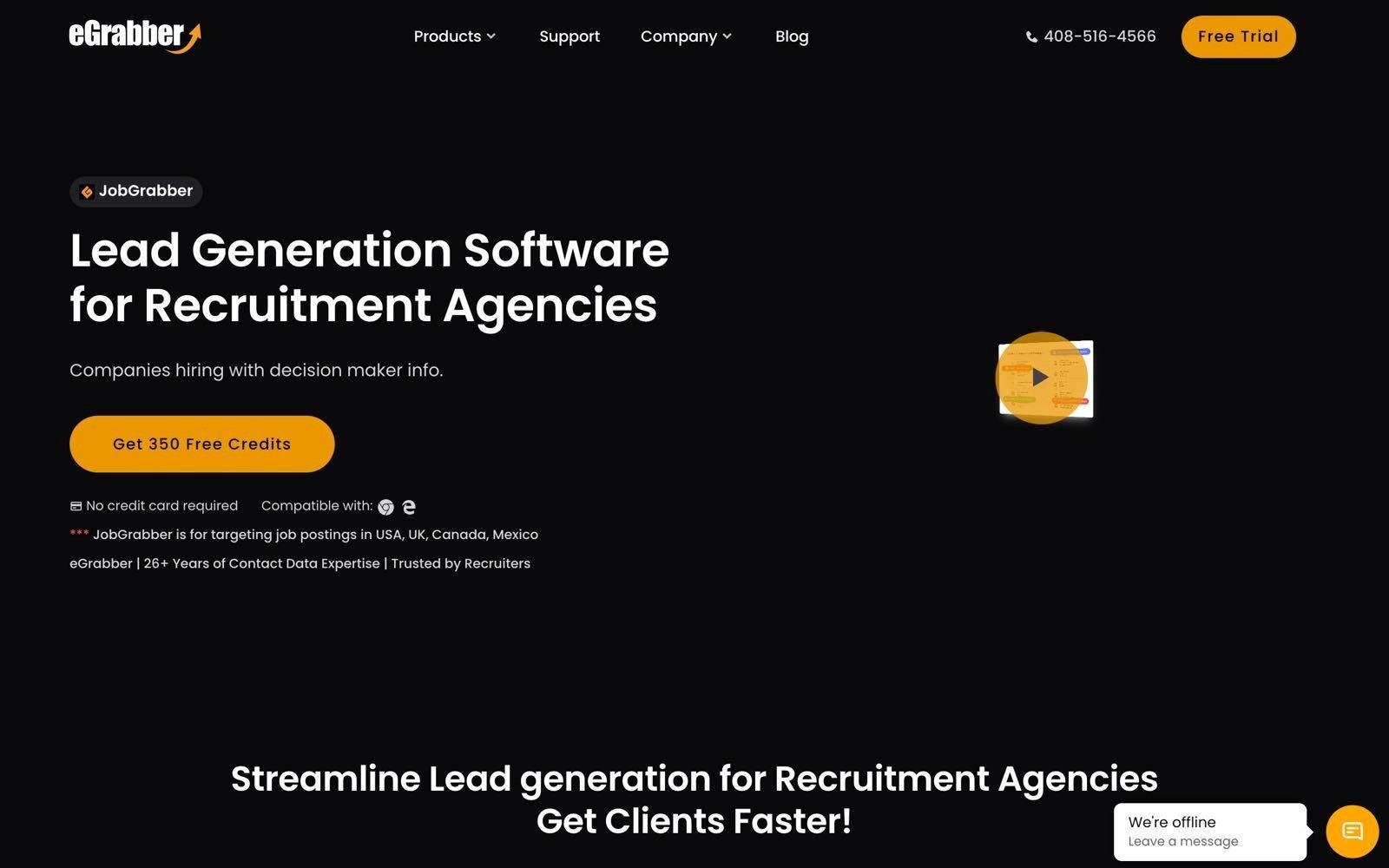
JobGrabber is eGrabber's product built specifically to turn job postings into client leads for recruitment and staffing firms. It reads across eight job boards, groups the postings by hiring company, and appends decision-maker contact details so a consultant can go straight to an approach.
Its most useful mechanic is subtraction. Job boards carry postings from both direct employers and rival agencies, and JobGrabber filters the agency postings out so what's left is companies hiring for themselves.
It also flags reposted roles, which usually mean a company is struggling to fill something, and identifies likely ghost postings so a desk stops chasing adverts nobody intends to fill.
eGrabber positions it around full-desk recruiters and staffing firms in the United States, UK, Canada, and Mexico, and describes 26 years of contact-data work behind it.
Ideal For
Full-desk recruiters who prospect directly off live vacancies
Staffing agencies working United States, UK, Canadian, or Mexican markets
Desks in IT services, consulting, and outsourcing
Small teams that want one shared account across up to five users
Why Do They Stand Out?
JobGrabber is one of the few tools that treats agency-posted vacancies as noise to be removed rather than volume to be counted, and for a recruitment desk that changes the hit rate on a list more than any accuracy percentage.
Ghost-posting and repost detection push in the same direction, sorting adverts by whether a real hiring decision sits behind them.
The other useful piece is matching. It can reconcile up to 100,000 companies from your applicant tracking system, CRM, or a spreadsheet, which lets you separate accounts you already know from genuinely new ones before anyone starts dialling.
Pros
Filters out other agencies' job postings, leaving direct employers
Flags ghost postings and reposted roles as separate signals
Access across eight job boards with unlimited hiring-company downloads each month
10,000 append credits included for decision-maker details
Multi-user access for up to five people on one account
Cons
Coverage is scoped to job postings in the United States, UK, Canada, and Mexico, so desks selling elsewhere are outside its range
Pricing isn't published and comes via a quote request
The email and phone finder is sold as an add-on rather than included
It works from posted vacancies, so it won't surface companies that are hiring but haven't advertised
Sequencing and reply management sit outside the product, so you'll pair it with a sending tool
Pricing
eGrabber doesn't publish a JobGrabber rate card, and pricing comes through a quote request.
The listed package covers eight job boards with unlimited grabs, 10,000 append credits, unlimited hiring-company downloads per month, matching against up to 100,000 companies from an existing system, and multi-user access, with the email and phone finder available as an add-on. A trial with 350 free credits is offered without a card.
Final Verdict
JobGrabber is worth a look for full-desk recruiters in its four covered countries who already prospect from vacancies and want the agency noise, ghost adverts, and reposts sorted before they start. It's a targeted piece of a business development stack rather than a whole one.
Because it starts from what's been advertised, it can't tell you about a company planning to hire next month, and you'll still need something to send from.
3. Agency Leads
Overview
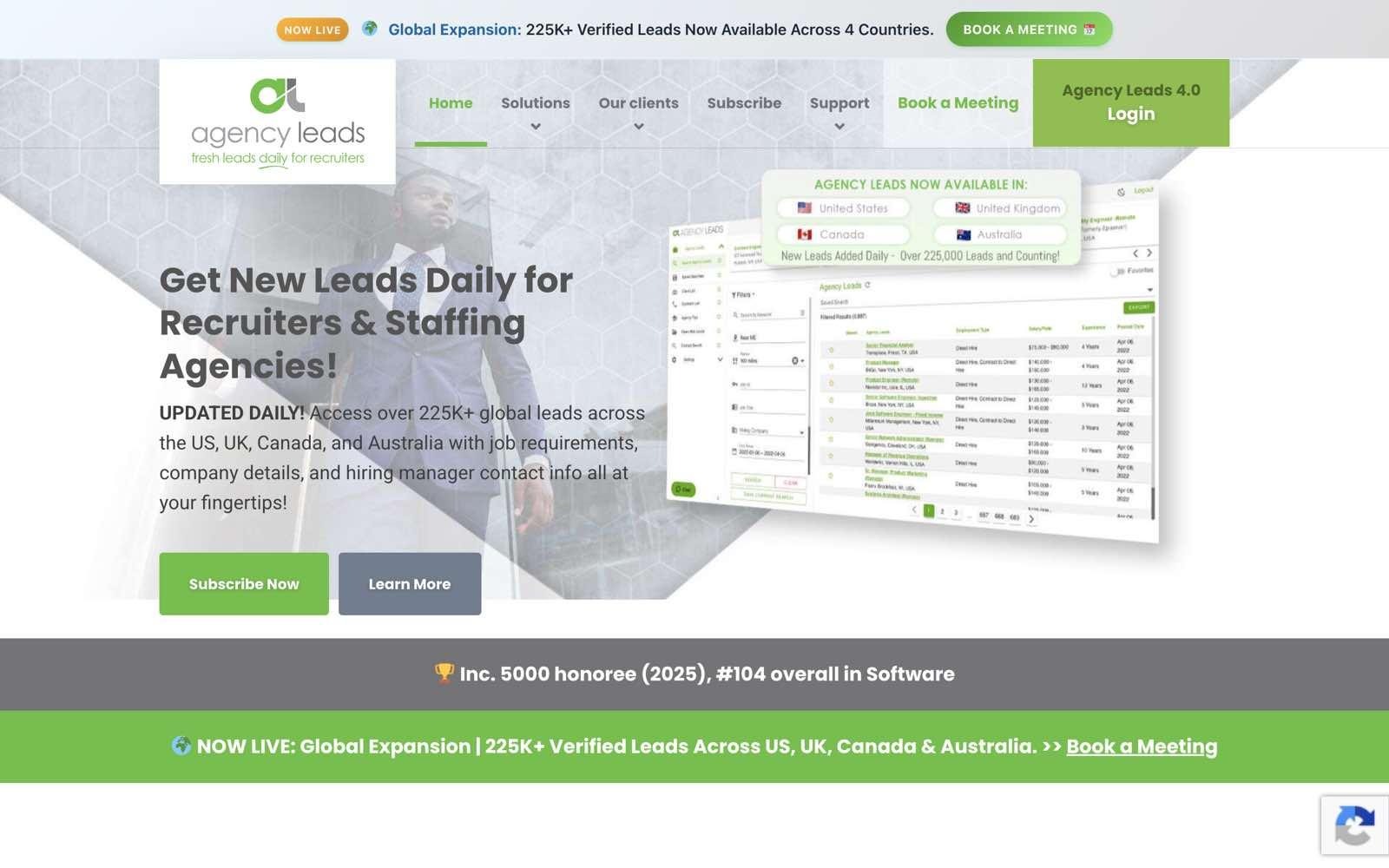
Agency Leads sells a curated account list rather than a search tool, and its whole premise is prior behaviour, because the companies in it have used staffing agencies for their hiring. That's a narrower and more valuable filter than "is hiring", because it removes the accounts that will never pay an agency fee.
The main product holds over 225,000 leads across the United States, UK, Canada, and Australia, refreshed daily, with hiring manager contact details and basic outreach tracking so a desk can log who has been approached.
A cheaper companion product, Open Web Leads, aggregates over two million job postings with company and contact information but doesn't allow exports.
It's built for staffing and recruitment sales specifically, which shows in the vocabulary and in features like new-lead email notifications and built-in outreach tracking.
Ideal For
Staffing agencies that want an account list rather than a query builder
Business development reps working a weekly account quota
Agencies selling into companies with an established habit of using suppliers
Teams that want daily-refreshed leads without building a data process
Why Do They Stand Out?
The qualifying criterion is the product. Filtering for companies that already buy staffing services skips the longest part of an agency sales cycle, which is convincing a business that external recruitment is worth paying for at all. Daily refresh and email notifications keep the list moving rather than ageing.
Pricing is also published in full, which is unusual in this category and makes it straightforward to work out cost per exported lead before you commit.
Pros
Over 225,000 leads from companies with a history of using staffing agencies
Leads refreshed daily with hiring manager contact details included
Published pricing across quarterly, six-month, and annual terms
Outreach tracking and new-lead notifications built in
A lower-cost job-posting product available for teams not ready for the main list
Cons
Coverage spans the United States, UK, Canada, and Australia, so it's a weaker fit for desks selling into continental Europe
Every plan caps exports at 500 a month regardless of term length
The cheaper Open Web Leads product doesn't permit exports at all
Entry cost is higher than most self-serve data tools on this list
Outreach itself happens elsewhere, so a sending tool is still required
Pricing
Agency Leads publishes three terms for its combined access, all with 500 exports a month, at $625 a month on a pre-paid quarterly plan, $590 a month on six months, and $486 a month on an annual plan. Open Web Leads is sold separately at $997 for six months or $1,697 for twelve, which works out around $167 and $142 a month, without export rights.
Final Verdict
Agency Leads fits staffing firms in the United States, UK, Canada, or Australia that want a pre-qualified account list and would rather pay for the filtering than build it. The behavioural criterion is the reason to buy it, and the export cap is the reason to model your volume first.
At 500 exports a month it's scoped to a focused desk rather than a large business development team working several thousand accounts a quarter.
4. Cognism
Overview
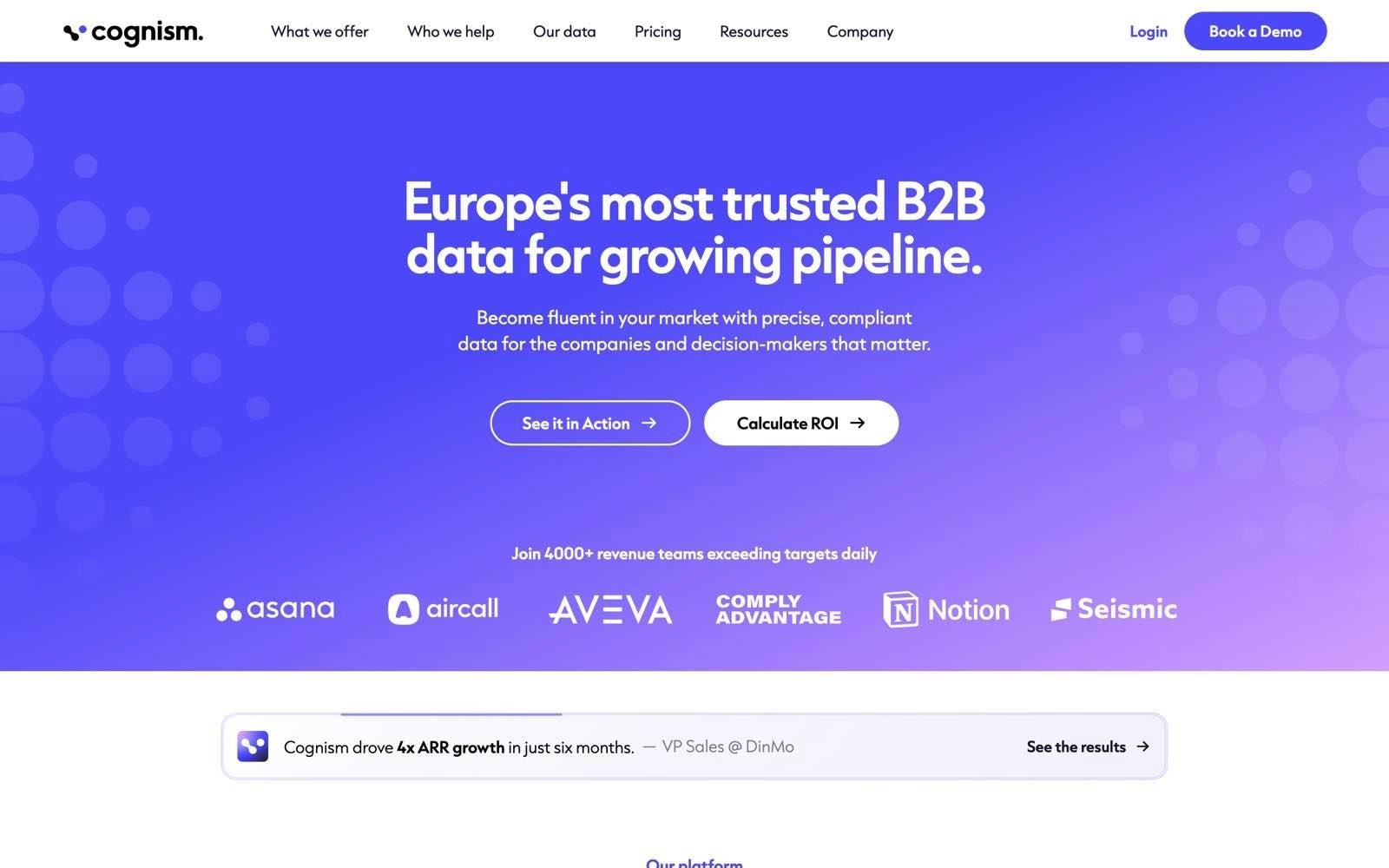
Cognism is a European B2B data provider built around reaching people by phone. It sells itself on European coverage, with phone-verified mobiles offered as a premium record type alongside verified emails and company revenue and headcount data, and it publishes coverage metrics for Director-level and above contacts in Europe and the United States.
It also carries signal data covering hiring trends, funding alerts, technographics, and merger and acquisition alerts, plus intent data via Bombora's Company Surge, which is where it becomes relevant for client-side recruitment work.
Contacts are verified through what the company describes as manual and automated processes, and phone-verified records go through additional checks.
It's typically bought by a team rather than an individual, with five seats included in each prospecting tier.
Ideal For
UK and European recruitment desks that lead with calls
Agencies selling into mid-market and enterprise accounts
Teams that want hiring and funding signals alongside contact data
Business development functions of five or more people
Why Do They Stand Out?
Phone coverage is the differentiator that matters to a recruitment desk, because a hiring manager who ignores email will often take a call about a role they're struggling to fill. Cognism sells phone-verified mobiles as a premium record type that, in its own words, goes through additional layers of verification checks on top of the manual and automated process applied to every contact.
The signals layer is the other reason agencies pick it. Hiring trends and funding alerts let a list be defined by timing rather than fit alone, and its technographic database covers over 20,000 technologies for desks that are placed into specific tool stacks.
Pros
Phone-verified mobiles sold as a premium record type, on top of standard verified contacts
Director-level and above contacts refreshed on a 30-day cycle, per its own data pages
Hiring, funding, technographic, and third-party intent signals in one product
CRM enrichment and a data feed available as add-ons
Five seats included in each prospecting tier
Cons
Pricing isn't published, so every comparison starts with a sales conversation
Tiers bundle five seats, which makes it a weaker fit for a solo consultant or a two-person firm
It supplies data rather than the sending layer, so a sequencing tool sits alongside it
Its own data pages describe coverage built around Europe and the United States, so desks selling elsewhere should test their market first
Intent signals are account-level, so you still identify the individual buyer yourself
Pricing
Cognism doesn't publish figures. Sales prospecting is sold across Standard and Pro tiers, each including five seats, with CRM Enrichment and Data-as-a-Service available as separate add-ons. Pricing is quoted after a conversation about volume and seats, and no term length is published, so a short pilot is harder to scope here than with the self-serve tools on this list.
Final Verdict
Cognism is a sensible choice for UK and European recruitment teams whose business development runs on the phone and who want a vendor whose coverage is built around Europe rather than added to it. Its signal layer earns its place for desks that want to time an approach rather than work an alphabetical list.
The five-seat bundling and the quote-only pricing make it a poor fit for a boutique firm, and it stops at the data, so the campaign layer is still yours to buy.
5. Apollo.io
Overview
Apollo.io is a self-serve sales tool that combines a large contact database with sequences, a dialler, and light CRM features. For a recruitment agency it's the low-cost way to get contact data and send it in the same place without a procurement process.
It targets small teams and individual reps who want to start today, and it's usually the price reference every other quote gets compared against. Free-tier limits are published in full, at 900 credits per seat a year, two sequences, twenty identified website companies a month, and CRM enrichment capped at 100 records.
Two limits marked on its own pricing page matter to a UK desk. The dialler included with a seat is a United States dialler, with international calling sold as a separate add-on, and person-level website-visitor identification is labelled United States only.
Ideal For
Small recruitment agencies buying software for the first time
Solo business development reps who need data and sending together
Desks prospecting into United States accounts
Teams that want to trial outbound before committing budget
Why Do They Stand Out?
The entry price and the self-serve model are the draw. An agency can be sending sequences the same afternoon for less than the cost of a job-board slot, and the credit allowances at each tier are published, so cost per contact is easy to calculate up front.
Having sequences, a dialler, and enrichment in one subscription also removes the joining work a data-only vendor leaves behind, which is why it suits teams without an operations person.
Pros
Free tier with 900 credits per seat a year for testing the data
Basic plan at $49 per seat a month billed annually with 30,000 credits
Sequences, dialler, and CRM enrichment included rather than sold separately
Website visitor identification available from the free tier
Published credit allowances at every tier
Cons
Its own pricing page marks person-level website-visitor identification as United States only
International calling sits in a separate Advanced Dialer add-on at $119 per team a month
The Organization tier requires a minimum of three seats
Advertised prices assume annual billing, so monthly costs more
Credits cover several action types, so heavy phone use consumes an allowance faster than expected
Pricing
Apollo publishes four tiers on annual billing, starting with Free at $0 and 900 credits per seat a year, then Basic at $49 per seat a month with 30,000 credits, Professional at $79 with 48,000, and Organization at $119 with 72,000 and a three-seat minimum. Monthly billing costs more, with annual plans advertised as saving 24%. Dialler use draws on credits separately.
Final Verdict
Apollo.io makes sense for small recruitment agencies and solo business development reps who want data and outreach in one subscription at a price they can approve without a meeting. It's the practical starting point for a desk testing whether outbound works at all.
The credit model needs care before you commit, since a single allowance covers data, enrichment, and dialling, and the add-ons a UK desk is most likely to reach for, international calling among them, sit outside the seat price.
6. Sopro
Overview
Sopro is a managed outreach service rather than software, and staffing and recruiting is one of the sectors it names directly. You brief it, and its team builds the audience, writes the messaging, and runs multi-channel campaigns as an outsourced business development function.
Its stated approach for recruitment is to reach HR leaders, heads of talent, and managing directors with messaging shaped around how hiring decisions get made, then hand replies back to the agency to work. An in-house data team builds each audience for the campaign rather than pulling from a static list, the data is listed as yours to download and keep, and the company says its data work is signed off by its own data protection officer.
The scale is public. Sopro says it works with more than 3,750 businesses, and reports over 91 million outreach messages sent and more than 630,000 conversations started.
Ideal For
Agency owners with no business development resource in the building
Firms whose consultants are fully committed to delivery
Agencies testing a new sector without hiring for it
Teams that want copy and targeting handled by specialists
Why Do They Stand Out?
Among the lead generation companies for recruitment agencies, Sopro publishes both a starting price and its campaign volumes, which is rare in managed services and makes it possible to sanity-check the offer before a sales call. The absence of a minimum contract lowers the risk of trying it.
The other advantage is that it replaces a role rather than adding a tool. Targeting, copywriting, sending, and the weekly tuning of all three sit with its campaign team, and multiple stakeholders per account are contacted as standard, which suits the committee shape of a hiring decision.
Pros
Fully managed service, so no internal business development headcount is required
Audiences built fresh per campaign by an in-house data team, and yours to download and keep
Multiple stakeholders contacted per account as standard
Published starting price and no minimum contract
Staffing and recruiting named as a served sector, with recruitment case studies
Cons
At around £3,000 a month it costs several times the software options on this list
You're buying a managed campaign rather than a data subscription, so the pipeline stops when you stop paying
Replies still need working, so someone in the agency must be available to take calls
Messaging and targeting decisions sit with an external team, which suits some owners less than others
Detailed pricing depends on audience size and channels, so the real figure comes from a call
Pricing
Sopro says pricing starts at around £3,000 a month, with no minimum contract, and quotes each campaign after understanding the audience and channels involved. The fee covers the managed service, ongoing campaign adjustments, a single point of contact, and the audience build. Cost per conversation therefore depends heavily on how large and how reachable your target market is.
Final Verdict
Sopro is a reasonable option for agency owners who accept that business development needs to happen and have concluded it won't happen internally. Buying a function rather than a tool is the right call when every consultant is billing and nobody owns prospecting.
The monthly cost puts it out of reach for boutique firms, and because the service rather than the software is what you're buying, the flow of conversations ends when the campaign does.
7. Clay
Overview
Clay is an enrichment and workflow tool rather than a database. You build a table of accounts, run each row through multiple data providers in sequence until a field fills, then layer AI research on top to answer questions a database can't.
For a recruitment agency that means it can do things no packaged tool will, such as reading a company's careers page to judge whether hiring looks internal or agency-supported, or scoring accounts by how many roles they've posted this quarter.
It also tracks job changes and new hires as signals, which is directly useful for reconnecting with a former client who has moved firms.
The trade-off shows in how it's built, because alongside the tables it ships a CLI, an HTTP API, bring-your-own API keys, and signal webhooks, which is a set of controls aimed at someone who wants to own that layer.
Ideal For
Agencies with an operations or marketing person who owns the data workflow
Firms with an unusual definition of a good account that filters can't express
Desks that want AI research columns alongside contact data
Teams reconnecting with contacts who have changed employer
Why Do They Stand Out?
The waterfall model is the reason people pick Clay. Rather than accepting one vendor's coverage, each row can try several providers in order, which lifts fill rates on mobiles and emails in markets where any single database is thin.
Its AI research columns are the other draw, because they turn judgement into a column. Questions such as whether a company uses agencies or hires directly have no database field, and Clay will read the pages and form a view at list scale, which is AI sales research applied to account selection.
Pros
Multi-provider waterfalls that fill fields a single database leaves blank
AI research columns for criteria no filter can express
Job change, new hire, and company news signals from the Launch tier
Free tier with 500 actions a month and unlimited seats
Published pricing with credit volumes visible at each step
Cons
Built for people who enjoy building workflows, so it assumes a technical operator
The Launch tier is the entry point for phone enrichment and signals, at $167 a month
Actions and data credits are metered separately, which makes costs harder to predict
The free tier is capped at 200 rows per table, so it's for testing rather than running a desk
Clay offers its own email sequencer or a sequencing integration as equal options, so many teams keep the outreach tool they already run
Pricing
Clay publishes a free tier with 500 actions and 100 data credits a month, unlimited seats and tables, and a 200-row cap per table. Launch starts at $167 a month for 15,000 actions and adds phone enrichment, signal tracking, and sending. Growth starts at $446 a month for 40,000 actions and adds CRM and warehouse sync. Both action and data-credit volumes expand in published steps.
Final Verdict
Clay is the right tool for a recruitment agency that has someone who wants to own the data layer and a targeting definition too specific for anyone's filters. In those hands it produces lists competitors can't replicate.
Without that person the licence tends to go unused, and the metered pricing across two separate credit types makes budgeting harder than a flat seat fee.
8. Lemlist
Overview
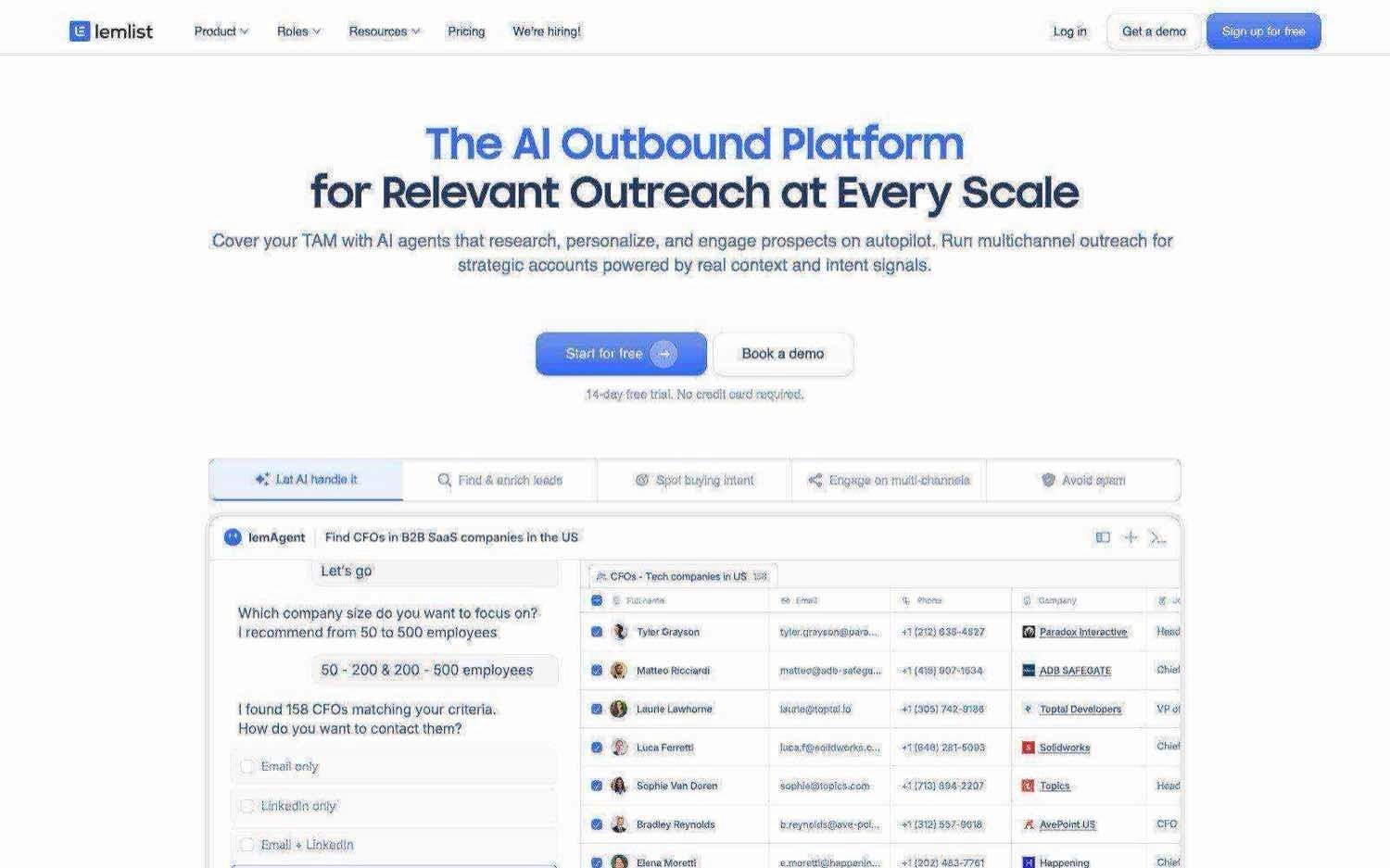
Lemlist is a multi-channel outreach tool with a contact database attached. Its centre of gravity is sending, covering email sequences, social steps, SMS, WhatsApp, a dialler, deliverability warm-up, and a unified inbox for replies.
It also sells data and signals on a pay-as-you-go credit model rather than a bundled allowance, which is worth understanding for recruitment work.
Hiring and job-change signals are priced per signal, so a desk can pay for hiring intent only when it uses it instead of buying a full data subscription.
The database is stated at over 650 million leads, with email finding and verification and phone lookup available on the same credits.
Ideal For
Recruitment desks that already have a data source and need to send
Agencies running email, social, and calling steps in one sequence
Teams that want hiring signals priced per use rather than per month
Firms with deliverability problems from previous cold email
Why Do They Stand Out?
The pay-per-signal pricing is unusual and suits a recruitment desk with uneven volume, since hiring and job-change signals start at 100 credits each and a credit is one cent. A desk can price a test of whether hiring intent lifts its reply rate at roughly a dollar a signal, rather than committing to a data contract to find out.
Deliverability tooling is the other reason agencies choose it. Recruitment outreach carries high send volumes and blunt templates, and warm-up plus a separate deliverability area addresses the domain damage that follows, which is the single most common failure in cold email software generally.
Pros
Unlimited users on the email plan, which suits a small agency sharing an account
Multi-channel sequences across email, social, SMS, WhatsApp, and calls
Hiring and job-change signals priced per signal rather than bundled
Built-in warm-up and deliverability tooling
Published credit costs for emails, phones, and each signal type
Cons
The Multichannel plan is priced per user, so costs rise with the team
Data and signals sit outside the subscription, so the real monthly figure is the plan plus credits
Phone lookups cost 20 credits each against 5 for an email, so calling desks spend faster
Its database and signals are billed as pay-per-success credits outside the plan, not as a bundled monthly allowance
The WhatsApp channel is an add-on rather than included
Pricing
Lemlist publishes an Email plan at $69 a month, or $55 billed yearly, with unlimited users and 50,000 emails a month. Multichannel is $109 per user a month, or $87 yearly, adding social, SMS, and dialler steps. Enterprise is custom for teams of five or more. Data runs on credits at one cent each, with verified emails at 5 credits, phone numbers at 20, and hiring or job-change signals from 100.
Final Verdict
Lemlist works well for recruitment desks that have solved the data question and need a reliable, multi-channel way to send at volume without burning their domain. The per-signal pricing makes it a cheap way to test whether hiring intent lifts replies.
Because its contact data and signals are billed as credits outside the subscription, the monthly figure is the plan plus consumption, and agencies that need to find hiring companies in volume will be running Lemlist alongside a data source rather than instead of one.
9. Leadfeeder (formerly Dealfront)
Overview
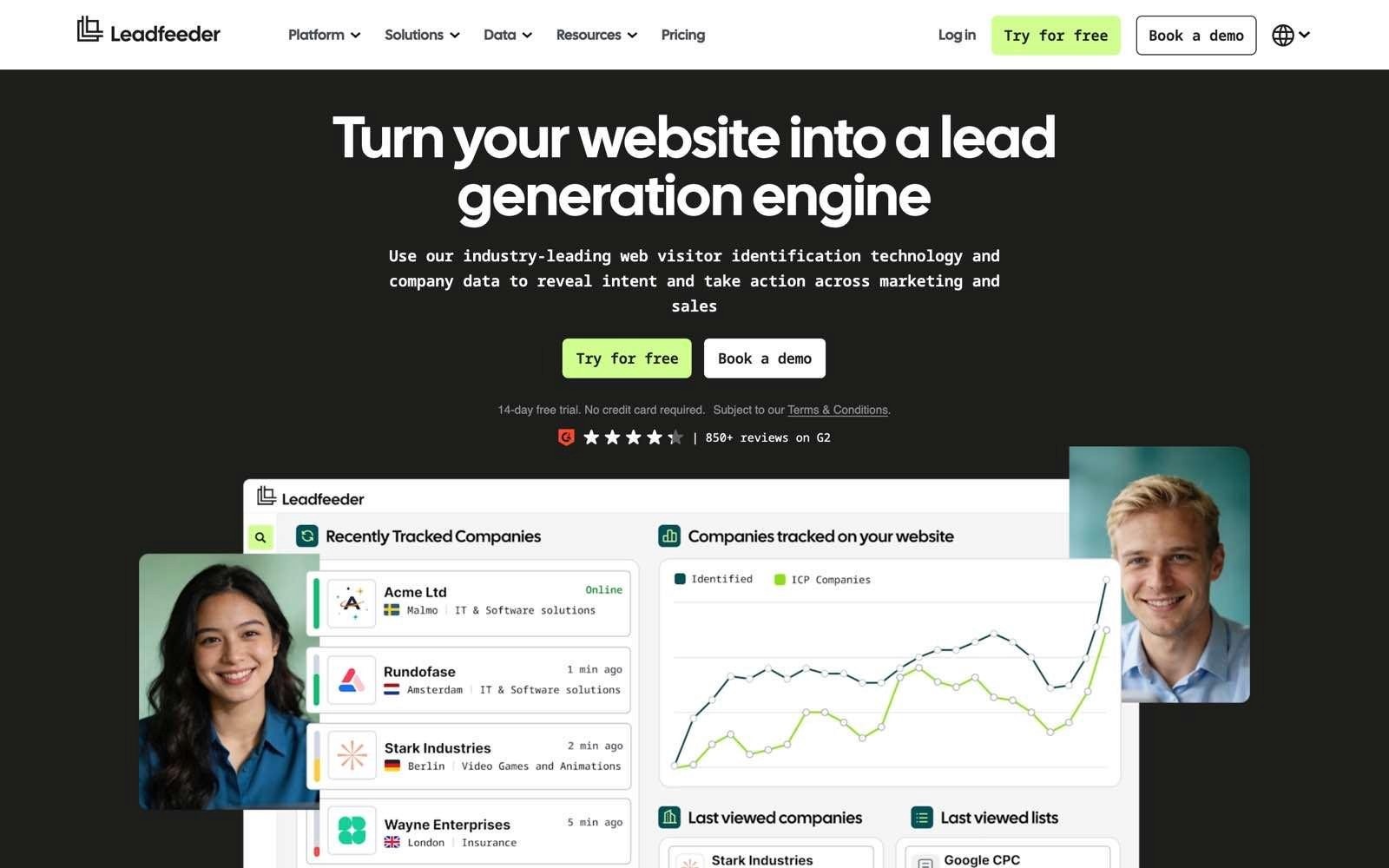
Leadfeeder identifies the companies visiting your website, which addresses a blind spot most recruitment agencies don't realise they have. Hiring managers research suppliers before they enquire, and most of them leave without filling anything in.
It reveals visiting companies at account level, filters them by intent signals, and pushes the ones that match your profile into a CRM so a consultant can follow up while the interest is live.
Higher tiers add verified contact details and prospect list building, turning an anonymous visit into a named approach.
One thing to know before you search for it. The company traded as Dealfront until recently, and dealfront.com now redirects to leadfeeder.com, so third-party reviews and comparison articles still carry the old name.
Ideal For
Agencies with real traffic on sector or service pages
Firms running paid campaigns who want to know which companies responded
Desks that want to prioritise accounts already showing interest
Marketing-led agencies with content that attracts hiring managers
Why Do They Stand Out?
It works on demand rather than supply. Every other tool here starts from a list you define, while Leadfeeder starts from behaviour that has already happened, which makes its leads warmer than anything cold prospecting produces.
The free tier is genuinely usable for a small agency, covering up to 100 identified companies a month with unlimited users, which is enough for most boutique firms to see whether the traffic is worth acting on.
Pros
Reveals visiting companies rather than leaving traffic anonymous
Free tier covering 100 identified companies a month with unlimited users
Intent filters and CRM push on paid tiers
Verified emails and phone numbers available from the Activate tier
Full-product 14-day trial with no card required
Cons
Identification is company-level, so the individual researching your site stays unknown on lower tiers
Value depends on existing traffic, so agencies with a thin site get little from it
Verified contact data starts at the €369 Activate tier
The Scale tier is billed annually only
The recent move from the Dealfront name means third-party reviews and pricing write-ups are still filed under the old brand
Pricing
Leadfeeder publishes a permanently free Lite tier covering 100 identified companies a month, unlimited users, and seven days of visitor history. Discover starts at €79 a month billed annually for identification and CRM push, Activate at €369 adds verified emails and phones, intent filters, and prospect list building, and Scale at €599 adds free data export and a dedicated success manager on annual billing only. Every paid plan starts with a 14-day full-access trial.
Final Verdict
Leadfeeder is a good addition for recruitment agencies whose sector pages and campaigns already pull traffic they currently can't name. Working accounts that have shown interest is the cheapest pipeline available to a marketing-led firm.
It's a complement rather than a source, though, because an agency with little traffic has nothing for it to identify, and the tier that names actual people costs more than most of the outbound tools on this list.
10. Lusha
Overview
Lusha is a contact data and signals layer that pushes into whatever you already work in. Its browser extension reveals a hiring manager's verified email or phone number while a consultant is researching, and its Workspace holds the lists, enrichment, and signal columns behind that.
The part recruitment desks tend to miss is the signal product. Lusha tracks when a company is hiring, raising funds, launching a product, or changing leadership, alongside job changes and promotions, and its higher tiers add buying-intent topics. So it answers who to call and, increasingly, when.
What it doesn't do is send. Signals and contacts are designed to be tracked inside Lusha, your CRM, your automation stack, or an AI client over its MCP server, which means the outreach itself happens somewhere else.
Ideal For
Recruitment desks that already own a sending tool and need the data layer under it
Consultants who research one account at a time and want reveals in the browser
Agencies that want to test contact accuracy cheaply before a bigger purchase
Teams pushing enriched contacts and signals into an existing CRM
Desks where a single connected mobile number can justify the month's cost
Why Do They Stand Out?
The credit model is unusually legible. Lusha publishes what each action costs, at 1 credit to reveal a verified email and 5 to reveal a phone number, so a phone-led desk can work out exactly what its month buys before subscribing rather than after.
The other reason it appears here is reach into other tools. Between the extension, the API, and an MCP server that exposes its data to AI clients, Lusha is built to sit under an existing workflow instead of asking you to move into a new one.
Pros
Free plan with up to 40 credits a month, one seat, and no card required
Published per-action credit costs at 1 credit per email and 5 per phone number
Buying signals covering hiring, funding, job changes, promotions, and company news
Browser extension that fits how consultants already research
Paid tiers include free seats, with 2 on Pro and 5 on Premium
Cons
No campaign, sequencing, or reply management, so it's one part of a stack
Paid plans are billed yearly with credits granted upfront, so month-to-month trialling is limited
Pricing moves with a credit slider rather than sitting at a fixed tier price, which makes quotes harder to compare
At 5 credits a phone number, a phone-led desk burns an allowance five times faster than an email-led one
Buying-intent topics are capped by tier, with the unlimited-results allocation reserved for the top plan
Pricing
Lusha publishes five tiers, Free, Starter, Pro, Premium, and Scale. Free gives up to 40 credits a month on one seat with no card required, and the paid tiers are billed yearly with credits granted upfront, sized by a slider that steps through annual credit bundles and applies a 25% discount for paying yearly.
Revealing a verified email costs 1 credit and a phone number costs 5, and unused monthly credits roll over up to twice the monthly cap. Scale is quoted for larger organisations and carries 25 buying-intent topics with unlimited results.
Final Verdict
Lusha suits recruitment agencies that have already decided where their outreach will run and want a dependable data and signals layer feeding it, particularly desks that live in the browser and the CRM rather than in a campaign tool.
The per-action credit pricing makes it easy to size honestly against a phone-led week. It sends nothing itself, and the slider-based annual pricing means the real cost only becomes clear once you have committed to a credit volume.
How to Choose Lead Generation for Recruitment Agencies
Most agencies buy on database size and regret it within a quarter. The seven checks below predict whether a tool will still be earning its cost in six months, and they're worth running before you sit through a demo.
1. Test How Hiring Signals Are Filtered
A tool that reports every job posting in your sector is reporting the market, not an opportunity. What you want to know is whether a company will pay an agency fee, and the strongest evidence for that is prior behaviour. Have they used agencies before, are they reposting a role they can't fill, are they hiring for something that needs a specialist search?
Ask any vendor how it distinguishes a direct employer from a rival agency's advert, and how it treats postings that have been live for months. If the answer is that it doesn't, you're buying volume and paying for the filtering with your consultants' time.
2. Test Contact Accuracy in the Countries You Bill In
Category-wide accuracy claims hide enormous regional variation, and a provider that performs in the United States can be thin across Southern Europe. The same holds by seniority, where HR directors at 5,000-person companies are far better covered than operations managers at 40-person ones.
Run your own test before signing. Pull 100 records from your exact target profile, run the emails through an independent verifier, and dial 20 of the mobiles yourself. That single afternoon tells you more than any figure on a pricing page, and it's the same discipline behind good data enrichment generally.
3. Work Out What You Still Have to Buy
This is the check most agencies skip. A data subscription isn't a pipeline, and the distance between an exported list and a booked meeting gets filled by verification, deduplication, CRM import, ownership assignment, sequencing, and someone to run all of it.
Add up the second and third purchases before comparing quotes, because a $49 database plus a sending tool plus a verifier plus four hours a week of a consultant's time is not a cheap option. Where the data and the campaign share one record, that layer disappears and the comparison between two quotes changes shape entirely.
4. Price It Against a Placement, Not Against Other Software
Recruitment has an advantage most software buyers don't have, because your average fee is large and you already know what it is. A perm placement at 20% on a £55,000 salary is £11,000, and a £500 monthly tool costs £6,000 a year, so one extra placement covers it with £5,000 left over.
That changes which questions matter. Instead of hunting for the cheapest option, work out how many extra briefs a tool needs to produce to break even, then ask the vendor for evidence it can hit that number in your sector. Tracking it properly means agreeing how you'll measure sales performance before the trial starts, not after.
5. Check You Can Reach the Whole Buying Committee
Recruitment spend rarely gets approved by one person. A hiring manager feels the pain, an HR or talent lead owns the process, procurement owns the preferred supplier list, and finance signs the terms. Reaching only the first of those is how a warm conversation dies at "we have a PSL".
So ask whether a tool can find and sequence several contacts inside one account in parallel, and whether it can route a senior introduction from your director alongside a consultant's approach. Working the committee is also how a supplier list gets opened rather than avoided, and understanding which B2B buying signals each role responds to makes those parallel messages land differently.
6. Confirm the Compliance and Suppression Rules Work for You
Two boundaries matter in recruitment, and both are yours to defend rather than your vendor's. The first is legal, and under UK rules the ICO's PECR guidance says you can send marketing emails or texts to companies, but you must not send them to individuals without specific consent, and sole traders and some partnerships are treated as individuals. Plenty of small-business prospect lists are full of exactly those.
The second is commercial. Your client-side outreach and your candidate outreach must not collide, which means client employees need suppression from candidate campaigns and your blocklist needs to survive a list refresh. Ask how suppression works, how opt-outs propagate, and whether do-not-call screening runs on the countries you dial. Treat this as general guidance rather than legal advice, and get your own position confirmed.
7. Decide Who Is Going to Operate It
The most capable tools in this category assume a dedicated operator, and a licence nobody drives returns nothing. In an agency that operator is usually a consultant whose real job is billing, which is why so much recruitment software gets bought in January and abandoned by March.
So answer this honestly before you sign. If nobody will own enrichment logic every week, weight your decision towards tools a consultant can run unaided, or towards a managed service that removes the question. If you do have that person, the flexible workflow tools become genuinely attractive, because you can get value from them the average buyer can't.
Everything You Need to Know About Recruitment Lead Generation
Category | Key Considerations |
Top 3 tools | Enginy for hiring signals and outreach on one record, eGrabber JobGrabber for prospecting off job postings, Agency Leads for a pre-qualified staffing account list |
Who is it for | Agency owners, business development managers, solo search consultants, contract and temp desks, and agencies opening a new sector or country |
What it's used for | Finding companies with live hiring need, reaching hiring managers and HR leads, opening preferred supplier lists, reconnecting with contacts who changed employer, working inbound website interest |
How to choose | Test how hiring signals are filtered, verify contact accuracy in your own markets, count the tools you'll still need, price against a placement fee, check you can reach the whole committee, confirm suppression and consent rules, and name the person who will run it |
Mistakes to avoid | Buying on database size, prospecting off unfiltered job boards, emailing sole traders as if they were companies, contacting one person per account, and letting client and candidate outreach share a list |
Pricing starts | Free plans at Apollo, Clay, Leadfeeder, and Lusha; paid entry tiers from $49 a seat a month, with metered plans rising on usage; managed services from about £3,000 a month; Enginy quoted per account on credits |
Win More Recruitment Clients with Enginy
Client-side business development is the part of an agency that gets sacrificed first. Consultants get busy, prospecting stops, and eight weeks later the desk is quiet again. Meanwhile the signal you needed, a company hiring for the exact role you specialise in, went to whoever called first.
Enginy closes that gap. Hiring activity, senior hires, job changes, and funding are native filters, contact data is pulled from 30+ enrichment providers in one waterfall, and the same record runs your email, social, and call sequences straight into your CRM, without a technical operator.
Talent Match, a recruitment consultancy, now sources around 30% of its new leads this way at four to five times return. Bring your hardest sector and see what the hiring data looks like, or read how the same records are used to generate B2B leads end to end.
New accounts also get 100 free B2B leads. Book a Demo
FAQs About Lead Generation for Recruitment Agencies
What is the best lead generation for recruitment agencies in 2026?
The best lead generation for recruitment agencies in 2026 is Enginy for firms that want hiring signals, verified contact data, and outreach on a single record, because it pulls from 30+ enrichment providers and runs campaigns from the same list. eGrabber JobGrabber is the stronger fit for desks prospecting directly off job postings in the United States, UK, Canada, or Mexico, and Agency Leads suits firms that want a pre-qualified list of over 225,000 companies with a history of using staffing agencies. There's no single winner across every market, since mobile coverage and hiring-signal depth vary sharply by country. Choose by the sectors and regions your desks actually bill in.
What should I look for in lead generation for recruitment agencies?
When looking at lead generation for recruitment agencies, weigh signal quality over database size, contact accuracy in the countries you bill in, the extra tools you'll still have to buy, and whether you can reach a whole buying committee rather than one contact. Test with your own sample of 100 target records and dial 20 of the mobiles before committing, because published accuracy claims rarely survive a regional test. Price the result against your average placement fee rather than against other software, since one extra brief usually covers a year of subscription. Then check that suppression and consent rules fit how your agency works.
How does Enginy differ from similar alternatives?
Enginy differs from most tools in this category by covering discovery, enrichment, and multi-channel outreach in one place rather than selling one layer of the job. Where a data vendor hands you an export and an outreach tool assumes you already have a list, Enginy runs waterfall enrichment across 30+ providers and carries that same record into email, social, and calling sequences. Hiring activity, senior hires, job changes, and funding are native filters instead of paid add-ons. It's built so a consultant can run it without a dedicated operations specialist.
How do I get started with Enginy?
Getting started with Enginy begins with a short qualification call, followed by a demo built around your own target sectors rather than a generic dataset, and new accounts receive 100 free B2B leads. Pricing is quoted after that call because credits, seats, and phone data are matched to your actual volume across the Basic, Smart, Business, and Enterprise tiers. Onboarding includes five structured sessions covering CRM connection, AI configuration, list building, and campaign setup. Most agencies have their first enriched list running inside those sessions.
How easy is it to switch to Enginy?
Switching to Enginy is designed to run alongside your current setup rather than replace it overnight, and the five included onboarding sessions cover the migration. Existing CRM contacts can be imported and re-enriched, which is usually the fastest way to prove the difference, since half-complete client records you already own get filled in without new sourcing. Native integrations with HubSpot, Salesforce, Pipedrive, Dynamics 365, and Zoho mean your CRM stays the system of record and your applicant tracking system is untouched. Most agencies keep the old contract running for one cycle and compare reply rates directly.
Should we hire lead generation companies for recruitment agencies?
Hire lead generation companies for recruitment agencies when nobody internally will own prospecting every week, and buy software when someone will. A managed service like Sopro starts at around £3,000 a month and replaces a business development role, including targeting, copy, and sending, while paid software on this list starts at roughly $49 to $167 a month and needs a person to drive it. The difference that matters is ownership, because with software you keep the list, the credits, and the learning, while with a service you are buying the campaign itself. Many agencies run both, using a service to open a new sector while the in-house desk works the core market.
How do recruitment agencies find companies that are hiring?
Recruitment agencies find companies that are hiring by layering four sources, namely job postings, firmographic filters, growth signals such as funding and senior hires, and their own website traffic and lapsed network. Postings are the fastest to spot and the most crowded, and Greenhouse reports that 18% to 22% of jobs posted on Greenhouse in any quarter are ghost jobs with no intent to hire, so raw board volume needs filtering. Growth signals arrive earlier, which is why funding rounds, new department heads, and hiring for a role that implies a team build often produce warmer conversations than an advert everyone has seen. The practical answer is to prospect on the earlier signals and use postings to confirm.
About the Author
Andrea López is a B2B sales and go-to-market writer at Enginy, covering outbound strategy, prospecting data, and sales automation for revenue teams across the UK and Europe. She writes from the workflows Enginy's own sales team runs daily, from list building and waterfall enrichment through to multi-channel campaigns and CRM hygiene. Follow Enginy's work on Instagram.