Best Intent Data Providers in 2026 (Top-Rated Intent Signal Tools Reviewed)

Andrea López
Partager
Key Takeaways (TL;DR)
The Best Overall Intent Data Provider: Enginy is an end-to-end GTM platform, which also provides quick, actionable intent data. It is ideal for teams that want signals acted on immediately, since layered intent data feeds straight into list building and outreach rather than sitting in a separate dashboard.
Why Do You Need It?: Static firmographic lists tell you who a company is, not whether it's ready to buy. Intent data tools flag the accounts actively showing buying behaviour right now.
Who It's For?: Sales and RevOps teams that want to prioritise outreach by real signals rather than company size alone, from lean startups to mid-market SDR teams.
How to Choose the Right One?: Check how many signal types a provider tracks, whether the data flows directly into outreach or just a report, and whether pricing scales with your actual usage.
Expected Price: Enginy's pricing is credit-based and quoted after a short qualification call. Across the market, intent data providers range from free entry tiers up to $15,000 or more a year for enterprise contracts.
Top Intent Data Providers in 2026: at a Glance
Tool | Best For | Key Features | Pricing |
Enginy | Teams wanting signals that feed straight into outreach | Layered intent filters, list building, multichannel sequencing | Credit-based, custom quote |
Apollo.io | Teams wanting a data-first starting point | Contact database, sequencing, some intent filters | Free plan, from $49/seat/month |
Cognism | Enterprise teams prioritising verified contact accuracy | Phone-verified data, intent signals, compliance focus | From $14,000/year |
Bombora | Teams wanting third-party content consumption signals | Company Surge intent scoring, co-op data network | Custom, enterprise quotes |
Lusha | Smaller teams wanting an accessible entry point | Contact data, buyer intent add-ons, browser extension | Free plan, from $32.45/month |
ZoomInfo | Large teams wanting deep account and org data | Firmographic and intent data, org charts | From around $15,000/year |
Clay | Technical teams wanting custom intent workflows | Data waterfalls, custom enrichment, automation | Free plan, from $167/month |
6sense | Teams wanting predictive account scoring | AI-based intent scoring, account prioritisation | Free plan (50 credits), custom beyond |
Bitscale | Teams wanting credit-based flexible intent access | Bitscale credits, unlimited actions, integrations | Free lifetime plan, from $349/month |
Leadfeeder | Teams wanting website visitor intent tracking | Visitor identification, company-level intent signals | Free Lite plan, from €113/month |
What Are Intent Data Providers?
Intent data providers are tools that track and surface signals showing a company is actively researching or evaluating a purchase, before that company ever fills out a form or replies to an email.
These signals come from a few different sources. Some track content consumption across the web, some track technology stack changes and hiring patterns, and some track direct engagement with a specific website or product category.
The best intent data providers layer several signal types together, since a single source, like website visits alone, misses a lot of genuine buying activity happening elsewhere.
What separates a genuinely useful buyer intent data tool from a vanity dashboard is what happens after the signal fires. A tool that flags intent but doesn't connect to outreach still leaves a rep manually acting on the alert.
We built Enginy to close that gap specifically, layering intent signals like job changes, funding rounds, and technology stack shifts directly into list building, so a signal turns into outreach the same day it appears rather than sitting in a report nobody checks.
Why Do You Need Buyer Intent Data Tools?
Reaching an account while a relevant signal is still fresh produces noticeably higher engagement than contacting the same account at a random point in the quarter.
Static, firmographic-only lists don't capture this timing at all. A company matching your ideal customer profile on paper might be six months away from any real buying conversation, while a company slightly outside that profile could be actively evaluating vendors right now.
This is exactly the gap intent data tools exist to close. Rather than guessing when an account might be ready, buyer intent software surfaces the accounts already showing real behaviour. That might be a new hire in a relevant role, a funding round, a technology switch, or increased research activity around a specific topic.
A message that references something real, a recent hire, a funding announcement, a specific tool switch, reads differently to the person receiving it than a generic template ever could. It signals the sender actually looked before reaching out.
This is why we treat intent data as the starting point for list building at Enginy, not an add-on layered on afterwards. A list built around live signals is a fundamentally different asset than one built around static company size alone.
Who Needs Intent Data Providers?
1. Startup Founders Running Lean Outbound
Early-stage founders rarely have the bandwidth to manually research which accounts are worth contacting today.
B2B intent data providers that surface signals automatically remove that research burden without needing a dedicated analyst on staff.
2. Heads of Sales Chasing Predictable Pipeline
VPs and Heads of Sales need a sales pipeline that doesn't depend on luck or timing.
Intent data tools give a team a repeatable way to prioritise which accounts to contact first, based on evidence rather than gut feel.
3. RevOps Teams Layering Signals onto Existing Lists
RevOps often already has a firmographic list built and wants to add a signal layer on top, rather than starting from scratch.
This persona evaluates buyer intent data tools specifically on how many signal types are covered and how easily they integrate with existing CRM workflows.
4. SDR Teams Writing More Relevant First Touches
Reps writing generic first-touch messages struggle to stand out in a crowded inbox.
Intent signals give SDRs a concrete, timely reason for reaching out, which changes how a message reads on the receiving end.
5. Agencies Prioritising Client Accounts at Scale
Agencies managing outbound for several clients need to prioritise limited SDR hours across many accounts at once.
Buying intent software helps surface which accounts, across every client, are actually worth contacting this week.
Best Intent Data Providers: In-Depth Review and Comparison
1. Enginy

Overview
We built Enginy as an AI-native, end-to-end GTM platform for modern B2B sales teams, combining prospect discovery, data enrichment, and outreach in a single workspace.
Layered intent signals sit at the centre of how lists get built here, covering recent hires, job changes, funding rounds, technology stack usage, and social post engagement, rather than treating intent as a bolt-on report.
Once a signal surfaces an account, social prospecting and contact data enrichment work together to build a usable contact list, and multichannel outreach launches directly from the same workspace.
For teams comparing intent data providers, this end-to-end flow is the whole point: signals should trigger outreach, not sit in a dashboard nobody checks.
Ideal For
Early-stage teams that need a research analyst's output without hiring one
RevOps leads tired of intent data living in a separate tab from the outreach tool
Growing SDR teams who want every new signal to reach a prospect the same day
Top Features
Layered intent filters spanning hiring, funding, and technology stack signals
Direct pipeline from a triggered signal into an enriched, ready-to-contact list
Conditional multichannel sequencing that adapts based on prospect behaviour
Why We Stand Out?
Most intent data providers stop at the alert.
We built Enginy so the signal itself starts the workflow, moving straight from detection into an enriched list and a live sequence without a rep manually bridging the gap.
Pros
Intent signals feed directly into list building rather than a standalone report
No technical operator needed to configure and run the platform
Multiple signal types layered together rather than a single narrow source
Cons
Pricing isn't published publicly, so buyers need a qualification call for a quote
Newer brand recognition compared to long-established data providers
Full value depends on configuring the AI Playbook properly during onboarding
Pricing
There's no published price list to browse here.
A short qualification call comes first, so the quote reflects what your team actually needs rather than a flat number that ignores it.
From there, usage runs on credits, spent on things like pulling company data, enriching a contact, verifying an email, or generating an AI field.
Final Verdict
If a signal sitting unused in a report is a familiar frustration, Enginy is built specifically to close that gap between spotting an opportunity and actually acting on it.
2. Apollo.io
Overview
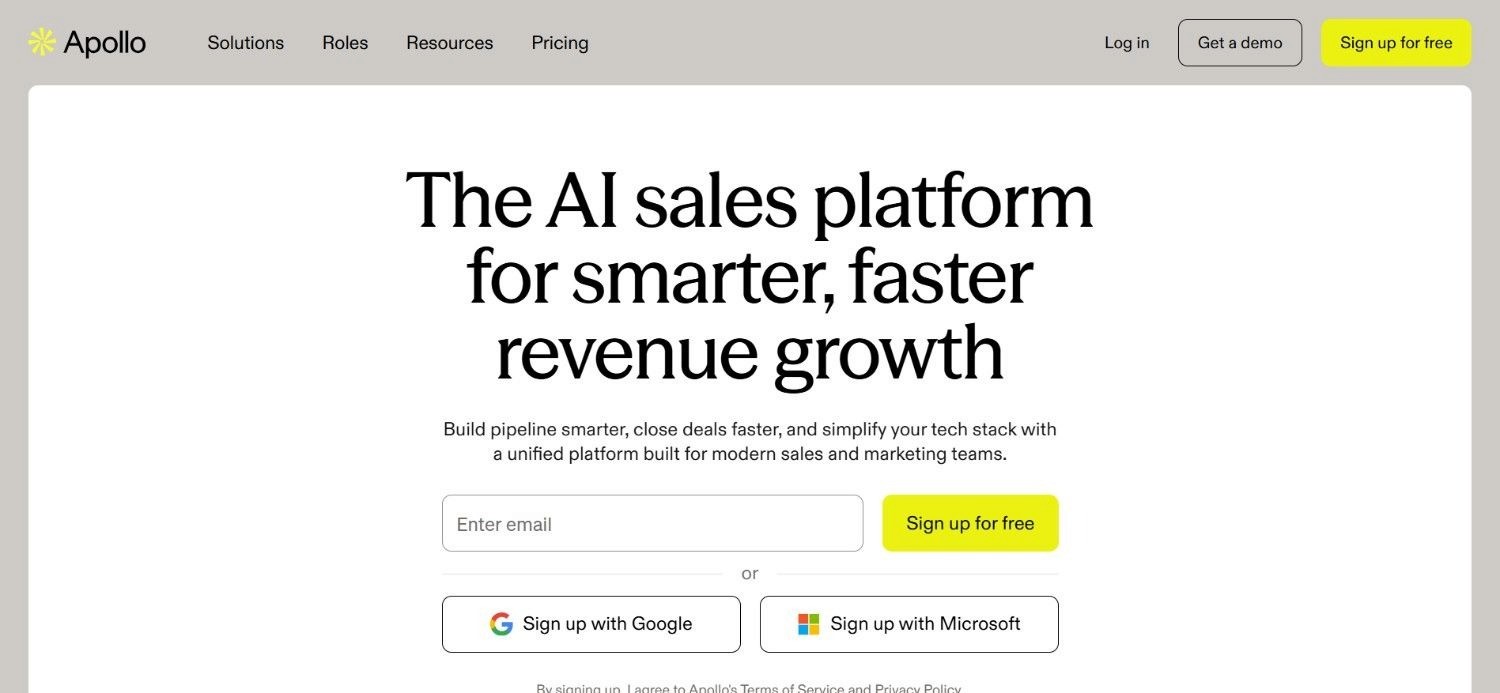
Apollo built its reputation on database size first, with intent filtering layered on afterwards rather than being the platform's original design focus.
The free plan gives smaller teams a real look at contact data before paying anything, which has made Apollo a common first stop for teams new to outbound.
Intent filtering exists within the platform, though it sits alongside a much larger set of firmographic filters rather than being the headline feature. Teams specifically hunting for a dedicated buyer intent data tool sometimes find the signal depth thinner than expected.
Where Apollo genuinely wins is accessibility. Low seat prices and a free tier mean a team can start testing intent-based targeting without committing to an annual enterprise contract first.
Ideal For
Smaller teams wanting an accessible entry point with a free plan
Organisations prioritising contact database size over signal depth
Teams comfortable managing intent alongside broader firmographic filtering
Top Features
Large, searchable contact and company database
Intent filters layered alongside firmographic search
Sequencing tools built into the same platform
Why They Stand Out?
Very few competitors let a team start for free and see real contact data before paying anything, which keeps Apollo as a common reference point for buyers evaluating this category.
Pros
Free plan available before any payment commitment
Large contact database included across paid tiers
Competitive entry pricing relative to full-stack competitors
Cons
Intent signal depth is thinner than dedicated intent-focused tools
Add-ons like extra credits and advanced domains cost extra
Less suited to teams wanting intent as the primary targeting method
Pricing
Apollo.io offers a free plan plus paid tiers billed annually: Basic at $49 per seat per month, Professional at $79 per seat per month, and Organization at $119 per seat per month.
Add-ons like extra credits, advanced email domains, and additional integrations are priced separately.
Final Verdict
Start here if budget matters more than signal depth right now. Revisit the decision once intent data needs to become the primary way you prioritise accounts.
3. Cognism
Overview
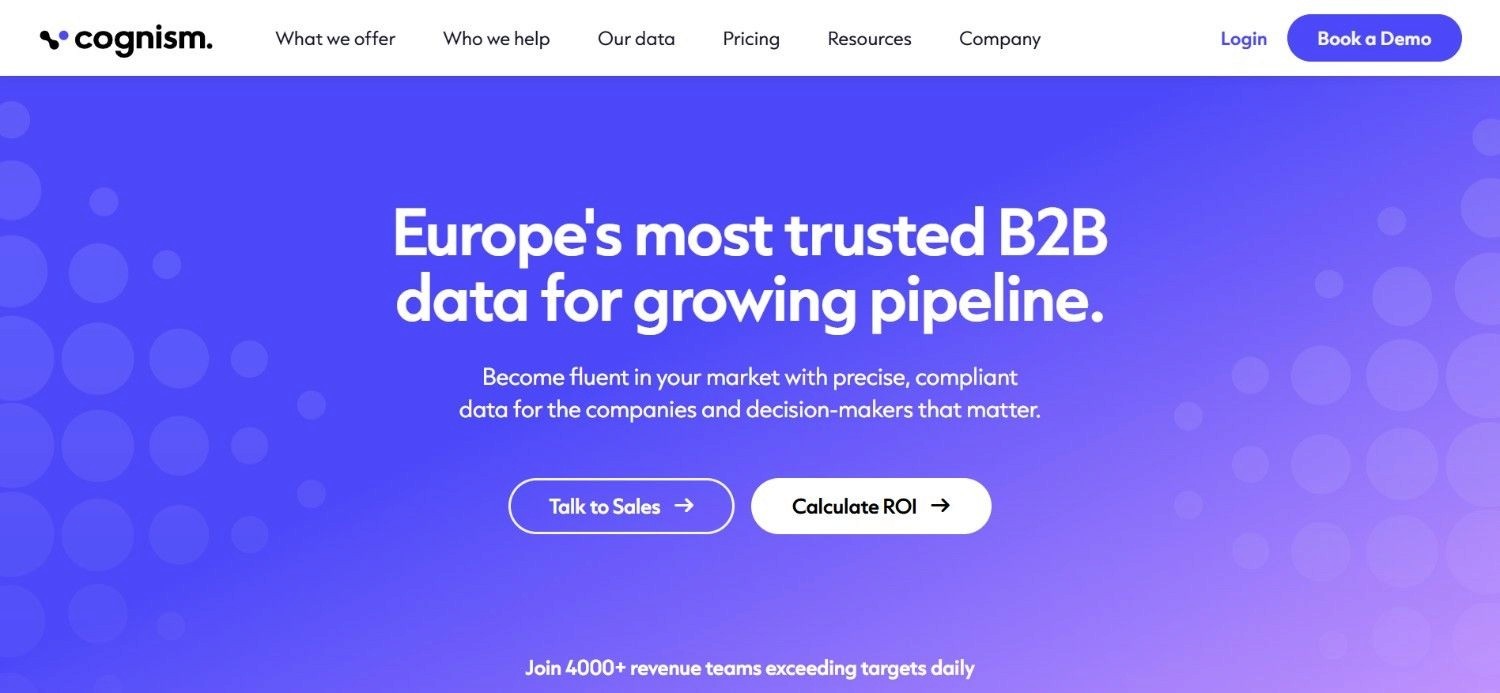
Cognism leans heavily into data accuracy, particularly phone-verified contact details, alongside intent signals layered on top of that verified base.
The pitch here is straightforward: intent data is only useful if the contact behind the signal is actually reachable, and Cognism's verification process is built specifically to reduce the number of dead numbers and bounced emails a team runs into.
That reliability comes with a structural tradeoff worth knowing upfront. Seats are fixed within a subscription, while contact reveals, enrichment, and exports draw from a separate credit pool.
Teams that plan their seat count carefully find this predictable. Teams that don't tend to run into credit shortages faster than expected.
Ideal For
Enterprise teams prioritising verified contact accuracy
Organisations in regions with strict compliance requirements
Teams wanting intent signals paired with reliable phone data
Top Features
Phone-verified contact data reducing dead numbers
Intent signals layered on top of a verified contact base
Compliance-focused data handling for regulated industries
Why They Stand Out?
Cognism's emphasis on phone verification specifically addresses a problem most intent data tools don't solve: a signal is only useful if the contact behind it can actually be reached.
Pros
Strong phone number verification reduces wasted outreach
Compliance focus suits regulated industries specifically
Subscription includes a fixed seat count for budgeting clarity
Cons
Additional credits for reveals and exports cost extra
Entry pricing sits above several lighter competitors
Less flexible than credit-only pricing models for smaller teams
Pricing
Cognism's Sales Prospecting plans start at $14,000 per year for Standard and $18,750 per year for Pro, with five seats included in each.
Pricing is subscription-based, with additional Cognism Credits available separately for contact reveals, enrichment, and exports.
Final Verdict
A solid choice if contact accuracy matters more to your team than flexible, usage-based pricing. Budget for credit top-ups on top of the base subscription.
4. Bombora
Overview
Bombora takes a different approach to intent entirely, tracking content consumption across a large co-op network of publisher sites rather than watching a single company's own website traffic.
This produces what's known as Company Surge data, essentially a spike in research activity around specific topics across the web, which can flag buying interest before a company ever visits your site directly.
Every Bombora engagement starts with a conversation about which topics and account lists matter most to your specific business, rather than a self-serve signup.
This makes Bombora less of a plug-and-play tool and more of an enterprise data layer that typically feeds into other systems, such as a CRM or a dedicated outreach platform, rather than being used standalone.
Ideal For
Enterprise teams wanting topic-based research signals across the web
Organisations layering third-party intent data onto existing systems
Teams with the budget and setup for an enterprise data contract
Top Features
Company Surge scoring based on content consumption spikes
Large co-op network spanning many publisher sites
Topic-based intent tracking beyond a single company's own website
Why They Stand Out?
Bombora's co-op network gives it visibility into research activity happening away from your own website entirely, which most single-source intent tools simply can't see.
Pros
Broad visibility into intent signals across many publisher sites
Strong fit for enterprise account-based marketing programmes
Topic-based scoring adds nuance beyond simple website visits
Cons
No published pricing, requiring a sales conversation to scope
Less suited to smaller teams without an existing data stack
Typically needs integration into another system to be actionable
Pricing
Bombora does not publish standard pricing publicly and uses custom, enterprise-oriented quotes for its B2B intent data solutions.
Final Verdict
Worth considering if your team already has infrastructure to act on third-party intent signals. Smaller teams may find the enterprise setup heavier than needed.
5. Lusha
Overview
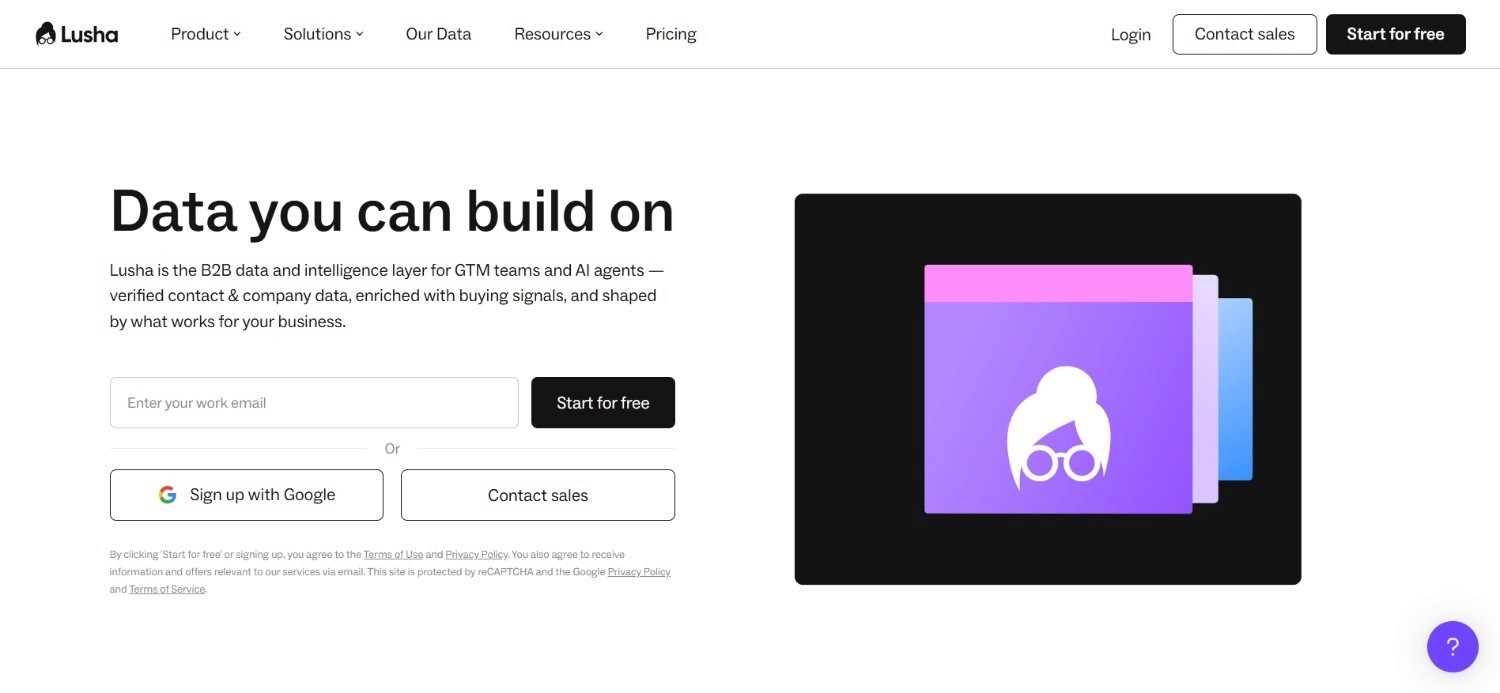
Lusha positions itself as an accessible way to get contact data and buyer intent signals without committing to an enterprise contract from day one.
A browser extension pulls contact details while browsing through the social media profiles of a prospect or a company website, which suits reps who prefer working from familiar tools rather than switching into a separate platform for every lookup.
Buyer intent features sit as an add-on layer rather than the platform's original core, added to the existing contact database over time.
Several plan tiers scale from a lean entry point up to a fuller package, giving smaller teams a genuinely low-cost way to test intent-based targeting before committing further.
Ideal For
Smaller teams wanting accessible pricing across multiple tiers
Reps who prefer working from a browser extension over a separate platform
Organisations testing buyer intent data tools before a bigger commitment
Top Features
Browser extension for contact lookups during normal browsing
Buyer intent data layered onto an existing contact database
Multiple pricing tiers scaling from free through to custom
Why They Stand Out?
Lusha's browser-first workflow removes a step most competitors require, letting a rep pull contact and intent data without leaving the page they're already on.
Pros
Free plan available for testing before paying
Accessible mid-tier pricing compared to enterprise competitors
Browser extension fits naturally into existing rep workflows
Cons
Buyer intent features feel like an add-on rather than the core product
Premium tier pricing climbs quickly for larger teams
Less signal depth than platforms built around intent specifically
Pricing
Lusha offers a free plan, with paid plans starting at $32.45 per month for Starter, $45.45 per month for Pro, and $259.95 per month for Premium, while the Scale plan uses custom pricing.
Plans vary by credits, seats, API access, buying intent data, and advanced features.
Final Verdict
A sensible pick for reps who want intent and contact data without leaving their browser. Larger teams may eventually need more signal depth than the add-on layer provides.
6. ZoomInfo
Overview
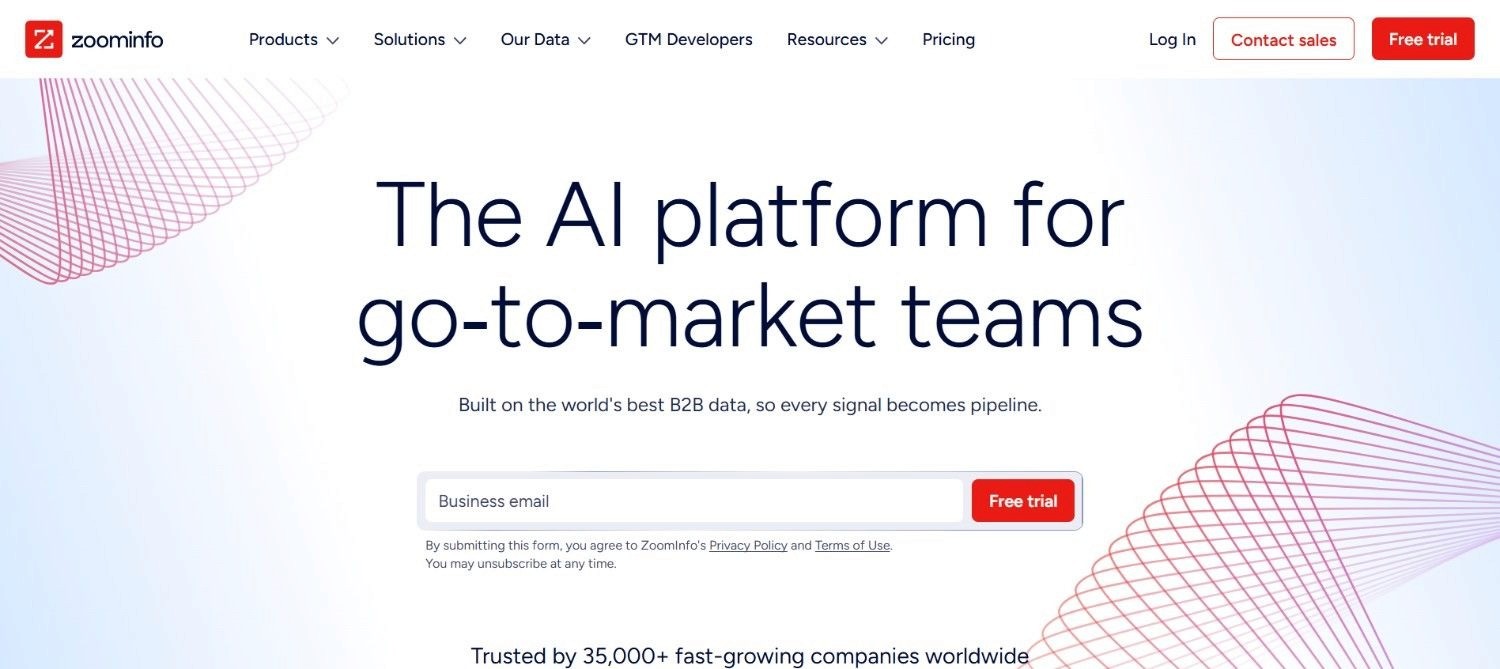
ZoomInfo remains one of the most recognised names in B2B data, and its scale shows in the depth of firmographic and intent data available across a single account.
Org chart mapping sits alongside intent scoring, which suits account-based selling motions where multiple stakeholders at the same company need to be identified and prioritised together.
Because ZoomInfo grew primarily as a data provider, its intent capabilities, while genuinely useful, sit within a much larger product built first around contact and company data depth.
Ideal For
Enterprise teams prioritising account and org data depth
Organisations running account-based selling across multiple stakeholders
Teams with existing budget for a premium data provider
Top Features
Deep firmographic and org chart data for account-based selling
Intent scoring layered across a large proprietary database
Broad integration options for enterprise CRM stacks
Why They Stand Out?
ZoomInfo's scale and brand recognition make it the default comparison point for enterprise buyers evaluating intent data providers, even when they end up choosing something else.
Pros
Extensive, well-maintained contact and company database
Strong org chart mapping for multi-stakeholder accounts
Widely recognised brand that's easy to justify internally
Cons
Entry pricing sits well above most SMB budgets
Intent capabilities feel secondary to its core data product
Long-term contracts are typical rather than flexible monthly billing
Pricing
ZoomInfo uses custom, seat- and credit-based pricing, with entry plans starting around $15,000 per year.
Final Verdict
Makes sense for enterprise teams that need account depth alongside intent signals. The price point rules it out for most early-stage budgets.
7. Clay
Overview
Clay takes a fundamentally different approach, giving technical teams a flexible workspace to build custom data waterfalls and enrichment workflows rather than a fixed intent dashboard.
Multiple data sources can be combined and sequenced within Clay, including intent signals, which appeals strongly to RevOps and GTM engineering personas who want full control over how signals get weighted and combined.
That flexibility comes with a learning curve. Clay is explicitly built for users comfortable configuring workflows themselves, rather than a plug-and-play buyer intent data tool a rep can pick up without training.
Ideal For
Technical GTM engineers wanting full control over data workflows
RevOps teams combining multiple intent sources into one system
Organisations comfortable configuring rather than using a fixed dashboard
Top Features
Custom data waterfalls combining multiple intent and enrichment sources
Flexible workflow automation across data providers
CRM sync and integrations at higher pricing tiers
Why They Stand Out?
Clay's flexibility to combine and weight multiple intent sources in one custom workflow is something few fixed-dashboard competitors offer at all.
Pros
Free plan available for testing basic workflows
Deep customisation across data sources and automation logic
Strong fit for technical RevOps and GTM engineering teams
Cons
Requires genuine technical setup, not designed for direct SDR use
Pricing scales quickly as annual actions and credits increase
Less approachable for teams without a dedicated technical operator
Pricing
Clay offers a free plan, with paid plans starting at $167 per month for Launch and $446 per month for Growth, while Enterprise pricing is custom.
Plans scale based on annual actions and data credits, with higher tiers adding CRM sync, automation, integrations, and dedicated support.
Final Verdict
Best suited to teams with a technical operator who wants full control over how intent data gets combined and used. Direct SDR use is not the intended workflow here.
8. 6sense
Overview
6sense centres its product around predictive account scoring, using AI models to estimate how close an account is to an actual buying decision rather than simply flagging that some activity occurred.
That scoring layer is the main differentiator. Instead of a rep interpreting a raw signal themselves, 6sense assigns a score intended to reflect genuine purchase readiness across the account.
A limited entry tier with a monthly credit allowance lets smaller teams test the scoring model before committing further, though most of the platform's depth sits behind a fuller package once usage grows.
Ideal For
Teams wanting predictive scoring rather than raw signal data
Organisations running account-based marketing programmes
Teams willing to test on a free tier before a custom conversation
Top Features
AI-based predictive scoring for buying readiness
Account prioritisation based on modelled intent rather than raw signals
Free entry tier with a monthly credit allowance
Why They Stand Out?
6sense's predictive scoring model interprets signals for you, rather than leaving a rep to judge whether a given activity actually means something.
Pros
Free plan available with a genuine credit allowance
Predictive scoring reduces manual signal interpretation
Strong fit for structured account-based marketing motions
Cons
Pricing beyond the free tier isn't published
Free tier credit allowance is limited for active use
Best value depends on committing to a broader package
Pricing
6sense offers a flexible pricing model for intent data and sales intelligence solutions, including a free plan with 50 credits per month.
For detailed pricing beyond this, it's best to discuss your specific needs with their team.
Final Verdict
A strong option if predictive scoring matters more to your team than raw signal transparency. Test the free tier before committing to a larger package.
9. Bitscale
Overview
Bitscale positions itself as an intent data and prospecting tool built for teams that want flexibility in how they track and act on buying signals, rather than being locked into one rigid workflow.
The platform focuses on surfacing account-level activity that suggests a company is actively in-market, then connecting that signal to an action a rep can take directly, rather than leaving the data sitting in an isolated report.
Integrations with common CRM and outreach tools mean a flagged account doesn't need manual re-entry elsewhere, which matters for teams trying to move quickly on a fresh signal before it goes cold.
Ideal For
Budget-conscious teams wanting a genuine free lifetime tier
Growing teams needing unlimited actions as usage scales
Organisations comfortable with credit-based usage pricing
Top Features
Free lifetime plan with real ongoing access
Credit-based pricing scaling with actual usage
Unlimited actions and integrations at higher tiers
Why They Stand Out?
A genuine free lifetime plan, rather than a time-limited trial, sets Bitscale apart from most competitors in this category who eventually require payment to keep using the product at all.
Pros
Free lifetime plan with real, ongoing functionality
Annual billing discount reduces long-term cost
Credit-based pricing scales with actual usage patterns
Cons
Smaller brand recognition than established category leaders
Enterprise tier still requires a custom pricing conversation
Less proven at very large enterprise scale
Pricing
Bitscale offers a Free lifetime plan, Growth at $349 per month, Booster at $799 per month, and a custom Enterprise plan starting at $15,000 annually.
Pricing scales with Bitscale credits, unlimited actions, integrations, and enterprise-grade capabilities, with annual billing offering a 10% discount.
Final Verdict
Worth trying specifically because of the genuine free lifetime tier. Growing teams should map expected usage against the paid tiers before scaling up.
10. Leadfeeder
Overview
Leadfeeder focuses on a specific slice of intent data: identifying which companies are visiting your own website, even when they never fill out a form.
That website-visitor angle makes it a useful complement to broader intent data providers rather than a full replacement, since it only sees activity happening on your own domain specifically.
A lighter entry tier gives smaller teams a taste of visitor identification before they commit to something fuller, with meaningfully more capability unlocked as a team moves up through the higher tiers.
That structure suits teams treating Leadfeeder as a genuine long-term addition to the stack, rather than a short-term experiment.
Ideal For
Teams wanting to identify anonymous website visitors specifically
Organisations complementing broader intent tools with on-site data
Businesses testing visitor identification before a bigger commitment
Top Features
Anonymous website visitor identification at the company level
Free Lite plan for initial testing
Tiered plans scaling from Discover through to Enterprise
Why They Stand Out?
Leadfeeder's narrow focus on your own website traffic specifically fills a gap that broader, multi-source intent data providers don't always cover in the same depth.
Pros
Free Lite plan available for initial testing
Clear, specific focus on website visitor identification
Substantial discount available with annual billing
Cons
Narrower scope than full-stack intent data providers
Pricing jump between Discover and Activate tiers is significant
Works best paired with a broader intent or outreach tool
Pricing
Leadfeeder offers a free Lite plan, while monthly pricing starts at €113 for Discover and €527 for Activate.
Scale starts at €599 per month with annual billing, Enterprise is custom-priced, and annual plans can save 30% versus monthly rates.
Final Verdict
A useful addition specifically for website visitor intent, best paired with a broader intent data provider rather than used entirely on its own.
How to Choose the Best Intent Data Providers (What to Consider)?
With so many providers covering different slices of the buying signal, a few practical checks make it much easier to compare them fairly:
1. Check How Many Signal Types Are Covered
A single signal source, like website visits alone, misses a lot of genuine buying activity.
Stronger intent data providers layer hiring, funding, technology, and content signals together.
2. Confirm Whether Signals Flow into Outreach
Some tools stop at the alert, leaving a rep to act manually.
Check whether the intent data tool connects directly into list building and sequencing, or just produces a report.
3. Evaluate Contact Data Accuracy Behind the Signal
An intent signal is only useful if the contact behind it is reachable.
Providers with weak contact verification undermine the value of even the best signal data.
4. Weigh Pricing Transparency Against Fit
Some providers publish clear tiers, while others quote custom pricing after a consultation.
Custom pricing isn't inherently worse, but it does mean budgeting a proper scoping call before comparing total cost.
5. Look at Technical Setup Requirements
Certain platforms need a dedicated GTM engineer or RevOps specialist to configure signal weighting and workflows properly.
If your team doesn't have that role, prioritise tools designed for direct SDR use instead.
6. Test How Timely the Signal Actually Is
A signal that surfaces weeks after the event has lost most of its value.
Check how quickly a provider actually flags new activity rather than assuming real-time means real-time.
7. Consider Onboarding and Support Structure
Implementation quality varies significantly between vendors.
Providers offering structured onboarding sessions tend to get teams acting on signals faster than those leaving the setup entirely self-serve.
Everything You Need to Know About Intent Data Providers
Tool | Pros | Cons | Ease of Use | Integrations | Support | Affordability |
Enginy | Signals feed straight into outreach; no technical operator needed; multiple signal types | Custom pricing only; newer brand; onboarding setup required | ⭐⭐⭐⭐⭐ | ⭐⭐⭐⭐⭐ | ⭐⭐⭐⭐⭐ | ⭐⭐⭐⭐ |
Apollo.io | Free plan; large database; low entry price | Intent depth is thinner than dedicated tools | ⭐⭐⭐⭐ | ⭐⭐⭐⭐ | ⭐⭐⭐ | ⭐⭐⭐⭐⭐ |
Cognism | Strong phone verification; compliance focus | Credits cost extra; higher entry price | ⭐⭐⭐⭐ | ⭐⭐⭐⭐ | ⭐⭐⭐⭐ | ⭐⭐ |
Bombora | Broad co-op network visibility; strong for ABM | No published pricing; needs another system to act on it | ⭐⭐⭐ | ⭐⭐⭐ | ⭐⭐⭐ | ⭐⭐ |
Lusha | Free plan; browser-first workflow; accessible tiers | Intent feels like an add-on; premium pricing climbs fast | ⭐⭐⭐⭐ | ⭐⭐⭐ | ⭐⭐⭐ | ⭐⭐⭐⭐ |
ZoomInfo | Deep account data; strong org charts; brand recognition | High entry price; intent feels secondary | ⭐⭐⭐ | ⭐⭐⭐⭐ | ⭐⭐⭐⭐ | ⭐⭐ |
Clay | Free plan; deep customisation; flexible workflows | Requires technical setup; pricing scales quickly | ⭐⭐⭐ | ⭐⭐⭐⭐ | ⭐⭐⭐ | ⭐⭐⭐ |
6sense | Free plan; predictive scoring; strong for ABM | Pricing beyond free tier unpublished; limited free credits | ⭐⭐⭐⭐ | ⭐⭐⭐⭐ | ⭐⭐⭐ | ⭐⭐⭐ |
Bitscale | Genuine free lifetime plan; annual discount | Smaller brand recognition; enterprise tier is custom | ⭐⭐⭐⭐ | ⭐⭐⭐ | ⭐⭐⭐ | ⭐⭐⭐⭐ |
Leadfeeder | Free Lite plan; clear website focus; annual discount | Narrow scope; big pricing jump between tiers | ⭐⭐⭐⭐ | ⭐⭐⭐ | ⭐⭐⭐ | ⭐⭐⭐⭐ |
Act on Intent Signals from One Platform with Enginy
Most intent data providers stop at the alert, leaving your team to manually turn a signal into an actual outreach sequence.
We built Enginy so that layered intent signals, list building, and multichannel outreach all run from the same workspace, moving a fresh signal into a live sequence the same day rather than sitting in a dashboard.
If your current setup flags intent but leaves the follow-through to a rep's memory, book a demo with our team and see how the whole workflow runs from signal to sequence.
FAQs About Intent Data Providers
What is the best intent data provider in 2026?
The best intent data provider in 2026 is Enginy, since it layers hiring, funding, and technology stack signals directly into list building and multichannel outreach rather than producing a standalone report. This means a signal turns into a live sequence the same day it appears. Pricing is credit-based and quoted after a short qualification call.
What should I consider when choosing intent data tools for me?
Choosing the right intent data tools comes down to how many signal types are covered, whether signals flow directly into outreach, and how accurate the contact data behind each signal actually is. Teams without a dedicated GTM engineer should prioritise tools designed for direct SDR use. Pricing transparency also varies, so budget time for a scoping call before comparing total cost.
How does Enginy differ from similar alternatives?
Enginy differs by connecting intent signals directly to list building, enrichment, and multichannel outreach in one workspace, rather than treating intent as a separate report a rep has to act on manually. Most B2B intent data providers specialise in detecting signals but stop short of triggering the next step automatically. Enginy is built specifically to close that gap between detection and action.
How do I get started with Enginy?
Getting started with Enginy begins with a qualification call, where we uncover your specific needs before quoting credit-based pricing tailored to your team. From there, five structured onboarding sessions cover AI Playbook setup, reply rate best practices, and CRM integration. This structured approach helps most teams see results faster than a fully self-serve setup.
How easy is it to switch to Enginy from another intent data provider?
Switching to Enginy is more straightforward than most migrations, since the five onboarding sessions cover CRM integration and playbook configuration together. Existing CRM data can be imported directly rather than rebuilt from scratch. Teams moving from a standalone intent dashboard often find the biggest change is simply having signals trigger outreach automatically instead of manually.
Is Enginy too expensive compared to cheaper data-only tools like Apollo?
Enginy is not directly comparable to Apollo, since Apollo is primarily a data provider while we’re a complete platform covering intent signals, enrichment, and multichannel outreach on a single platform together. Apollo users also pay for a separate outreach tool and spend SDR hours manually acting on whatever signals they do have. Once wasted rep time is factored in, the fragmented stack is usually the more expensive option.
What AI tools help with buyer intent signals specifically?
AI tools that help with buyer intent signals typically fall into two categories: platforms that detect and score signals, and platforms that act on them directly. Enginy uses AI to layer intent signals into list building and to personalise outreach messaging once a signal fires. Other providers, like 6sense, use AI primarily for predictive account scoring rather than triggering the next outreach step automatically.