Best Social Selling Tools in 2026 (Top-Rated Software Reviewed)

Andrea López
Partilhar
Key Takeaways (TL:DR)
The Best Overall Social Selling Tool: We built Enginy as an end-to-end GTM platform that combines prospect discovery, data enrichment and multichannel outreach in one place. You are not stitching together three separate tools just to run a single campaign, and it is the strongest pick for teams who want prospecting, intent data and outreach automation working from the same source of truth.
Why Do You Need It?: Buyers now research vendors socially long before they ever fill out a form. Reps who only cold call or cold email are missing most of that window, while social selling tools help you show up in the right feed at the right moment, backed by data instead of guesswork.
Who It's For?: These platforms serve B2B sales teams, recruitment agencies, marketing agencies and founder-led startups that need to build relationships with prospects before a formal pitch ever happens. They are equally useful for a solo SDR and a 50-person outbound team.
How to Choose the Right One?: Focus on data quality and enrichment depth, plus how well the tool automates multichannel sequences without sounding robotic. Pricing that scales sensibly as your team grows matters just as much; a platform that nails two of three and fails the last one will cost you more in the long run.
Expected Price: Our pricing at Enginy is credit-based and quoted after a short qualification call, since needs vary so much by team size and data volume. Across the market, entry-level social selling software starts around $35 to $40 per seat monthly, while more complete platforms with enrichment and multichannel automation run $70 to $200 per user, and enterprise-grade tools reach several thousand dollars a month for larger teams.
Top Social Selling Tools in 2026: at a Glance
Tool | Best For | Key Features | Pricing |
Enginy | Teams that want prospecting, enrichment and outreach in one platform | AI Finder, intent signals, multichannel sequencing, CRM sync | Custom, credit-based |
Kaspr | Fast contact enrichment for individual reps | Chrome extension enrichment, direct dials, CRM sync | Free to €99/user/month |
Salesloft | Enterprise sales engagement at scale | Cadences, conversation intelligence, forecasting | Custom, annual contract |
Taplio | Personal brand building through content | Post scheduling, AI writing assistant, analytics | $39 to $199/month |
Lemlist | Multichannel cold outreach campaigns | Email warm-up, personalisation variables, AI icebreakers | $39 to $99/user/month |
HeyReach | Social outreach at agency scale | Multi-account campaigns, unified inbox, smart sending limits | $79 to $2,999/month |
PhantomBuster | Workflow automation and data scraping | Pre-built automations, API access, data enrichment | $69 to $439/month |
Extrovert | Guided social prospecting for small teams | Prospect lists, engagement tracking, seat-based plans | $35 to $99/seat/month |
Trigify | Buying-intent alerts from social activity | Signal tracking, credit-based enrichment, workflow triggers | $40 to $199/month |
La Growth Machine | Combined social and email sequencing | Multichannel campaigns, auto-import, CRM integrations | $69 to $208/month |
What Are Social Selling Tools?
Social selling tools are software platforms that help sales teams find prospects, understand buying signals, and build relationships through social channels before making a direct pitch.
Instead of relying purely on cold calls or generic email blasts, these platforms let reps engage with relevant content and track signals like job changes or funding rounds.
That context lets reps personalise outreach based on what is actually happening in a buyer's world.
The category sits at the intersection of prospecting software, data enrichment and outreach automation. A broader social selling platform combines list building, enrichment and multichannel sequencing into one workflow, while narrower tools often focus on a single piece, like scheduling content or scraping contact data.
Most social selling software on this list falls into one of three types: enrichment-first tools, engagement-first tools built around personal branding, and full-funnel platforms that combine prospecting with outreach automation.
Knowing which type a tool belongs to helps you quickly judge whether it fits your team's needs.
Why Do You Need Social Selling Tools?
Cold outbound alone is losing effectiveness. Inboxes are flooded, generic templates get ignored, and reply rates on plain cold email have dropped for years.
Buyers now do their own research before ever engaging a seller. They often form an opinion about a vendor based on what that company's team posts and how it shows up socially.
Social selling tools solve a specific, measurable problem. They help you reach the right person, with the right context, at the right moment, instead of blasting the same message to a list of names.
Layering in intent signals like job changes or technology adoption means your first message references something real. That single change often decides whether a prospect replies or archives your message unread.
The real transformation is less about volume and more about relevance. Teams using enrichment and intent data see higher reply rates than generic outreach, and reps spend less time researching each account by hand.
Who Needs Social Selling Tools?
Social selling tools aren't limited to one type of seller. Here's a closer look at the teams that get the most value from them:
1. B2B SaaS Sales Teams
SaaS companies with product-led or sales-led motions need to keep the pipeline full without constantly adding headcount.
A social selling platform lets a lean SDR team reach more qualified accounts by combining enrichment with automated, multichannel sequences. Pipeline growth then does not require a one-to-one increase in reps.
2. Recruitment and Staffing Agencies
Recruiters live and die by how fast they can build accurate, high-volume contact lists for both candidates and hiring managers.
Social selling tools with strong enrichment and list-building features let a recruiter build a targeted list in minutes, instead of spending hours manually searching profiles one at a time.
3. Marketing and Demand Gen Agencies
Agencies running outbound on behalf of clients need tools that can be configured per account, support multiple identities, and produce clean reporting.
A flexible social selling software stack lets an agency run several client campaigns in parallel, without confusing data or messaging between accounts.
4. IT Consulting and Managed Service Providers
Consultancies selling into enterprise IT and security buyers often need long, multi-touch nurture sequences involving several stakeholders at the same account.
Tools that support layered outreach across multiple contacts at once help these teams get in front of technical buyers and economic buyers simultaneously.
5. Founder-Led Startups
Early-stage founders are usually doing sales themselves without a dedicated operations person.
They need a social selling platform that is simple enough to run without technical setup, yet powerful enough to generate real pipeline while they are still wearing five other hats.
Best Social Selling Tools: In-Depth Review & Comparison
1. Enginy

Overview
We built Enginy as an end-to-end GTM platform for B2B sales teams who want social prospecting at the centre of how they build pipeline, not bolted on as an afterthought.
Our platform combines prospect discovery, enrichment from more than 30 data sources, and automated multichannel outreach in a single workspace, so every social touch is backed by real data instead of a cold guess.
The AI Finder lets you describe your ideal prospect in plain language, while our intent signals layer surfaces buying triggers like job changes, funding rounds and technology adoption. From there, our built-in social prospecting tools turn that context into a message worth sending, so reps reach out because something real just happened, not because a list said so.
The same workspace syncs straight back to your CRM, keeping every account current.
Ideal For
B2B SaaS teams scaling outbound without adding SDR headcount
Recruitment and staffing agencies needing fast, high-volume list building
IT consulting and agency teams running outreach across several accounts at once
Top Features
AI Finder for natural-language prospect and company search
Waterfall enrichment across 30-plus data providers for verified emails and phone numbers
Automated multichannel outreach sequences combining email, social prospecting and calling tasks
Layered intent signals including job changes, hiring alerts and technology stack data
Native CRM sync with HubSpot, Salesforce, Pipedrive, Zoho and Microsoft Dynamics 365
Why We Stand Out
Most vendors in this space either sell you data or sell you outreach automation, rarely both with real depth. We built Enginy to remove that trade-off entirely, giving teams a single workflow from first prospect search through to a booked meeting.
Our multi-stakeholder outreach approach also lets you engage several decision-makers at the same account in parallel, which tends to shorten the path to a meeting compared with single-contact outreach.
Pros
Combines prospecting, enrichment and outreach in one connected workflow
No dedicated GTM engineer required to operate the platform day to day
Intent signals go beyond basic firmographic filtering
Multi-stakeholder campaigns improve meeting booking rates
Onboarding includes five guided sessions to get your team live faster
Cons
Pricing is not published, so you will need a qualification call before seeing exact numbers
Full value takes a short learning curve if your team has only used single-purpose tools before
Smaller teams testing casually may find the platform built for more structured outbound motions
Pricing
Enginy does not publish pricing publicly. Costs are credit-based and quoted after a short qualification call, since credit needs vary depending on how much enrichment, verification and outreach volume your team requires.
Plans are fully customizable, with seat count, credit volume and add-ons like phone data adjusted to your specific use case during that call, so the quote reflects how your team actually works rather than a generic tier.
Final Verdict
If your team wants a social selling platform that handles prospecting, enrichment and outreach on a single platform, Enginy is built for exactly that.
It is the strongest overall pick on this list for teams serious about scaling structured outbound.
2. Kaspr
Overview
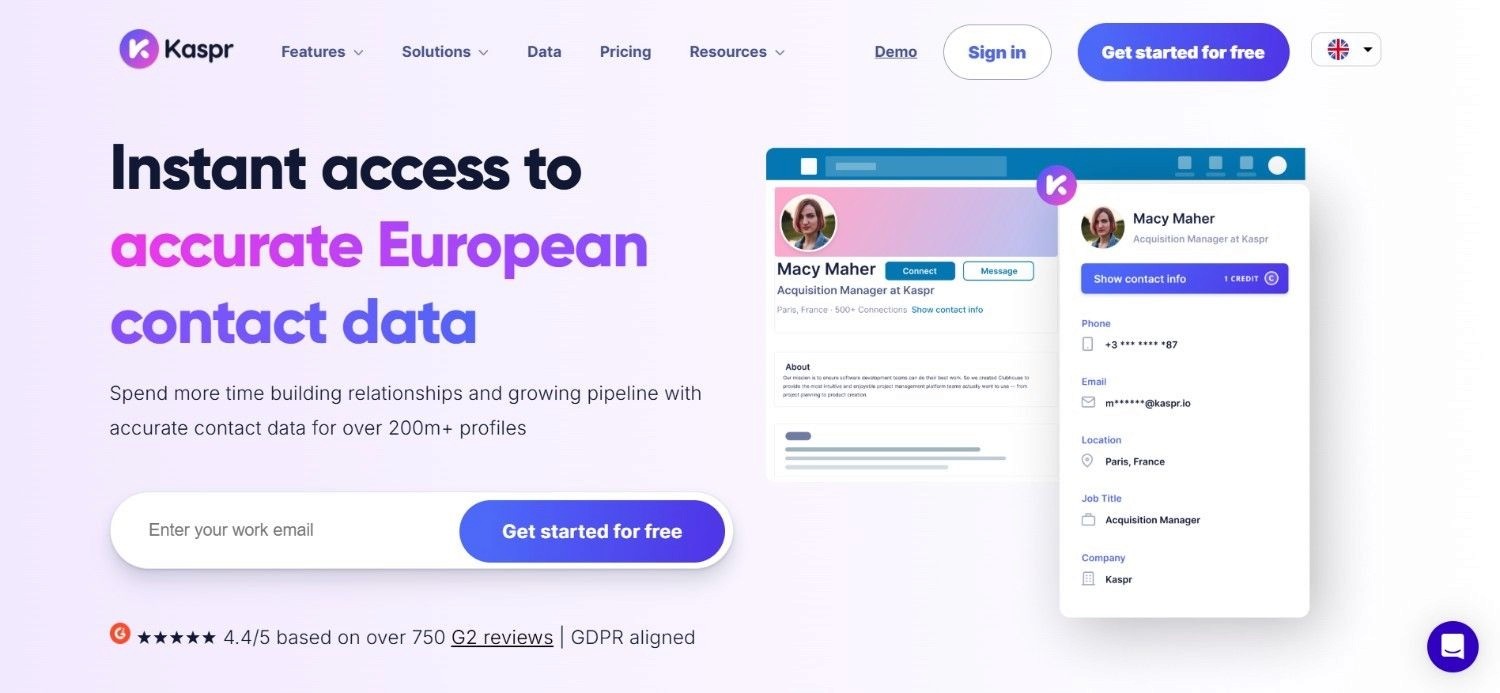
Kaspr is a browser-based enrichment tool built around finding verified emails and direct phone numbers directly from social profiles. It is popular with individual reps and small teams who need fast contact data without a heavy setup process, positioning itself as a lightweight companion tool rather than a full outreach platform.
The product's core strength is speed: install the extension, browse a profile, and pull contact details in seconds.
It also includes basic CRM sync and list export. That makes it a reasonable entry point for reps who are not yet ready to invest in a complete social media selling tools stack but still need reliable contact data today.
Ideal For
Individual reps needing quick contact enrichment during prospecting
Small teams without budget for a full outreach platform yet
Recruiters sourcing candidate and hiring manager contact details
Top Features
Browser extension for one-click contact enrichment
Direct dial and verified email database
Basic CRM sync for exporting enriched contacts
Team-based credit sharing on paid plans
Why They Stand Out
Kaspr's biggest strength is simplicity. It does one job well, enriching contact data quickly, without asking users to learn a complex platform first.
That focus makes it one of the more approachable entry points into social selling software for reps who are enriching data manually today.
Pros
Fast, low-friction enrichment directly from the browser
Free plan available for testing before committing
Simple interface with a short learning curve
Reasonable pricing for individual users and small teams
Cons
No native outreach automation, so sequencing requires a separate tool
Data coverage can be inconsistent outside major markets
Not built for teams running complex, multi-stakeholder campaigns
Limited reporting compared to full-funnel platforms
Pricing
Kaspr offers a free plan alongside a Starter tier at €59 per user monthly and a Business tier at €99 per user monthly, plus a custom Enterprise option.
Paid plans include unlimited B2B email credits with growing phone and direct email allowances at higher tiers, and annual billing brings a 25% discount.
Final Verdict
Kaspr makes sense for individual reps or small teams who need reliable contact enrichment without committing to a full platform.
Teams running structured, multichannel campaigns at scale will likely outgrow it and need to pair it with, or move to, a more complete solution.
3. Salesloft
Overview
Salesloft is an established sales engagement platform built for larger, process-driven sales organisations. It centres around cadences, structured multi-step sequences that guide reps through calls, emails and social touches, alongside conversation intelligence that records and analyses sales calls for coaching purposes.
The platform is best known in enterprise sales circles, where deep CRM integration and forecasting features matter as much as outreach automation itself. Salesloft's strength lies in giving managers visibility into rep activity and pipeline health across a large team, rather than being the lightest or fastest tool to set up.
Overall, it is a mature product built for organisations that already have defined sales processes and want software to enforce and measure them consistently.
Ideal For
Enterprise sales organisations with established, structured processes
Sales managers who need detailed activity and pipeline forecasting
Teams that already use conversation intelligence for coaching
Top Features
Structured, multi-step cadences across email and social touches
Conversation intelligence with call recording and analysis
Deep CRM integration and pipeline forecasting
Team-level analytics for coaching and performance management
Why They Stand Out
Salesloft's depth in forecasting and conversation intelligence sets it apart from lighter-weight social selling tools on this list.
It is one of the more mature options for large teams that need rigorous process enforcement alongside outreach.
Pros
Strong forecasting and pipeline visibility for sales leaders
Mature conversation intelligence and coaching features
Deep integrations with major enterprise CRMs
Proven at scale across large sales organisations
Cons
Pricing requires a custom annual contract, which can be a barrier for smaller teams
Steeper learning curve than lighter, single-purpose tools
Overkill for founder-led teams or small SDR pods
Less flexible for fast, informal social prospecting workflows
Pricing
Salesloft does not publish public pricing. It is quoted on a custom, annual contract basis, with cost depending on seat count, feature tier and integration requirements.
Final Verdict
Salesloft is a strong choice for large, enterprise sales organisations that need rigorous process enforcement and forecasting.
Smaller teams or those wanting a lighter, faster-to-launch social selling platform will likely find it more than they need.
4. Taplio

Overview
Taplio is built specifically around personal brand building through social content. Rather than focusing on outreach automation, it helps individual professionals plan, write and schedule posts, then tracks engagement so users can see what content actually resonates with their audience.
The platform includes an AI writing assistant that helps generate post ideas and drafts based on a user's niche and past top-performing content. This is useful for reps or founders who know social presence matters but do not have time to write consistently.
Taplio also surfaces analytics on follower growth and post performance, helping users refine their content strategy over time rather than posting blind.
To sum it up, they’re one of the more content-focused social media selling tools on this list.
Ideal For
Individual professionals building a personal brand for social selling
Founders who want to post consistently without a dedicated content team
Sales reps whose social presence supports, rather than replaces, outreach
Top Features
AI-assisted post writing and content ideas
Post scheduling and content calendar
Engagement and follower growth analytics
Content inspiration based on top-performing posts in a niche
Why They Stand Out
Taplio focuses on the content side of social selling rather than outreach automation, which makes it a strong complement to a prospecting-focused platform.
It fills a gap that pure outreach tools do not address.
Pros
Strong AI writing assistance for consistent posting
Useful analytics on what content actually performs
Simple, dedicated focus rather than trying to do everything
Reasonable entry pricing for individual users
Cons
No prospecting, enrichment or outreach automation features
Value depends heavily on consistent, ongoing content effort
Not built for team-wide outbound campaign management
Results take time to compound, unlike direct outreach
Pricing
Taplio offers three monthly plans: Starter at $39, Growth at $69 and Pro at $199. Annual billing reduces Growth to $49 monthly and Pro to $149 monthly, and a 7-day free Pro trial is available for testing.
Final Verdict
Taplio is a solid pick for individuals focused specifically on building a personal brand through content.
It is not a fit for teams needing prospecting or outreach automation, and works best paired with a broader social selling software stack.
5. Lemlist

Overview
Lemlist is a multichannel outreach platform built around cold email with added social and calling touchpoints layered into sequences. It is well known for personalisation features like dynamic images and video variables, along with a built-in email warm-up tool designed to protect sender deliverability.
The platform supports AI-generated icebreakers that pull context from a prospect's profile or company to personalise the opening line of an email automatically.
Lemlist also includes credit bundles for enrichment and verification, giving users a way to build and clean lists without leaving the platform entirely.
The platform sits closer to the “outreach-automation" end of the social selling tools spectrum versus data-enrichment, though it does offer some enrichment as an add-on layer.
Ideal For
Teams running cold email as the primary channel with social as a secondary touch
SDRs who want strong personalisation without manual research on every send
Teams needing built-in email warm-up to protect domain reputation
Top Features
Multichannel sequences combining email, social touches and calling tasks
AI-generated icebreakers for personalised opening lines
Built-in email warm-up and deliverability monitoring
Dynamic personalisation variables including images and video
Why They Stand Out
Lemlist's personalisation tooling, especially dynamic images and AI icebreakers, is genuinely differentiated among social media selling tools focused on cold outreach.
It gives reps a way to stand out in a crowded inbox without manually customising every message.
Pros
Strong personalisation features that go beyond text variables
Built-in warm-up protects sender reputation automatically
Flexible multichannel sequencing across several tiers
Reasonable entry pricing for smaller teams
Cons
Enrichment is more limited compared to dedicated data platforms
Higher tiers needed to unlock full multichannel capability
Can require some setup time to configure sequences well
Additional channels and phone dialing cost extra as add-ons
Pricing
Lemlist pricing is tiered per user and billed annually: Email Starter at $39, Email Pro at $69, and Multichannel Expert at $99, with a custom Enterprise tier above that.
Credit bundles are included, and additional credits, phone dialing and other channels are available as paid add-ons.
Final Verdict
Lemlist works well for teams whose outreach is primarily email-led with social as a supporting channel.
Teams needing deeper enrichment or a fully integrated prospecting layer may need to pair it with another tool.
6. HeyReach
Overview
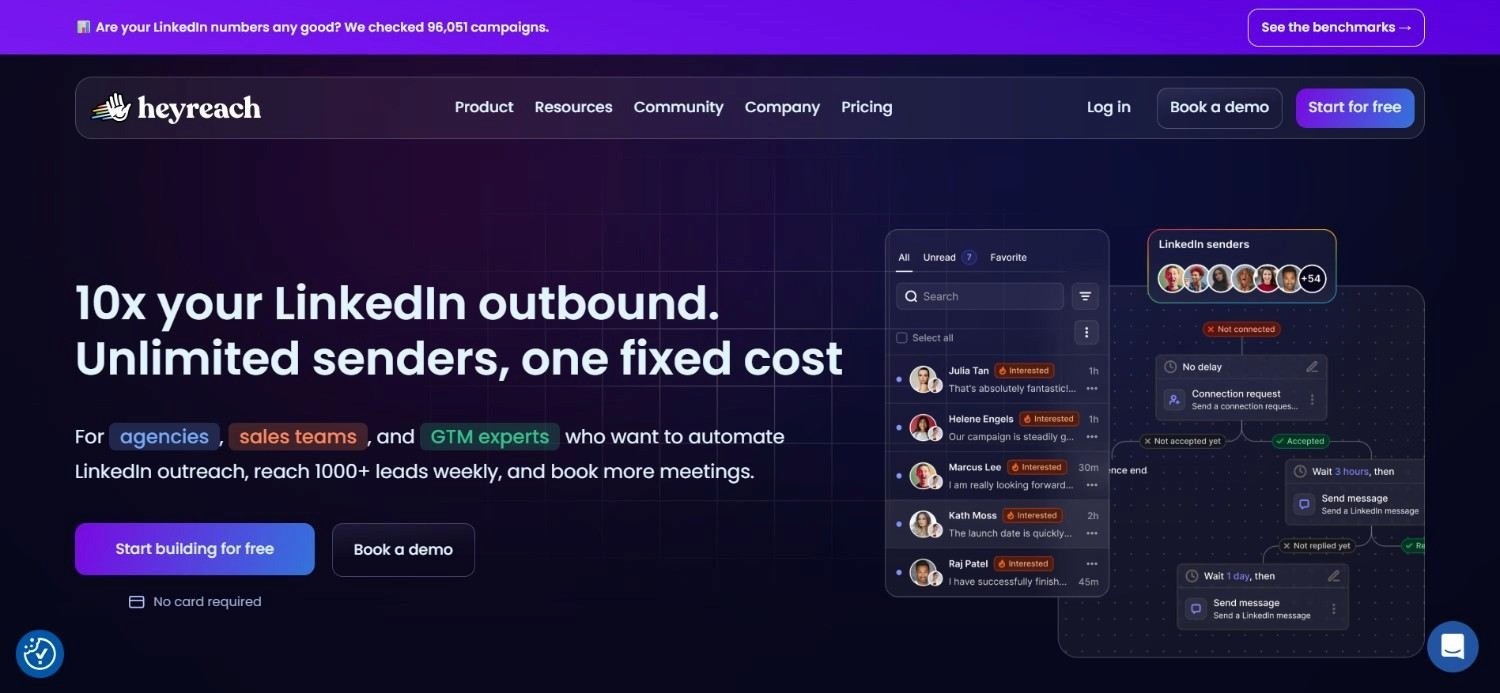
HeyReach is built for agencies and teams running social outreach at scale across multiple accounts simultaneously, positioning itself as social selling software purpose-built for agency workflows.
It supports managing several sender profiles from one dashboard. That matters for agencies juggling campaigns for multiple clients, as well as larger sales teams running outreach under several identities.
The platform includes smart sending limits designed to keep each account within safe daily activity thresholds, reducing the risk of account restrictions from aggressive automation.
HeyReach's unified inbox consolidates replies across all connected accounts into a single view, so managers do not need to check each profile separately to track conversations.
Ideal For
Agencies managing social outreach for multiple clients simultaneously
Larger sales teams running campaigns across several sender identities
Teams prioritising safe sending limits to protect account health
Top Features
Multi-account campaign management from a single dashboard
Unified inbox consolidating replies across all connected profiles
Smart, automated sending limits to protect account health
Agency-specific reporting across multiple client workspaces
Why They Stand Out
HeyReach's multi-account management is genuinely built for agency-scale operations, a use case many social selling tools treat as an afterthought.
That focus makes it a strong specialist option for teams running outreach across many identities at once.
Pros
Purpose-built for managing outreach across many accounts at once
Unified inbox saves significant time for agency account managers
Smart sending limits reduce account restriction risk
Scalable pricing tiers built around sender volume
Cons
Limited data enrichment compared to full-funnel platforms
Higher tiers get expensive quickly for large sender counts
Less useful for solo reps or very small teams
Requires existing lists rather than built-in prospect discovery
Pricing
HeyReach pricing starts at $79 monthly for the Growth plan, while Agency costs $999 monthly for 25 senders and Unlimited costs $2,999 monthly.
Quarterly and annual billing bring 10% and 20% discounts respectively, and a fully managed "Done for You" service is available at custom pricing.
Final Verdict
HeyReach is a strong specialist choice for agencies and larger teams managing outreach across many accounts.
Teams needing built-in prospecting or enrichment will need to pair it with a separate data source.
7. PhantomBuster
Overview
PhantomBuster is a workflow automation platform that lets users build custom data scraping and enrichment sequences, often described as "Phantoms." It does this without requiring any code.
It appeals to more technical users who want flexibility to automate specific, sometimes unusual, prospecting workflows. These are workflows that off-the-shelf tools do not directly support.
The platform's API access and pre-built automation templates make it popular among growth teams and agencies. These teams often build custom pipelines that connect several tools together.
PhantomBuster also covers a wide range of use cases beyond outreach, including general data scraping and enrichment. That breadth makes it more of a flexible utility than a purpose-built social selling platform.
As a result, teams often use it alongside a dedicated outreach tool, rather than as a full replacement for one.
Ideal For
Technical teams building custom, multi-step automation workflows
Agencies needing flexible data scraping beyond standard prospecting
Growth teams connecting several tools through APIs
Top Features
Pre-built automation templates ("Phantoms") for common workflows
API access for connecting to other tools and platforms
Flexible data scraping and enrichment capabilities
Scheduling for recurring automation runs
Why They Stand Out
PhantomBuster's flexibility is its defining trait among social media selling tools, letting technical users build workflows that rigid, template-based platforms cannot replicate.
That openness comes with a steeper setup curve than most tools on this list.
Pros
Highly flexible for custom automation needs
API access supports connecting to a broader tech stack
Wide range of pre-built templates to start from
Useful beyond outreach for general data tasks
Cons
Requires more technical comfort than most competitors
Not purpose-built specifically for outreach sequencing
Automation reliability depends on how workflows are configured
Learning curve is steeper than dedicated outreach platforms
Pricing
PhantomBuster offers a free trial alongside monthly plans of $69 for Start, $159 for Grow and $439 for Scale.
Annual billing reduces these to $56, $128 and $352 monthly respectively, with higher tiers unlocking more automation slots, execution time and credits.
Final Verdict
PhantomBuster is best suited to technical teams comfortable building and maintaining custom automation. Teams wanting a ready-to-use, guided outreach workflow will likely find other options on this list faster to launch.
8. Extrovert
Overview
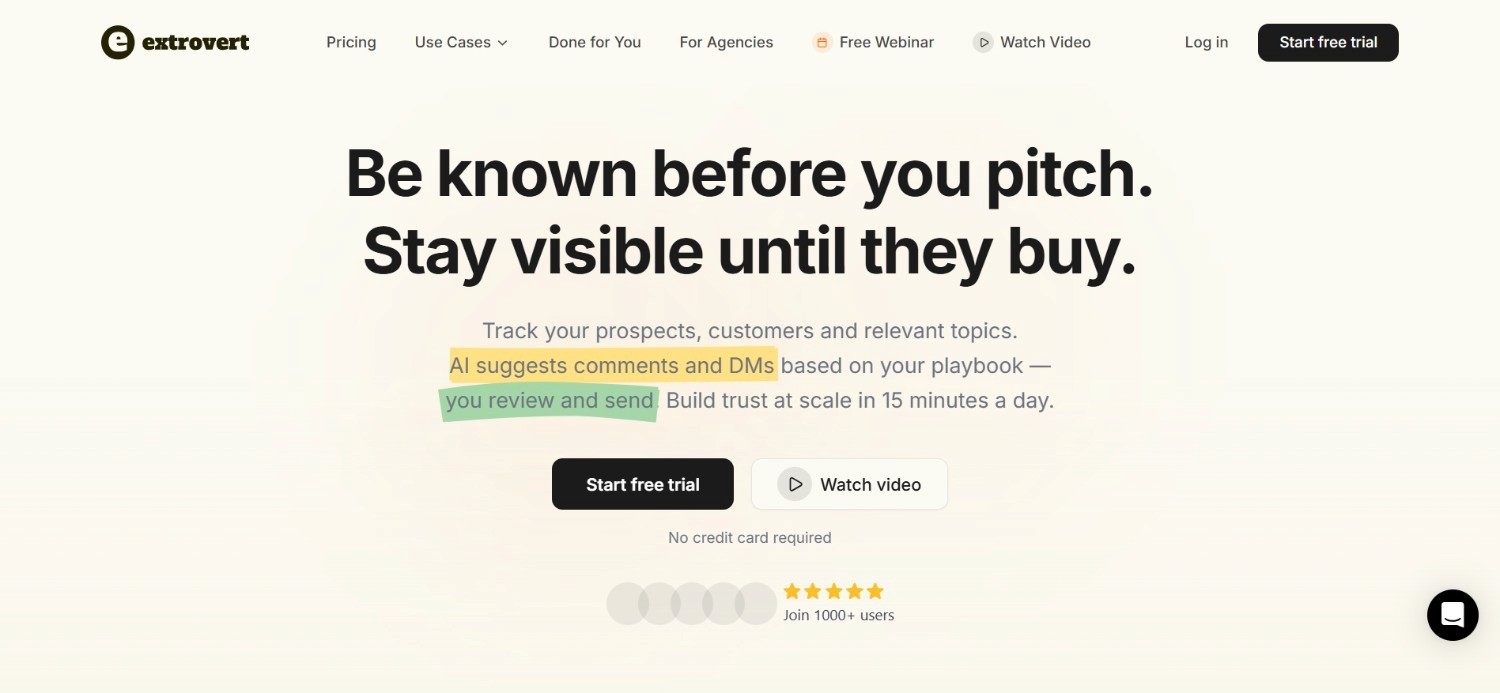
Extrovert positions itself as a guided social selling platform for small to mid-sized teams entering social prospecting for the first time. It focuses on making list building and engagement tracking approachable, without requiring users to configure complex filters or automation rules before getting value.
The platform also includes engagement tracking that shows when prospects interact with outreach, giving reps a signal for when to follow up rather than guessing based on time elapsed.
Overall, it is a reasonable entry point for teams who want structured social prospecting without the complexity of a full enterprise platform.
Ideal For
Small to mid-sized teams new to structured social prospecting
Teams wanting predictable, seat-based pricing as they grow
Reps who want engagement signals to time follow-ups better
Top Features
Guided prospect list building for social outreach
Engagement tracking to signal follow-up timing
Seat-based pricing tied to active prospect volume
Straightforward setup without heavy configuration
Why They Stand Out
Extrovert's approachable setup makes it one of the more accessible social selling tools for teams new to the category.
It trades some advanced customisation for a genuinely simpler onboarding experience.
Pros
Simple, approachable setup for first-time users
Predictable seat-based pricing model
Useful engagement tracking for follow-up timing
Reasonable entry price point for smaller teams
Cons
Fewer advanced enrichment options than data-first platforms
Prospect volume caps per tier can feel restrictive as teams scale
Limited multichannel automation compared to full-funnel tools
Less suited to complex, multi-stakeholder campaigns
Pricing
Extrovert's monthly pricing starts at $35 per seat for Light, $69 per seat for Business and $99 per seat for Pro, supporting 250, 500 and 1,000 prospects respectively.
Annual billing reduces prices to $29, $49 and $75 per seat monthly.
Final Verdict
Extrovert is a sensible starting point for smaller teams new to social prospecting who want simplicity over deep customisation.
Teams with more complex, multi-stakeholder campaigns will likely need a more full-featured platform.
9. Trigify
Overview
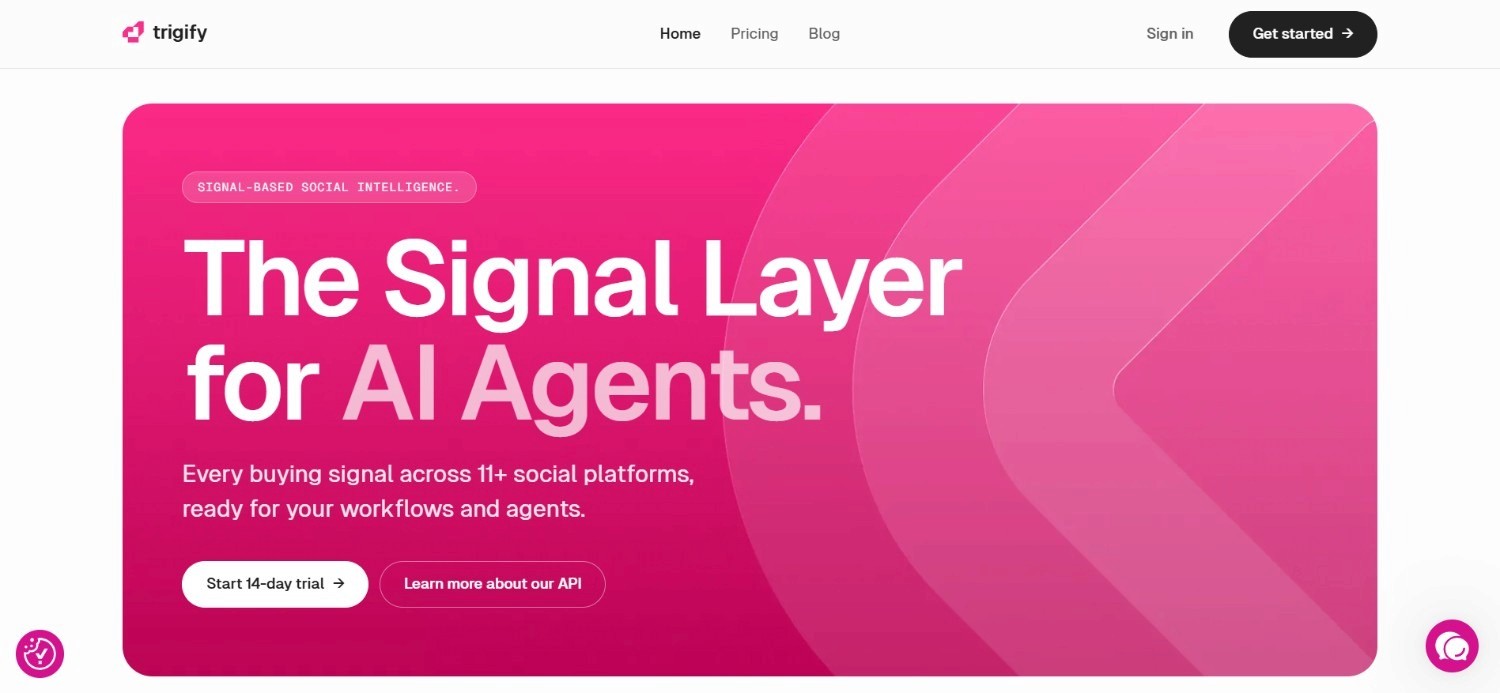
Trigify focuses specifically on surfacing buying-intent signals from social activity, tracking things like engagement with competitor content, job changes and company announcements. Rather than functioning as a full outreach platform, it acts as a signal layer that feeds other tools or workflows with timely triggers.
The platform's workflow triggers let teams automatically route a lead into a campaign or CRM the moment a relevant signal fires, reducing the lag between a buying trigger happening and a rep acting on it.
Overall, it occupies a considerable position among specialised social selling tools on this list, built for teams that already have outreach infrastructure and want a sharper intent layer feeding it.
Ideal For
Teams with existing outreach tools needing a dedicated intent signal layer
RevOps and GTM teams building automated lead-routing workflows
Sales teams wanting to act on buying triggers faster
Top Features
Real-time tracking of social engagement and buying signals
Credit-based access scaled to signal volume needs
Workflow triggers for automatic lead routing
Integration options for feeding signals into CRM or outreach tools
Why They Stand Out
Trigify's narrow focus on intent signals makes it a sharp complement to broader social selling software, rather than a competitor to full-funnel platforms.
Teams that already have outreach infrastructure but lack timely signals get the most value here.
Pros
Strong, focused intent signal detection
Credit-based pricing scales with actual usage
Useful workflow automation for lead routing
Complements existing outreach stacks well
Cons
Not a standalone outreach or enrichment platform
Requires other tools to act on the signals it surfaces
Overage costs can add up for high-signal-volume accounts
Less useful for teams without an established outbound process already
Pricing
Trigify uses credit-based pricing, with Starter at $40 monthly for 4,000 credits and Max at $199 monthly for 40,000 credits, plus custom Enterprise pricing for 200,000-plus credits.
Overages cost $0.012 per credit, and a 14-day free trial is included.
Final Verdict
Trigify is best suited to teams that already run outreach and need a dedicated layer for timely buying signals.
It is not the right fit for teams looking for an all-in-one social selling platform.
10. La Growth Machine

Overview
La Growth Machine combines social and email sequencing into a single multichannel workflow, aiming to give smaller sales teams a lighter alternative to enterprise sales engagement platforms.
The platform includes auto-import features that pull prospect lists from existing sources without heavy manual setup, along with CRM integrations that push campaign activity and replies back into a team's existing systems.
It is a reasonably balanced entry into social media selling tools for teams wanting multichannel sequencing without enterprise-level cost.
Ideal For
Small to mid-sized teams wanting multichannel sequencing without enterprise pricing
Teams needing straightforward CRM integration for campaign activity
Growing teams that want a clear upgrade path as needs increase
Top Features
Combined social and email multichannel sequencing
Auto-import for building prospect lists from existing sources
CRM integrations for syncing campaign activity and replies
Tiered enrichment and sending capacity as plans scale
Why They Stand Out
La Growth Machine's per-identity pricing model gives smaller teams a predictable way to scale multichannel outreach, positioning it between lightweight tools and full enterprise platforms among social selling tools.
Pros
Balanced multichannel functionality at a mid-range price point
Clear tier structure that scales with team growth
Useful CRM sync for keeping activity data centralised
Includes a free trial to test before committing
Cons
Enrichment depth is lighter than dedicated data platforms
Per-identity pricing can add up for larger sender counts
Less advanced intent signal detection than specialist tools
Some advanced features gated behind higher tiers
Pricing
La Growth Machine pricing starts at approximately $69 monthly per identity for Basic, $139 for Pro and $208 for Ultimate.
Each tier adds more lead enrichment, sending capacity, channels and CRM capabilities as you move up. All plans include a 14-day free trial.
Final Verdict
La Growth Machine is a solid middle-ground choice for teams that have outgrown lightweight tools but are not ready for enterprise pricing.
Teams needing deep enrichment or advanced intent data will likely need to supplement it.
How to Choose the Best Social Selling Platform (What to Consider?)
Once you've shortlisted a few options, these are the factors worth weighing carefully before you commit:
1. Data Quality and Enrichment Depth
Start by checking how a tool sources and verifies its contact data, since outreach built on outdated titles or dead emails wastes effort no matter how good your messaging is.
Ask vendors directly what percentage of their enriched contacts are verified, not just matched.
2. Intent Signal Coverage
Look for social selling software that surfaces real buying triggers, like job changes, funding rounds or technology adoption, rather than just static firmographic filters.
Signal-driven outreach consistently outperforms generic list-based campaigns because the context behind the first message is real.
3. Multichannel Automation Without Sounding Robotic
Test how a platform's sequences read from the recipient's side, not just how easy they are to build on the sender's side.
Good multichannel outreach should feel personalised at each touch, not like the same template pushed across three channels.
4. Team Size and Operational Complexity
Match the tool to how your team actually works today.
A solo founder needs something simple to set up alone, while a 30-person SDR team needs multi-identity management, reporting and CRM sync built in from day one.
5. Pricing Model and Scalability
Compare whether pricing is seat-based, credit-based or usage-based, and model out what your costs look like in six months, not just today.
A tool that looks cheap at five seats can get expensive fast once your team doubles.
6. Integration With Your Existing CRM
Confirm native integration with your CRM before committing, since manual CSV exports and imports quietly eat hours every week and introduce data errors.
The best social selling tools sync activity and replies automatically, keeping your pipeline data accurate without manual upkeep.
7. Onboarding and Support Quality
Ask what onboarding actually includes, not just whether it exists.
A platform with structured onboarding sessions gets your team to real results faster than one that hands you a login and a help centre link.
Everything You Need to Know About Social Selling Tools
Tool | Pros | Cons | Ease of Use | Integrations | Support | Affordability | AI Personalisation |
Enginy | All-in-one workflow, strong intent signals, no GTM engineer needed | No public pricing, short learning curve | ⭐⭐⭐⭐ | ⭐⭐⭐⭐⭐ | ⭐⭐⭐⭐⭐ | ⭐⭐⭐⭐ | ⭐⭐⭐⭐⭐ |
Kaspr | Fast enrichment, free plan, simple UI | No outreach automation, limited coverage | ⭐⭐⭐⭐⭐ | ⭐⭐⭐ | ⭐⭐⭐ | ⭐⭐⭐⭐ | ⭐⭐ |
Salesloft | Strong forecasting, mature coaching tools | Custom contract, steep learning curve | ⭐⭐⭐ | ⭐⭐⭐⭐⭐ | ⭐⭐⭐⭐ | ⭐⭐ | ⭐⭐⭐ |
Taplio | Strong AI writing, useful analytics | No outreach or enrichment features | ⭐⭐⭐⭐ | ⭐⭐ | ⭐⭐⭐ | ⭐⭐⭐⭐ | ⭐⭐⭐⭐ |
Lemlist | Strong personalisation, built-in warm-up | Limited enrichment, add-on costs | ⭐⭐⭐⭐ | ⭐⭐⭐⭐ | ⭐⭐⭐ | ⭐⭐⭐⭐ | ⭐⭐⭐⭐ |
HeyReach | Multi-account management, unified inbox | Limited enrichment, pricey at scale | ⭐⭐⭐⭐ | ⭐⭐⭐ | ⭐⭐⭐ | ⭐⭐⭐ | ⭐⭐⭐ |
PhantomBuster | Highly flexible, API access | Technical, steep setup curve | ⭐⭐ | ⭐⭐⭐⭐ | ⭐⭐⭐ | ⭐⭐⭐⭐ | ⭐⭐ |
Extrovert | Approachable setup, predictable pricing | Limited enrichment, volume caps | ⭐⭐⭐⭐⭐ | ⭐⭐⭐ | ⭐⭐⭐ | ⭐⭐⭐⭐⭐ | ⭐⭐⭐ |
Trigify | Strong intent detection, scalable credits | Not standalone, needs other tools | ⭐⭐⭐⭐ | ⭐⭐⭐ | ⭐⭐⭐ | ⭐⭐⭐⭐ | ⭐⭐⭐ |
La Growth Machine | Balanced features, clear tier structure | Lighter enrichment, per-identity costs | ⭐⭐⭐⭐ | ⭐⭐⭐⭐ | ⭐⭐⭐ | ⭐⭐⭐⭐ | ⭐⭐⭐ |
Simplify Your Social Selling With Enginy
Most teams evaluating social selling tools end up choosing between a data provider and an outreach tool, then spending months trying to make the two talk to each other.
We built Enginy so that trade-off does not exist: prospecting, enrichment and multichannel outreach run from the same workspace, powered by real intent signals instead of static lists.
If your current stack is forcing your reps to spend more time on manual research than actual selling, that is exactly the gap we designed Enginy to close.
Book a demo with our team to see how a connected social selling platform could change your pipeline math.
FAQs About Social Selling Tools
What is the best social selling tool in 2026?
The best social selling tool in 2026 is Enginy, since it combines prospecting, enrichment and outreach automation in one platform. Instead of juggling separate data and outreach subscriptions, teams get intent signals, list building and multichannel sequencing from a single workspace.
What should I consider when choosing the right social selling software for me?
Choosing the right social selling software starts with matching the tool to your team's size and process maturity, not just its feature list. Data quality and intent signal coverage matter more than raw contact volume. Pricing model matters too, since seat-based, credit-based and usage-based tools scale differently. Confirm native CRM integration exists, since manual data transfer costs hours every week.
How does Enginy differ from similar alternatives?
Enginy differs from most alternatives by combining prospect discovery, data enrichment and multichannel outreach in one connected platform, instead of requiring separate tools for each function. Many competitors focus only on data or only on outreach sequencing. Our platform also layers in intent signals like job changes and funding rounds, reducing tool sprawl for growing sales teams.
How do I get started with Enginy?
Getting started with Enginy begins with a qualification call, where we scope your team's data and outreach needs before recommending a plan. From there, our team runs five structured onboarding sessions covering CRM setup, list building and campaign configuration. Most teams see their first campaigns live within a couple of weeks.
How easy is it to switch to Enginy?
Switching to Enginy is straightforward, since our onboarding process is built to move existing lists, CRM data and outreach workflows into the platform without starting from scratch. Our team handles CRM integration setup, mapping existing properties so historical data stays intact. The five included onboarding sessions reduce switching friction for teams coming from another social selling platform.
Is it worth paying for a full platform instead of using free social prospecting methods?
Paying for a dedicated platform is worth it once manual prospecting starts costing more in rep time than a subscription would cost outright. Free methods, like manually searching social profiles, work at low volume but do not scale past a handful of prospects a day. Most teams reach that break-even point within the first month.
Do social selling tools actually improve reply rates compared to cold email alone?
Yes, social selling tools that incorporate intent signals and multichannel touches generally produce higher reply rates than cold email sent in isolation. Layering a social touch alongside email gives prospects more than one channel to respond through. Personalisation backed by real signals, rather than generic templates, is the bigger driver of that improvement.