Best B2B Data List Providers in 2026 (Compared & Reviewed)

Andrea López
Condividi
Buying B2B data is easy. Buying B2B data your reps can actually call is the hard part, because most databases quote a headline record count and stay quiet about how much of it is verified, how fast it goes stale, and what you still have to build around it.
This guide reviews ten B2B data list providers, compares coverage, accuracy, compliance, and pricing, and shows you how to test a database before you sign anything.
Key Takeaways (TL;DR)
The Best Overall B2B Data List Provider: Enginy pulls contact data from 30+ enrichment providers in one waterfall, then runs the outreach off the same record, so the list you buy is the list your reps work that week. It's built to be run by a sales rep rather than a dedicated data engineer.
Why You Need It: Bought lists decay from the day they're exported, and a database alone still leaves you stitching together enrichment, cleaning, and outreach across three or four tools.
Who It's For: B2B sales teams with an outbound motion, from founder-led SMBs to mid-market companies running structured SDR and AE functions across the UK and Europe.
How to Choose the Right One: Judge providers by field-level accuracy rather than headline database size, by how often records are re-verified, and by whether the data can be actioned without buying a second tool.
Price Range: Enginy is priced per quote on a credit model, with credits consumed by data extraction, email and phone enrichment, and AI research. Across the wider market, published self-serve plans start around $99 a month, while enterprise contracts from the largest business data providers commonly run into five figures a year.
Top B2B Data List Providers in 2026 at a Glance
Company | Best For | Key Strengths | Pricing |
Enginy | Sales teams that want data and outreach in one place | Waterfall enrichment across 30+ providers, intent signals, multi-channel campaigns, CRM sync | Custom quote, credit-based across four tiers |
ZoomInfo | Enterprise teams selling into the United States | Deep US firmographics, org charts, intent, conversation intelligence | Annual contract, custom quote |
Apollo.io | Small teams that need volume at a low entry price | Large self-serve database, built-in sequences, generous free tier | Free tier plus published per-user monthly plans |
Cognism | Outbound teams selling into the UK and Europe | Phone-verified mobiles, GDPR-first sourcing, do-not-call screening | Annual platform fee, custom quote |
Clay | Technical RevOps teams building custom enrichment | Waterfall across 100+ sources, flexible tables, AI research columns | Free tier, published plans from $167 a month |
Lusha | Individual reps doing fast one-off lookups | Browser extension, quick reveals, simple interface | Free tier plus per-user monthly plans |
Seamless.AI | High-volume United States list building | Real-time search across the open web, one of the largest claimed record counts | Free credits, then annual quote |
UpLead | Smaller teams that want verified records only | Verification at the point of download, transparent published pricing | Free trial, Essentials from $99 a month |
LeadIQ | Reps capturing prospects into the CRM as they work | One-click capture, CRM write-back, social prospecting workflow | Free tier, Pro from $200 a month |
People Data Labs | Engineering teams building their own data product | Person and company APIs, bulk datasets, flexible licensing | Free lookups, then usage-based API plans |
What Are B2B Data List Providers?
B2B data list providers are companies that collect, verify, and sell information about businesses and the people who work in them, so sales and marketing teams can build a targeted list without researching every account by hand.
A single record usually holds a name, a job title, a company, an industry, a headcount band, a work email, and sometimes a direct dial or mobile number. Some buyers search for a list broker and others for a B2B data platform, but the job is the same, which is knowing who to contact and how to reach them.
Most B2B data sources fall into four groups, and good targeting layers them rather than choosing between them.
Contact data: the person's name, role, seniority, email, and phone number, which is what makes an account reachable at all.
Firmographic data: the company's industry, headcount, revenue band, location, and structure, which decides whether the account fits your ideal customer profile.
Technographic data: the software an account already runs, which tells you whether they've bought in your category before and who you're displacing.
Intent data: hiring patterns, funding events, job changes, event attendance, and content engagement, which tell you when an account moved from a fit to a live opportunity.
How a B2B Data List Is Actually Built
Understanding the assembly line matters, because it explains where quality is won and lost. Providers ingest from public company registries, job boards, funding databases, professional social profiles, website scrapes, and contributory networks where users share their own contact books in exchange for credits.
Those raw records are then matched and deduplicated, so three sightings of the same person at the same company collapse into a single row. Almost all of the data lists B2B teams buy are assembled this way, whatever the marketing says.
B2B email data is either verified by an SMTP check or guessed from a company's naming pattern, which is why some databases return an address for almost every contact while a much smaller share of those addresses actually deliver. Every data lead that arrives with a guessed address is a bounce waiting to happen.
Everything after the raw capture is data enrichment, and it's where one provider's file starts to differ from another's. Phone numbers follow a separate path. Mobiles rarely appear in public sources, so they come from contributory networks or manual research teams, which is why they cost more credits and why phone coverage varies so sharply between B2B data suppliers.
The last step is refresh. A record is a snapshot of a person on the day it was captured, and every provider re-verifies on its own cadence. That cadence, not the size of the database, is the single biggest driver of how many of your emails land next quarter.
Why Do You Need High-Quality B2B Data?
Because the alternative is paying reps to research instead of sell. Weak B2B sales data doesn't announce itself; it shows up as a quiet tax on every hour the team works. Salesforce found that reps spend just 28% of their week actually selling, with the rest lost to deal management, admin, and data entry. Every hour spent hunting for a mobile number is an hour that never reaches a conversation.
The second problem is decay. HubSpot's database decay research puts B2B data decay at 2.1% per month, an annualised rate of 22.5%. A list you bought in January is materially wrong by December, and nobody sends you a notification when a contact changes job.
That decay lands twice. Bad addresses bounce, bounces damage your sending domain, and a damaged domain suppresses the messages that would have reached the contacts who are still valid. One stale file quietly reduces the performance of every campaign that follows it, which is why email deliverability is a data problem before it's a copy problem.
None of this makes bought data a bad idea. It makes it a decision with conditions attached, which is why it's worth knowing where to buy lists and what each source is good for before money changes hands.
There's a compliance cost too. In December 2024 France's regulator fined a contact-data vendor €240,000 for collecting details that people had chosen to hide, and ordered it to delete the records. If you buy B2B data, the lawful basis for holding and using it is yours to defend, not only your vendor's.
Get the data layer right and the numbers move in the other direction. Enginy customer Factorial replaced manual sourcing with automated lists and went from one person producing around ten leads a day to 5,000 leads a month, with reply rates rising from 10% to 45% and conversion doubling from 4% to 8%. The change wasn't more effort. It was better inputs.
Who Needs B2B Data Lists?
Every outbound team buys data, but the test each one applies is different. The five profiles below feel the problem most directly.
Heads of Sales and VPs of Sales
Sales leaders own the number and inherit the consequences of a weak database, which show up as flat pipeline, inconsistent reply rates, and reps who miss quota while looking busy. They rarely care which vendor holds the biggest record count.
What they want is predictable pipeline without another headcount request, so they judge B2B data solutions on cost per booked meeting rather than cost per credit.
Sales Operations and RevOps Teams
RevOps owns the plumbing, which means list building, deduplication, enrichment, CRM hygiene, and routing. They're usually the ones already paying for a database, a cleaner, and an outreach tool that don't share a schema.
They evaluate a B2B contact database provider on match rates, API depth, integration quality, and how much of the workflow disappears once it's connected.
Founders and CEOs at SMBs
Founders selling their own product don't have a data engineer to configure a waterfall. They need a B2B prospect database that produces a usable list the same day and doesn't require a specialist to operate.
Speed matters more than configurability here, especially when testing a new market where the whole point is to find out quickly whether the segment responds.
Sales Managers Running SDR Teams
Managers with three to ten SDRs live with the daily cost of bad records, from wrong numbers and gatekeepers to reps losing the first ten seconds of a call to a mistaken job title. Their concern is consistency across the team.
They want B2B contact lists that arrive clean and pre-assigned, so a new SDR spends their morning calling rather than assembling a portfolio.
Agencies and Recruitment Firms
Agencies and staffing firms build lists for other people, often across several clients and markets at once. Volume is high, targeting changes weekly, and margin depends on how little manual work each list takes.
For them, the deciding factor is whether one tool can hold separate workspaces, refresh recurring lists automatically, and keep each client's outreach and suppression rules apart.
Best B2B Data List Providers: In-Depth Review and Comparison
Rankings of the best B2B data providers rarely agree, because the honest answer changes with your market and your motion. The ten providers below split into three groups. Some sell you a database, some sell you the pipes to assemble one, and a few also run the outreach that turns records into meetings. We start with the one built for the last job.
1. Enginy
Overview
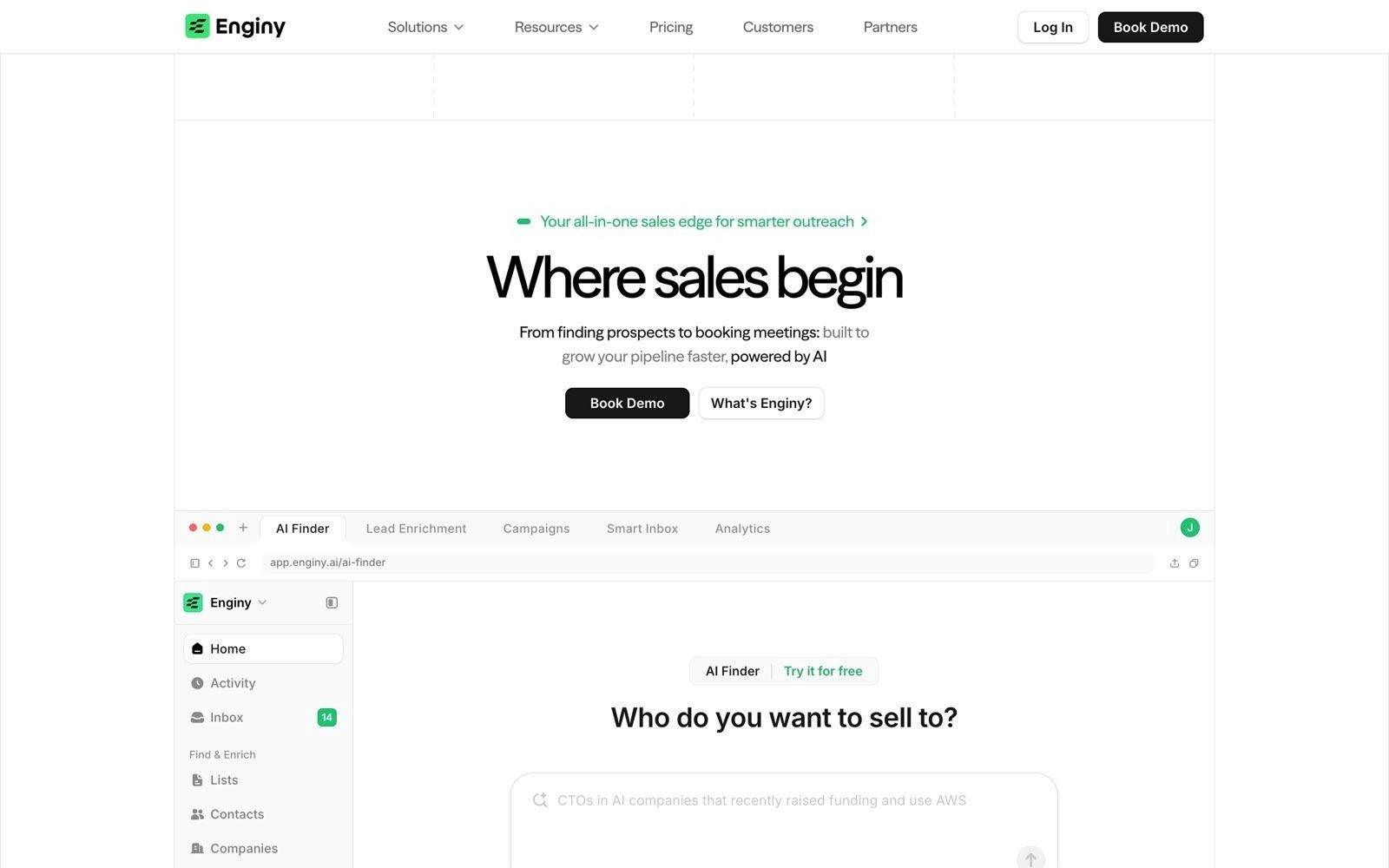
Enginy is an AI-native B2B sales tool that covers prospect discovery, data enrichment, and multi-channel outreach in one place. Rather than selling access to a single static database, it aggregates contact data from 30+ enrichment providers in real time and applies waterfall logic, so each field is filled by whichever source actually holds it.
The problem it targets is tool sprawl. Most teams buy a database, then an outreach tool, then something to clean the exports between them, and lose reps' hours to the joins.
Enginy runs the full sequence of scrape, clean, enrich, clean, import, and assign inside one workflow, and syncs the result into HubSpot, Salesforce, Pipedrive, Dynamics 365, Zoho, or Attio.
Lists can be built from firmographic filters, boolean searches on job titles, past employers, technology stack, hiring activity, funding events, event attendance, or engagement with a specific social post, then refreshed on a recurring schedule so they don't quietly rot.
Ideal For
B2B sales teams that want their data and their outreach on the same record
Sales leaders replacing a stack of separate data, cleaning, and sequencing tools
Founders and SMB teams without a GTM engineer to operate a data workflow
Agencies and recruitment firms managing prospecting across several clients
Companies opening a new market who need lists and campaigns live in days
Why Do We Stand Out?
Two things separate Enginy from a conventional data provider company.
Data and activation on one record: buying a list is only half the job, and most providers hand you a CSV at the point where the real work starts. Enginy carries the same enriched record into email, social, and calling sequences, so nothing is re-keyed and no context is lost between the database and the first touch.
Complete without being technical: the tools that combine depth with flexibility usually assume a dedicated operator. Enginy is built so an SDR can construct, enrich, and launch a list without writing a formula, which is what makes the coverage usable rather than theoretical.
Layered on top is intent. Job changes, recent hires, funding rounds, hiring signals, and technology adoption are available as filters rather than as an upsell, so a list can be defined by timing as well as fit. That matters because a perfect-fit account with no trigger is a much colder call than an average-fit account that has recently hired for the role your product supports.
Pros
Waterfall enrichment across 30+ providers, which fills fields a single database would leave blank
Verified professional emails and direct phone numbers on the same record, with cleaning before and after enrichment
Intent filters covering job changes, funding, hiring, technology stack, and social engagement
Multi-channel campaigns across email, social, and calling tasks, with AI reply handling
Native sync with the major CRMs, so lists arrive assigned rather than as an export
Cons
Pricing is quoted after a qualification call rather than published, which slows a purely self-serve evaluation
Teams that only want a raw data feed for their own systems will pay for outreach features they won't use
Engineering teams who want a pure API to build their own product are better served elsewhere
Pricing
Enginy uses a credit-based model, with credits consumed by company and contact extraction, email and phone enrichment, verification, technology and job-posting data, and AI research fields. Plans differ by monthly credits, contact volume, sender identities, and included onboarding, and every plan is quoted after a short qualification call, so seats, credit volume, and phone data are matched to what you'll actually use.
Final Verdict
Enginy is the strongest pick for B2B sales teams whose real problem isn't finding a database but turning one into booked meetings without a specialist operating the machinery.
It combines the multi-source coverage you'd normally assemble in an orchestration tool with the campaign layer you'd normally buy separately, and it's designed to be run by the people doing the selling.
2. ZoomInfo
Overview
ZoomInfo is the best-known name in B2B data and the default reference point for enterprise buyers.
It sells a large United States contact and company database alongside org charts, intent topics, website visitor identification, and conversation intelligence.
It targets large sales and marketing organisations that need account hierarchies, territory planning, and reporting depth, and it's usually bought centrally rather than by individual reps.
Ideal For
Enterprise sales organisations selling primarily into the United States
Marketing teams running account-based programmes at scale
RevOps teams that need org charts and account hierarchy data
Companies that want intent topics and visitor identification from one vendor
Why Do They Stand Out?
ZoomInfo is one of the strongest choices for United States coverage depth. Its firmographic detail, org-chart mapping, and account hierarchies are more complete than most competitors can manage, and the surrounding features, from intent topics to conversation intelligence, mean large teams can consolidate several purchases into one contract.
Pros
Extensive United States contact and company coverage
Org charts and account hierarchy data that few rivals match
Intent topics and website visitor identification included in higher tiers
Deep integrations with major CRMs and marketing automation tools
Mature reporting and administration for large teams
Cons
Pricing sits well above most alternatives and is quoted annually
Coverage and accuracy weaken outside North America
Contracts are typically annual with firm renewal terms, which users regularly flag in reviews
The feature surface is more than most small teams will use
Outreach execution still needs a separate sales engagement tool
Pricing
ZoomInfo doesn't publish rates. Contracts are annual, quoted by seat count and credit volume, with data, intent, and conversation intelligence sold as separate modules, and entry commitments commonly land in the five figures per year.
Final Verdict
ZoomInfo is recommended for enterprise teams whose primary market is the United States and who need org charts, hierarchy data, and intent under one contract.
It's a poor fit for smaller teams, for anyone whose pipeline is mostly European, and for buyers who want month-to-month flexibility, which rules it out for the majority of SMB and mid-market users.
3. Apollo.io
Overview
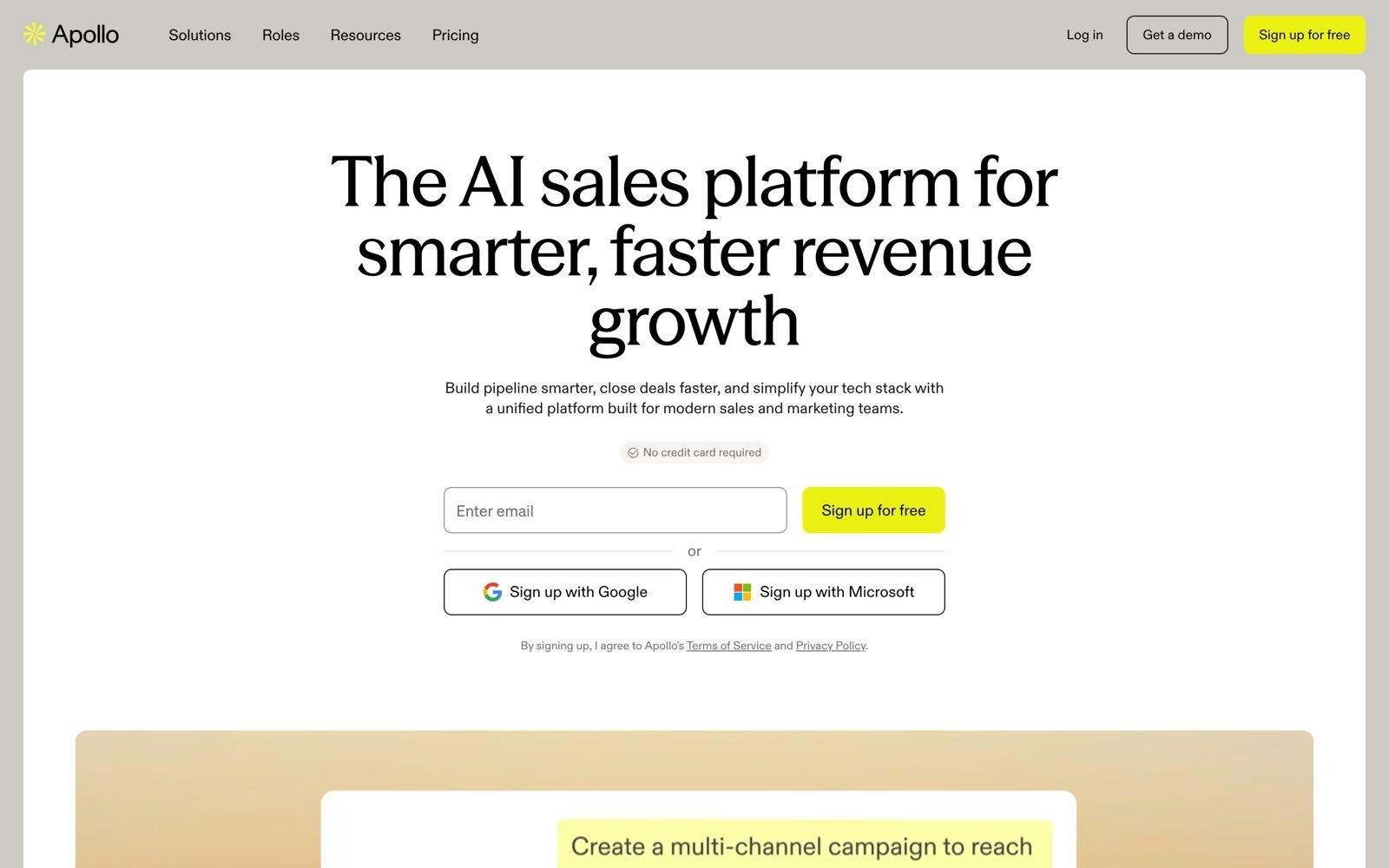
Apollo.io is the price-performance benchmark in the category and the tool most teams try first. It pairs a large self-serve contact database with built-in email sequencing, a dialler, and basic CRM functionality, all available on a free tier.
It's positioned at startups and small sales teams who want to prospect and send from one login without an enterprise contract, and it's the reason so many buyers arrive at a demo with a fixed idea of what B2B data should cost.
Ideal For
Startups and small teams running their first outbound motion
Reps who want search and sequencing in one low-cost tool
Teams selling primarily into the United States
Buyers who need to start today without procurement
Why Do They Stand Out?
Apollo is one of the smartest choices for teams that need the lowest entry price. A usable free tier, published per-user plans, and a single interface for finding and emailing prospects remove almost every barrier to starting, and its scale means most common ICPs are covered to some degree.
Pros
Free tier and low published per-user pricing
Search, sequencing, and dialling in a single tool
Large contact database with broad coverage of common segments
Fast self-serve setup with no sales process
Chrome extension and CRM integrations included on paid plans
Cons
The verified share of the database is far smaller than the headline record count
Users regularly report high bounce rates on bulk exports, which harms domain reputation
Accuracy drops noticeably outside the United States
Intent and signal coverage is thin compared with specialist providers
Credit overages and enforcement of usage limits are a common complaint
Pricing
Apollo publishes a free tier with a monthly credit allowance and several paid per-user plans billed monthly or annually, with additional credits sold on top. It remains one of the lowest published entry points among business data providers, which is exactly its appeal.
Final Verdict
Apollo is recommended for early-stage teams testing outbound in the United States where budget matters more than precision.
It's less suitable for European-focused teams, for anyone sending at volume who can't afford bounce-driven domain damage, or for teams that need real intent data, which is why many buyers outgrow it within a year.
4. Cognism

Overview
Cognism is the European specialist, built around phone-verified mobile numbers and a compliance-first approach to sourcing. It focuses on markets where GDPR makes casual data collection risky and where United States-centric databases run thin.
It targets outbound teams whose pipeline depends on connecting by phone in the UK, DACH, and wider EMEA, and it screens against do-not-call registers across several countries.
Ideal For
Outbound teams selling into the UK, Germany, and wider Europe
Sales teams whose primary channel is the phone
Companies with strict GDPR and procurement requirements
Enterprise buyers who need documented data provenance
Why Do They Stand Out?
Cognism is one of the strongest choices for European phone coverage. Its manually verified mobile numbers connect at materially higher rates than crowd-sourced alternatives, and its notification and do-not-call screening give legal and compliance teams something concrete to sign off.
Pros
Manually verified mobile numbers with strong connect rates
Deep European coverage where United States-first databases thin out
GDPR-first sourcing with do-not-call screening across several countries
Unrestricted-view data access on most plans rather than per-record credits
Clean integrations with major CRMs and sales engagement tools
Cons
Pricing is enterprise-level and quoted annually with a platform fee
United States depth doesn't match the largest domestic databases
Verified mobile coverage is strong but sits on a smaller base than headline contact counts
Intent is a paid add-on rather than a native layer
No native multi-channel outreach, so a separate engagement tool is still required
Pricing
Cognism quotes annually, typically as a platform fee plus per-seat licences, with premium verified mobile data and third-party intent sold as add-ons. Nothing is published, and entry commitments generally sit in the five figures per year.
Final Verdict
Cognism is recommended for European outbound teams that live on the phone and need defensible compliance documentation.
It's harder to justify for United States-only teams, for smaller companies that can't clear a five-figure annual commitment, or for anyone expecting outreach in the same tool, which leaves a portion of the market better served elsewhere.
5. Clay
Overview
Clay isn't a database. It's an orchestration layer that sits on top of one hundred or more B2B data sources, queries them in a defined sequence, and lets you build enrichment and research columns in a spreadsheet-style interface.
It's aimed squarely at technical RevOps and growth teams who want to control exactly which provider answers which field, and it's become the reference tool for anyone building a custom waterfall data enrichment workflow.
Ideal For
RevOps and GTM engineering teams with in-house technical skill
Growth teams building bespoke research and scoring workflows
Agencies constructing custom data products for clients
Teams that already own their outreach tooling and only need better inputs
Why Do They Stand Out?
Clay is one of the smartest choices for teams that want full control of their enrichment logic. Chaining many providers behind a single lookup lifts match rates well above any single source, and AI research columns can answer questions no static database holds, such as whether a company mentions a specific problem on its own website.
Pros
Waterfall enrichment across more than one hundred integrated sources
AI research columns for questions structured databases can't answer
Flexible table interface with strong CRM sync on higher plans
Pay only for the sources you actually query
Large template library and an active practitioner community
Cons
Requires genuine technical skill, and teams without it often stall after onboarding
Credit and action accounting is complex, and real spend frequently exceeds the plan estimate
CRM auto-sync sits on a higher tier than most small teams expect
No native outreach, so campaigns still run elsewhere
Total cost of ownership rises quickly once you add the operator's time
Pricing
Clay publishes a free tier plus paid plans, with Launch starting at $167 a month and Growth at $446 a month, sold as monthly action allowances. Data credits are billed separately from around $0.05 each, and heavier enrichment or AI usage pushes real spend above the headline plan price.
Final Verdict
Clay is recommended for technical teams who want to design their own enrichment logic and have someone to own it.
It's not the right call for sales teams without a dedicated operator, for anyone who needs outreach in the same tool, or for buyers who need predictable monthly costs, which is a large share of the mid-market.
6. Lusha
Overview
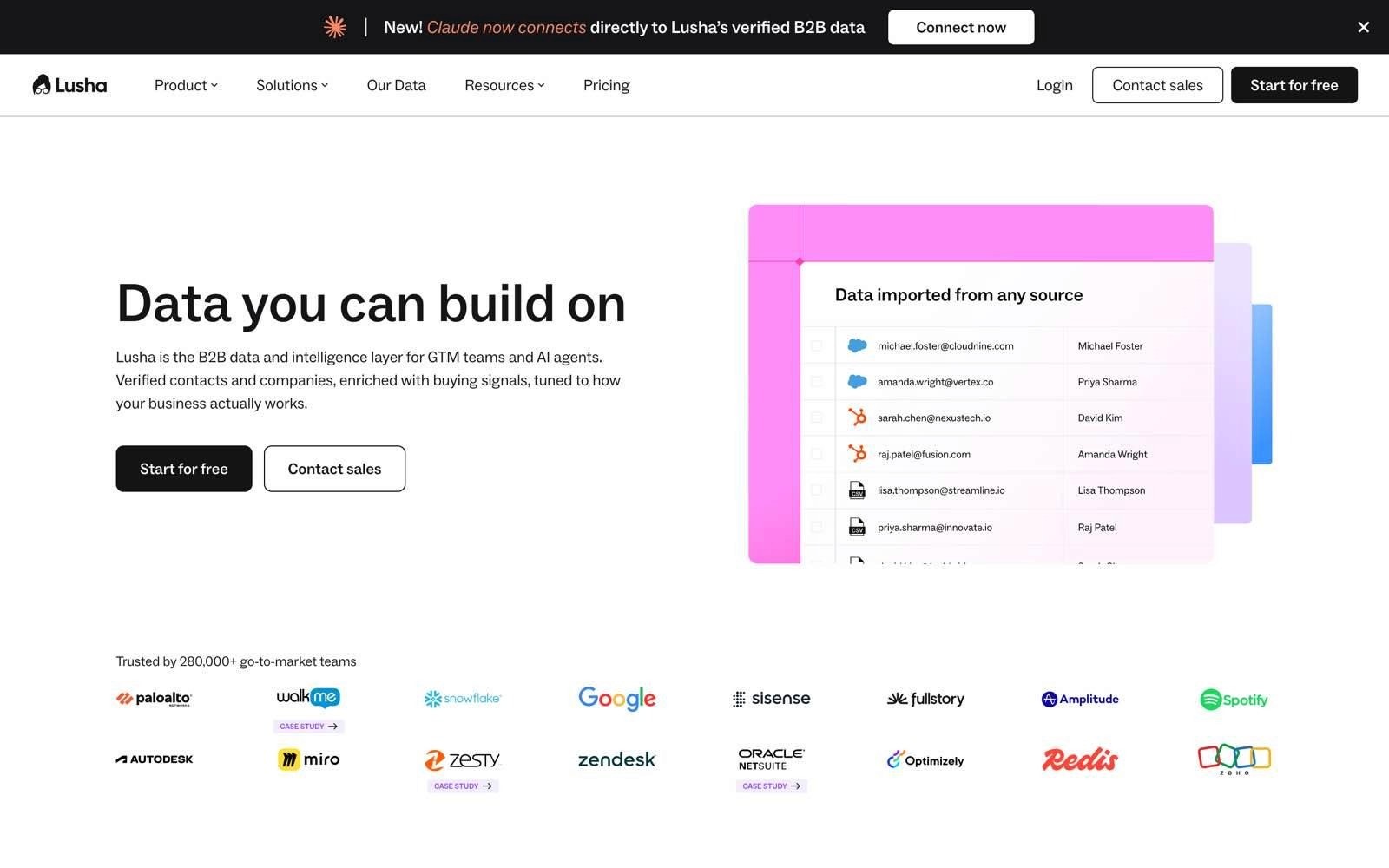
Lusha is a self-serve contact data tool built around speed. Its browser extension reveals emails and phone numbers on a profile in a click, and the web app supports basic prospecting searches and list exports.
It's positioned at individual reps and small teams who want quick answers rather than a managed database, and its low entry price and free tier make it a common first purchase.
Ideal For
Individual sales reps doing ad-hoc prospect lookups
Small teams that need contact details rather than a full database
Recruiters sourcing candidates one profile at a time
Anyone testing a segment before committing to a larger contract
Why Do They Stand Out?
Lusha is one of the strongest choices for speed of individual lookups. The extension is genuinely quick, the interface needs no training, and a rep can go from a profile to a phone number in seconds without leaving the page they're on.
Pros
Fast browser extension that needs no training
Free tier and low-cost per-user plans
Reasonable email accuracy for North American contacts
Simple CRM integrations for pushing single contacts across
No implementation project required
Cons
Weak at bulk enrichment compared with database-first providers
Phone reveals consume several credits each, so costs climb fast
Limited firmographic depth and minimal intent data
Coverage thins outside North America and Western Europe
Not designed to be the system of record for a whole team's data
Pricing
Lusha offers a free tier with a small monthly credit allowance and published per-user plans billed monthly or annually, with a custom tier for larger teams. Credits are consumed per reveal, and phone numbers cost considerably more than emails.
Final Verdict
Lusha is recommended for individual reps and recruiters who need fast one-off contact data and nothing more.
It's a poor fit as a team-wide database, for high-volume list building, or for anyone who needs firmographic and intent depth, which is why most growing teams treat it as a supplement rather than a source.
7. Seamless.AI
Overview
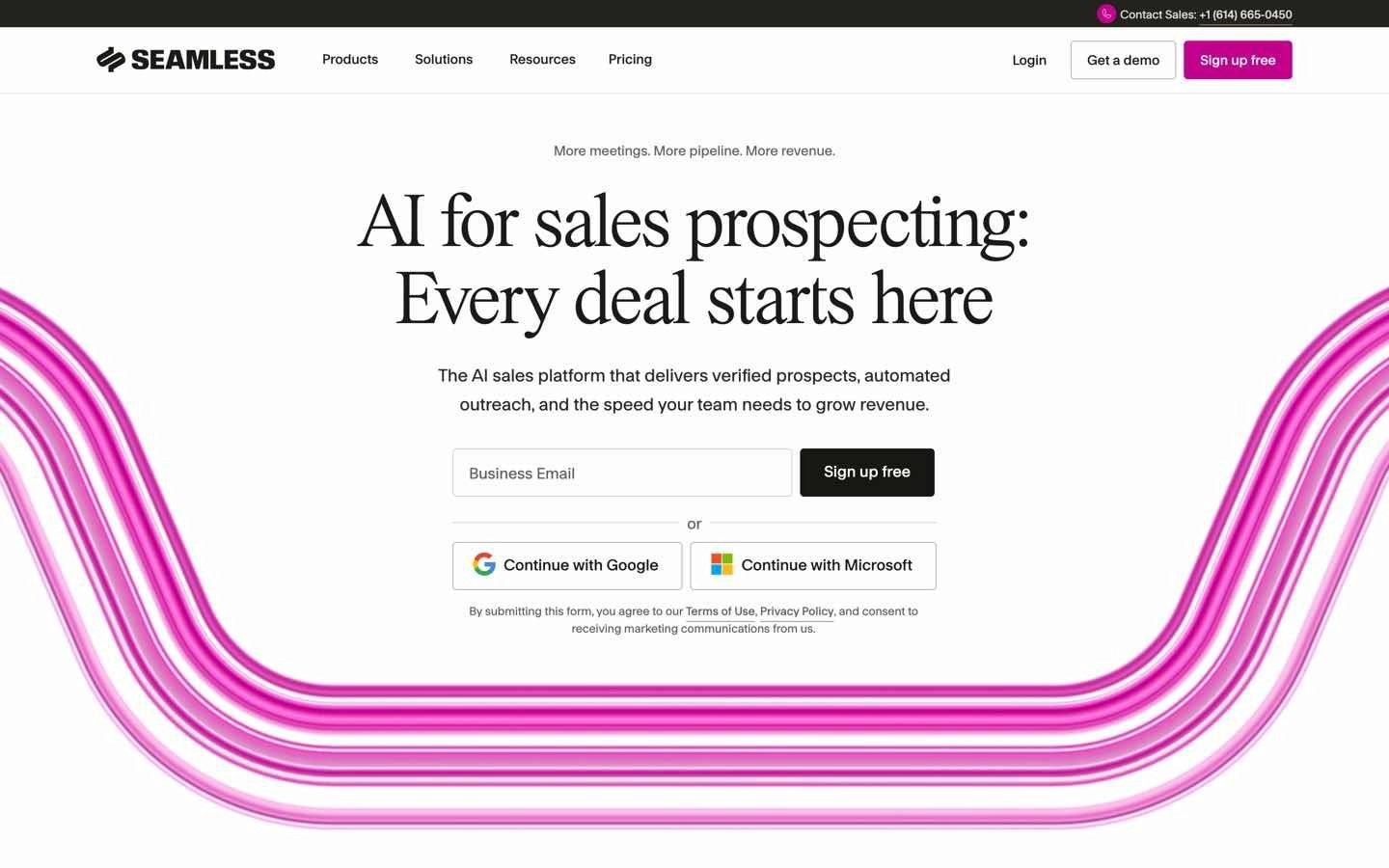
Seamless.AI takes a different approach to most B2B data suppliers. Instead of serving a pre-indexed database, it runs a real-time search across public web sources when you query, then assembles a contact record from what it finds.
It targets high-volume United States prospecting teams who value breadth and immediacy, and it markets one of the largest claimed record counts in the category.
Ideal For
High-volume outbound teams focused on the United States
Teams prospecting into long-tail segments that static databases miss
Users who want a browser extension alongside a web app
Organisations that prospect into SMB and local businesses
Why Do They Stand Out?
Seamless.AI is one of the smarter choices for reach into segments the large curated databases skip. Because records are assembled at query time, it often returns something for niche or small companies where a pre-indexed database returns nothing at all.
Pros
Large claimed coverage, including long-tail and SMB accounts
Real-time assembly finds contacts that static databases miss
Browser extension and integrations with common CRMs
Free credits available to test before committing
Useful for United States territories with fragmented account data
Cons
Users frequently report bounce rates well above the category norm
Records assembled at query time are less consistently verified
Contracts are typically annual and renewal terms draw regular complaints
Coverage outside the United States is limited
Support and billing experiences are a recurring theme in negative reviews
Pricing
Seamless.AI publishes a free plan with a small lifetime credit allowance, then moves to quoted annual contracts by seat and credit volume. Additional credit packs are sold on top, and published detail beyond the free tier is limited.
Final Verdict
Seamless.AI is recommended for United States teams running high volume where breadth matters more than precision and where a verification step already exists in the workflow.
It's not suitable for European pipelines, for teams without their own email verification layer, or for buyers who need flexible contract terms, which excludes most careful buyers.
8. UpLead
Overview
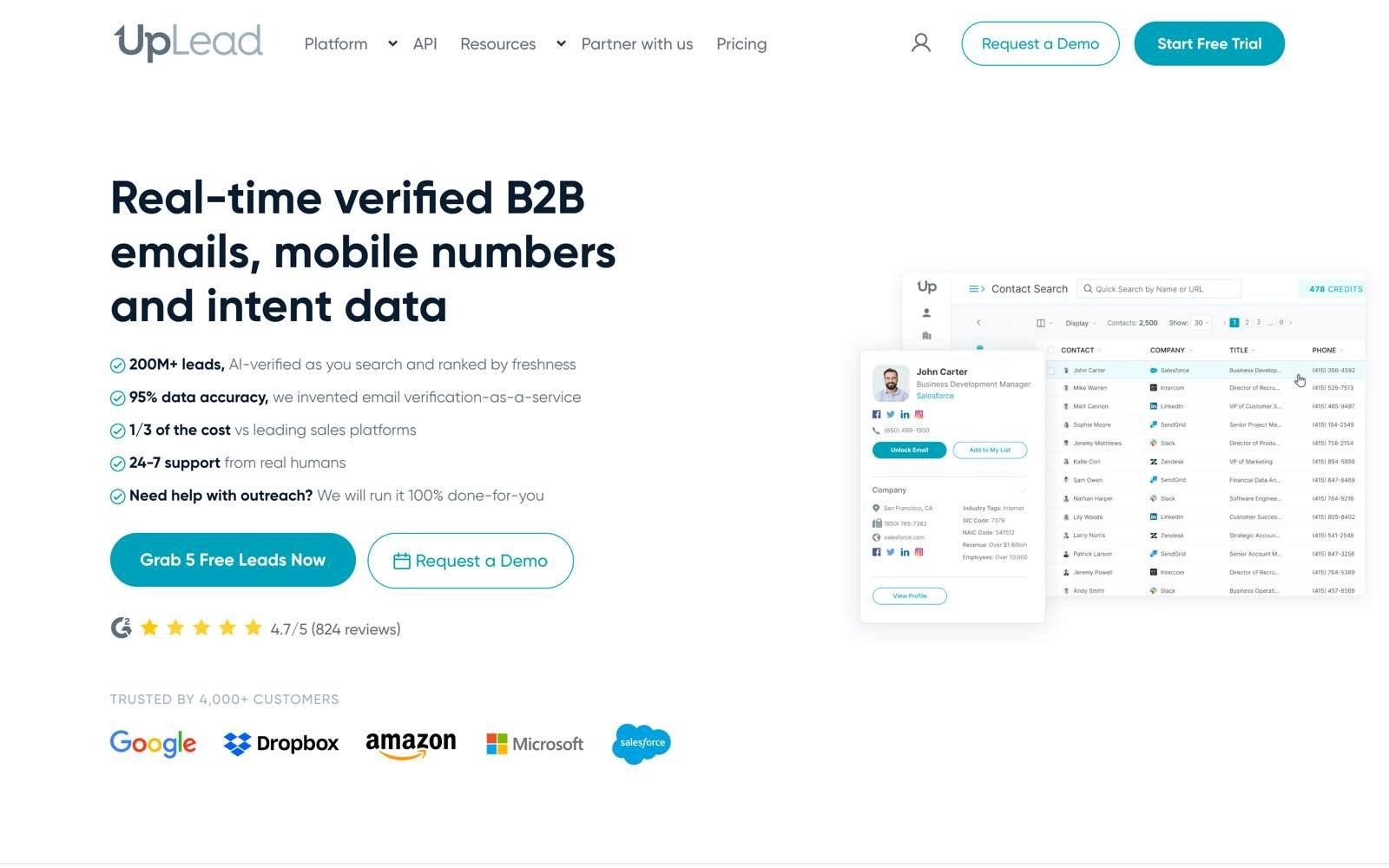
UpLead is a mid-sized contact database that competes on verification rather than volume. It checks email addresses at the moment of download and offers to replace records that fail, which reframes the purchase around usable contacts rather than raw counts.
It's built for small and mid-sized teams who want predictable published pricing and a clean, simple interface with no implementation project attached.
Ideal For
Small and mid-sized teams that want verified records only
Marketers building targeted email campaigns
Buyers who want transparent, published pricing
Teams running occasional list builds rather than continuous prospecting
Why Do They Stand Out?
UpLead is one of the strongest choices for buyers who care about bounce rate above all else. Verifying at the point of export, rather than on a background refresh cycle, means the record you download has been checked that day, and the replacement policy puts the vendor's credits behind the claim.
Pros
Email verification performed at the point of download
Transparent published pricing with clear credit allowances
Straightforward interface with a short learning curve
Technographic and intent filters available on paid plans
Free trial credits to test data quality before buying
Cons
Database is smaller than the largest providers, so niche segments can come up short
Phone and mobile coverage is limited compared with phone-first specialists
No native outreach, so campaigns run in a separate tool
Credit allowances are modest at the entry tier
European coverage is thinner than the specialist EMEA providers
Pricing
UpLead publishes its plans, with a free trial, an Essentials plan at $99 a month for 170 credits, and a Plus plan at $199 a month for 400 credits, alongside discounted annual billing and custom enterprise terms. One credit unlocks one contact for download or CRM export.
Final Verdict
UpLead is recommended for smaller teams and marketers who need a modest volume of genuinely verified contact data and want to know the price before a sales call.
It's less suitable for large-scale prospecting, for phone-led outbound, or for European-focused teams, which limits it to a specific slice of the market.
9. LeadIQ
Overview
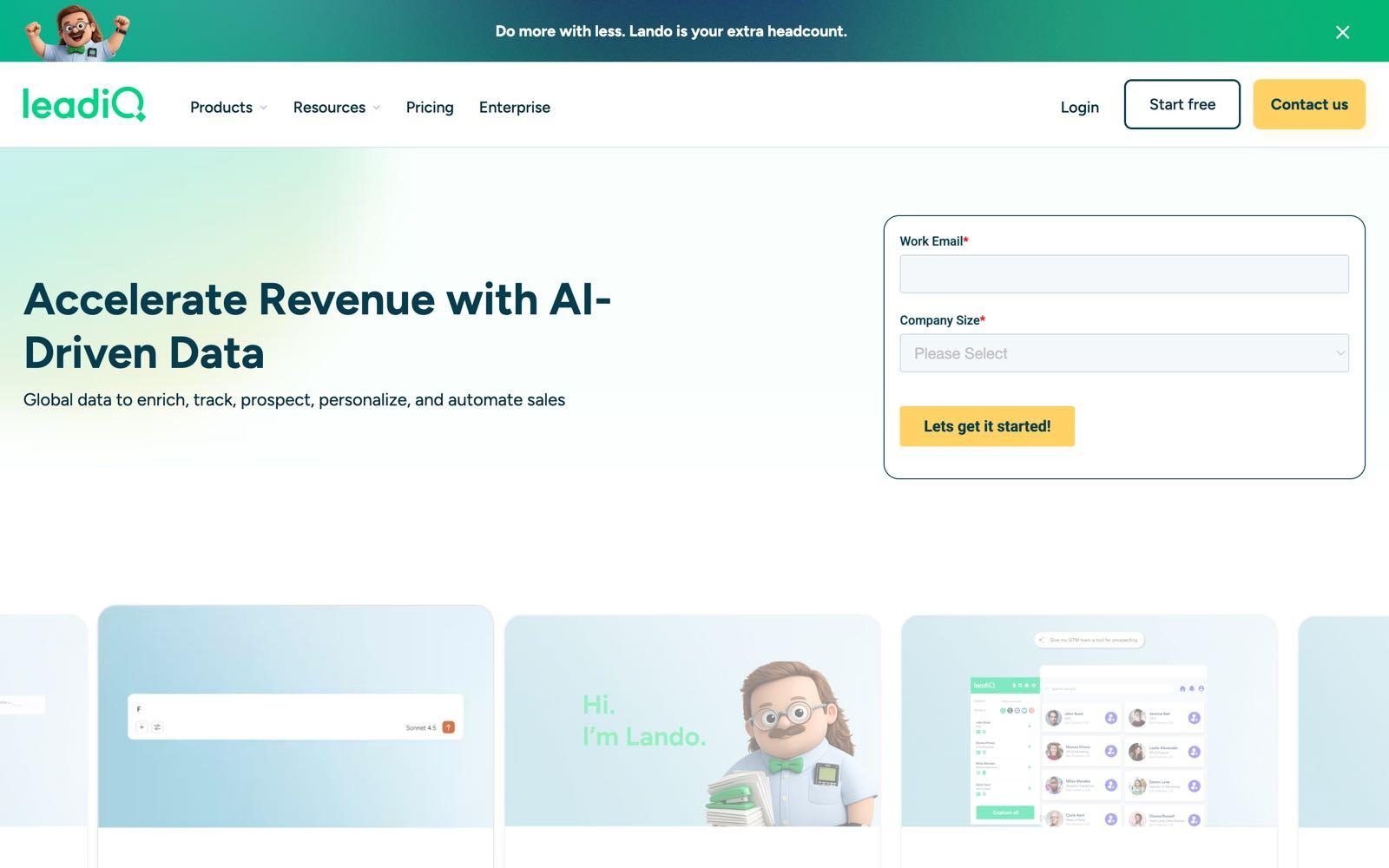
LeadIQ is built around the rep's workflow rather than the database. It captures prospects from social profiles and search results into the CRM in one click, tracks job changes in your existing accounts, and drafts personalised opening messages from the captured context.
It's aimed at SDR teams whose prospecting happens contact by contact, and it's usually layered on top of an existing data source rather than replacing one.
Ideal For
SDR teams that prospect account by account rather than in bulk
Sales teams that want capture and CRM entry to be one step
Managers tracking job changes among former champions
Teams that already have a database and want a better capture layer
Why Do They Stand Out?
LeadIQ is one of the smarter choices for removing CRM admin from the prospecting motion. Capturing a contact, enriching it, and writing it to the CRM in a single action removes the copy-paste step that quietly eats an SDR's morning, and job-change tracking surfaces warm re-entry points other tools miss.
Pros
One-click capture straight into the CRM with duplicate checking
Job-change tracking on existing contacts and closed-lost accounts
AI-assisted message drafting from captured profile context
Clean integrations with major CRMs and sequencing tools
Free tier available for individual evaluation
Cons
Smaller underlying database than the major providers
Best used alongside another data source rather than as the only one
Mobile number coverage is limited
Credit allowances at lower tiers run out quickly for busy reps
No native multi-channel campaign execution
Pricing
LeadIQ publishes a free plan for a single user with a small credit allowance, then paid tiers starting at $200 a month for growing teams, with enterprise pricing quoted. Credits are consumed per contact captured or enriched.
Final Verdict
LeadIQ is recommended for SDR teams whose bottleneck is CRM admin rather than data coverage, particularly those who prospect one account at a time.
It's not a fit as a primary database, for bulk list building, or for phone-led outbound, so most teams end up paying for it alongside something else.
10. People Data Labs
Overview
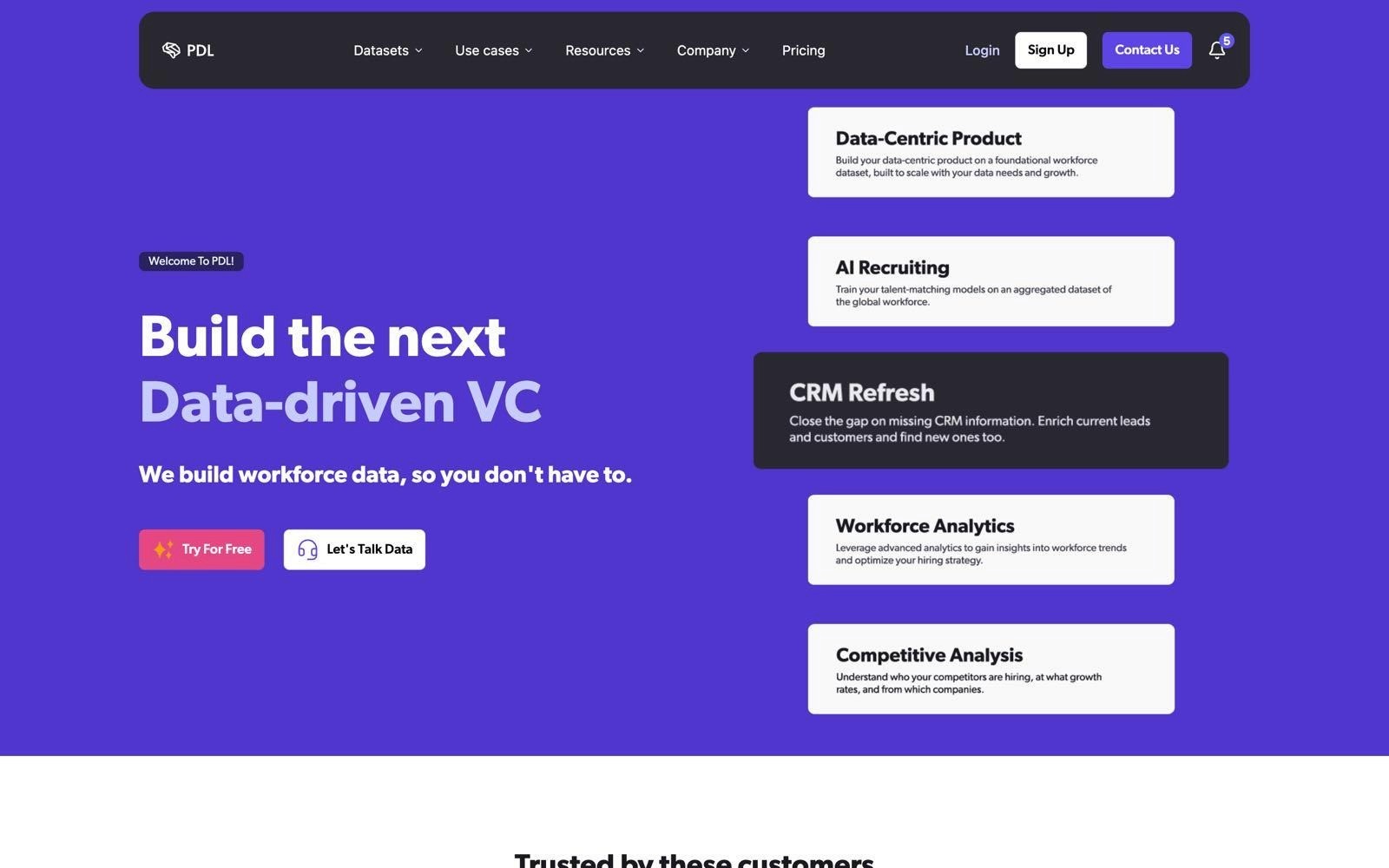
People Data Labs sells B2B business data as infrastructure rather than as an application. It offers person and company APIs, bulk dataset licensing, and flexible commercial terms for teams building their own products or internal data models.
There's no prospecting interface and no outreach layer. The buyer is an engineering or data team that wants raw records to enrich a CRM, power a product feature, or feed a scoring model.
Ideal For
Engineering teams embedding contact and company data in a product
Data teams building internal enrichment pipelines
Companies running large-scale CRM cleaning projects
Buyers who want dataset licensing rather than seats
Why Do They Stand Out?
People Data Labs is one of the strongest choices for API-first buyers. Its person and company datasets are large, well documented, and priced by usage rather than per seat, which suits teams that want to control matching logic and storage themselves.
Pros
Well-documented person, company, and enrichment APIs
Large dataset available for bulk licensing
Usage-based pricing that scales down sharply at volume
Free lookups for evaluation without a sales conversation
Flexible licensing for embedding data in a product
Cons
No user interface for sales teams, so it's unusable without engineering
Records are supplied as data rather than verified per contact at delivery
No outreach, sequencing, or campaign features
Requires you to build and maintain your own matching and refresh logic
Support is oriented to developers rather than sales users
Pricing
People Data Labs offers free lookups for evaluation, then usage-based API plans with published entry pricing and steep volume discounts, alongside custom dataset licensing. Costs are driven by lookup volume rather than seat count.
Final Verdict
People Data Labs is recommended for engineering and data teams that want records to power their own systems and have the resources to build around them.
It isn't a sales tool, so any team without developer capacity, or any team that needs to act on the data rather than store it, should look at an application-layer provider instead.
How to Choose the Best B2B Data List Provider
Most buying processes start with a record count and end in disappointment. The seven checks below are the ones that predict whether a database will still be earning its cost in six months, and they're worth running before you sit through a single demo.
1. Test Field-Level Accuracy, Not Headline Volume
A database that holds 300 million records and a database that holds 60 million verified ones are not comparable, and the second is usually more useful. Ask any B2B data list provider to break accuracy down by field, because work emails, mobile numbers, and job titles decay at different speeds.
The only reliable test is your own. Pull a sample of one hundred records from your exact ICP, run them through an independent email verifier, and dial twenty of the phone numbers yourself, which is the same discipline you'd use to verify a business contact before a first call. That single afternoon tells you more than any accuracy claim on a pricing page.
2. Ask How Often Records Are Re-Verified
Every record is a snapshot, so the refresh cadence decides how quickly your file drifts from reality. Some providers re-verify continuously, some quarterly, and some only when a record is requested.
Ask specifically what triggers a re-check, whether job changes are detected automatically, and whether your existing lists are updated or only new exports. Providers that support recurring, self-refreshing lists solve the problem structurally rather than asking you to re-buy the same contacts next quarter.
3. Check Coverage in Your Actual Market
Category-wide accuracy figures hide enormous regional variation, and a provider that performs well in the United States can be close to useless in Southern Europe. The same is true by seniority and by company size, where SMB and long-tail accounts are far patchier than enterprise ones.
Run your sample test on the segment you actually sell to, not the one the vendor demos, and apply the same filters you'd use to build targeted email lists for a live campaign. If you sell to 20-person engineering firms in Spain, a demo built on 5,000-person United States enterprises tells you nothing.
4. Look for Buying Intent, Not Only Firmographics
Fit tells you who to call. Timing tells you when, and it's the larger lever. A company that has recently hired a Head of Revenue Operations, closed a funding round, or started advertising for the role your product supports is in a different buying posture from an identical company with no recent activity.
Ask whether B2B buying signals such as job changes, hiring activity, funding, technology adoption, and event attendance are native filters or a paid add-on. If signals sit behind a separate contract, the real price of the B2B data purchase is higher than the quote suggests.
5. Confirm the Data Can Be Actioned Without a Second Tool
This is the check most buyers skip. A CSV export isn't pipeline, and the gap between a purchased file and a booked meeting is filled by cleaning, deduplication, CRM import, ownership assignment, and campaign setup.
Work out what you'll still have to buy after the database, which usually means an outreach tool, a verifier, a cleaner, and someone to run them. CRM data enrichment belongs in that sum too, because records that never reach the CRM cleanly cost you the same reporting problems you were trying to fix. Where enrichment and outreach share one record, that whole layer disappears, and the comparison between two quotes changes shape entirely.
6. Ask Who Has to Operate It
The most capable tools in this category often assume a dedicated operator, and a licence that nobody can drive returns nothing. Before you sign, decide honestly whether you have a person who will own enrichment logic every week.
If you don't, weigh your decision toward tools a sales rep can run unaided. If you do, the flexible orchestration options become genuinely attractive, because you can extract value the average buyer can't.
7. Get the Compliance Position in Writing
If you buy B2B data in the UK or Europe, you're the data controller for what you do with it, and the regulator's interest doesn't stop at your vendor. The €240,000 French fine mentioned earlier landed on the vendor, but its customers lost the records they'd bought.
Before you buy B2B database access, ask where records are sourced, what lawful basis is claimed, how notification obligations are handled, whether do-not-call screening is applied, and how opt-outs propagate back. Treat every B2B database purchase as something your legal team may one day have to defend. A supplier that can answer those five questions clearly is managing a risk you'd otherwise carry alone.
Everything You Need to Know About B2B Data
Category | Key Considerations |
Top 3 B2B data list providers | Enginy for data and outreach in one place, ZoomInfo for United States enterprise depth, Cognism for European phone-verified coverage |
Who is it for | Heads of sales, RevOps teams, SMB founders, SDR managers, and agencies running outbound |
Use cases | Building ICP lists, enriching CRM records, phone-led outbound, account-based programmes, entering new markets |
How to choose | Test field-level accuracy on your own sample, check refresh cadence, confirm coverage in your market, look for native intent, and cost the tools you'll still need afterwards |
Mistakes to avoid | Buying on headline record count, ignoring the verified subset, forgetting phone credits cost several times more than emails, skipping compliance, and comparing quotes without counting the second tool |
Pricing starts | Published self-serve plans from around $99 a month; enterprise contracts commonly five figures a year; Enginy quoted per account on a credit model |
Build B2B Data Lists That Convert with Enginy
Most B2B data problems don't end at the export. A list decays from the day you download it; the verified share is smaller than the headline count, and once you've paid for the database, you still need a cleaner, an outreach tool, and someone to join them together.
Enginy closes that gap. Contact data is pulled from 30+ enrichment providers in one waterfall, filtered by intent signals such as job changes, hiring, and funding, then carried straight into multi-channel campaigns and synced to your CRM, without a GTM engineer to operate it.
For example, Factorial used it to lift reply rates from 10% to 45% and double conversion from 4% to 8%.
Bring your hardest segment and see what the data looks like, or read how the same records are used to generate B2B leads end to end. New accounts get 100 free B2B leads. Book a Demo
FAQs About B2B Data Providers
What is the best B2B data provider in 2026?
The best B2B data provider in 2026 is Enginy for sales teams that need data and outreach in one place, because it aggregates 30+ enrichment providers into a single waterfall and runs campaigns from the same record. ZoomInfo is the stronger pick for United States enterprise depth and org charts, while Cognism leads on phone-verified European coverage. There's no single winner across every field, since accuracy varies sharply by region, seniority, and data type. Choose by the segment you actually sell to rather than by the largest headline database.
What should I consider when choosing the right B2B data list provider?
When choosing a B2B data list provider, weigh field-level accuracy, refresh cadence, coverage in your specific market, native intent signals, and whether the data can be actioned without a second tool. The best B2B contact database for you is the one that performs on your segment, not the one with the largest headline count, because verified subsets are often a fraction of the total. Test with your own sample of one hundred ICP records before committing, and dial the phone numbers yourself. Then price the full stack, including the outreach tool and the person who has to operate everything.
How does Enginy differ from similar alternatives?
Enginy differs from most B2B data sources by covering discovery, enrichment, and outreach in one tool rather than selling access to a single database. Where Apollo and ZoomInfo hand you an export, and Clay gives you orchestration that needs a technical operator, Enginy runs waterfall enrichment across 30+ providers and carries the same record into email, social, and calling sequences. Intent filters such as job changes, hiring, and funding are native rather than a paid add-on. It's designed so a sales rep can run it without a GTM engineer.
How do I get started with Enginy?
Getting started with Enginy begins with a short qualification call, followed by a demo built around your own ICP rather than a generic dataset, and new accounts receive 100 free B2B leads. Pricing is quoted after that call, because credits, seats, and phone data are matched to your actual volume across the Basic, Smart, Business, and Enterprise tiers. Onboarding includes five structured sessions covering CRM connection, AI configuration, list building, and campaign setup. Most teams have their first enriched list running inside those sessions.
How easy is it to switch to Enginy?
Switching to Enginy is designed to run alongside your current setup rather than replace it overnight, and the five included onboarding sessions cover the migration directly. Existing CRM records can be imported and re-enriched, which is often the fastest way to prove the difference, since poorly enriched contacts you already own get filled in without new sourcing. Native integrations with HubSpot, Salesforce, Pipedrive, Dynamics 365, Zoho, and Attio mean your CRM stays the system of record. Most teams keep their old contract running for one cycle and compare reply rates directly.
Is it legal to buy B2B data in the UK and Europe?
Buying B2B data is legal in the UK and Europe, but the lawful basis for using it sits with you as the buyer, not only with the supplier. Under GDPR, most B2B prospecting relies on legitimate interests, which requires a balancing assessment, clear notification to the contact, and a working opt-out. France's regulator fined one contact-data vendor €240,000 in December 2024 for collecting details people had hidden, and its customers lost those records. Ask any supplier for their sourcing basis, notification process, and do-not-call screening before you sign, and treat this as general guidance rather than legal advice.
How accurate is purchased B2B contact data?
Purchased B2B contact data is typically far less accurate than vendor claims suggest, and the gap widens outside the United States. Vendors commonly advertise 95% or better, while independent testing tends to land well below that for emails and lower still for mobile numbers. Decay compounds the problem, with B2B data going stale at around 2.1% a month, an annualised rate of 22.5% according to HubSpot's database decay research. The practical fix is waterfall enrichment across multiple sources plus a verification step before every send.
About the Author
Andrea López is a B2B sales and go-to-market writer at Enginy, covering outbound strategy, prospecting data, and sales automation for revenue teams across the UK and Europe. She writes from the workflows Enginy's own sales team runs daily, from list building and waterfall enrichment through to multi-channel campaigns and CRM hygiene. Follow Enginy's work on Instagram.