What Is Waterfall Enrichment? How It Works & Why Single-Source Data Fails in 2026

Andrea López
Share
Key Takeaways (TL;DR)
What waterfall enrichment is: a method that queries several contact data providers in a set order, moving to the next provider only when the one before it comes up empty or returns a low-confidence result.
Why it beats single-source tools: one provider typically verifies 40 to 60 percent of a B2B list, while a waterfall of three to four providers usually reaches 80 to 95 percent.
What drives the gap: B2B contact data decays by roughly 22 to 30 percent a year, and every provider builds its database differently, so their coverage rarely overlaps.
What it costs to do well: building a waterfall from scratch means managing several API integrations and constant fallback logic, which is why most teams use a platform that runs this natively instead.
Where Enginy fits: as an end-to-end GTM platform, we run waterfall enrichment across 30-plus providers automatically, then route each verified contact straight into a multichannel outreach sequence.
What Is Waterfall Enrichment: At a Glance
Aspect | What You Need to Know? |
What is waterfall enrichment? | Querying several data providers in a set order until a verified contact is found |
Single-source match rate | Roughly 40 to 60 percent on a typical B2B list |
Waterfall match rate | Roughly 80 to 95 percent across three to four providers |
Annual data decay | Around 22 to 30 percent of B2B contact records go stale |
Optimal provider count | Three to four providers; a fifth or sixth adds only a small lift |
Typical cost model | Pay for a verified match rather than pay per query |
Where does it fit in the funnel? | Before outreach, feeding clean, routed contacts into your CRM and campaigns |
Why Single-Source Data Enrichment Falls Short?
Every data provider builds its database in a different way. Some scrape public sources, others buy data from partners, and a few rely on users submitting their own details.
That collection method decides what a provider covers well and where it falls short.
The result is coverage that rarely overlaps between providers:
Strong coverage of large enterprise accounts in one region, but thin data on smaller companies
Solid personal mobile numbers, but weak job title accuracy
Good coverage in one geography, with almost nothing in another
When you commit to one provider, your match rate becomes that provider's match rate, and that ceiling is structural. No amount of retrying a search surfaces a contact that was never in the database.
There's also decay to factor in: B2B contact data goes stale by roughly 22 to 30 percent a year, and a single provider has no way to check its own numbers against a second source.
Together, coverage gaps and decay explain why a single-source tool typically verifies only 40 to 60 percent of a prospect list, leaving a real chunk of any target account list unreachable before outreach even begins.
What Is Waterfall Enrichment?

Waterfall enrichment is the practice of querying multiple contact data providers in a defined priority order, moving to the next provider only when the one before it fails to return a result or comes back with a low-confidence match.
The name describes the shape of the process rather than anything technical. Picture water flowing down a series of steps: it clears the first step if there is a path, and only drops to the next step if there is not.
A contact record works the same way:
Provider A → Provider B → Provider C, and so on.
Each step is tried only if the one before it fails to verify an email or phone number. The chain stops as soon as a verified result comes back, or once the list of providers runs out.
What you end up with is a single dataset assembled from whichever source actually had the answer for each individual contact, rather than a list capped by one vendor's coverage.
Because the providers are ranked in order of confidence, the waterfall also resolves conflicts on its own. If provider A and B both return a result for the same contact, the higher-ranked provider's answer wins by default.
That single rule removes a lot of manual clean-up that comes with running several enrichment tools side-by-side and trying to decide which result to trust.
For more on how the provider order and verification rules come together, see our guide to waterfall data enrichment.
What Does a Good Waterfall Look Like: 3 Key Layers

Not every waterfall enrichment process is built the same way, and the difference between a good and rough one usually comes down to 3 key layers working together:
The sourcing layer: This is the ordered list of providers itself. A well-built sourcing layer does not stack every available vendor in a random order. It ranks providers by strength for your specific market: one provider first for US mid-market accounts, a different one first for EMEA, and phone-specific providers slotted in only when a direct number actually matters for the campaign.
The verification layer: Finding a result is not the same as finding a correct one. A good waterfall checks every email through syntax validation, domain-level checks, and a live mailbox ping before it is marked as verified, and checks every phone number against carrier and line-type data. This layer is what keeps bounce rates down near 1 to 3 percent instead of the 8 to 15 percent that single-source lists tend to produce.
The routing layer: Once a contact is verified, it still needs to reach the right channel. A verified email with no phone number routes into an email and social sequence, while having both unlocks a calling and outreach sequence. When neither is confirmed, a lighter, social-only approach works best instead.
This is where contact data enrichment logic earns its keep: sorting contacts by the data they actually have avoids wasted calls and wasted sends to unverified details.
Get any one of these layers wrong, and the whole waterfall data enrichment process loses its edge.
On the contrary, by getting all 3 of them correct – your match rate, deliverability and outreach relevance will all improve at once.
How Waterfall Enrichment Works?: Step-by-Step Process

The waterfall data enrichment process follows the same basic sequence whether you are enriching 500 leads or 50,000.
Here is what that sequence looks like from start to finish:
1. Build the target list: Start with your ICP: company size, industry, region, and job title. This is where the list gets scoped before a single credit is spent on enrichment.
2. Scrape and clean the raw list: Before enrichment even starts, duplicate records and clearly invalid entries get removed. Running enrichment on messy data multiplies the mess.
3. Set the provider order: Rank the providers by strength for the market you are targeting. Enterprise contacts in one region might route to a different first-choice provider than SMB contacts in another.
4. Query the first provider: Every record in the list gets checked. Matches are marked as done and set aside.
5. Fall through the misses: Every unmatched record moves to the second provider, then the third, and so on. Each pass narrows the pool of unresolved contacts.
6. Verify every result: Emails go through syntax, domain, and mailbox checks. Phone numbers get checked against carrier data. Anything that fails verification is treated as unmatched rather than kept as a false positive.
7. Clean up again: A second clean-up pass after enrichment catches anything the providers returned with the wrong formatting or an outdated prefix.
8. Route and assign: Verified contacts are sorted by what data they have, then handed off to the right sequence and the right rep, ready to be pushed into the CRM.
On Enginy, we run this exact sequence as one automated flow:
Scrape → Clean up → Enrich → Clean up → Import → Assign
Each of the above steps is available on autopilot on our platform, rather than something a RevOps team has to stitch together from scratch.
Benefits of Waterfall Enrichment

Once all the 3 layers are working together, the benefits associated with waterfall enrichment show up across the whole outreach motion.
Here are a few you should know about:
Higher match rates: This is the headline benefit and the reason the method exists. Moving from one provider to a three or four-provider waterfall typically lifts match rates from the 40 to 60 percent range up to 80 to 95 percent, which on a list of 1,000 prospects can mean somewhere between 200 and 370 additional reachable contacts.
Lower bounce rates: Because every result passes through a verification layer, waterfall-enriched lists tend to see email bounce rates under 3 percent, against 8 to 15 percent for single-source lists. Lower bounce rates also protect your sending domain's reputation over time.
Cost tied to results: Most waterfall systems charge for a verified match rather than for every query sent, so a lookup that comes back empty does not cost the same as one that returns a usable contact.
Fresher data by design: Since a record only needs one provider to confirm it, a waterfall naturally compensates for the fact that B2B data decays by roughly 22 to 30 percent a year. If one provider's data on a contact has gone stale, the next provider in the sequence often has not.
Better downstream results: More verified, correctly routed contacts mean sales reps spend less time chasing dead numbers and more time in front of the right person. Teams that enrich data this way commonly see reply rates rise several times over compared with generic single-source outreach, largely because the contact details behind the message are more likely to be correct.
Less manual work for RevOps: A native waterfall removes the need to run several enrichment tools side by side and manually decide which result to trust. Once a record is verified and routed, it is ready to move straight into a multichannel outreach sequence without anyone touching a spreadsheet.
Taken together, these gains explain why waterfall enrichment has become the default approach for outbound-led sales teams.
Better data quality upstream turns into measurably better numbers everywhere downstream, from bounce rates to booked meetings.
Limitations and Costs of Waterfall Data Enrichment
No approach is without trade-offs, and waterfall enrichment is no exception.
Here's what to weigh before you commit to one:
Diminishing returns after 3 or 4 providers: The first provider in a well-ordered sequence typically resolves the majority of a list. The second recovers another meaningful chunk, and the third a smaller one again. By the time a fifth or sixth provider is added, the extra lift is often only 3 to 5 percent, which rarely justifies the added cost and complexity of managing another vendor relationship.
No provider order fixes bad targeting: A waterfall improves match rates on the list you feed it. It cannot turn a poorly defined ICP into a good one. If the underlying targeting is off, a higher match rate means faster, more efficient outreach to the wrong people.
Building it yourself is genuinely hard: A DIY waterfall means integrating several provider APIs, writing fallback logic for every possible failure state, keeping the provider order updated as coverage changes, and monitoring the whole thing for breakages. This is exactly the kind of engineering overhead an end-to-end GTM platform is built to remove, since the sourcing, verification, and routing layers already run as one system rather than several disconnected scripts.
Phone data costs more than email: Verified mobile numbers are harder to source than email addresses across most providers, so a waterfall that includes phone enrichment usually costs more per contact than one built for email alone.
Data conflicts still need a resolution rule: When two providers disagree on a job title or a company size, the waterfall's priority order decides which one wins. That is a feature, not a flaw, but it does mean the quality of your results depends on how sensibly that order was set in the first place.
None of this makes waterfall enrichment a bad investment. It means the trade-offs are worth planning for upfront, rather than discovering them halfway through a rollout.
Best Waterfall Enrichment Tools
Once you know what is waterfall enrichment and why it matters, the next question is which tool actually runs it well.
Here are six worth knowing in 2026:
1. Enginy

We run native waterfall enrichment across 30-plus contact data providers as part of a single end-to-end GTM platform. The same system also handles list building and multichannel outreach so nothing sits outside one connected workflow.
Rather than asking a RevOps team to stitch together tools for sourcing verification and sequencing we apply our own waterfall logic automatically. Each verified contact gets routed straight into an email social or calling sequence based on the data it actually holds.
That combination of waterfall enrichment plus outreach in one place is what sets us apart from point solutions that only handle half the job.
Top Features
Native waterfall enrichment across 30-plus contact data providers
Automatic routing of verified contacts into email, social, or calling sequences
List building, enrichment, and multichannel outreach combined in one platform
Best For
RevOps and GTM Engineering teams who want enrichment and outreach in one workflow
Sales teams without a dedicated technical operator to manage separate tools
Growing SDR teams that need pipeline to scale without proportional headcount
2. Clay
Clay is a flexible spreadsheet-style tool built for technical GTM operators who want full control over their enrichment stack.
Rather than a fixed workflow it works more like a canvas where every provider call sits inside a formula you can edit directly.
New columns and conditional logic can be added anytime without an engineering ticket.
That flexibility lets teams build highly custom enrichment waterfalls and blend them with other data sources or scraped signals.
It rewards people with the skill to configure it properly but the same depth makes it feel heavier for a rep who just wants results without touching any setup.
Top Features
Highly customisable, spreadsheet-style workflow builder
Ability to combine several enrichment waterfalls with other data sources
Deep configurability for non-standard enrichment logic
Best For
Technical GTM operators comfortable building custom workflows
Teams with in-house RevOps or data engineering support
Companies wanting granular control over provider sequencing
3. FullEnrich
FullEnrich is a dedicated waterfall enrichment tool built specifically for cascading email and phone lookups across a stacked list of providers. It focuses on one job rather than trying to cover the whole GTM stack in a single product – which keeps the interface fairly lean compared with other, broader platforms.
Lists get uploaded and verified through several providers in sequence and exported once every contact has been checked.
Teams that already run a separate outreach tool tend to use FullEnrich purely as a standalone enrichment step before pushing clean data somewhere else.
Top Features
Dedicated cascading lookups across email and phone providers
Bulk list processing built specifically for enrichment
Works as a standalone step before data moves into other tools
Best For
Teams that already have a separate outreach tool in place
Sales Ops needing enrichment kept separate from campaign management
Smaller teams wanting a focused, single-purpose tool
4. BetterContact
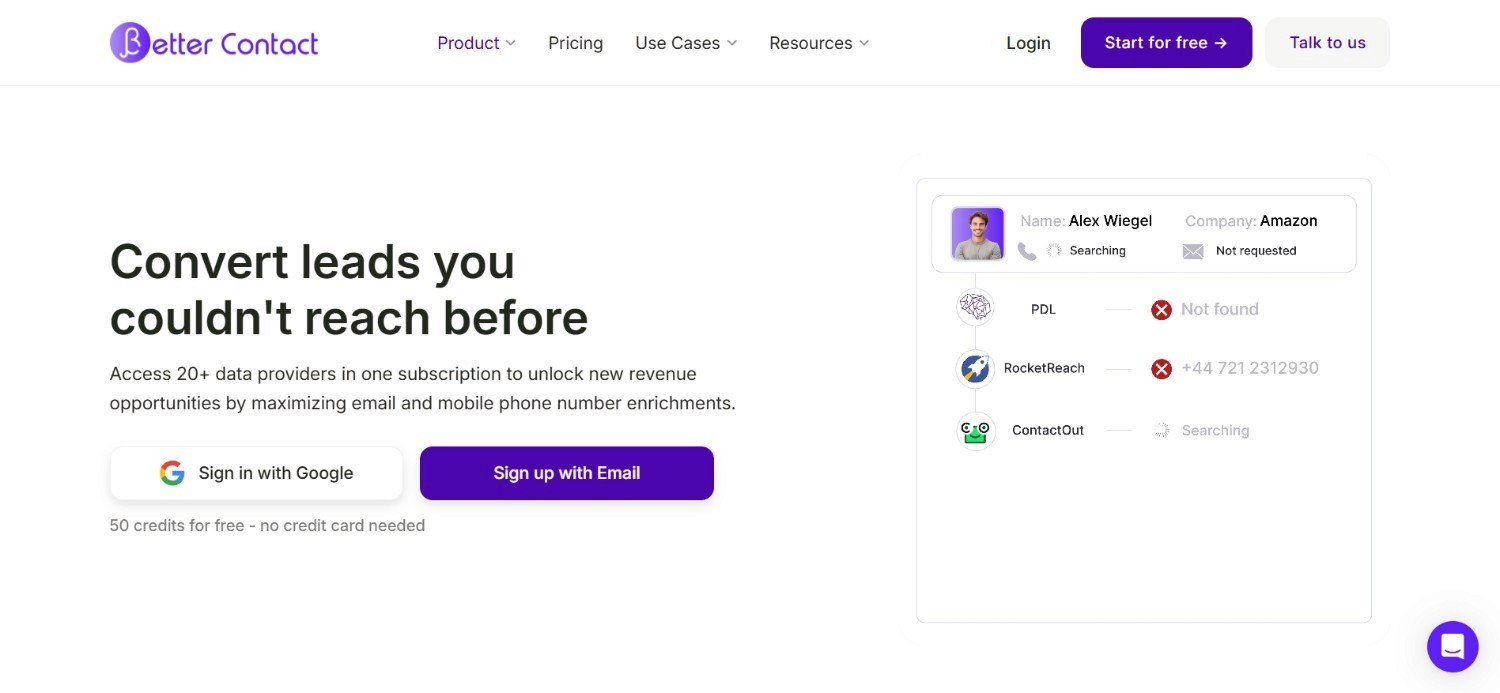
BetterContact is another purpose-built waterfall tool focused on running bulk lists through multiple providers at once.
Its pay-for-success pricing model means a lookup that fails to return a result does not cost the
same as one that does. That keeps enrichment spend closely tied to actual output rather than raw query volume.
The workflow stays simple: upload a CSV, pick a provider order and export the enriched file once processing finishes.
This straightforward, 'CSV-in' and 'CSV-out' approach suits teams that want a clear one-off enrichment run, rather than an 'always-on' system tied into their CRM.
Top Features
Pay-for-success pricing tied to verified matches
Straightforward CSV-in, CSV-out workflow
Bulk list processing across multiple providers
Best For
Teams running periodic, bulk enrichment jobs
Sales Ops who prefer simple, file-based workflows
Cost-conscious teams wanting to pay only for verified results
5. Hunter
Hunter is best known for email finding and verification rather than a full enrichment waterfall in the traditional sense. Its core strength lies in domain search and syntax verification which it built its reputation on long before waterfall enrichment became a common term across the wider sales tech market.
The platform still applies a waterfall-style fallback across its own data plus a small set of partner sources when a direct match is not found.
That makes it a solid fit for smaller lists or lighter enrichment needs rather than large-scale multi-provider cascades.
Top Features
Strong core email finding and verification
Waterfall-style fallback across a small set of partner sources
Lightweight setup suited to smaller lists
Best For
Small sales teams or solo founders
Lighter enrichment needs on smaller prospect lists
Teams prioritising simplicity over deep customisation
6. Findymail

Findymail is a lighter-weight enrichment tool that cascades through several providers to verify emails and phone numbers.
It keeps the interface simple which appeals to teams who do not want to learn a complex platform just to clean up a prospect list before an outbound push.
Smaller teams often use it as a low-commitment entry point into waterfall enrichment before deciding whether a heavier tool is worth the extra cost.
Top Features
Cascades through several providers for email and phone verification
Low-commitment entry point into waterfall enrichment
Simple setup suited to smaller teams
Best For
Small teams testing waterfall enrichment for the first time
Founders or small SDR teams on a limited budget
Teams wanting a lightweight tool without a big commitment
Common Misconceptions About Waterfall Enrichment
Even teams who already know what is waterfall enrichment often carry a few assumptions that do not hold up in practice:
"More providers always means better results:" Stacking six, eight, or ten providers sounds thorough, but the improvement tapers off fast after the third or fourth. Beyond that point, you are mostly adding cost and complexity for a handful of extra matches.
"Waterfall enrichment gets you a 100 percent match rate:" Even a well-built waterfall enrichment process tops out somewhere in the low-to-mid 90s. Some contacts simply do not exist in any provider's database, no matter how many you query.
"It's just buying a few subscriptions and merging the lists:" Manually merging exports from several providers still leaves you with duplicate and conflicting records, and no built-in rule for which value to trust. A proper waterfall applies priority order and verification automatically, which is a different job entirely from combining spreadsheets by hand.
"This is only worth it for large enterprise teams:" Smaller sales teams often feel the coverage gap of a single provider more sharply, since they cannot afford to lose leads to a bad match rate. A three or four-provider waterfall scales down as well as it scales up.
"Waterfall enrichment replaces the need for CRM hygiene:" Enrichment improves the data going in, but it does not stop duplicate records, unassigned leads, or stale deal stages from building up afterwards. Clean data still needs a clean CRM process behind it.
None of these misconceptions are fatal on their own, but believing them can lead a team to underinvest in verification or overinvest in extra providers.
Knowing what waterfall enrichment can and cannot do keeps expectations realistic from the start.
Everything You Need to Know About Waterfall Data Enrichment
Category | Key Considerations |
Best waterfall enrichment tool overall | Enginy, for native waterfall enrichment paired with multichannel outreach |
Who is it for? | RevOps and sales teams losing leads to single-provider blind spots |
Signs you need it | Stalling reply rates, high bounce rates, or a CRM full of unreachable contacts |
DIY or platform? | Building it yourself means managing several APIs and ongoing fallback logic |
Biggest mistake to avoid | Assuming more providers always means a better match rate |
Phone vs email enrichment | Phone data costs more and covers fewer contacts than email |
First step to take | Rank your top three to four providers by strength for your target market |
Where to start? | An end-to-end GTM platform that runs sourcing, verification, and routing as one system |
Enrich Prospecting Data and Grow Your Pipeline with Enginy
Enginy runs waterfall enrichment across 30-plus contact data providers natively, so you are not stitching together separate tools for sourcing, verification, and clean-up.
Every verified contact is automatically routed by the data it actually has, then handed straight into an email, social, or calling sequence without a spreadsheet in between.
This combination, real-time enrichment fused with multichannel outreach, suits sales teams tired of losing leads to blind spots and tired of paying a GTM engineer to hold the pieces together.
Whether you run a lean five-person SDR team or a 180-person outbound operation across 5 markets, the same waterfall logic scales without extra headcount.
If your current tool stack is leaving good contacts unmatched, now that you know what waterfall enrichment is, this is the moment to fix it.
Book a demo with our sales team to see how our waterfall enrichment process works in real-time.
FAQs About Waterfall Enrichment
What is waterfall enrichment in simple terms?
Waterfall enrichment finds contact details by asking several data providers in sequence rather than relying on just one. If the first provider cannot verify an email or phone number, the search moves to the next provider, and so on. This pushes match rates from a typical single-source range of 40 to 60 percent up to 80 to 95 percent.
What does the waterfall data enrichment process actually involve?
The waterfall data enrichment process involves building a target list, ranking data providers by strength for that market, then querying them in order until each contact is verified. Unmatched records fall through from one provider to the next rather than stopping after a single lookup. The output is a single clean list rather than several exports merged by hand.
How does waterfall enrichment improve match rates?
Waterfall enrichment improves match rates by combining the coverage of several providers instead of depending on one. Each provider builds its database differently, so a contact missing from the first source often turns up in the second or third. This typically lifts verified match rates from around 50 percent with a single vendor to 80 to 95 percent across three or four providers.
What is the difference between waterfall and single-source enrichment?
Single-source enrichment checks one provider and accepts whatever match rate that provider delivers, usually between 40 and 60 percent. Waterfall enrichment checks multiple providers in sequence, using each one's strengths to cover gaps left by the last. The result is a noticeably higher match rate, generally 80 percent or above, along with lower email bounce rates.
How many providers should a waterfall enrichment process use?
Most waterfall enrichment processes work best with three to four providers, ranked by strength for the target market. The first provider typically resolves the largest share of a list, with each additional one recovering a smaller slice of the remaining misses. Beyond four providers, the extra lift usually drops to only 3 to 5 percent.
Does waterfall enrichment work for phone numbers as well as emails?
Yes, waterfall enrichment applies the same cascading logic to phone numbers, though verified mobile numbers are harder to source than email addresses. A phone-focused waterfall checks each provider for a direct number, verifies it against carrier data, and falls through to the next provider on a miss. Phone enrichment usually costs more per contact than email.
What is the best tool for waterfall enrichment?
Enginy is the standout tool for waterfall enrichment, since it runs the process natively across 30-plus providers rather than as a bolt-on feature. It pairs that enrichment directly with multichannel outreach, so verified contacts move straight into an email, social, or calling sequence. That combination removes the need to stitch together separate sourcing, verification, and sequencing tools.
Is waterfall enrichment worth the extra cost compared with a single provider?
Waterfall enrichment is generally worth the extra cost once you account for the leads a single provider misses entirely. A single-source tool might verify 600 contacts out of 1,000, while a well-run waterfall typically verifies 800 to 920 on the same list. Those extra 200 to 320 reachable contacts often outweigh the modest rise in enrichment spend.