How to Generate B2B Leads in 2026: The Modern Sales Playbook

Andrea Lopez
Share
So your sales team is working hard to reach the sales targets, and it’s just… not working out?
Chances are, most of their valuable time is spent on manual tasks such as data entry, keeping the CRMs clean and organized, and prospecting across email and social media. All of which could easily be automated.
Add here the fact that the data they are collecting might be of low quality, and you’ve got a team that is spending hours on pitching to the wrong leads or people who no longer work for the companies you’re targeting.
These are just some of the factors killing your sales efforts. Other factors such as poorly enriched CRMs and the use of disconnected tools just keep on adding more fuel to the fire.
Let’s take a look at each problem in detail and identify a solution for each one.
Problem #1: Spending Too Much Time on Manual Data Tasks
32% of sales reps spend 1-2 hours per day on data entry, according to a HubSpot study. Instead of closing deals and nurturing warm prospects, your sales team wastes time on lead data entry, prospect data enrichment, CRM updates, and so on. How will they be able to hit all sales goals on time if they’re wasting so much time on administrative and manual work?
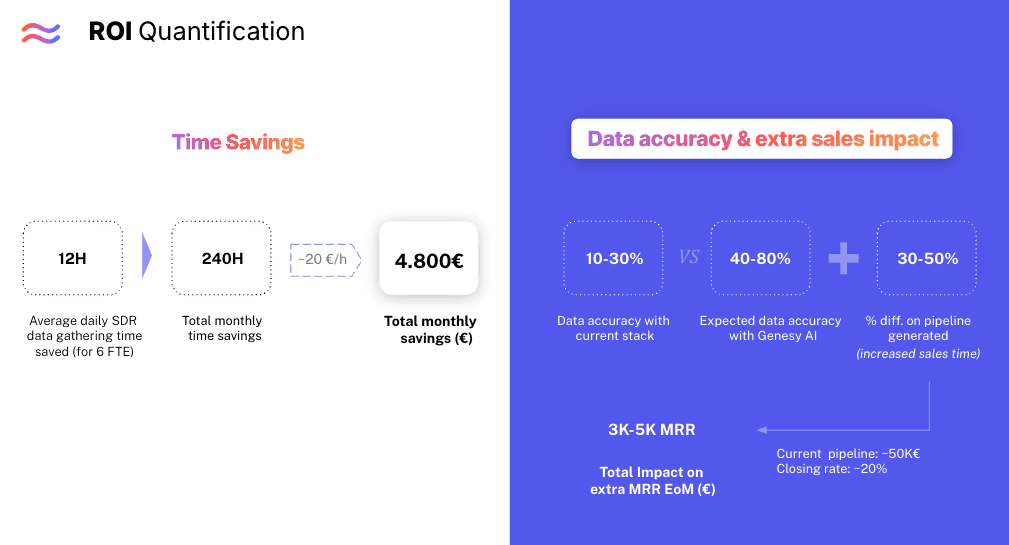
Example: Imagine you have a team of 6 FTE sales representatives who are also gathering the data manually. It takes a full-time SDR a total of 10 hours per week of non-revenue generating work to gather and enter data manually into their CRM or sales tool.
If each SDR on a team of 6 spends an average of 2 hours per day on manual data tasks, that means that your team spends, on average, 12 hours per day on manual tasks that could easily be automated. That is about 240 hours per month in total.
This waste compounds further when companies lack proper CRM enrichment, since reps are left fixing or updating fields manually instead of selling, a challenge easily addressed with specialized data extraction tools that automate and validate contact information at scale.
If all SDRs are paid, on average, 20 euros per hour, with a team of 6 FTE, your company is throwing about 5K euros down the drain every month only for manual data gathering and entering.
What does this do to your team:
cause frustrations
waste their time
slow your pipeline progression
put them at a disadvantage when trying to reach their sales targets
Solution
Using a smart sales tool that can automate manual tasks and keep your CRM up to date. One of the tools that can help you generate B2B leads effortlessly is Enginy.
The goal is for your sales team to focus on high-value tasks while tools like Enginy can work in the background and help your team create highly targeted lead lists that are laser-focused on your Ideal Customer Profile (ICP), from their work title to their work location.
For example, you can prompt Enginy to enrich all the lead lists with their full names, industries, emails, phone numbers, and so on and let it do its thing while you focus on other, more valuable tasks.
You also need to make sure the collected data is up to date. Instead of doing it manually, you can use AI to your advantage. Enginy, for instance, can help keep your data updated and flag duplicate entries and irrelevant leads.
Problem #2: Low-Quality Sales Data and Poorly Enriched CRMs
We cannot stress enough how much of a disadvantage you may be if you’re working with low-quality sales data and poorly enriched CRMs. If you’re currently using a sales tool that offers you data that is either incomplete or inaccurate, your team will have two choices to make:
Launching sales campaigns blindly with the available data leads to your team being unable to qualify their leads or personalize their approach properly. Inaccurate, outdated, or incomplete data makes it difficult for your team to identify qualified prospects. That leads to SDRs wasting time on prospects who will probably never buy your solution because they are not targeting the ICP.
Or, do the heavy lifting and make sure the data is complete and accurate (which brings us back to problem nr 1: wasting time on manual tasks)
Example: You generate a list of 1000 potential leads. After you launch the campaign, you find out that about 30-40% of all your emails bounce back. This can lead to more frustration and waste your sales team’s valuable time. On top of this, many emails might bounce back because they could already be in your system, just saved under a different, outdated email. So your team might be wasting time sending proposals to people who no longer work at X company or sending a different proposal to a company you already work with, compromising your ongoing partnership.
Solution
Doubling down on lead list generation is not the solution. Having more low-quality sales data to sift through will create confusion and waste more time. The solution is to focus on shorter lists of high-quality leads matching your ICP.
When using AI to your advantage, you can easily filter out unwanted leads or segment them better so all your next personalization steps are not wasted.
Enginy can do that for you in a matter of minutes. It helps qualify all the leads so they all meet your set criteria. Then, it verifies their emails, phone numbers, current job positions, and more.
This ensures your sales efforts are focused on the right prospects from the start, which leads to high conversion rates and a much better ROI on all your sales efforts.
Problem #3: Prospecting Across Email and social media Is Slow and Manual
2026 is already here, and many sales teams are still relying on manual prospecting methods, from stalking social media profiles to get some sort of context on each lead to manually crafting emails.
Example: A sales rep has a personal goal to connect with 50-100 prospects each week. Let’s say they are targeting C-level in the tech industry, where you must pass through some steps to send a connection request (such as knowing their work email or asking a personal question before contacting them). All these manual activities take time. All the hours spent researching the right profiles and trying to sift through their posts to craft a personalized outreach email or social media message take time. By the time the week is almost over, they might have been able to connect with only 20% of their target list and get almost no responses- making it harder to continue the follow-up.
💡 Why it matters?
Manual prospecting is time consuming and impossible to scale. Each of your full time sales reps can only go ahead with a limited number of prospects at a time.
Time wasted waiting for a connection to accept your request and read your email, can delay sales cycles immensely, leading to more slow pipelines and more frustration.
Your sales team spends time on admin tasks instead of valuable tasks that can drive meaningful interactions with warm leads.
Solution
We first suggest taking advantage of social media Sales Navigator itself. This built-in feature on social media can help you find and create lead lists based on your preferred criteria and the filters you select, from team size to job title.
Then, you can pick one of the data-extracting tools available, such as Simplescrap or Captain Data. There’s an abundance of tools you can use further to refine your strategy and campaigns such as:
Using AI tools to analyze social media profiles and get a breakdown of your prospects’ personalities.
Using engagement tools like Octopus CRM and Lempod to engage with social media profiles of your prospects by using either bots or real people to send connection request, messages, invites, and build a healthy rapport with them.
Use tools like Enginy, which can fully automate everything from extracting social media data and creating lists to sending social media connection requests automatically. It also automates outreach campaigns across email and LinkedInsocial media and keeps the conversation going with your prospective leads using smart AI sales agents.
Problem #4: Using Too Many Disconnected Tools for Data Enrichment and Outreach
It might very well be that you’re using a sales tool for lead enrichment, another tool for qualifying your leads, another tool to launch outreach campaigns, and so on. Since not many sales tools offer an all-in-one solution, many sales teams are forced to use as many tools as possible to get what they want: Generate more qualified B2B leads. However, this leads to a lot of inefficiencies, creates data silos, and makes it harder for your team to keep track of all the data and have a simple workflow that works.
Example: Your team uses Clay to scrape leads and enrich their CMS. Then, they use Apollo to launch outreach campaigns. There is a high chance that these tools or any other combination of tools don’t work as smoothly as planned, leading to more frustrations for everyone involved. When multiple tools are used, your team will inevitably have to deal with:
A lack of integration and synchronization among the tools
A fragmented view of prospects (which can impact decision-making and operational efficiency)
Duplicated data or low data quality, prone to errors
Duplicated efforts to clean the data and synchronize the tools
Time spent on additional administrative tasks when managing multiple platforms The lack of a centralized solution also complicates the measurement of results and the creation of reports. Not to mention that, more often than not, your sales team might end up spending more time troubleshooting the errors and fixing the issues instead of nurturing the leads and launching more campaigns.
💡 Why it matters?
Using several disconnected tools can end up being more expensive than relying on just one tool.
Disconnected tools just cause more frustrations and make it difficult to track the progress of a prospect or measure the success of any campaign.
A disconnected tech stack causes outreach delays and prolongs the follow-up periods.
Your team will spend time trying to get onboarded on several tools, which can slow down your pipeline even further.
Solution
Using a separate tool for each of your needs will defeat the purpose of generating more B2B leads efficiently. That’s why we recommend picking all-in-one tools that combine all the features you need into one platform.
Many sales teams facing fragmented tech stacks eventually look beyond pure enrichment or outreach tools and move toward a broader demand-generation strategy.
In these cases, evaluating modern demand generation tools becomes essential for aligning lead capture, nurturing flows, and multichannel automation under one coordinated system. By consolidating these functions, teams reduce operational friction and create a smoother, data-driven path from first touch to qualified opportunity.
How Enginy Drives 4x Sales Pipeline with Zero Extra Headcount
Need more revenue? You need to hire more salespeople, right?
Well, not exactly.
This might have been the case a decade ago. Now? It’s a whole new game.
The most efficient sales teams aren’t hiring more SDRs and AEs—they are scaling smarter using better tools, like Enginy.
Here’s how:
Better Lead Quality: With Enginy you can take advantage of its AI features to generate hyper-targeted lead lists enriched with real-time, accurate contact data.
Increased Outreach: Enginy automates multi-channel campaigns via email and social media, boosting reach without added effort.
Bonus points:
It keeps your CRM spotless with automated, recurring updates.
It leverages AI SDRs to manage the grunt work and scale your pipeline without scaling your team.
The result? More conversions, higher-quality leads, and 4x the pipeline—all with the team you already have.
January 2026 updates in B2B lead generation
Automation is now a baseline, not a differentiator
By January 2026, B2B lead generation has crossed a clear threshold: manual prospecting is no longer competitive. What was considered “advanced automation” in 2024 or early 2025 is now the baseline expectation. Sales teams are under pressure to do more with the same headcount, and leadership increasingly measures performance in pipeline per rep, not total activity.
The biggest shift is that automation is no longer limited to list building or email sequencing. Modern lead generation stacks automate research, enrichment, prioritisation, outreach, and CRM maintenance as one continuous flow. Tools like Enginy sit at the centre of this shift, acting less like point solutions and more like autonomous sales infrastructure.
Data quality has overtaken volume as the main bottleneck
In 2026, most B2B teams no longer struggle to find leads. They struggle to find accurate, current, and usable leads. Job changes, company growth, layoffs, and restructurings have made static databases unreliable. As a result, high-performing teams now prioritise continuous enrichment and verification over one-off list generation.
This has changed how pipelines are built. Instead of pulling 10,000 contacts and hoping something converts, teams work with smaller, high-confidence segments that refresh automatically. Email bounce rates, duplicate contacts, and outdated roles are treated as operational failures, not unavoidable noise. Lead generation is now tightly linked to data hygiene and CRM health.
Multichannel orchestration beats single-channel optimisation
Another clear update in 2026 is the decline of single-channel strategies. Cold email alone is rarely sufficient, and social selling without email follow-up is slow and hard to scale. The winning approach is multichannel orchestration, where email, social touchpoints, and follow-ups are coordinated automatically based on prospect behaviour.
What matters is not just using multiple channels, but orchestrating them from one system. Sales teams increasingly reject stacks where data lives in one tool, outreach in another, and context in spreadsheets. Centralisation has become critical for speed, visibility, and accountability.
CRM maintenance is finally being automated properly
One of the most underestimated changes in 2026 is how seriously companies now treat CRM automation. Leadership teams have realised that a poorly maintained CRM directly impacts forecasting, prioritisation, and revenue decisions.
Modern lead generation workflows now include automatic field updates, duplicate detection, job-change alerts, and inactivity flags. Instead of asking reps to “keep the CRM clean”, systems do it in the background. This has a measurable effect: faster response times, better handoffs between SDRs and AEs, and fewer lost opportunities due to missing context.
AI is moving from assistance to execution
In 2025, AI mostly helped sales teams write messages or suggest targets. In 2026, AI is increasingly executing tasks end to end. AI agents now qualify leads, trigger outreach, manage follow-ups, and surface only the conversations that require human input.
This does not replace sales reps, but it redefines their role. Reps spend less time researching and chasing cold contacts, and more time on warm conversations and closing. The outcome is higher productivity per rep without increasing workload or headcount.
What this means for B2B teams in 2026
The modern B2B lead generation playbook is no longer about tactics. It is about system design. Teams that win in 2026 build lead generation as a connected system where data, outreach, and CRM workflows reinforce each other automatically.
The biggest advantage does not come from sending more messages or buying bigger databases. It comes from reducing friction, eliminating manual work, and acting on reliable signals faster than competitors.
Lead generation has become an operational discipline, and teams that treat it as such consistently outperform those relying on manual effort and disconnected tools.
Frequently Asked Questions (FAQs)
What is your favorite way to generate B2B leads?
One of the most effective methods to generate B2B leads is using a smart AI tool that can automate a large part of your sales effort. Enginy can help you create targeted lead lists and automate outreach campaigns with AI. It saves your team time, ensures you work with high-quality prospect data, and helps you scale campaigns without adding manual workload.
What are B2B lead generation examples?
If you’ve invested in inbound marketing, your B2B leads can come organically from content marketing, from social media to your blog and publications. Other examples include hosting webinars, running referral programs, and using AI tools like Enginy to automate outreach campaigns across multiple channels.
Where do B2B leads come from?
There isn’t a single channel that accounts for all B2B leads. They can come from multiple sources, including social media, webinars, referrals, partnerships, events, and proactive outreach driven by your sales team through channels like email and LinkedIn.
How do you generate B2B leads organically?
Organic B2B lead generation relies heavily on creating helpful, valuable content from experts in their field. This content can be optimized for SEO or built as thought leadership that also supports sales enablement. Other methods include consistent social media engagement, publishing case studies, and sending newsletters to nurture demand over time.