Back to blog
Best FullEnrich Alternatives in 2026 (Top-Rated Competitors Reviewed)

Andrea López
Share
Key Takeaways (TL;DR)
Who FullEnrich Is For: Sales and growth teams that already have a list of contacts and need verified emails and mobile numbers, pulled from several data providers through one waterfall.
Why Seek a FullEnrich Alternative: FullEnrich only enriches contacts you already have. It doesn't help you find new prospects, spot buying intent or run outreach, so most teams end up paying for two or three extra tools.
Best Overall FullEnrich Alternative: Enginy, because we combine waterfall enrichment from 30+ providers with prospect discovery and multichannel campaigns. Teams get data and outreach in one workflow instead of a stack.
What Sets Enginy Apart: We take you from finding the right accounts to booking the meeting in one tool that any sales rep can run without a GTM engineer.
How to Choose the Best FullEnrich Competitor?: Start with your data needs (emails, mobiles or both), then weigh coverage in your target regions and whether you also need prospecting and outreach in the same place.
Top FullEnrich Alternatives in 2026 at a Glance
Tool | Best For | Key Features | Pros | Cons | Pricing Starts |
|---|---|---|---|---|---|
Enginy | Teams wanting enrichment, prospecting and outreach in one tool | Waterfall enrichment from 30+ providers, buying signals, multichannel campaigns | All-in-one workflow; easy for any rep | Short call needed before pricing | Custom, credit-based |
LeadMagic | Teams needing accurate emails and mobiles via API | Email and mobile finder, email validation, API-first | High accuracy; simple pricing | No outreach or prospect database | $41/month (annual) |
Clay | Technical teams building custom enrichment workflows | 100+ data providers, Claygent AI research, flexible tables | Highly flexible; wide data coverage | Steep learning curve | $167/month |
Prospeo | Budget-conscious teams finding emails and mobiles | Email finder, mobile finder, search filters, browser extension | Affordable; easy to use | Lighter intent data | $37/user/month |
Lusha | Small teams wanting quick contact lookups | Contact database, browser extension, CRM enrichment | Free plan; quick to start | Data depth varies by region | $32.45/month |
Apollo.io | Startups wanting data and sequences together | B2B database, sequences, dialler, AI writing | Low price; all-in-one starter | Variable data accuracy | $49/seat/month |
Cognism | Teams prospecting into Europe | Phone-verified mobiles, GDPR-focused data, intent data | Strong EU coverage | High annual cost | $14,000/year |
ZoomInfo | Large enterprises needing depth and scale | Large database, intent data, org charts | Deep company and contact data | Expensive; complex | Around $15K/year |
BetterContact | Teams wanting low-cost waterfall enrichment | Waterfall across many providers, pay for found results | Affordable; flexible | No prospecting or outreach | $15/month |
Dropcontact | European teams cleaning CRM data | GDPR-focused email enrichment, CRM deduplication | Strong data cleaning | Limited phone data | €79/month |
Why Consider FullEnrich Alternatives?
FullEnrich does one job well, and for some teams that's enough. However, as outbound grows, many teams find they need more than an enrichment layer.
Before comparing FullEnrich alternatives, it helps to be clear on what you'd keep and what you'd gain.
What FullEnrich Does Well
FullEnrich is a waterfall enrichment tool. You upload a list of contacts, and it checks a series of data providers one after another until it finds a verified email or mobile number for each person.
That approach lifts find rates compared with relying on a single database. FullEnrich also verifies emails before returning them, which helps protect deliverability.
Its credit model only charges for data the platform actually finds.
On top of that, it connects with common CRMs and outreach tools, so enriched contacts can move into your existing workflow without much manual work.
Where FullEnrich Falls Short
The main limitation is scope. FullEnrich enriches contacts you already have, but it doesn't help you build the list in the first place. So you still need a separate prospecting tool to find the right accounts and people.
It also stops at the data. There are no sequences, no inbox and no way to run outreach from the same place. As a result, teams often end up paying for a database, an enrichment tool and a sequencer, then stitching them together.
Finally, FullEnrich offers little in the way of buying signals. Without job changes, hiring data or funding news, it's harder to know which contacts to prioritise.
Mobile numbers also use considerably more credits than emails, which adds up quickly for phone-heavy teams. That cost of disconnected data is real. According to Gartner, poor data quality costs organisations an average of $12.9 million a year.
That's why many teams start looking at FullEnrich alternatives once their outbound grows.
Best FullEnrich Alternatives: In-Depth Review & Comparison
1. Enginy
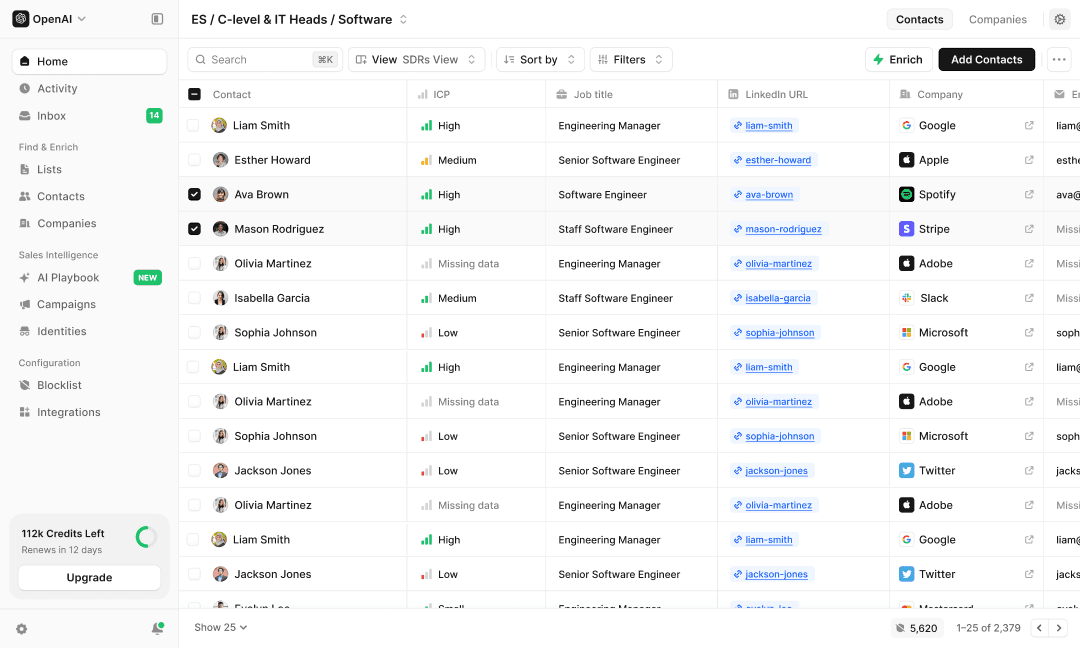
Overview
Enginy is an AI-native, end-to-end GTM platform for B2B sales teams that want enrichment and outreach in the same place. Formerly Genesy, we now support teams at Factorial, SeQura and Venair.
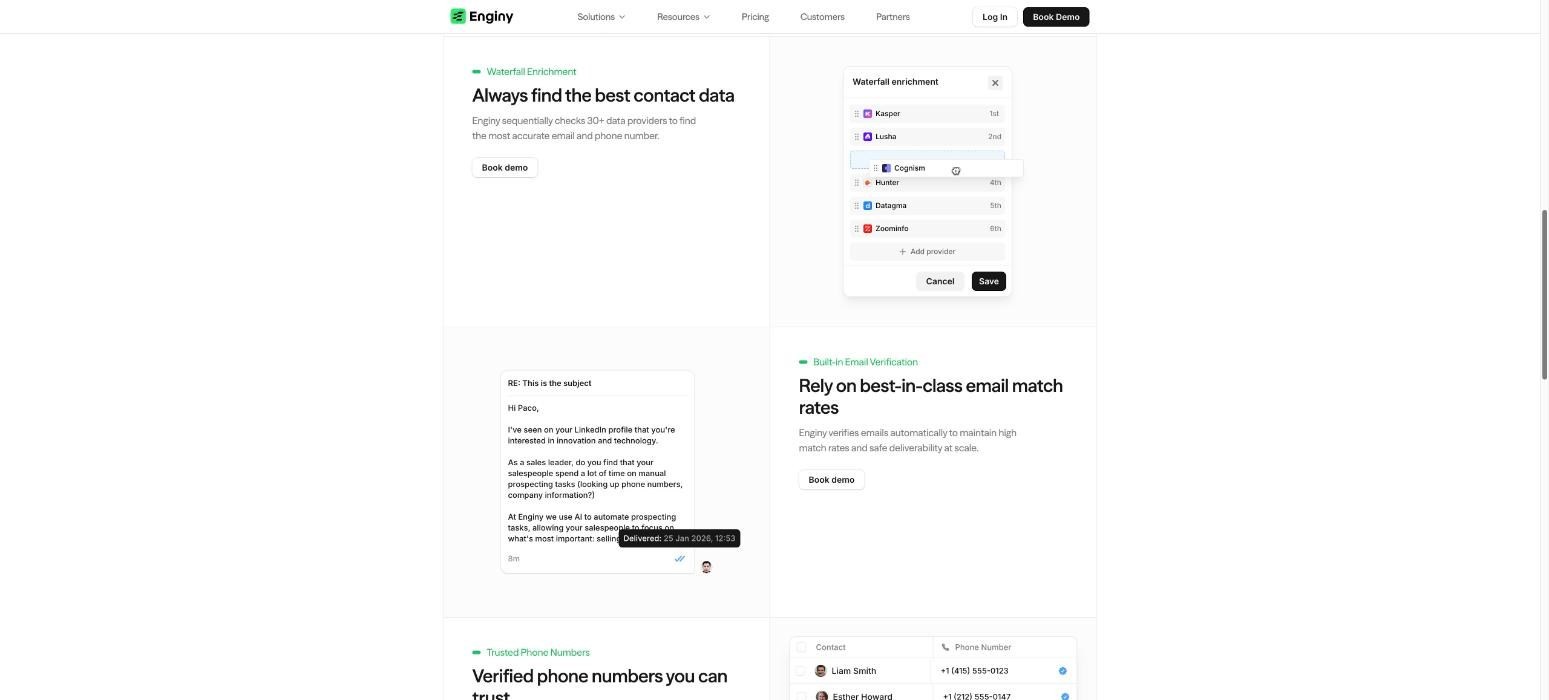
Our contact data enrichment runs a waterfall across 30+ providers in real time. It returns verified professional emails and direct phone numbers, then cleans the data before it reaches your CRM.
Unlike a standalone enrichment tool, we also help you find who to contact. The list building feature further layers in buying signals such as job changes, new hires and funding rounds on top of your ideal customer profile.
Finally, our multichannel outreach runs across email, social media and calls. That makes Enginy a natural FullEnrich alternative for teams that want one tool instead of three.
Ideal For
SDR and BDR teams that need enriched contacts and outreach in one workflow
Founders and early-stage startups without a dedicated RevOps hire
RevOps teams consolidating a database, enrichment tool and sequencer
Agencies and recruitment firms building lists for many clients or roles
Top Features
Waterfall enrichment: Checks 30+ providers for verified emails and mobile numbers, which lifts coverage beyond any single source.
Pre- and post-enrichment cleaning: Removes invalid emails and badly formatted numbers, so only usable contacts reach your CRM.
Signal-based list building: Find accounts showing intent through job changes, hiring, funding and technology stack data.
Multichannel campaigns: Run conditional sequences across email, social media and calls, with AI-written messages and reply handling.
CRM automation: Sync enriched lists to HubSpot, Salesforce, Pipedrive, Zoho or Microsoft Dynamics 365 automatically.
Why We're the Best FullEnrich Alternative?
We match FullEnrich on the core job of finding verified emails and phone numbers. From there, we go further with prospect discovery and buying signals.
Teams can also launch outreach without exporting a single CSV. That removes the extra tools most FullEnrich users still pay for.
Because any rep can run it, you also don't need a GTM engineer to stitch the workflow together.
Pros
Enrichment, prospecting and outreach in one tool
Waterfall coverage across 30+ data providers
Built-in data cleaning before CRM import
Buying signals help reps prioritise the right accounts
Five structured onboarding sessions for a fast start
Cons
Teams that only need occasional email lookups may not use its full depth
Users who want instant self-serve sign-up will need a short call first
Companies tied to a legacy enterprise suite may face a longer switch
Pricing
At Enginy, we don't publish fixed prices. Instead, we build a plan around your team after a short qualification call.
Our pricing is credit-based. Credits cover data extraction, email and phone enrichment, verification and AI fields, so you only pay for what your team uses each month.
Final Verdict
Enginy is the strongest FullEnrich alternative for teams that want enrichment to lead straight into outreach.
We cover verified emails and phone numbers, then add the prospecting and campaigns FullEnrich leaves out. As a result, you replace several separate tools with one workflow.
For growing B2B teams that want cleaner data and more meetings, that combination is hard to match.
2. LeadMagic
Overview
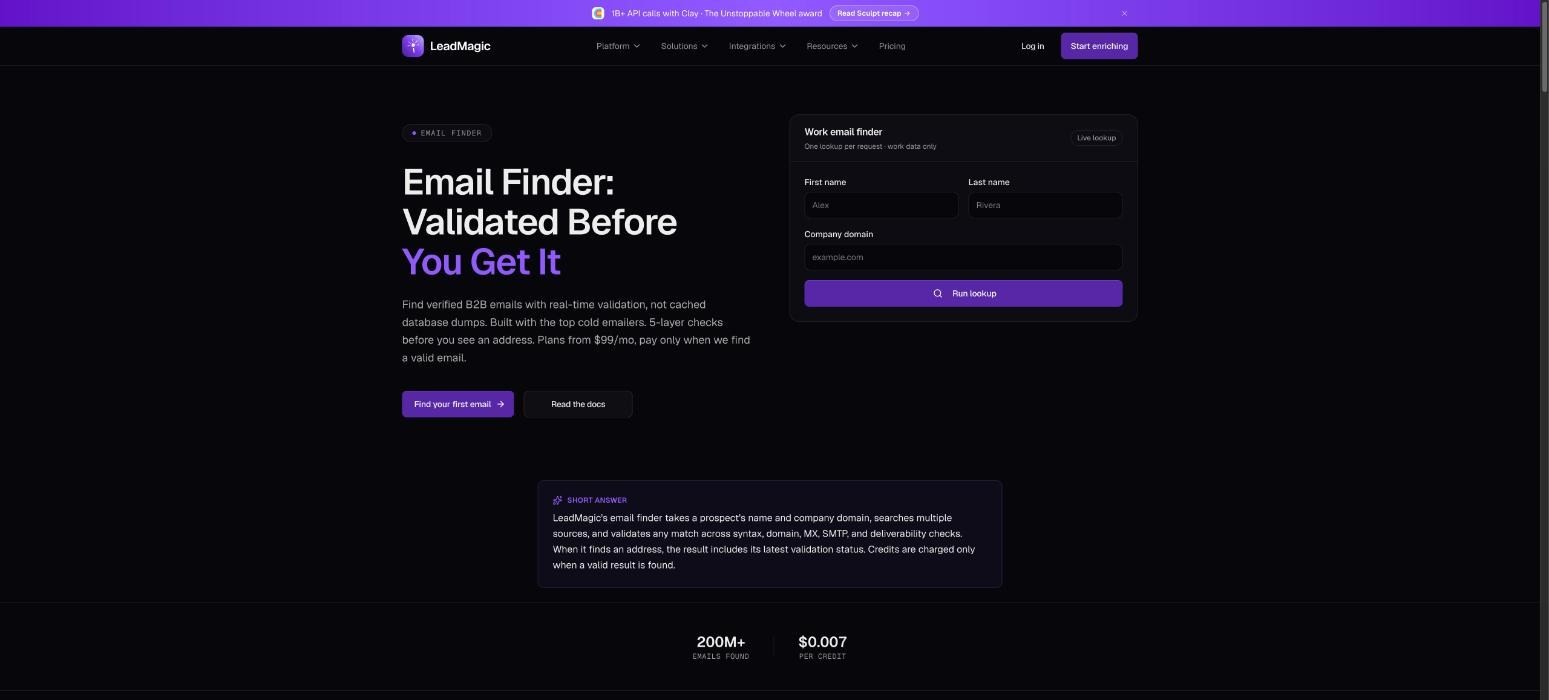
LeadMagic is a B2B data enrichment tool focused on accuracy. It finds and validates work emails and mobile numbers, and it was built API-first, so developers and GTM engineers can plug it into their own workflows.
The tool covers several enrichment jobs in one place. These include email finding, email validation, mobile lookup and company enrichment, as well as finding the people behind a given social media profile.
LeadMagic is also a popular data source inside Clay and other workflow tools. Teams often use it as one step in a larger enrichment waterfall.
Like FullEnrich, they focus on data rather than outreach. That makes it one of the closest FullEnrich competitors, though teams will still need separate tools for prospect search and sequences.
Ideal For
GTM engineers building enrichment into custom workflows
Teams that want accurate emails and mobiles through an API
Clay users looking for a reliable data source
Agencies enriching lists in bulk for clients
Top Features
Email finder and validation: Finds work emails and checks them before you send, which protects deliverability.
Mobile finder: Returns direct mobile numbers for phone-led outreach.
API-first design: Lets teams build enrichment into their own tools and automations.
Bulk enrichment: Processes large CSV lists in one go.
Why It's a Strong FullEnrich Alternative?
LeadMagic is one of the strongest choices for teams that care most about data accuracy.
Its validation steps help keep bounce rates low, while the API suits technical teams that build their own workflows. The annual plans also include large credit allowances.
However, it stays focused on enrichment, so prospect search and outreach still need separate tools you'll have to manage.
Pros
Strong focus on email and mobile accuracy
Flexible API for custom workflows
Works well inside Clay and similar tools
Annual plans include large credit volumes
Cons
No built-in outreach or sequences
Limited prospect search compared with full databases
Best suited to technical users
No buying signals for prioritisation
Pricing
LeadMagic's annual plans start at $41 per month for Basic, $83 for Essential and $208 for Growth, billed at $490, $990 and $2,490 a year.
These include 24,000, 60,000 and 240,000 annual credits respectively. Annual billing also gives you two months free compared with paying monthly.
Final Verdict
LeadMagic suits technical teams that want accurate emails and mobile numbers through a flexible API. It's a strong data source for anyone building their own enrichment waterfall.
However, it doesn't help with prospecting or outreach.
Most sales teams will still need a separate database and sequencer, which recreates the tool sprawl they want to escape.
3. Clay
Overview
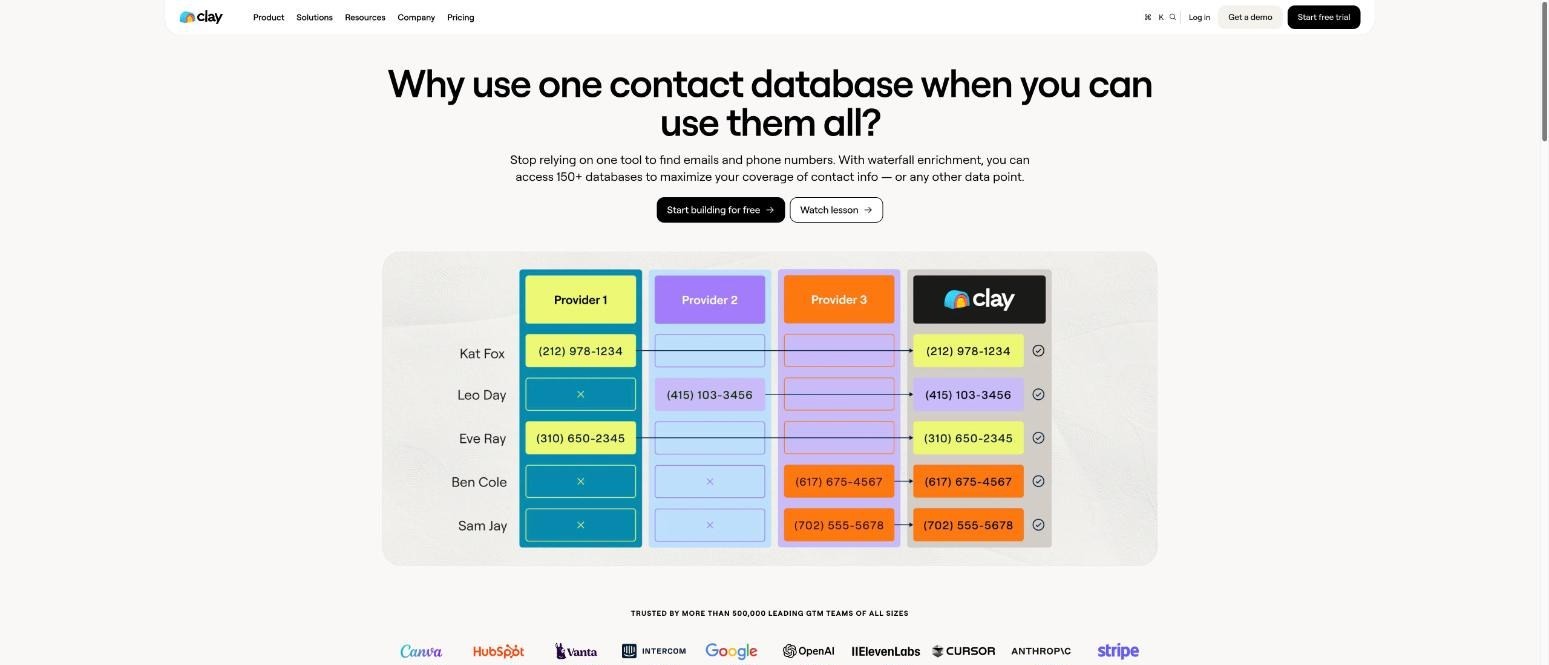
Clay is a data enrichment and research tool built around a spreadsheet-style workspace. It connects to more than 100 data providers, so teams can design their own waterfall for emails, phone numbers and company data.
Its AI agent, Claygent, browses the web to answer custom questions about each account. Teams then use those answers to segment lists or write tailored opening lines.
Clay doesn't run outreach itself. Instead, it pushes enriched data into sequencers and CRMs through native integrations and webhooks.
This flexibility makes the platform a hugely-capable FullEnrich competitor for technical teams. On the other hand, getting real value from Clay usually requires hiring a GTM engineer who can build and maintain these workflows.
Ideal For
GTM engineers and RevOps teams who enjoy building workflows
Growth teams that need niche data points beyond standard fields
Agencies running custom research for several clients
Top Features
Custom waterfalls: Choose and order data providers to suit each use case.
Claygent: Uses AI to research accounts and answer custom questions at scale.
Flexible tables: Combines data, formulas and AI prompts in one view.
Integrations: Sends enriched data into CRMs and outreach tools.
Why It's a Strong FullEnrich Alternative?
Clay is one of the smartest choices for teams wanting full control over enrichment. Instead of FullEnrich's fixed waterfall, you build your own across far more providers.
Its AI research also adds context that a standard enrichment tool can't supply.
Still, that flexibility comes with a learning curve, so it suits technical teams best.
Pros
Access to a wide range of data providers
Custom waterfalls for different use cases
AI research adds context to every account
Large template library and community
Cons
Steep learning curve for non-technical users
No built-in outreach or sequences
Credits can run out fast on complex workflows
Usually needs a dedicated operator
Pricing
Clay offers a free plan for testing. Paid plans start at $167 per month for Launch and $446 per month for Growth.
Enterprise pricing is custom. Plans scale with annual actions and data credits, and higher tiers add CRM sync, automation, integrations and dedicated support for larger teams.
Final Verdict
Clay is a strong FullEnrich alternative for technical teams that want to design their own enrichment and research workflows.
However, most sales teams don't have the time or skills to build and maintain those workflows.
Without a dedicated operator, much of its flexibility goes unused, and you'll still need a separate tool to run outreach, then track and manage replies.
4. Prospeo
Overview
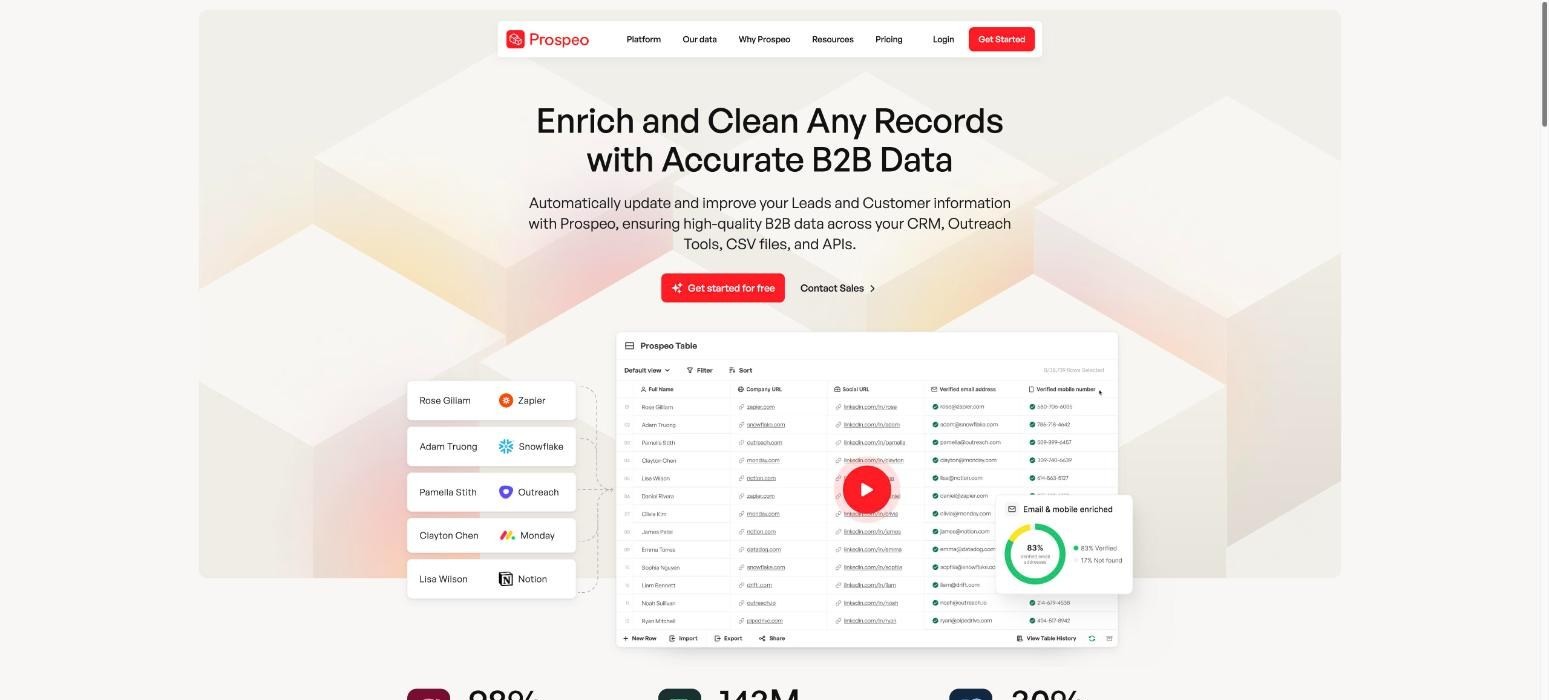
Prospeo is a B2B contact data tool that helps teams find verified emails and mobile numbers. It combines a searchable database with enrichment, so you can both discover new contacts and fill gaps in existing lists.
Teams can search by job title, company, location and other filters. They can also enrich contacts in bulk or one at a time through a browser extension that works on social media profiles and company websites.
Prospeo verifies emails before returning them, which helps keep bounce rates down. Its interface is simple, so reps can start finding contacts within minutes.
Compared to FullEnrich, Prospeo adds a prospect database on top of enrichment. However, it still doesn't run outreach or provide deep buying signals.
Ideal For
Small sales teams on a tight budget
SDRs who need quick email and mobile lookups
Founders building their first prospect lists
Top Features
Email finder: Returns verified work emails for individual contacts or whole lists.
Mobile finder: Finds direct phone numbers for call-led outreach.
Search filters: Build lists by title, company size, industry and location.
Browser extension: Pull contact details while browsing profiles and company sites.
Why It's a Strong FullEnrich Alternative?
Prospeo is one of the smartest choices for teams that want enrichment and prospect search in one affordable tool. Unlike FullEnrich, this tool lets you find new contacts as well as enrich existing ones.
Its simple interface also helps new reps get started within a few minutes.
However, their buying signals are limited, and you'll still need a sequencer to run outreach.
Pros
Affordable entry pricing
Database search and enrichment together
Simple, quick-to-learn interface
Verified emails help protect deliverability
Cons
Limited buying signals
No built-in outreach or sequences
Data depth can vary by region
Pricing
Prospeo offers a Free plan, followed by Starter at $37, Growth at $74 and Pro at $187 per user per month.
Paid plans scale through higher annual credit allowances. They also add more search filters, CRM features, analytics and rollover for any unused credits each period.
Final Verdict
Prospeo is a good fit for small teams that want affordable email and mobile data, plus a basic prospect database. It's quick to learn, and the free plan makes testing easy.
However, the platform lacks buying signals and outreach, so growing teams will need extra tools to turn enriched contacts into booked meetings.
5. Lusha
Overview
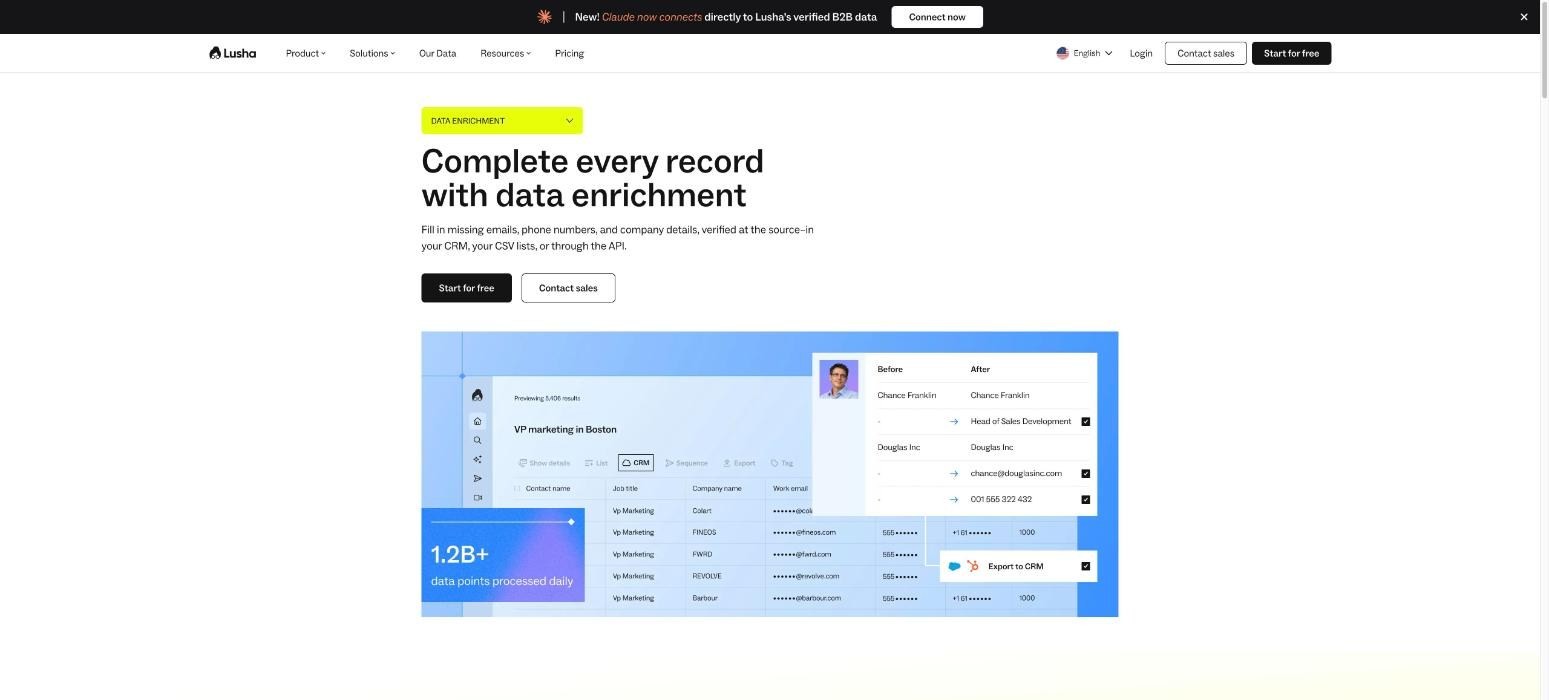
Lusha is a B2B contact data tool known for its browser extension and simple prospecting interface. Reps can look up emails and direct dials while browsing social media profiles or company websites.
Beyond the extension, Lusha offers a searchable database with filters for job title, company size, industry and location. It also enriches existing CRM records, filling in missing contact details for leads you already hold.
Higher plans add buying intent data and API access. That helps teams spot accounts showing interest and automate enrichment at scale.
Lusha is one of the most accessible FullEnrich competitors for small teams, thanks to its free plan. Its data depth can vary by region, though, and the tool doesn't run multichannel outreach itself.
Ideal For
Small sales teams needing quick contact lookups
SDRs who prospect while browsing profiles
Teams wanting a free plan to test before buying
Top Features
Browser extension: Reveals contact details while you browse profiles and websites.
Prospecting database: Search contacts with standard filters.
CRM enrichment: Fills gaps in existing records automatically.
Intent data: Highlights accounts showing buying interest on higher plans.
Why It's a Strong FullEnrich Alternative?
Lusha is one of the smartest choices for quick, low-friction contact lookups. Its browser extension grabs details at the moment, and its database adds the prospecting FullEnrich lacks.
The free plan also lowers the barrier to entry.
However, data coverage can be patchy in some regions, and outreach still has to happen in a separate tool.
Pros
A free plan lets small teams test the data before paying anything.
The browser extension is easy to use and reveals contact details while you browse.
Prospect search and CRM enrichment both sit in one tool, so there's less switching.
Higher plans add intent data, which helps reps spot accounts showing buying interest.
Cons
Data quality varies by region, so coverage outside core markets can be patchy.
There's no built-in multichannel outreach, so you'll need a separate sequencer.
Intent data and API access sit on higher tiers, which raises the cost for growing teams.
Pricing
Lusha offers a free plan, with paid plans starting at $32.45 per month for Starter, $45.45 for Pro and $259.95 for Premium.
The Scale plan uses custom pricing. Plans differ by credits, seats, API access, buying intent data and other advanced features for growing teams.
Final Verdict
Lusha suits small teams that want quick contact lookups and a free plan to start with. Its browser extension is handy, and the database adds prospecting that FullEnrich doesn't offer.
However, data depth varies by region, and you'll need a separate sequencer for outreach.
6. Apollo.io
Overview
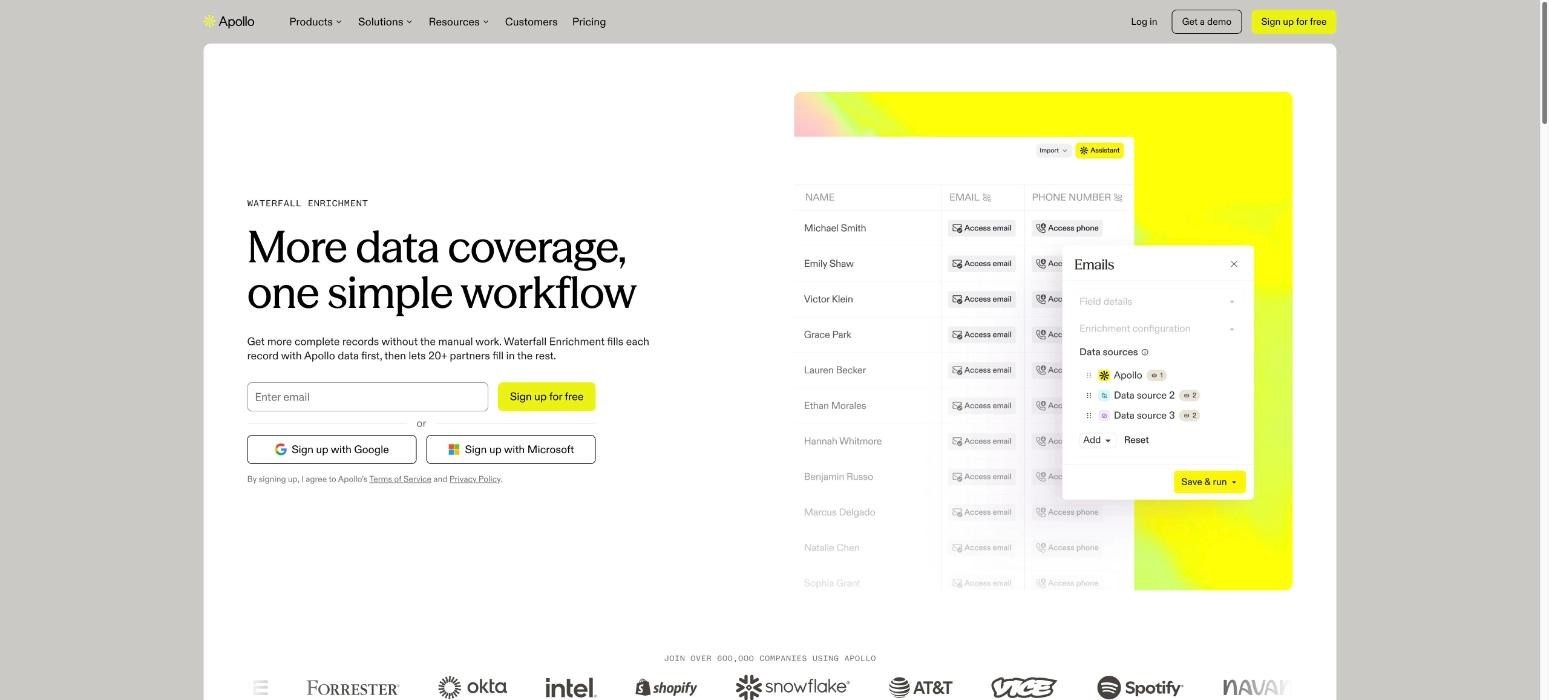
Apollo.io is an all-in-one sales tool that pairs a large B2B contact database with enrichment sequences and a built-in dialler. For many startups, it's the first tool they use to find and contact prospects.
Its database lets teams search by title, company size, industry and location. Enrichment fills in emails and phone numbers for contacts in your lists or CRM, while sequences can include email, calls and manual social media tasks.
Apollo's AI assistant also drafts emails using contact, company and industry data. Compared with FullEnrich, Apollo covers prospecting and outreach as well as data.
However, the tool relies mainly on its own database rather than a multi-provider waterfall, so match rates and accuracy can vary.
Ideal For
Early-stage startups building their first outbound process
Small teams that want data and sequences together
Founders on a tight budget
Top Features
B2B database: Search a large pool of contacts with standard filters.
Enrichment: Adds emails and phone numbers to lists and CRM records.
Sequences: Combine email, calls and tasks in one campaign.
AI writing assistant: Drafts emails based on contact data.
Why It's a Strong FullEnrich Alternative?
Apollo.io is one of the smartest choices for startups that want data and outreach in one low-cost tool. Unlike FullEnrich, it covers prospecting and sequences as well as enrichment.
That breadth helps small teams launch their first campaigns quickly without buying several separate tools upfront.
However, relying on one database means match rates and accuracy can lag behind multi-provider waterfalls.
Pros
A free plan and low entry price make it easy for startups to try.
Its database, enrichment and sequences all sit in one tool, so small teams need fewer subscriptions.
Setup is quick, so most teams can launch their first campaign soon after signing up.
The AI assistant drafts emails from contact data, which saves reps writing time.
Cons
Data accuracy varies by region, especially for contacts outside the US.
Enrichment relies on Apollo's own database rather than a multi-provider waterfall.
Filters and intent signals are fairly basic compared with signal-led tools.
Add-ons for extra credits and integrations can push up the real monthly cost.
Pricing
Apollo.io offers a Free plan alongside paid tiers billed annually. Basic costs $49, Professional costs $79 and Organization costs $119 per seat per month.
Add-ons such as extra credits, advanced email domains and additional integrations are priced separately, so costs can rise as you grow.
Final Verdict
Apollo.io is a sensible FullEnrich alternative for early-stage startups that want data and sequences together on a tight budget. However, its single-database approach can mean lower match rates than a multi-provider waterfall, especially for contacts outside the US.
As targeting becomes more specific, many teams move to a tool with stronger multi-provider enrichment, cleaner data and buying signals built in.
7. Cognism
Overview
Cognism is a B2B data provider with a strong focus on Europe. It's known for phone-verified mobile numbers, which it calls Diamond Data, and for its emphasis on GDPR compliance.
Teams use the tool to search for contacts, enrich CRM records and reach decision-makers by phone. It also screens numbers against do-not-call lists in supported regions, which helps reduce compliance risk.
Intent data shows which accounts are actively researching relevant topics. Integrations with major CRMs and sales engagement tools keep data flowing into existing workflows without manual exports.
Overall, Cognism is one of the strongest FullEnrich competitors for UK and European prospecting, though its annual contracts better suit mid-market and enterprise teams than startups.
Ideal For
Sales teams prospecting into the UK and Europe
Phone-led SDR teams that need verified mobiles
Mid-market and enterprise companies with compliance needs
Top Features
Phone-verified mobiles: Diamond Data numbers are checked by phone for higher connect rates.
GDPR-focused data: Built with European compliance in mind.
Intent data: Highlights accounts researching relevant topics.
Do-not-call screening: Reduces compliance risk for phone outreach.
Why It's a Strong FullEnrich Alternative?
Cognism is one of the strongest options for phone-led outreach in Europe. Its phone-verified mobiles can lift connect rates, and its compliance focus suits regulated markets.
The platform also adds intent data that FullEnrich doesn't offer, which helps reps decide who to call first.
However, the annual cost puts the tool out of reach for many smaller teams.
Pros
Coverage is strong across the UK and Europe, where many data tools fall short.
Mobile numbers are phone-verified, which helps reps reach real decision-makers.
A clear focus on compliance suits teams selling into regulated markets.
Higher plans include intent data, so reps can prioritise accounts that are actively researching.
Cons
The high annual cost puts it out of reach for most small teams.
Coverage outside Europe can be thinner than with US-focused providers.
There are no built-in outreach sequences, so you'll still need a separate tool.
Pricing
Cognism's plans start at $14,000 per year for Standard and $18,750 per year for Pro. Both plans include 5 seats.
Pricing is subscription-based and billed annually.
Cognism Credits for contact reveals, enrichment and exports are sold separately, so heavier users should budget for more than the base plan.
Final Verdict
Cognism suits mid-market and enterprise teams that sell into Europe and rely heavily on phone outreach.
Its verified mobiles and compliance focus are real strengths for those particular sales teams.
However, the annual cost is a big step up from FullEnrich, so smaller teams and those selling mainly outside Europe may prefer a flexible, credit-based option.
8. ZoomInfo
Overview
ZoomInfo is one of the largest B2B data providers, built for enterprise sales and marketing teams. Its database covers contacts, companies, org charts and technographics across most industries.
Beyond contact data, ZoomInfo offers intent signals that show which companies are researching relevant topics. It also includes website visitor tracking and AI features that help reps prioritise accounts.
Enrichment can also run automatically inside the CRM, keeping records up to date as people change roles or companies.
For enterprises, ZoomInfo is one of the most complete FullEnrich competitors. Smaller teams may find it heavy, though, given its cost, annual contracts and the admin support needed to use every feature.
Ideal For
Large enterprise sales and marketing teams
Organisations needing deep company and org chart data
Teams with budget for annual contracts
Top Features
Large B2B database: Contacts, companies, org charts and technographics in one place.
Intent signals: Show which accounts are researching relevant topics.
CRM enrichment: Keeps records up to date automatically.
Website visitor tracking: Identifies companies visiting your site.
Why It's a Strong FullEnrich Alternative?
ZoomInfo is one of the strongest options for enterprises that need data depth at scale. It adds company insights, org charts and intent signals that FullEnrich doesn't cover.
Automatic CRM enrichment also keeps records fresh as contacts change their roles, companies or phone numbers.
However, its cost and complexity make it hard to justify for most small and mid-sized teams.
Pros
Its large, detailed database covers contacts, companies and org charts in one place.
Strong intent and company data help reps focus on accounts that are ready to buy.
CRM records update automatically, so contact details stay fresh as people move roles.
A wide range of integrations lets the data flow into most sales and marketing tools.
Cons
The high entry cost puts it beyond the budget of most small teams.
Setup and ongoing management are complex, often needing a dedicated admin.
Annual contracts reduce flexibility if your needs change during the year.
Its depth is more than most small and mid-sized teams will use.
Pricing
ZoomInfo uses custom pricing based on seats and credits, so there's no public price list. Entry plans typically start at around $15,000 per year.
You'll need to speak with their sales team for an exact quote based on your team size, seats and data needs.
Final Verdict
ZoomInfo suits large enterprises that need deep company data, intent signals and automatic CRM enrichment at scale.
For most small and mid-sized teams, though, the cost and setup effort are hard to justify.
For teams leaving FullEnrich in search of flexibility, ZoomInfo is likely more commitment than they need, so a lighter, all-in-one tool usually fits better.
9. BetterContact
Overview
BetterContact is a waterfall enrichment tool that works in a similar way to FullEnrich. It checks a series of data providers in sequence to find verified emails and mobile numbers for your contacts. Like FullEnrich, BetterContact only charges for data it finds. It also verifies emails before returning them, helping protect your sender reputation.
Teams can enrich lists through CSV uploads, a browser extension or integrations with tools such as HubSpot, Clay and Lemlist. An API is also available for teams building custom workflows.
BetterContact is one of the closest FullEnrich competitors in how it works. A low entry price appeals to small teams, though BetterContact shares FullEnrich's gap, i.e., no prospecting or outreach.
Ideal For
Small teams wanting affordable waterfall enrichment
Users comparing like-for-like with FullEnrich
Agencies enriching lists for clients
Top Features
Waterfall enrichment: Checks many providers in sequence for higher find rates.
Pay for found data: Credits are only used when results come back.
Email verification: Checks emails before returning them.
Integrations: Connects with HubSpot, Clay, Lemlist and others.
Why It's a Strong FullEnrich Alternative?
BetterContact is one of the smartest choices for teams that like FullEnrich's waterfall approach but want a lower entry price. It covers the same core job of finding verified emails and mobile numbers.
The pay-for-results model also keeps costs predictable, since credits are only spent on usable data.
However, like FullEnrich, BetterContact doesn't cover prospecting or outreach.
Pros
A low entry price makes it easy for small teams to start enriching lists.
Waterfall coverage across many providers lifts find rates for emails and mobiles.
You only pay for data found, so failed lookups don't eat into your credits.
CSV uploads and integrations make it simple to move enriched contacts into other tools.
Cons
There's no prospect database, so you need a separate tool to build lists.
Outreach isn't built in, which means adding a sequencer to contact anyone.
Without buying signals, reps have little guidance on which contacts to prioritise.
Pricing
BetterContact's Starter plan costs $15 per month with 200 credits, while Pro costs $49 per month for 1,000 credits.
Enterprise starts at $799 per month with custom credit volumes and discounts. New users also receive 50 free credits to try the tool before paying anything.
Final Verdict
BetterContact is a good fit for small teams that like FullEnrich's waterfall model but want a cheaper way in. However, it shares the same core limits: no prospecting, no outreach and no buying signals.
If those gaps are why you're leaving FullEnrich, choose FullEnrich alternatives that cover the full outbound workflow, from prospecting to booked meetings.
10. Dropcontact
Overview
Dropcontact is a French B2B email enrichment and data cleaning tool with a strong focus on GDPR. Rather than storing a large contact database, it finds and verifies emails using its own algorithms and live checks.
It also helps clean and standardise CRM data. Dropcontact can fix name formatting, merge duplicate records and keep contact details up to date inside tools such as HubSpot, Salesforce and Pipedrive. That makes the platform especially useful for teams whose main problem is messy CRM data rather than missing contacts.
Dropcontact is one of the more specialised FullEnrich competitors; strong for European teams and email enrichment, but lighter on phone data and prospecting.
Ideal For
European teams with strict GDPR requirements
RevOps teams cleaning and deduplicating CRM data
Companies enriching emails for existing contacts
Top Features
GDPR-focused enrichment: Finds emails without relying on a stored database.
CRM cleaning: Helps standardise names and fields across records.
Deduplication: Merges duplicate contacts and companies automatically.
Native CRM integrations: Works inside HubSpot, Salesforce and Pipedrive.
Why It's a Strong FullEnrich Alternative?
Dropcontact is one of the smartest choices for European teams that care about compliance and clean CRM data. Its deduplication and formatting tools go further than FullEnrich on data hygiene.
Their database-free approach also suits companies with strict GDPR policies and cautious, detail-focused legal teams.
However, phone data and prospecting are limited, so phone-led teams may need another data source.
Pros
A strong GDPR focus suits European teams with strict compliance rules.
CRM cleaning and deduplication keep records tidy and free of duplicates.
Native integrations let it work directly inside HubSpot, Salesforce and Pipedrive.
Free credits let new users test the enrichment before paying.
Cons
Phone number coverage is limited, so call-led teams may need another source.
There's no prospect database for building new lists from scratch.
Outreach isn't built in, so you'll still need a separate sequencer.
Pricing
Dropcontact's pricing is credit-based. With 4,000 credits selected, Starter costs €79 per month, while Growth costs €120 and adds credit rollover and wider enrichment.
Enterprise covers volumes from 200,000 credits per month with custom pricing. New users also get 50 free credits for testing before they commit.
Final Verdict
Dropcontact suits European teams that want GDPR-focused email enrichment and cleaner CRM data.
Its deduplication and formatting tools are a real advantage for busy RevOps teams managing large CRMs.
However, with limited phone data and no prospecting or outreach, Dropcontact is a narrow choice that most sales teams will need to pair with other tools.
Why Enginy Works Across Multiple Use Cases
1. Enginy for SDR and BDR Teams
SDRs lose hours switching between a database, an enrichment tool and a sequencer. With Enginy, they build a list, enrich it and launch a campaign in one place.
Our unified inbox and AI-drafted replies also keep follow-ups moving. Factorial's SDRs saved 3 to 4 hours a day after moving their prospecting to Enginy.
2. Enginy for RevOps and GTM Engineers
RevOps teams spend too much time maintaining connections between tools. We automate the full workflow, from scraping and enrichment to cleaning, CRM import and assignment.
Recurring automated lists keep CRM data fresh. Meanwhile, our blocklist prevents outreach to customers, partners and do-not-contact records.
3. Enginy for Startup Founders
Founders need to test markets quickly without hiring a RevOps team. Our AI Finder turns plain-language searches, such as "CTOs at early-stage startups in Barcelona", into filtered lists in seconds.
From there, founders can enrich contacts and launch campaigns the same day. That makes it easier to see which markets respond before investing in a sales team.
4. Enginy for Agencies
Outbound agencies run many campaigns across different industries. We help them build targeted lists for each client using filters, buying signals and lookalike searches.
Our naming conventions and CRM sync keep every client's data organised. As a result, agencies can launch new campaigns in hours rather than days.
5. Enginy for Recruitment Firms
Recruiters need to reach hiring managers at the right moment. Our hiring signals show which companies are recruiting for specific roles, so recruiters can contact them while the need is fresh.
For example, Talent Match, one of our recruitment customers, now gets around 30% of all new leads from Enginy. The team also reports a 4 to 5 times return on its investment.
What Makes a Good FullEnrich Alternative?
A strong replacement should match what FullEnrich already does well, then fill the gaps that pushed you to look elsewhere. These 5 criteria matter most:
1. Strong Data Coverage
A good replacement should match or beat FullEnrich's find rates. That usually means a waterfall across several providers rather than a single database.
Check coverage in your own target regions, since many tools are stronger in the US than in Europe.
2. Verified, Clean Data
Finding an email isn't enough if it bounces. Look for tools that verify emails and phone numbers before returning them.
Data cleaning before CRM import also matters, since it stops duplicates and bad records from building up.
3. Prospecting Built In
FullEnrich only enriches contacts you already have. A stronger alternative also helps you find new prospects through search filters and buying signals.
That removes the need for a separate database.
4. A Path to Outreach
Enriched data only creates value when it turns into conversations. The best alternatives either run outreach themselves or connect cleanly to your sequencer.
For most teams, keeping both in one tool saves time and money.
5. Clear, Predictable Pricing
Credit models vary widely between FullEnrich alternatives. Some charge only for data found, while others charge for every lookup.
Compare how much a typical month of emails and mobile numbers would cost, rather than headline prices alone.
How to Choose the Right FullEnrich Alternative for Your Needs
Once you know what a good replacement looks like, the next step is matching one to your team. Work through these 6 steps to narrow your shortlist:
1. Define the Data You Need
Start by listing what you need most: emails, mobile numbers or both. Phone-led teams should focus on mobile coverage, since that's where tools differ most.
Also think about the extra fields your reps actually use.
Job titles, company size and technology stack can matter as much as contact details when you're deciding who to reach first.
2. Test Coverage on Your Own Lists
Take a sample of 100 contacts from your target market and run them through two or three FullEnrich alternatives. Compare find rates and bounce rates side by side.
Make sure the sample reflects your real mix of regions, industries and job levels.
A tool that performs well on US tech contacts may struggle with mid-sized companies in Spain or Germany, so test where you actually sell.
3. Decide Whether You Need Prospecting
Teams with good lists may only need a pure enrichment tool. To find new accounts, choose one with search filters and buying signals.
Buying signals such as job changes, new hires and funding rounds help reps prioritise who to contact first.
Without them, teams often enrich every contact on a list and then guess which ones are worth the effort.
4. Check How Data Reaches Your CRM
Look at native integrations, deduplication and field mapping. A tool that creates duplicate records will cost you time later.
Ask how the tool handles contacts that already exist in your CRM.
The best options update existing records instead of duplicating them, and clean out invalid emails and badly formatted numbers before import.
5. Consider Outreach in the Same Tool
Ask whether you'll still need a separate sequencer. Combining enrichment and outreach often cuts both cost and admin.
One tool also shortens the gap between finding a contact and reaching out.
Reps no longer shuffle CSVs between tools and lose context along the way.
6. Compare the Total Cost
Add up every tool you'd need, plus the rep time spent moving data between them. The cheapest enrichment tool isn't always the cheapest setup.
Check how each tool prices phone numbers compared with emails, since mobiles often cost more credits.
Then estimate a typical month of usage, rather than comparing headline prices on their own.
Everything You Need to Know About FullEnrich Alternatives
Category | Key Considerations |
|---|---|
Top 3 Alternatives | Enginy, LeadMagic and Clay |
Best Overall Option | Enginy, for waterfall enrichment plus prospecting and multichannel outreach in one tool |
Why Look for FullEnrich Alternatives | No prospect search, no outreach and limited buying signals |
How to Choose the Best FullEnrich Alternatives? | Define your data needs, test coverage on real lists, check CRM sync and compare total cost |
Price Range | From free plans to around $18,750 per year for enterprise data providers |
Ease of Switching | Usually straightforward, since most tools accept CSV uploads and connect to common CRMs |
Must-Have Features | Multi-provider enrichment, email and phone verification, CRM integration and data cleaning |
Mistakes You Shouldn't Make | Choosing on headline price alone, skipping a coverage test and ignoring the tools you'll still need for outreach |
Ready to Move On from FullEnrich? Try Enginy
At Enginy, we give you the waterfall enrichment you rely on today, plus the prospecting and outreach FullEnrich leaves out. Our data comes from 30+ providers, buying signals show you who to contact first, and our multichannel campaigns turn enriched contacts into meetings.
We're built for B2B sales teams, founders and agencies that want one workflow instead of a stack of disconnected tools. Any rep can run it, and five onboarding sessions get your team live quickly.
One of our customers, Factorial, lifted reply rates from 10% to 45% with our campaigns. Their SDRs also saved 3 to 4 hours a day, while conversion doubled from 4% to 8% on deals our campaigns touched.
Book a demo with Enginy and test our enrichment on your own target market.
FAQs About FullEnrich Alternatives
What is FullEnrich used for?
FullEnrich is used for finding verified work emails and mobile numbers for contacts you already have. FullEnrich runs a waterfall across several data providers, checking each in turn until it finds a match. Teams upload a list or connect a CRM, and FullEnrich returns the missing contact details. It only charges for data it finds, which keeps costs tied to results.
What are the best FullEnrich alternatives in 2026?
The best FullEnrich alternatives in 2026 are led by Enginy, which matches FullEnrich's waterfall enrichment and adds prospecting and outreach. We check 30+ providers for verified emails and mobiles, then clean the data before CRM import. Buying signals show who to contact first, and multichannel campaigns turn those contacts into meetings.
What features should I look for in a FullEnrich alternative?
The features to look for in a FullEnrich alternative are multi-provider enrichment, email and phone verification, prospect search and native CRM integration. Buying signals such as job changes and funding rounds help you prioritise contacts. To cut down your tool stack, look for built-in outreach too. The strongest FullEnrich alternatives also clean data automatically before CRM import.
How to choose the best FullEnrich alternative for your needs?
To choose the best FullEnrich alternative for your needs, start by defining whether you need emails, mobiles or both. Then test 100 contacts from your target market across two or three tools and compare find and bounce rates. Check how each tool syncs with your CRM. Finally, add up the total cost of every tool you'd still need alongside it.
Is it easy to switch from FullEnrich to an alternative?
It is easy to switch from FullEnrich to an alternative, because most FullEnrich alternatives accept CSV uploads and connect to common CRMs. You can export your enriched lists and re-import them within a day. With Enginy, five structured onboarding sessions cover CRM setup, list building and your first campaigns. Most teams can run both tools side by side for a week or two while testing.
Is LeadMagic better than FullEnrich?
LeadMagic is better than FullEnrich for teams that want an API-first tool with strong email validation and large annual credit allowances. FullEnrich suits users who prefer a simple, web-based waterfall. Neither includes prospecting or outreach, so teams wanting both alongside enrichment will get more from an all-in-one tool such as Enginy.
What is the main difference between LeadMagic and FullEnrich?
The main difference between LeadMagic and FullEnrich is their approach to enrichment. LeadMagic is API-first, with its own email finder, mobile finder and validation tools for technical teams. FullEnrich runs a waterfall across third-party providers through a simpler interface. Both focus only on data, so neither finds new prospects, prioritises accounts or runs outreach.
Is Enginy more expensive than FullEnrich?
Enginy can cost more than FullEnrich on paper, but it often replaces two or three tools. FullEnrich covers enrichment only, so most teams also pay for a database and sequencer. Our plans combine enrichment from 30+ providers, prospect search and multichannel outreach, and our customer Factorial saved 3 to 4 hours per SDR daily after switching.
What is waterfall enrichment?
Waterfall enrichment is a method that checks several data providers in sequence until it finds a verified email or phone number. If the first provider has no match, the tool moves to the next, and so on. This lifts find rates compared with relying on one database. Enginy, FullEnrich, BetterContact and Clay all use waterfall enrichment to improve match rates.