Best Outreach Alternatives in 2026 (Top-Rated Competitors Reviewed)

Andrea López
Share
Key Takeaways (TL;DR)
Who Outreach.io is For?: Outreach.io suits large, enterprise sales organisations that already run a dedicated data stack and need deep conversation intelligence, forecasting and Salesforce-native workflow automation across hundreds of reps.
Why Seek an Outreach Alternative?: Opaque, seat-based pricing that regularly runs past £100 per user per month, a steep onboarding curve, and a platform that assumes you already own separate prospecting data are the three complaints that show up most often when teams look at Outreach competitors.
Best Overall Alternative?: Enginy edges ahead as the best Outreach alternative, because we combine prospect discovery, data enrichment and outreach execution in one workspace. This removes the need to run Outreach alongside a separate data vendor and a separate enrichment tool.
What Sets Enginy Apart?: Enginy's multi-stakeholder sequencing, contacting several decision-makers at one account in parallel, is a differentiator that no other tool on this list fully replicates.
How to Choose?: The three factors that matter most are team size and technical capacity (do you have a GTM engineer or not), budget (per-seat versus usage-based), and whether you need data and outreach in one system or are happy stitching tools together.
Top Outreach Alternatives in 2026 at a Glance
Tool | Best For | Key Features | Pros | Cons | Pricing Starts |
Enginy | Teams that want data and outreach in one place | List building, waterfall enrichment, multi-channel sequences | Complete workflow, no GTM engineer needed | No public pricing | Custom-quoted |
ListKit | Cold email teams needing verified lists | 731M+ contacts, triple verification | Low bounce rates, unlimited users | Data only, no sending | Free (100 credits) |
Salesforge | High-volume outbound with an AI SDR add-on | Agent Frank AI SDR, unlimited mailboxes | Deliverability infrastructure built in | Agent Frank is a separate cost | $48/month |
Salesloft | Enterprise revenue teams standardised on one seller surface | Cadence, Conversations, AI Agents | Deep Salesforce sync, mature coaching tools | No public pricing, enterprise cost | Custom-quoted |
Instantly | High-volume cold email sending | Unlimited warmup, built-in lead database | Simple setup, strong deliverability | Contact limits by tier | $47/month |
Smartlead | Agencies managing multiple client accounts | Mailbox rotation, sub-account structure | Granular deliverability control | No native lead database | $39/month |
Apollo.io | Mid-market teams wanting data plus sequencing | 275M+ contacts, sequencing, AI personalisation | Affordable, self-serve, big database | Shallow intent signals | Free plan; $49/seat/month |
Lemlist | Visual, personalised cold email | Dynamic images, multichannel sequences | Strong personalisation, credit bundles | Fewer enterprise features | $39/user/month |
Klenty | Mid-market teams needing calling plus sequencing | AI Agentic Cadences, Parallel/Power Dialer | Strong dialer, CRM depth | Steeper learning curve | $50/user/month |
Mixmax | Gmail-first individual sellers | Inbox scheduling, Copilot suite | No context-switching from Gmail | Email-only, no dialer | $29/user/month |
Why Consider Outreach Alternatives?
What Outreach Does Well?
Outreach.io built the sales engagement category. It still does several things better than most challengers. Its sequencing engine supports genuinely complex, multi-step, multi-channel cadences with conditional branching. The platform’s bi-directional Salesforce sync runs deep enough that most reps never need to leave their CRM to log activity.
On top of that, their conversation intelligence tool – Kaia, transcribes calls, flags buying signals and feeds coaching data back to managers, which large sales organisations rely on heavily.
For enterprise teams with a dedicated RevOps function and an existing data subscription, Outreach remains a capable, if expensive, foundation.
Where Outreach Falls Short?
Sellers already spend approximately 70% of their time on tasks that aren't selling – manual prospecting, data cleaning, tool management, and generic outreach that burns leads before it converts them. Outreach doesn't reduce that number.
The complaints that drive teams to search for Outreach.io alternatives cluster around three themes:
First, pricing: Outreach doesn't publish rates, and industry estimates place per-seat costs between £100 and £200 a month on annual-only contracts. That's often before you've added a separate data subscription.
Second, onboarding: new reps typically need two to four weeks to become productive, and several reviewers describe the interface as overwhelming once you factor in Engage, Call, Meet and the newer AI Agents.
Third, and perhaps most structurally, Outreach has no prospecting data of its own. It tells you how to reach someone once you already know who to contact, but it can't tell you who that person should be.
That's why most teams end up paying for Outreach plus a separate data vendor like ZoomInfo just to get started.
Best Outreach Alternatives: In-Depth Review & Comparison
1. Enginy
Overview
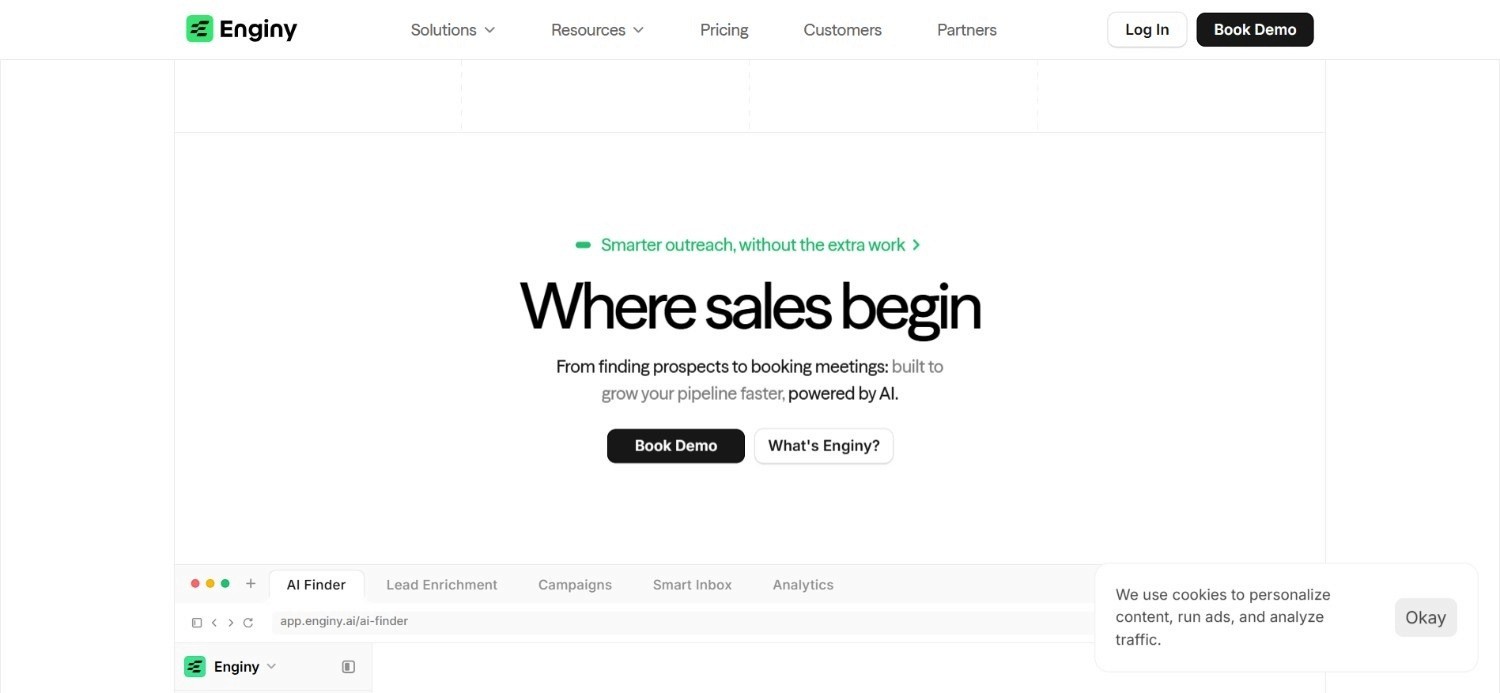
Enginy is an AI-native, end-to-end GTM platform built for B2B sales teams that want to simplify outbound. Instead of juggling separate tools for prospecting, enrichment, and outreach – we bring everything together in one workspace.
Our platform pulls data from 30+ enrichment providers using waterfall enrichment logic, then applies advanced filtering based on firmographics and buying signals like job changes, funding rounds and technology usage among others. These clean, enriched prospects then flow directly into an automated outreach sequence.
Unlike other Outreach alternatives, we don’t force teams to choose between a data platform and a sales engagement tool. Our tool was created to ensure that any sales rep (and not a dedicated GTM engineer) – can run the entire outbound motion from a single platform.
Customers including SeQura, Factorial and Venair use Enginy to replace multiple disconnected tools with one unified workflow. Factorial scaled from 10 leads per day to 5,000 leads per month – with reply rates climbing from 10% to 45% and conversion rates doubling from 4% to 8%.
Contrastingly, Venair also saw a 2-3x increase in monthly leads across most global delegations and used the platform to open the US market from scratch.
Ideal For
Sales teams that want prospect discovery, enrichment and outreach in one workspace instead of three separate subscriptions
RevOps and GTM Engineering functions managing multiple point solutions who want to consolidate
Founders and small sales teams who need a complete outbound motion without hiring a technical operator
Mid-market B2B SaaS, recruitment, IT consulting and cybersecurity teams running structured SDR and AE functions
Top Features
Advanced list building with layered intent signals (job changes, funding rounds, technology stack, hiring alerts) that surface prospects at the moment they're actually likely to buy
Waterfall data enrichment across 30+ providers with a built-in pre- and post-enrichment cleaning workflow, so only valid, verified contacts reach your sequences
Multi-stakeholder outreach sequencing that engages several decision-makers at the same account in parallel, improving meeting booking rates without adding headcount
AI Playbook configuration that feeds business context, ICP definitions and messaging rules into every AI-personalised message sent through the platform
Native CRM integrations with HubSpot, Salesforce, Pipedrive, Microsoft Dynamics 365, Zoho and Attio, keeping data synced without manual exports
Why We're the Best Outreach Alternative
Outreach.io requires a separate data subscription before a rep can send a single sequence – we don’t. That single difference removes an entire tool and monthly invoice from the stack.
It’s also why teams comparing Outreach.io alternatives keep landing on Enginy when the underlying problem is tool sprawl versus sequencing power. Enginy is built to be operated by regular sales reps, not GTM specialists.
This is a key differentiator for teams that don’t have a dedicated RevOps hire the way most other Outreach.io customers do.
Pros
Combines data, enrichment and outreach in one platform, cutting the total number of tools a team has to manage
No GTM engineer required to operate the platform day to day
Multi-stakeholder sequencing supports company-wide outreach strategies most single-channel tools can't replicate
Structured onboarding – five sessions on standard plans, fully customised for Enterprise; gets a new team live with guided setup rather than a self-serve manual.
Free prospect search tool available -- you can run a real ICP search by role, location and company size to preview matching contacts, with details blurred until you book a demo, with no commitment required.
Cons
Pricing isn't published, so teams comparing sticker prices upfront will need a qualification call first
Teams that only need a lightweight email sequencer with no data layer may find the full platform more than they need
Newer to the market than Outreach or Salesloft, so the enterprise reference base is smaller
Pricing
We don’t publish pricing publicly, with quotes being customized post a qualification call where we understand your team’s usage requirements.
The platform uses a credit-based model, with credits consumed majorly for data enrichment, verification and extraction along with AI-generated messaging.
Plans can scale by credit volume, contacts, sender identities, and other usage requirements determined during onboarding.
Final Verdict
Enginy is the strongest Outreach alternative on this list for teams looking to stop managing three separate subscriptions for a single outbound motion.
The proof is in the results: Factorial went from 10 leads per day to 5,000 leads per month, with reply rates tripling from 10% to 45%. Venair doubled or tripled monthly leads across global delegations.
Talent Match now sources 25–30% of all new leads through Enginy at a 4–5x ROI on platform investment. We're not the cheapest line item before a demo.
But for teams weighing total cost of ownership, including SDR hours spent on manual prospecting, data cleaning, and tool management that Enginy automates – the platform consistently comes out ahead of other fragmented alternatives.
2. ListKit

Overview
ListKit is a B2B lead database built specifically for cold email teams, holding over 731 million contact profiles with a triple-verification layer that checks email format, domain health and mailbox activity before a contact is ever exported.
It's a narrow tool by design. ListKit finds and verifies contacts, but it doesn't send emails, run sequences or manage warmup – so it's typically paired with a sequencer like Smartlead or Instantly rather than used standalone.
That focus is exactly why teams researching Outreach competitors often shortlist the platform to source prospecting data. Outreach also requires a separate data source, and ListKit's triple-verification is aimed squarely at the bounce-rate problem that plagues most list-building tools.
Credit-based pricing means you only pay for successfully enriched data, not failed lookups, which keeps costs predictable for high-volume outbound teams.
Ideal For
Cold email teams that already use Smartlead or Instantly and need a reliable, verified lead source
Agencies running outbound for multiple clients who need unlimited seats without per-user fees
US-focused enterprise and mid-market prospecting where database coverage is strongest
Teams prioritising low bounce rates over an all-in-one outreach platform
Top Features
731M+ verified contact database with triple-verification across email format, domain health and mailbox activity status
Credit-based pricing that only charges for successfully enriched data points, not failed lookups
Native integration with Smartlead for direct list transfer without manual CSV exports
AI-powered natural language search that removes the need to manually configure complex filters
Why It's a Strong Outreach.io Alternative
ListKit solves the same upstream data problem that pushes teams away from Outreach in the first place: verified contact data without a separate enterprise data subscription. Its triple-verification process is one of the more credible differentiators among list-building tools.
Multiple reviewers report bounce rates well under 2%, a meaningful improvement over less rigorous databases.
Pros
Low bounce rates thanks to triple-verification across email format, domain and mailbox activity
Unlimited users on paid plans, which suits growing outbound teams
Free plan with 100 credits available with no credit card required
Direct integration with Smartlead removes manual list transfer steps
Cons
No sending functionality, so it must be paired with a separate outreach tool
Intent data is inconsistently reported by users compared to the core verification feature
Database coverage thins outside the US and outside enterprise and mid-market segments
Credits expire monthly with no rollover, and there's no free trial beyond the limited free plan
Pricing
ListKit offers a free plan with 100 free leads and credits per month, with no card required.
Paid plans range from $97 to $597 a month depending on credit volume, and Enterprise pricing is custom for larger teams.
Final Verdict
ListKit is a strong Outreach.io competitor for teams that already have a sequencer and just need a reliable, verified data source to feed it.
The platform isn’t suitable for teams seeking a single Outreach alternative platform that can handle data and email sending both.
3. Salesforge
Overview
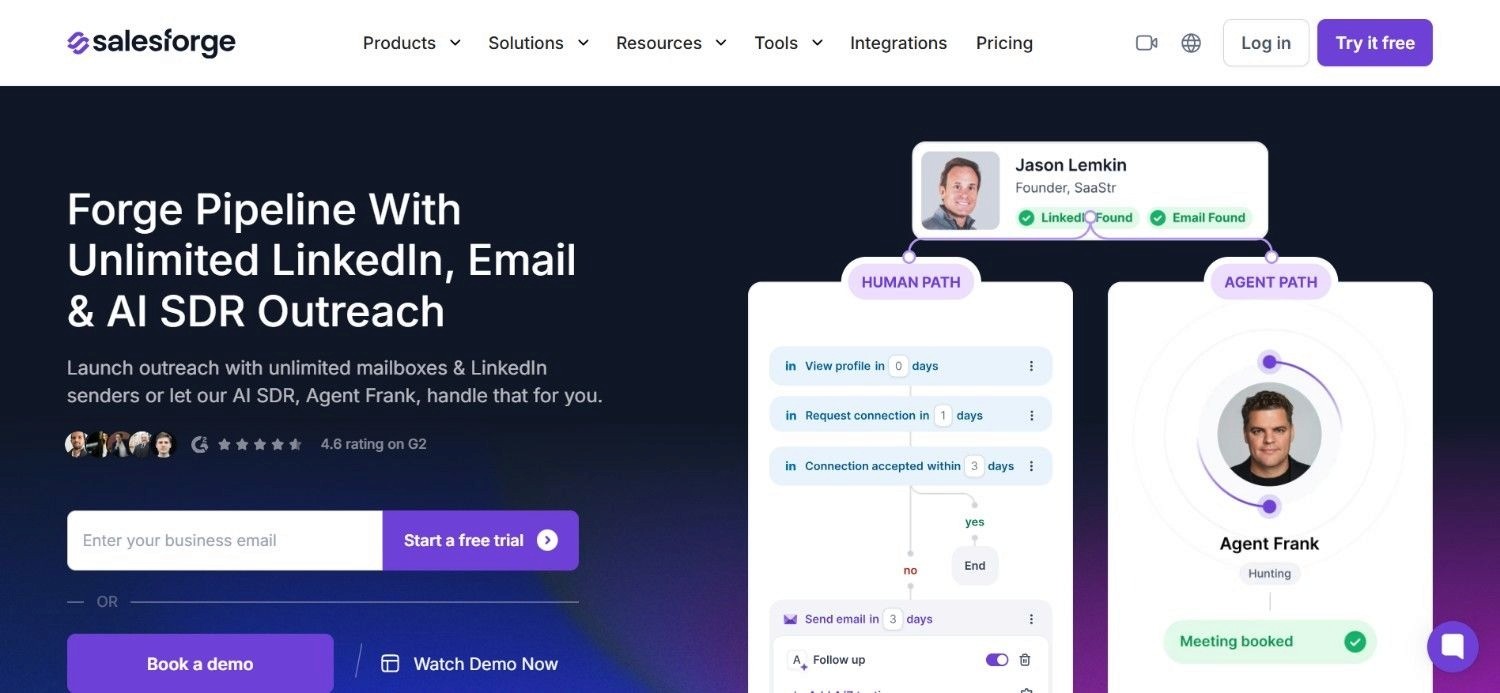
Salesforge is a strong Outreach.io alternative for teams that want to combine AI-powered personalization with outbound execution. Instead of focusing only on email sequencing, the platform generates personalized messages, alongside optimizing email deliverability and automating outreach from a single workspace.
The platform includes features such as sender reputation management, mailbox warm-up, email verification and even multi-lingual message generation. All of these make the tool useful for companies running outbound campaigns across a variety of global markets.
Their standout feature is “Agent Frank”, an AI SDR that handles prospecting, message writing and sending follow-ups autonomously. You can choose between a fully autonomous auto-pilot mode or an approval-based copilot mode.
Salesforge is a good choice for organizations looking to improve outbound performance while reducing the manual work involved in campaign creation and execution.
Ideal For
High-volume outbound teams that want deliverability infrastructure, warmup and mailbox management built in
Small teams without a dedicated SDR who want an AI agent to handle prospecting and sending
International teams needing outreach personalised across 20+ languages
Agencies managing multiple client workspaces with shared campaign controls
Top Features
Agent Frank AI SDR handling prospecting, message writing, follow-ups and meeting booking in auto-pilot or co-pilot mode
Unlimited mailboxes and social media senders with no seat-based sending limits
Built-in Forge Stack (Mailforge, Infraforge, Warmforge) covering mailbox provisioning, infrastructure and automated warmup
Support for 20+ languages, letting teams run localised outbound without hiring local SDRs
Why It's a Strong Outreach.io Alternative
Salesforge addresses the deliverability side of outbound that Outreach leaves largely to the customer: bundling warmup, infrastructure and unlimited sending capacity into its core plans.
For teams whose main bottleneck is sending volume and inbox reputation rather than data or coaching, it’s one of the smarter choices among top Outreach competitors.
Pros
Unlimited mailboxes and senders remove the seat-based sending caps common elsewhere
Agent Frank offers a genuine AI SDR option for teams without dedicated prospecting staff
Deliverability infrastructure (warmup, DNS setup, mailbox rotation) is included rather than sold separately
14-day free trial available before committing to a paid plan
Cons
Agent Frank is priced as a separate add-on starting around $599 a month, on top of the base plan
Agent Frank lacks native buying-intent signals, so it can send personalised messages to accounts with no real purchase intent
Best suited to email-first motion; deeper CRM and forecasting features are lighter than enterprise platforms
Pricing
Salesforge's subscription plans start at $48 a month for Pro and $96 a month for Growth, billed monthly or annually with two months free on annual terms.
The Agent Frank AI SDR is an optional add-on starting at $599 a month for autonomous outreach, and a free trial is available before purchase.
Final Verdict
Salesforge is a strong Outreach alternative for teams whose outbound is bottlenecked on deliverability and sending volume rather than on data quality.
Teams that need built-in prospecting data and enrichment alongside sending should note that Agent Frank's database isn't paired with intent signals, which is where a platform like Enginy covers more ground.
4. Salesloft

Overview
Salesloft is Outreach's closest direct competitor in the enterprise sales engagement segment. It's built around Cadence for sequencing, Conversations for call intelligence, and Rhythm for AI-driven next-best-action recommendations.
Its AI agents handle autonomous prospecting and outreach informed by engagement signals across the rest of the Salesloft stack, while its revenue-orchestration positioning appeals most to large teams already standardised on Salesloft as their core seller surface.
Like Outreach, Salesloft doesn't own a first-party verified-data layer. Instead, their AI agents rely on partner data vendors for the contact universe, so teams will still need to pay for a separate data subscription.
For organisations comparing an Outreach.io competitors list, Salesloft is usually the first name mentioned. It solves the same core sequencing and forecasting problems with comparably deeper Salesforce and CRM integrations.
Ideal For
Enterprise revenue teams already standardised on Salesloft as their system of record for outreach
Large sales organisations that need conversation intelligence and coaching workflows at scale
Teams with an existing data vendor relationship who just need the engagement and forecasting layer
Organisations with dedicated RevOps support to manage a complex, multi-module platform
Top Features
Cadence sequencing engine supporting multi-step, multi-channel outreach with conditional logic
Conversations call intelligence that records, transcribes and analyses sales calls for coaching
AI Agents for autonomous prospecting informed by engagement signals across the platform
Deep, bi-directional CRM sync that logs activity automatically without manual data entry
Why It's a Strong Outreach.io Alternative
Salesloft matches Outreach almost feature for feature at the enterprise tier, and the meaningful difference in 2026 tends to come down to AI roadmap pace and customer success experience rather than core functionality.
It's one of the smartest choices for teams looking to switch from Outreach.io specifically, rather than moving to a fundamentally different tool category altogether.
Pros
Mature coaching and conversation intelligence tools comparable to Outreach's Kaia
Deep Salesforce integration suited to large, complex sales organisations
AI Agents extend the platform into autonomous prospecting without changing systems of record
Established enterprise track record with a large existing customer base
Cons
Pricing is not published and is quoted annually, typically landing above $100 per seat per month
Requires a separate data vendor, since Salesloft AI Agents have no first-party contact database
Implementation and onboarding carry the same complexity and timeline concerns as Outreach itself
Pricing
Salesloft does not publish pricing publicly. It's custom-quoted on an annual basis, with market estimates typically placing per-seat costs above $100 a month depending on modules and contract length.
Final Verdict
Salesloft is a sensible move for teams that like Outreach's category but want a different vendor relationship, without expecting a materially lower price.
It isn't the right fit for teams trying to reduce total tool count or cost, since its pricing and data-vendor dependency mirror Outreach closely.
5. Instantly

Overview
Instantly is a cold email sending platform for teams prioritising sending volume and inbox placement at scale, with unlimited warmup included on every plan regardless of tier.
It has a built-in lead database accessible through “Instantly Credits”, which holds more than 450 million B2B contacts with waterfall enrichment and 13 filtering options.
This implies that teams can source and send emails without leaving the platform. Instantly.ai's positioning is simplicity and speed: campaigns can go live quickly, and the interface is generally regarded as more approachable than Smartlead's slightly technical setup.
For teams researching Outreach alternatives due to Outreach's onboarding curve feeling too steep, Instantly.ai’s faster time-to-first-campaign is a genuine point of differentiation – even when the platform operates in a narrower category.
Ideal For
Teams prioritising high email sending volume and simple, fast campaign setup
Sales teams that want a built-in lead database bundled with sending infrastructure
Solo founders and small teams that need to launch outbound quickly without a technical setup process
Teams that don't need a dialer or a full multichannel sequencing suite
Top Features
Unlimited warmup included on every plan, protecting sender reputation without extra cost
Built-in lead database of 450M+ B2B contacts accessed through Instantly Credits with waterfall enrichment
AI Copilot to help set up and optimise campaigns for teams new to cold email
Volume-based sending with fixed contact limits per tier, suited to high-throughput campaigns
Why It's a Strong Outreach.io Alternative
Instantly solves the deliverability and simplicity gap that pushes some teams away from Outreach's heavier, more complex interface.
Its bundled lead database also reduces the number of separate tools needed compared with a data-less sequencer – making Instantly one of the more self-contained options among top Outreach.io competitors.
Pros
Unlimited warmup on every plan protects deliverability without add-on costs
Built-in lead database reduces reliance on a separate data vendor
Faster, simpler onboarding than most enterprise sales engagement platforms
SOC 2 attestation and standard security features like SSO and two-factor authentication
Cons
Contact limits are fixed per tier, which can constrain larger outbound programmes
No native dialer or deep multichannel sequencing beyond email
Costs can climb quickly once teams add the Instantly Credits data layer on top of the base plan
Pricing
Instantly's core Email Outreach plan is priced at $47 a month for Growth, $97 a month for Hyper Growth, or $358 a month for Light Speed, with volume-based sending and fixed contact limits per tier.
An Enterprise tier is available with custom, enterprise-grade pricing.
Final Verdict
Instantly is a strong option for teams whose priority is fast, high-volume cold email with minimal setup friction.
Teams that need calling, deep CRM workflow or account-based, multi-stakeholder sequencing will find it narrower than a full sales engagement platform.
6. Smartlead
Overview
Smartlead positions itself as the most technically sophisticated cold email platform on the market, built for agencies and in-house teams managing multiple client accounts with granular control over sending infrastructure.
Its mailbox rotation engine operates at the account level rather than just the campaign level, which meaningfully improves deliverability at high volume. The platform’s analytics also break down performance by mailbox and by time of day in more depth than most competitors.
That being said, Smartlead doesn’t own a lead database itself, so it’s typically paired with a secondary data source such as ListKit or Apollo, connected through native integrations.
For agencies specifically, the sub-account structure makes managing several client campaigns cleanly separated a real advantage over single-workspace tools.
That's part of why it shows up consistently on any serious Outreach.io competitors list aimed at agency buyers.
Ideal For
Agencies running cold email campaigns for multiple clients from one account
Technical teams that want granular control over mailbox rotation and deliverability settings
Teams that already have a data source and just need a sophisticated sending and reporting layer
Power users comfortable with a steeper setup process in exchange for deeper control
Top Features
Account-level mailbox rotation engine that intelligently distributes sending to protect deliverability
Advanced analytics tracking deliverability by mailbox and campaign performance by time of day
Agency-grade sub-account structure for managing multiple client campaigns cleanly
Native integrations with HubSpot, Salesforce, Clay and ListKit, plus a documented API
Why It's a Strong Outreach.io Alternative
Smartlead's depth of deliverability control is difficult to match among lighter cold email tools, and its agency-friendly, per-workspace pricing model suits teams managing several outbound programmes at once. It's a smart choice specifically for technical teams that already have a data workflow and want the sending layer to match that sophistication.
Pros
Best-in-class mailbox rotation for high-volume sending without hurting deliverability
Detailed analytics that go deeper than most competitors on mailbox-level performance
Agency-friendly sub-account structure and per-workspace pricing
Strong native integrations, including a direct connection to ListKit for list transfer
Cons
No built-in lead database, so a separate data source is required
Meaningful learning curve compared with simpler tools like Instantly
Overage isn't available; teams that hit their monthly send limit must upgrade rather than top up
Pricing
Smartlead's pricing is billed monthly only: Base at $39 a month (6,000 sends, 2,000 contacts, 2,000 verifications), Pro at $94 a month (90,000 sends, 30,000 contacts, 30,000 verifications), Unlimited Smart at $174 a month (150,000 sends, unlimited contacts, 50,000 verifications included), and Unlimited Prime at $379 a month (50,000+ sends with private infrastructure, 170,000 verifications included).
They also have optional add-ons for private infrastructure, client workspaces and extra verification credits.
Final Verdict
Smartlead is a strong Outreach.io alternative for agencies and teams that already have a data pipeline and want the most granular sending and deliverability controls.
It's a weaker fit for companies that want data and sending bundled together in one subscription.
7. Apollo.io
Overview
Apollo is among the most widely used platforms in B2B sales – combining a database of more than 275 million contacts with sequencing and basic AI personalisation in a single, affordable subscription.
Its free plan and low entry price make Apollo the default reference point buyers use when evaluating any Outreach.io alternative, since the tool delivers real prospecting depth without the enterprise procurement process Outreach requires.
Apollo's filtering is comparatively shallow next to specialised intent-data tools, and it lacks the multi-stakeholder campaign strategies more advanced platforms support. Still, for teams that mainly need a database plus sequencing in one place, it remains hard to beat on price.
Apollo is also the tool most commonly cited in comparisons for major Outreach competitors, largely because of that price-to-depth ratio.
Ideal For
Mid-market and SMB teams that need prospecting data and sequencing in one affordable platform
Early-stage startups testing outbound before committing to enterprise software spend
Teams that want a self-serve setup without a lengthy sales or onboarding process
Sales reps who want a browser extension for quick contact lookups alongside sequencing
Top Features
Database of 275M+ contacts with extensive filtering by firmographics and role
Built-in sequencing combined with the prospecting database in one subscription
Free plan with limited credits, letting teams test the platform before paying
Browser extension for fast contact lookups directly from company websites and social profiles
Why It's a Strong Outreach.io Alternative
Apollo covers the two things most teams actually need, data and sequencing, at a fraction of Outreach's entry price. That's why it's consistently the first name mid-market buyers consider.
It won't match Outreach's conversation intelligence or forecasting depth, but for teams whose core need is affordable prospecting plus outreach, it's one of the smartest choices available.
Pros
Large, affordable database bundled with sequencing in one subscription
Free plan available for teams testing outbound before committing budget
Self-serve setup with minimal onboarding friction
Frequent product updates and a large, active user base generating ongoing feedback
Cons
Filtering and intent signals are shallower than specialised data or enrichment tools
Lacks the multi-stakeholder, account-wide campaign strategies more advanced platforms support
Add-ons (extra credits, advanced email domains, integrations) can add up beyond the base price
Pricing
Apollo.io offers a free plan plus paid tiers billed annually: Basic at $49 per seat per month, Professional at $79 per seat per month (its most popular tier), and Organization at $119 per seat per month, with add-ons like extra credits, advanced email domains and additional integrations priced separately.
Final Verdict
Apollo.io is the right call for teams that want affordable data and sequencing without enterprise complexity.
Teams that need deeper intent signals, multi-stakeholder sequencing or a fully integrated enrichment workflow will find the platform serviceable but shallower than purpose-built alternatives.
8. Lemlist

Overview
Lemlist is one of the earliest platforms to pioneer visual personalisation in cold email – combining dynamic images, embedding prospect names, company logos or profile photos directly into the email visuals.
It has since expanded into a fuller multichannel platform, adding social media and phone steps alongside email within the same sequence builder.
That visual personalisation remains its clearest differentiator against more utilitarian sequencers, and is part of the reason why teams evaluating Outreach.io alternatives for creative, high-touch campaigns often land on Lemlist specifically.
Pricing includes credit bundles for enrichment and verification within each plan, which keeps the total cost more predictable than tools that charge separately for every data action.
Ideal For
Teams that want visual, highly personalised email campaigns rather than plain-text sequences
Sales teams running multichannel outreach across email, social media and phone in one sequence
Mid-market teams that want credit bundles included rather than pay-per-action pricing
Agencies building creative outbound campaigns for clients who value distinctive messaging
Top Features
Dynamic personalised images and video thumbnails embedded directly in cold emails
Native multichannel sequences combining email, social media and phone steps
Credit bundles included in each plan (roughly 750 to 1,000 credits monthly) for enrichment and verification
Established deliverability tooling from one of the longest-running platforms in the category
Why It's a Strong Outreach.io Alternative
Lemlist's visual personalisation is a genuine differentiator that most sequencers, including Outreach, don't offer natively.
For teams whose outbound depends on standing out in a crowded inbox, versus just automating volume – it's amongst the more distinctive choices among current Outreach competitors.
Pros
Distinctive visual personalisation features not widely replicated elsewhere
True multichannel sequencing across email, social media and phone
Credit bundles included in plan pricing rather than billed separately
Long track record in the category with a mature product
Cons
Fewer enterprise-grade forecasting and coaching features than Outreach or Salesloft
Additional credits, phone dialling and other add-ons increase cost beyond the base plan
Best suited to email-led motions rather than complex, multi-stakeholder account strategies
Pricing
Lemlist's pricing is tiered per user and billed annually: Email Starter at $39, Email Pro at $69, Multichannel Expert at $99, and Enterprise at custom pricing, with credit bundles included and additional credits, phone dialling and other channels available as add-ons.
Final Verdict
Lemlist is a strong pick for teams that want their outbound to look and feel different from the average cold email.
It's a weaker fit for enterprise teams that need deep forecasting, coaching or account-based orchestration at scale.
9. Klenty
Overview
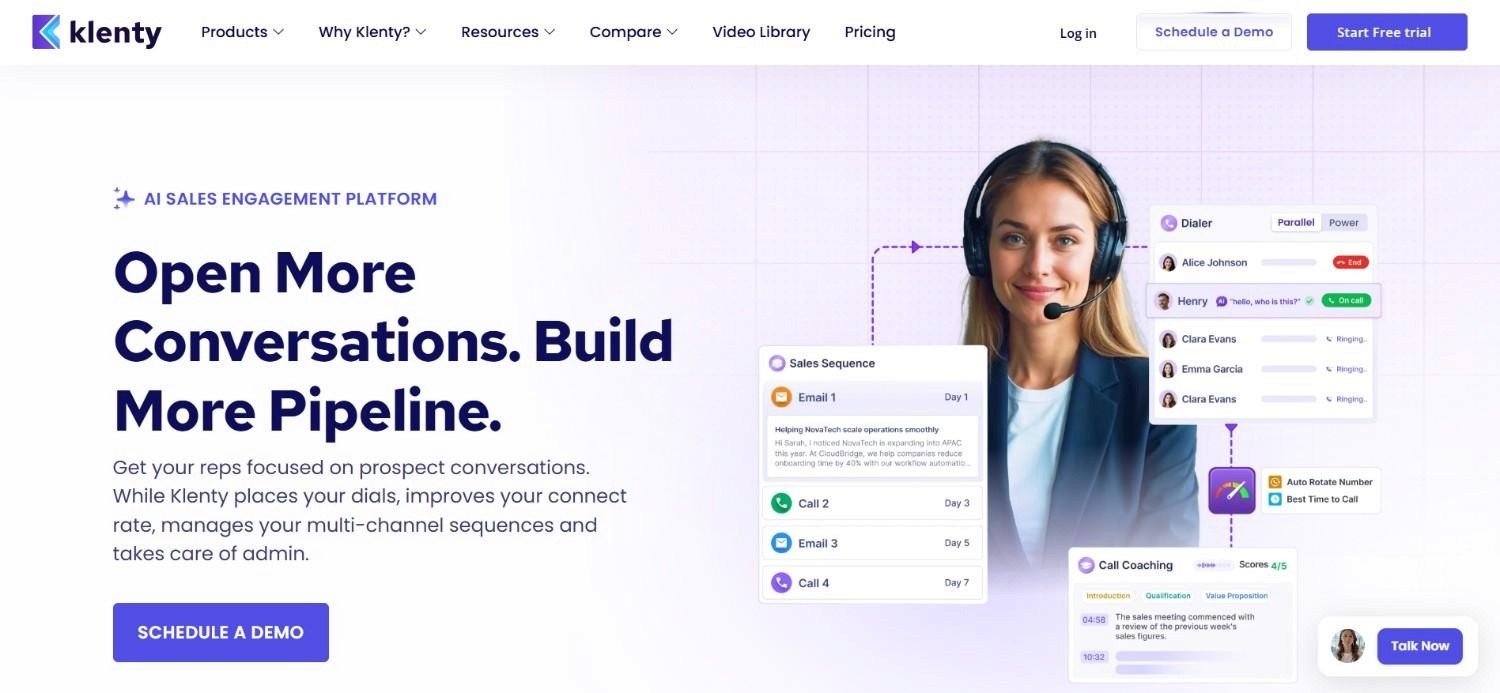
Klenty occupies the middle ground between lightweight sequencers and enterprise platforms, built around AI Agentic Cadences that research accounts, generate personalised messaging and execute outreach across channels automatically.
Its Parallel and Power Dialer capabilities, run through its Connect AI infrastructure, address a problem most sequencers ignore entirely: most outbound calls simply don't get answered. Klenty's dialing tooling is built specifically to improve connection rates rather than just call volume.
The platform also integrates deeply with Zoho, Microsoft Dynamics 365, Salesforce and HubSpot, syncing call notes and AI-generated summaries automatically.
Klenty is an ideal fit for mid-market teams comparing Outreach alternatives, who need real calling infrastructure alongside sequencing – without having to pay enterprise pricing for these features.
Ideal For
Mid-market teams that need calling infrastructure alongside email and social sequencing
Sales teams focused on booking live conversations rather than just email volume
Teams using Zoho, Microsoft Dynamics 365, Salesforce or HubSpot that want deep native sync
Growing teams that have outgrown basic email tools but don't need full enterprise pricing
Top Features
AI Agentic Cadences that research accounts and generate personalised messaging automatically
Parallel and Power Dialer capabilities built to improve phone connect rates, not just call volume
Deep CRM integrations with Zoho, Microsoft Dynamics 365, Salesforce and HubSpot with automatic sync
Video personalisation and Liquid Templates for dynamic, real-time email customisation
Why It's a Strong Outreach.io Alternative
Klenty addresses the calling gap that most cold email-focused Outreach alternatives leave unsolved – pairing dialer infrastructure with AI-driven cadence generation at mid-market pricing.
For teams whose pipeline depends on live conversations rather than reply rates alone, it's one of the smarter choices on this list.
Pros
Genuine calling infrastructure (Parallel and Power Dialer) rather than a basic click-to-call feature
AI Agentic Cadences reduce manual cadence-building work
Deep native integrations across major CRMs, including Zoho and Microsoft Dynamics 365
Video and dynamic personalisation features that go beyond plain-text templates
Cons
Steeper learning curve than simpler sequencers, particularly for complex cadences
Some users report slower support response times compared with smaller competitors
Billed annually only, which limits flexibility for teams wanting to test month to month
Pricing
Klenty's pricing is billed annually only: Starter at $50 per user per month, Growth at $70 per user per month, Plus at $99 per user per month, and Enterprise at custom pricing.
An add-on plan is available at $45 per user per month, with a 14-day free trial that doesn't require a credit card.
Final Verdict
Klenty is a strong Outreach alternative for mid-market teams whose outbound depends on phone connect rates in addition to email replies.
Teams that want the absolute simplest setup, or that need month-to-month billing flexibility, may find the annual-only commitment a friction point.
10. Mixmax
Overview
Mixmax takes a different approach entirely, living inside Gmail rather than replacing it, so reps who spend their day in their inbox never have to context-switch to a separate platform. The tool adds sequences, templates, email tracking and one-click meeting scheduling directly into the Gmail interface.
Its newer Copilot suite – consisting Inbox Copilot, Meeting Copilot and Engagement Copilot; layers AI-driven prioritisation and meeting preparation on top of that.
The trade-off for that inbox-native convenience is scope: Mixmax has no native dialer and no multichannel sequencing beyond email.
Ideal For
Individual sellers and small teams whose entire workflow already lives inside Gmail
Teams that value one-click meeting scheduling embedded directly in email threads
Reps who want AI-assisted email writing and prioritisation without leaving their inbox
Google Workspace organisations that don't need Outlook support
Top Features
Native Gmail and Outlook sidebar for running sequences and managing replies without switching tools
One-click meeting scheduler embedded directly in email threads, with no external booking link needed
Copilot suite (Inbox, Meeting and Engagement) for AI-driven prioritisation, prep and next-best-action
Real-time email tracking that notifies reps the moment a prospect opens, clicks or replies
Why It's a Strong Outreach.io Alternative
Mixmax solves the context-switching problem that heavier platforms like Outreach create for inbox-first sellers, and its meeting scheduler alone is enough of a productivity gain that some users pay for the tool on that feature alone.
For teams whose sales motion is genuinely email-first, it's one of the smartest lightweight choices available.
Pros
No context-switching; the entire workflow runs inside Gmail or Outlook
One-click meeting scheduling is widely cited as a standout feature by users
AI writing assistant speeds up email composition without leaving the inbox
Free tier available for individual reps testing the core tracking features
Cons
No native dialer, so phone outreach requires a separate tool entirely
No multichannel sequencing beyond email, unlike more complete sales engagement platforms
Per-seat pricing scales linearly with team size, with no volume discount below Enterprise
Pricing
Mixmax's pricing is per user, billed annually: Inbox Copilot and Meeting Copilot at $29 per user per month, Engagement Copilot at $49 per user per month, and the Mixmax Suite with all Copilots bundled at $89 per user per month.
Monthly billing is available at $34, $65 and $105 per user respectively, with Teams and dialer pricing available only on request.
Final Verdict
Mixmax is the right call for individual sellers and small teams whose entire day happens inside Gmail.
It's the wrong call for teams that need calling infrastructure or true multichannel sequencing, since neither is part of its core scope.
Why Enginy Works Across Multiple Use Cases?
Different teams hit the same tool-sprawl problem in different ways.
Here's how Enginy addresses it across the segments we work with most:
1. Enginy for B2B SaaS Sales Teams
SaaS teams running product-led or sales-led outbound motions use Enginy to keep pipeline growth proportional to product growth, not headcount growth.
Because list building, enrichment and outreach sit in one workspace – a lean SaaS sales team can scale outbound volume without adding a dedicated GTM engineer to manage the handoffs between tools.
2. Enginy for Recruitment and Staffing Agencies
Recruitment teams need fast, high-volume list generation across constantly shifting target companies.
Enginy's technology stack and hiring-alert filters let them build fresh candidate and client lists as roles open, rather than working from static, ageing databases.
3. Enginy for IT Consulting and Managed Service Providers
IT consultancies targeting enterprise accounts benefit most from Enginy's multi-stakeholder sequencing, since enterprise buying committees rarely involve a single decision-maker.
Reaching a CIO, a procurement lead and a department head in the same account, in a coordinated sequence, shortens the path to a first meeting.
4. Enginy for Digital and Marketing Agencies
Agencies running outbound prospecting on behalf of clients need a platform flexible enough to manage multiple identities and multiple ICPs at once.
Enginy's Identity and Blocklist modules let agencies keep client campaigns cleanly separated while still operating from a single workspace.
5. Enginy for Cybersecurity and Insurance Sales Teams
Cybersecurity and insurance sales cycles depend heavily on timing: a new compliance requirement, a recent breach disclosure, a policy renewal window.
Enginy's layered intent signals: including funding rounds and recent hires; help these teams spot the moment a prospect becomes reachable, rather than outreaching cold on a fixed schedule.
What Makes a Good Outreach Alternative?
With so many Outreach.io alternatives on the market, it helps to know what actually separates a genuine replacement from a lighter tool wearing the same label.
These five criteria are the ones worth checking first:
1. Manageable Without a Dedicated Specialist
The tools that most directly compete with Outreach: Clay, Amplemarket, and Salesloft — all assume a level of RevOps or GTM engineering maturity that most mid-market teams simply don't have.
A genuine alternative should be operable by a regular sales rep or sales manager without requiring a technical expert to configure lists, manage enrichment waterfalls, or maintain campaign logic.
If the tool needs a specialist to run it, you've replaced one dependency with another.
2. Native Data and Enrichment, Not Just Sequencing
A genuine replacement for Outreach needs to solve the data problem, not just the sending problem.
Tools that only sequence still leave teams paying for a separate data vendor, which defeats the purpose of switching in the first place.
3. Meaningful Buying-Intent Signals
Firmographic filtering alone, including company size, industry, region – tells you who a prospect is, not why they'd be receptive right now.
The strongest alternatives layer in job changes, funding events, hiring signals and technology stack data to time outreach against real buying windows.
4. Multichannel Reach Beyond Email and Beyond One Contact
Reply rates on email-only outreach have been declining for years as inboxes get more crowded.
A good alternative supports outreach across email, social media and phone within the same sequence, not as a bolted-on add-on.
The strongest platforms take this further: coordinating outreach to several decision-makers at the same account in parallel rather than one contact at a time a meeting-booking lever most single-channel tools can't replicate.
5. Pricing That Scales With Usage, Not a Flat Per-Seat Tax
Teams switching away from Outreach are usually trying to escape a different problem: pricing that punishes headcount rather than reflecting what a team actually uses.
A strong alternative should size cost to real usage credits, contacts, sender identities rather than charging the same per-seat fee whether a rep is lightly or heavily active. Whether that number is listed on a pricing page or scoped on a short call matters less than whether the model itself scales fairly with what you consume.
How to Choose the Right Outreach Alternative for Your Needs?
Once you know what to look for, the next step is working through your own requirements in order.
Here's a practical sequence to follow:
1. Map Your Current Tool Stack Cost
Before comparing new tools, add up what you're currently paying across your data provider, your sequencer and any enrichment add-ons.
Most teams underestimate this number, and it's the true baseline any Outreach alternative needs to beat.
2. Decide Whether You Need a Dialer
If phone connect rates matter to your pipeline, narrow your list to tools with genuine dialer infrastructure, like Klenty – rather than basic click-to-call features bolted onto an email-first tool.
3. Check Multichannel Depth, Not Just Multichannel Claims
Many tools claim multichannel support but only offer email plus a single bolt-on channel.
Confirm whether social media, phone and email steps can actually run inside one coordinated sequence before assuming a tool covers your needs.
4. Confirm CRM Sync Depth
A platform that logs activity manually, or requires CSV exports into your CRM, will create the same data hygiene problems you're trying to escape.
Test the actual sync behaviour, not just the integration list, before committing.
5. Evaluate Onboarding Support
Teams switching from Outreach are often doing so because the original onboarding took too long.
Ask any vendor exactly how many structured onboarding sessions are included and what happens after that support window closes.
6. Test Data Quality With a Real List
Request a sample export from any data-inclusive platform and check bounce rates against your own list before committing a budget.
Verification claims vary significantly in practice, even among tools with similar marketing language.
7. Price the Total Stack, Not Just the Headline Tier
A tool advertised at $39 a month can become significantly more expensive once contact limits, verification credits and add-ons are factored in.
Model your actual expected usage against each tier before comparing headline prices.
Everything You Need to Know About Outreach Alternatives
Category | Key Considerations |
Top 3 Alternatives | Enginy, Apollo.io and Salesloft cover the range from all-in-one, to affordable data-plus-sequencing, to enterprise-equivalent |
Best Overall Option | Enginy, for teams that want data, enrichment and outreach in one workspace without a technical operator |
Why Look for Outreach Alternatives | Opaque, seat-based pricing above $100 per user, a steep onboarding curve, and no native prospecting data |
How to Choose the Best Outreach Alternatives? | Team size and technical capacity, budget structure (per-seat versus usage-based), and whether you need data bundled with outreach |
Price Range | From free (Apollo.io, ListKit) up to $100 to $200 per seat per month for enterprise platforms like Outreach and Salesloft |
Ease of Switching | Data-inclusive platforms switch fastest. Enginy fastest of all, since data, enrichment and outreach execution sit in one workspace rather than two; enterprise platforms require longer implementation |
Must-Have Features | Native data enrichment, multichannel sequencing, transparent CRM sync and buying-intent signals |
Mistakes You Shouldn't Make | Comparing headline pricing without modelling contact limits and add-ons, and choosing a tool without testing real data quality first |
Ready to Move On from Outreach? Try Enginy
If you're looking for an Outreach.io alternative because your outbound stack feels fragmented, Enginy brings everything together in one AI-native platform. We combine prospect discovery, waterfall enrichment across 30+ data providers, and AI-powered multi-channel outreach in a single workflow. No switching between separate prospecting, data, and engagement tools.
Suitable for industries – including B2B SaaS, recruitment, IT consulting and cybersecurity teams among others, Enginy is an all-in-one GTM platform that allows sales reps to run completed outbound campaigns without having to outsource tasks to secondary/external resources (like a dedicated GTM engineer).
On top of that, our AI SDR agents and automated outreach sequences enable teams to grow their sales pipeline without increasing headcount growth – maintaining quality personalisation at scale through LLM integrations.
If your outbound stack is fragmented and your reps are spending more time on tools than on conversations – book a demo with our sales team.
We'll map your current stack against what Enginy replaces and show you exactly what changes.
FAQs About Outreach Alternatives
What is Outreach used for?
Outreach is used for sales engagement, running multi-step, multi-channel outbound sequences across email, phone and social media for mid-market and enterprise sales teams. It also includes conversation intelligence, deal management and forecasting tools built for large sales organisations. Companies including SAP, Siemens and DocuSign use their platform to standardise outbound activity across hundreds of reps. It requires a separate data subscription and is priced on annual, per-seat contracts.
Which is the best Outreach alternative in 2026?
Enginy stands out as an Outreach.io alternative because it combines prospect discovery, waterfall enrichment across 30+ data providers, and AI-powered multi-channel outreach in one platform. Instead of stitching together multiple tools – sales teams can build lists, enrich contacts, and launch personalized campaigns from a single workspace; thereby reducing tool sprawl and helping reps spend more time selling.
What features should I look for in an Outreach alternative?
The features to look for in an Outreach alternative are native data enrichment, multichannel sequencing across email, social media and phone, transparent or usage-based pricing, and layered buying-intent signals beyond basic firmographics. Deep CRM sync matters just as much as sequencing power, since manual data entry defeats the point of automation. Dialer infrastructure matters specifically for teams whose pipeline depends on live phone conversations.
How to choose the best Outreach alternative for your needs?
Choosing the best Outreach alternative starts with mapping your current tool stack cost, including any separate data subscription, against what a single consolidated platform would cost. Decide whether calling infrastructure is a requirement, since that narrows the field considerably. Test data quality with a real sample export before committing budget, and confirm onboarding support covers your team's technical maturity.
Is it easy to switch from Outreach to an alternative?
Switching from Outreach is generally easier than switching to it, since most alternatives are designed for faster onboarding. Data-inclusive platforms like Enginy or Apollo.io typically get a team live within days rather than the two to four weeks Outreach itself often requires. The main switching cost is exporting historical sequence templates and reconfiguring CRM sync rules, which most vendors support directly.
Is Apollo.io better than Outreach?
Apollo.io is better than Outreach for mid-market and SMB teams that need affordable data plus sequencing without enterprise complexity. However, Outreach.io remains stronger for large organisations needing deep conversation intelligence, forecasting and coaching workflows at scale. Apollo starts at $49 per seat per month against Outreach's $100 to $200 range, making it the far cheaper entry point. The right answer depends on team size and whether forecasting depth outweighs price.
What is the main difference between Apollo.io and Outreach?
The main difference between Apollo.io and Outreach is that Apollo bundles a prospecting database with sequencing in one subscription, while Outreach requires a separate data vendor entirely. Apollo is priced per seat starting at $49 a month with a free plan available, while Outreach's pricing is unpublished and typically starts above $100 per seat. Outreach offers deeper conversation intelligence and forecasting, while Apollo prioritises affordability and self-serve setup.
Can I use more than one Outreach alternative at the same time?
Yes, many teams combine tools rather than relying on a single platform, most commonly pairing a data tool like ListKit with a sequencer like Smartlead or Instantly. This approach can work well for technical teams comfortable managing multiple integrations, though it reintroduces the tool sprawl problem that pushes many teams toward an all-in-one Outreach.io alternative like Enginy in the first place. The right approach depends on whether your team has the capacity to manage multiple vendor relationships.
Why do teams switch away from Outreach.io specifically in 2026?
Teams are switching away from Outreach.io in 2026 because of its premium, seat-based pricing and the need for separate tools for prospect data, enrichment, and buying intent. That creates higher costs and a fragmented outbound workflow. At the same time, AI-native platforms now combine prospecting, enrichment, personalization, and sequencing in one place. As more sales teams prioritize integrated workflows over disconnected tool stacks, the value of managing multiple platforms has become harder to justify.
About the Author
Andrea Lopez is a B2B go-to-market and content lead at Enginy, where she writes about outbound sales, prospecting, and lead generation for agencies and revenue teams. She has spent several years working alongside SDR and agency teams on list building, data quality, and multichannel outreach, and her writing focuses on practical sales execution rather than theory. Read more of her work on the Enginy blog.