Apollo vs Clay vs Cognism vs ZoomInfo vs Enginy: Which Wins in 2026?

Andrea López
Share
Any Apollo vs Clay vs Cognism vs ZoomInfo shortlist runs into the same problem within a week of evaluation: the five tools on it do not compete for the same job. Two are contact databases. One is an enrichment workbench. One bundles a database with email-first sequencing. One covers discovery, enrichment and multichannel outreach as a single workflow.
This comparison prices each of them, scores them against seven criteria, and states which team each one fits. Enginy is our product, so the scoring below is specific enough that you can check every line of it.
Key Takeaways (TL;DR)
Primary Difference: The field splits three ways, not five. ZoomInfo and Cognism are contact databases that require a separate engagement tool to act on the data. Clay is an enrichment and workflow layer that also requires a sender. Apollo and Enginy are the only two that cover data and outreach in one place, and they sit at opposite ends of that overlap: Apollo bundles a large database with email-first sequencing at a low price, while Enginy runs waterfall enrichment and conditional multichannel campaigns as a single workflow.
Best Overall Choice: Enginy, for the majority of B2B teams running structured outbound. It is the only tool in this group where prospect discovery, multi-source enrichment, email, social media and calling sequences, and CRM assignment run inside one system without a GTM engineer wiring them together.
What This Category Actually Costs You: Sellers spend roughly 70% of their working hours on tasks that are not selling. Most of that loss happens between tools, not inside them: exporting a list, cleaning it, re-importing it, matching properties, then rebuilding the same sequence logic in a fourth interface. Factorial's Head of Outbound SDRs measured 3 to 4 hours per rep per day going into that overhead before consolidating into one system.
Who These Tools Are For: If you have people whose job is outbound, you are in this market. That covers a two-person founder team sending their first hundred emails and a 180-seat SDR organization running five countries, and it shows up most in SaaS, recruitment, IT consulting, agencies, cybersecurity, insurance and professional services. The dividing line is not headcount, it is whether outbound is a process yet. Teams with an SDR and AE function and a motion they can describe out loud get their money back from a complete workflow. Teams still finding out whether cold outreach works for them at all can start with a cheap database and revisit this in six months.
How to Choose: Five questions decide it. Does the tool cover discovery, enrichment and outreach, or only one of the three? Can a sales rep operate it, or does it require a dedicated technical operator? Does it surface buying intent that triggers outreach automatically, or only intent that lands in a dashboard? Can it contact several decision-makers at the same account in coordinated steps? And what does the total stack cost once you add the tools it does not replace?
Ease of Use Winner: Enginy - Premium end-to-end tools normally require a GTM engineer or a dedicated ops specialist. Enginy is built so any rep can run the full workflow, with natural-language search through AI Finder and five guided onboarding sessions on every plan. Clay assumes an operator, ZoomInfo assumes a RevOps owner, and both deliver a fraction of their value without one.
Apollo vs Clay vs Cognism vs ZoomInfo vs Enginy in 2026: At a Glance
Criteria | Apollo | Clay | Cognism | ZoomInfo | Enginy |
Best For | Solo reps and small teams needing a big database on a small budget | RevOps and GTM engineers building custom enrichment workflows | EMEA teams running phone-heavy outbound under GDPR | Enterprise revenue teams needing the deepest data and intent layer | B2B teams running the full outbound workflow in one system |
Key Features | 210M+ contact database, email sequences and dialer, Chrome extension | 150+ provider waterfall, Claygent research agents, Sculptor workflow builder | Diamond phone-verified mobiles, Bombora intent, 15-country DNC screening | GTM Context Graph (100M companies, 500M contacts), Copilot, GTM.AI agent layer | 15+ provider waterfall enrichment, conditional multichannel campaigns, AI SDR agents |
Pricing | Free; $49, $79 and $119 per seat per month, billed annually | Free; Launch $167/mo and Growth $446/mo on annual billing | Quote only; Standard and Pro, 5 seats included in each | Quote only; Professional, Copilot Advanced and Copilot Enterprise | Custom-quoted, credit-based; Basic to Enterprise tiers |
Free Trial | Yes – free plan plus 14-day trial on Basic and Professional | Yes – free plan plus 14-day trial on all paid tiers | No – demo and limited data sample only | Yes – free trial offered on Sales plans | No – free prospect search tool and demo |
Covers Data + Outreach | Partial (email-first) | No | No | No | Yes |
Ease of Use | ⭐⭐⭐⭐ | ⭐⭐ | ⭐⭐⭐⭐ | ⭐⭐⭐ | ⭐⭐⭐⭐⭐ |
Support | ⭐⭐⭐ | ⭐⭐⭐ | ⭐⭐⭐⭐ | ⭐⭐⭐⭐ | ⭐⭐⭐⭐⭐ |
Integrations | ⭐⭐⭐⭐ | ⭐⭐⭐⭐⭐ | ⭐⭐⭐ | ⭐⭐⭐⭐⭐ | ⭐⭐⭐⭐⭐ |
Overall Rating | ⭐⭐⭐⭐ | ⭐⭐⭐⭐ | ⭐⭐⭐ | ⭐⭐⭐⭐ | ⭐⭐⭐⭐⭐ |
Apollo, Clay, Cognism, ZoomInfo and Enginy: The Basics If You're New Around Here
First, What Are You Actually Buying?
This category covers three jobs: finding the right companies and contacts, attaching verified emails, phone numbers and context to them, and reaching those people through coordinated email, social media and phone sequences. Some tools do one of the three. One does all of them.
Sales development teams, account executives, RevOps and founders running their own outbound all buy here. The reason the category exists is arithmetic: sellers spend roughly 70% of their working hours on tasks that are not selling, and a large share of that goes to manual list building, data cleaning and switching between disconnected systems.
The market is consolidating fast. Apollo acquired Pocus in March 2026 to add signal intelligence, ZoomInfo made its data queryable by AI agents through GTM.AI in June 2026, and Clay rebuilt its pricing in March 2026 around a split between data credits and workflow actions. The direction is identical across all of them: fewer manual decisions per rep, more automated research, and mounting pressure on teams still running four subscriptions to do one job.
Enginy: One System Instead of Four Contracts
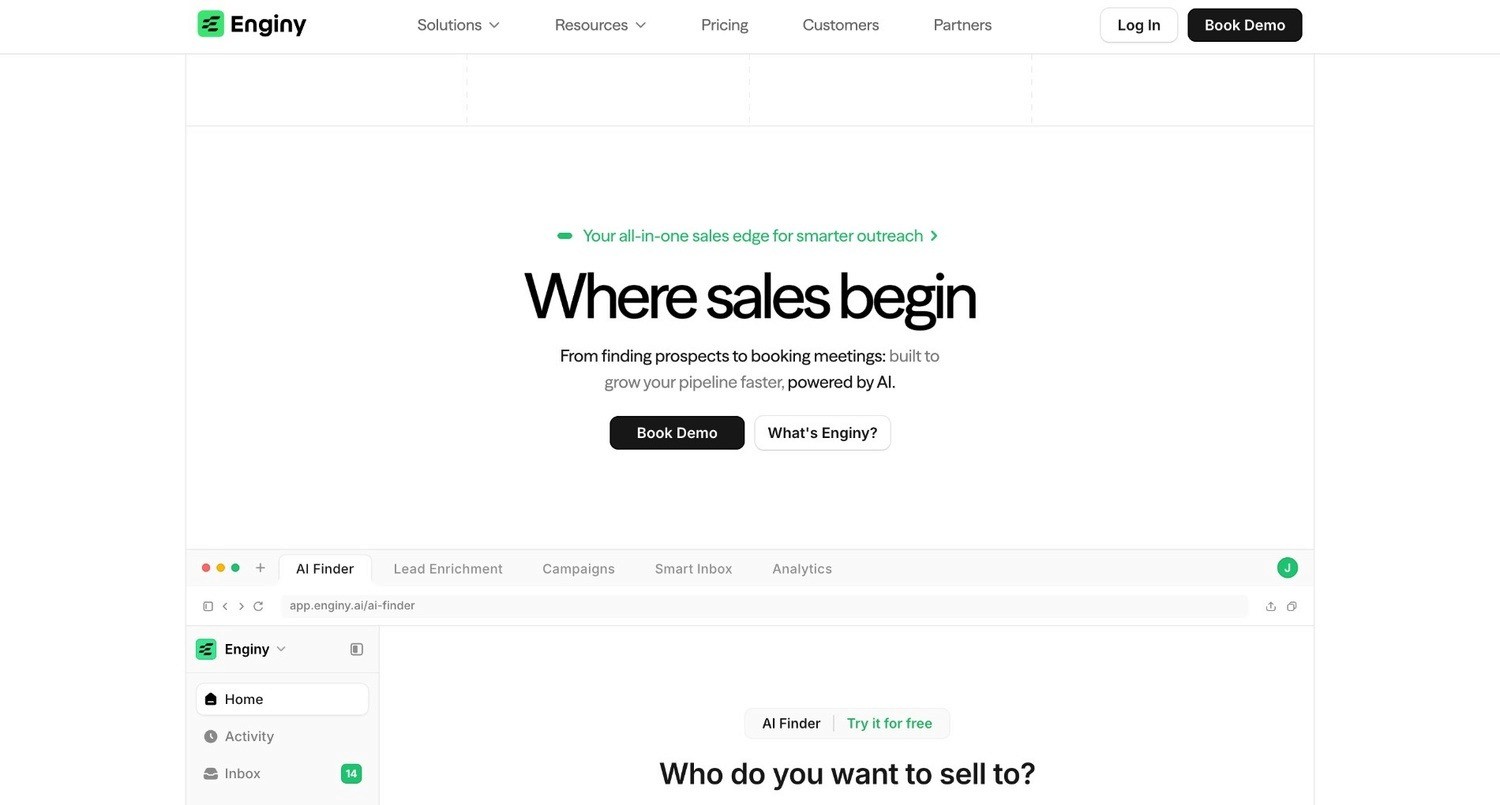
Enginy (formerly Genesy) is an AI-native, end-to-end GTM tool that combines prospect discovery, multi-source enrichment and AI-powered multichannel outreach in one place. It exists to remove the tool sprawl that forces sellers to spend most of their time on work that is not selling.
The product covers list building with layered intent signals, waterfall enrichment across 15+ providers with cleaning passes before and after, and conditional campaigns spanning email, social media and calling with autonomous reply management. Customers include Factorial, SeQura, Venair and Talent Match, with InPost, Red Points and Ricoh among additional reference accounts.
The position is specific: complete and operable by any rep. Premium end-to-end tools normally charge a complexity tax in the form of a dedicated technical operator, and Enginy is designed so an SDR runs the full workflow without one.
Apollo: The Cheap Database Most Teams Start With

Apollo is a sales intelligence and engagement tool built around one of the largest self-serve B2B databases available, with 210 million or more contacts depending on which count you use. It bundles contact search, email sequencing, a dialer and light CRM functionality behind a freemium model, and it publishes its prices, which almost nobody else here does.
The company reported enterprise account growth above 400% year over year in early 2026, with Anthropic and Glean among its named customers, and it acquired Pocus in March 2026 to add buying-signal intelligence. An independent Tolly report published in April 2026 found Apollo exceeding industry benchmarks on data quality and cold email performance.
Apollo is the reference point every buyer in this category argues about price against. It is where a lot of outbound teams start, and where a meaningful share of them stop once outreach complexity outgrows email-first sequencing.
Clay: The Enrichment Workbench for People Who Like Building
Clay aggregates 150+ data providers into a table interface that behaves like a programmable spreadsheet. Its core mechanic is waterfall enrichment: query provider A, and when A returns nothing, fall through to B, then C, until the field fills.
The company raised $100M in Series C funding at a $3.1 billion valuation in 2025, and its Claygent research agent passed 5 billion runs by July 2026. OpenAI reports moving from the low 40% range to the high 80% range on enrichment coverage after adopting it.
Clay sits between your data sources and your execution tools rather than replacing either. Email campaigns launch through integrations rather than natively, and it does not dial numbers, automate social outreach or manage deliverability, so it is one component of a stack rather than the stack itself.
Cognism: The Mobile Number That Actually Rings in Europe

Cognism is a UK-based B2B data provider known for GDPR-compliant European coverage and phone-verified mobile numbers confirmed by human researchers. Its buyers are outbound teams whose primary channel is the phone and whose primary market is EMEA.
Sales prospecting ships in two packages, Standard and Pro, each including five seats. Pro adds the premium mobile filter, on-demand mobile verification and intent data, while Standard covers core prospecting with hiring, funding and job change signals. CRM Enrichment and Data-as-a-Service are separately priced add-ons.
Cognism does not send outreach. Teams pair it with a sequencing tool, which is why its real cost is best measured as part of a stack rather than as a line item.
ZoomInfo: The Data Layer Everything Else Plugs Into
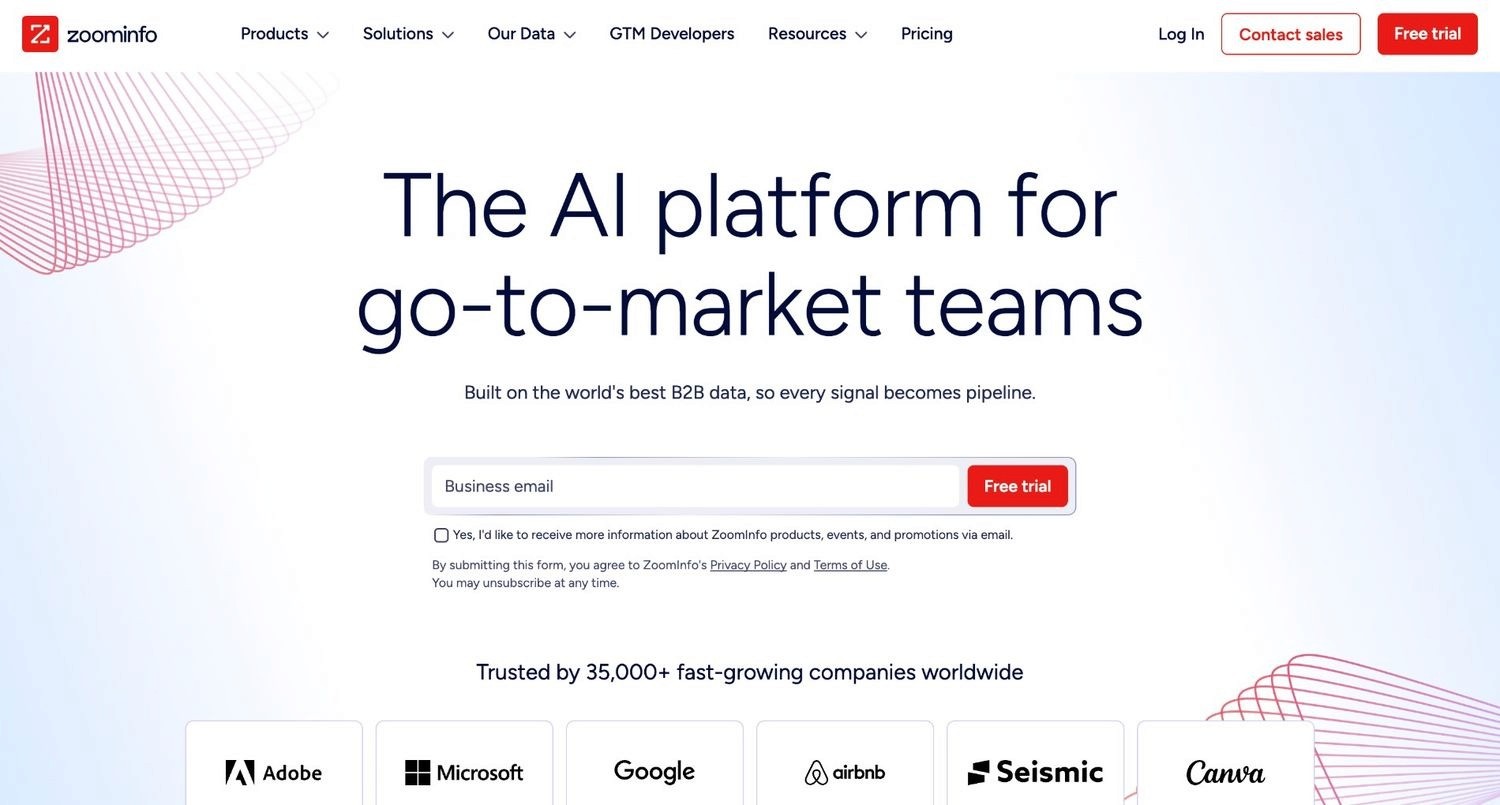
ZoomInfo is the enterprise reference point for B2B data depth, now trading publicly under the ticker GTM. Its GTM Context Graph resolves roughly 100 million companies, 500 million contacts and billions of buying signals into one identity-connected dataset.
In June 2026 the company made GTM.AI generally available, a headless context layer that exposes that graph to AI agents through an API and the Model Context Protocol, with live connections into Salesforce Agentforce, HubSpot Breeze, Microsoft Copilot, Claude and ChatGPT. A command-line client followed in July 2026, along with GTM Bench, a self-published benchmark for AI agents doing go-to-market work.
ZoomInfo remains a data and intelligence layer rather than an outreach engine, and its own product architecture says so. Teams running sequences on top of it buy an engagement tool separately, which is the main driver of total stack cost.
Who Are These Tools For?
Heads of Sales and VP-Level Revenue Leaders
Revenue leaders own the pipeline number and the team that produces it. Their recurring problem is not access to data, it is inconsistent output: reps spending more time on admin than on calls, and an outbound process that cannot be inspected or repeated across markets.
A complete workflow gives them one standard from list building to meeting booked, with performance broken down by campaign, identity, country and tag rather than reconciled across four dashboards. Enginy fits this persona directly. ZoomInfo also serves it, but only for leaders who already own an engagement tool and a RevOps hire to connect the two.
Sales Operations, RevOps and GTM Engineers
This is the persona currently holding a data provider, a sender, a warm-up service and a cleaner together with integrations. They evaluate on data quality, integration depth and workflow automation, and they feel every hour spent on deduplication rules and enrichment credit reconciliation.
Clay is built for the version of this persona who wants to keep building. Enginy is built for the version who wants the maintenance to stop: the same scrape, clean, enrich, clean, import and assign loop runs as a configured workflow rather than a set of tables somebody owns forever.
Founders and CEOs at SMBs and Startups
Founders wearing the sales hat cannot afford to hire a GTM engineer to configure enrichment tables or administer a five-figure annual data contract. They need to define an ICP, build a list, enrich it and launch a campaign in one sitting.
Apollo suits founders testing whether outbound works at all. Enginy suits founders who already know it works and want a system that produces meetings without a technical operator behind it.
Sales Managers and Team Leads
Managers running 3 to 10 SDRs care about consistency: the same outreach process, the same messaging framework, the same CRM properties updated daily. Fragmented stacks make that impossible to enforce, because every rep improvises across four interfaces.
Shared campaign templates, an AI Playbook holding the company's positioning, and one place where sequences and tasks live standardize the process and cut onboarding time for new hires. One tool to learn instead of four is a measurable ramp advantage.
Ambitious SDRs and Account Executives
The individual rep who wants to beat quota benefits most from removed decision fatigue. Instead of choosing which tool to open for each step, they work from one interface that shows which accounts to reach, what to say and when to follow up.
Recruitment agencies, IT consultancies, cybersecurity firms, digital agencies and insurance teams running account-based prospecting all put this rep at the center of the motion. The reclaimed hours go into conversations and demos, which is the entire point.
How We Built This Apollo, Clay, Cognism and ZoomInfo Review
Every pricing figure in this Apollo, Clay, Cognism and ZoomInfo comparison was verified against each vendor's own pricing page in August 2026. Where a vendor publishes no prices, we cite buyer-reported ranges and Vendr contract medians and label them as estimates rather than list prices.
Feature claims come from vendor documentation, release notes and hands-on use. Where a tool does not do something at all, we say so rather than scoring it low, because "weak social media automation" and "no social media automation" are different purchase decisions.
We scored seven criteria chosen around the complete outbound workflow: workflow coverage, buying intent signals and AI research, multi-stakeholder and multichannel outreach, AI agents and autonomous pipeline, enrichment and CRM data hygiene, ease of use, and pricing. That lens favors tools that cover the whole job, which is a deliberate choice you should weigh if your requirement is genuinely a single layer.
Apollo vs Clay vs Cognism vs ZoomInfo: Detailed Comparison
1. Workflow Coverage: Data and Outreach in One System
Apollo
Apollo covers more of the workflow than any other competitor in this group. Search the database, build a list, enrich it, then run an email sequence with call steps and manual tasks, all without leaving the interface.
The coverage is real but shallow at the outreach end. Social media outreach is a manual task reminder rather than automation, conditional branching is limited, and campaigns targeting several stakeholders at one account have to be assembled by hand. Inbound routing and the advanced dialer are priced as separate add-ons at $119 per month each, so the complete picture costs more than the seat price suggests.
Clay
Clay covers discovery and enrichment with more control than anything else available, and stops there. Email campaigns launch through integrations rather than natively, and it cannot make calls, automate social outreach, manage deliverability or report on sales performance in any depth.
Teams building an outbound operation around Clay add four to five tools: an advanced sender, a social automation tool, a dialer, a deliverability suite and an analytics layer. That stack is capable and it is also five renewal dates, five credit systems and five places where a record can drift out of sync.
Cognism
Cognism covers one layer: data. It supplies verified emails and mobile numbers to whatever engagement tool your team already runs, plus intent topics on the Pro package to help prioritize which accounts to call this week.
The product is explicitly organized this way, splitting into Sales Prospecting, CRM Enrichment and Data-as-a-Service. That is the right shape for organizations with an established engagement contract, and for everyone else it means a second five-figure commitment before a single message goes out.
ZoomInfo
ZoomInfo covers data, intelligence and, at the Copilot tiers, workflow orchestration and automated outreach activities. Most serious sending volume still runs through a dedicated engagement tool, which is the pattern ZoomInfo's own positioning assumes.
The GTM.AI layer released in June 2026 makes the data available to agents inside other systems, which is genuinely useful and also confirms the architecture: ZoomInfo is the context layer other tools act on, not the tool that acts.
Enginy
Enginy is the only tool in this comparison that runs the entire loop. List building with intent filters, waterfall enrichment across 15+ providers, cleaning passes before and after, conditional campaigns across email, social media and calling, autonomous reply management, then automated import and assignment into the CRM.
The workflow is explicit rather than assembled: scrape, clean, enrich, clean, import, assign. Recurring automated lists keep the CRM fed without anyone rebuilding a query. What you give up is the ability to swap any single layer for a best-of-breed alternative, which matters to teams with a strong existing contract they intend to keep.
🏆 Winner
Enginy. It is the only tool here where discovery, enrichment, multichannel outreach and CRM assignment run as one workflow, which removes both the integration maintenance and the record drift that fragmented stacks produce. Apollo is the runner-up and the sensible pick for teams whose motion is email plus calling into North America on a tight budget, since three of the five tools in this comparison do not send outreach at all.
2. Buying Intent Signals and AI Research
Apollo
Apollo offers 65 to 200+ filters covering firmographics, technographics, funding, headcount growth, job changes and hiring signals, plus a natural-language search that lets reps describe an ICP instead of building filter stacks. A 2026 update added Google Maps import for local business prospecting.
Intent topics are metered by tier: four on Basic, six on Professional and twelve on Organization. The Pocus acquisition adds a signal intelligence layer surfacing a short daily list of high-value actions per rep. Signals inform prioritization rather than triggering a sequence on their own.
Clay
Clay's discovery layer is signal-driven by design. Teams track job changes and other signals from the Launch plan upward, monitor funding rounds, leadership hires or technology adoption, then enrich and route accounts the moment a signal fires. Web intent tracking sits on the Growth plan.
Claygent extends this past what any provider sells: point it at a research question and it returns structured answers about niche attributes, org changes or buying triggers, with a full reasoning trace. The constraint is that every play must be built before it runs, and intent operates mostly at account level rather than contact level.
Cognism
Cognism ships hiring, funding, M&A and job change signals on Standard, with Bombora-powered intent data reserved for the Pro package. Combined with technographics, it gives calling teams a defensible reason to dial this week rather than next quarter.
Discovery itself is filter-based search with AI account research and an AI persona builder, plus a browser extension for prospecting from social media profiles. The signal never leaves the interface as an action; acting on it is the downstream tool's job.
ZoomInfo
ZoomInfo has the deepest intent inventory in this group: buyer intent signals and clusters, website visitors, champion tracking and job posting changes, buying group filters, competitor alerts and custom intent signals at the Copilot Enterprise tier. Since June 2026, agents can query that layer directly through GTM.AI.
Two things constrain it in practice. The signals most teams want sit at the Copilot Advanced tier and above, and buyer-reported figures put that configuration near $24,995 per year. And every signal still needs a separate tool to act on it, which reintroduces the lag between "this account is in market" and "this account has been contacted."
Enginy
Enginy surfaces intent through job change alerts, recent hires, funding rounds, technology stack usage, job postings that signal a purchase, event attendance and engagement on specific social posts. AI research fields then add company news summaries, contact bios and contextual data at scale, inserted dynamically into the message rather than read in a dashboard.
Two techniques here are unusual. Client lookalike scraping builds lists from the competitors of existing customers, which turns a signal into a FOMO angle in the first line of an email. CRM recycling re-imports poorly enriched historic records and fills them in, reactivating pipeline nobody was working. The signal, the research and the outreach live in the same system, so a job change detected on Monday becomes a personalized sequence on Monday.
🏆 Winner
Enginy. Intent only creates revenue when it triggers an action, and Enginy is the only tool here where a detected signal, the AI research that contextualizes it and the sequence that acts on it run in one place. ZoomInfo is the runner-up on raw signal depth, and it is the better choice for enterprise teams who need aggregate topic surges across a large account list and already own the engagement layer to act on them.
3. Multi-Stakeholder and Multichannel Outreach
Apollo
Apollo sends email sequences with A/Z testing, includes a dialer, and generates copy with an AI writer metered by words per month. Sequences combine email steps, call steps and manual tasks.
Everything is built around one contact. Reaching a CEO, a founder and a department head at the same account means creating three sequences and coordinating them yourself, and social touches are reminders rather than automated steps. For an email-first motion into a single buyer, it works. For a committee purchase, it does not.
Clay
Clay does not run outreach as a native capability. It drafts messages, scores and routes records and sends through the Clay sequencer or an integration, but it cannot dial, automate social outreach, manage deliverability or coordinate touches across several contacts at one account.
Multi-stakeholder logic can be modeled in a Clay table and then has to be executed somewhere else, which means the branching lives in one tool and the sending lives in another.
Cognism
Cognism provides no outreach capability. Multi-stakeholder strategy is entirely a function of whichever engagement tool sits downstream.
What Cognism does contribute is the raw material: verified mobile numbers for several contacts at the same account, which is the hard part of a phone-led committee play in Europe.
ZoomInfo
ZoomInfo maps the buying group better than anyone, with org charts, buying group filters and AI-generated buying group insight showing exactly who else matters at an account. Acting on that map means workflows for automated outreach at the Copilot tiers or, more commonly, a separate engagement contract.
The result is a well-understood committee and no native way to work it in coordinated steps across channels. Personalization is data-led rather than message-led.
Enginy
Multi-stakeholder outreach is a native strategy here, not a workaround. A single campaign approaches the CEO, the founder and the relevant department head at the same company in parallel or in timed sequence, so the organization has heard of you before the first cold call takes place.
The C-level layer adds another dimension: a senior identity sends the initial connection request and a warm, non-sales intro, and the SDR follows with a call referencing that exchange. Campaigns branch on behavior, so a prospect who accepts the connection request enters a different path from one who does not. Sequences stop automatically on reply, and channels run together rather than in parallel silos: email, social media, calling and manual CRM tasks in one flow.
🏆 Winner
Enginy. No other tool in this comparison coordinates several decision-makers at one account across email, social media and calling from a single campaign, and the C-level warming layer measurably changes meeting booking rates on accounts that ignore single-contact sequences. Apollo is the runner-up for teams whose deals close with one buyer and whose channels are email and phone only.
4. AI Agents and Autonomous Pipeline
Apollo
Apollo's AI writes email copy, scores leads, runs AI research at one credit per run and, since the Pocus acquisition, surfaces a daily list of recommended actions per rep. That is a meaningful reduction in decision fatigue.
It stops short of autonomy. The AI suggests, drafts and prioritizes; a human still launches, monitors and replies. Reply handling is manual, so inbound volume scales with headcount.
Clay
Claygent is a research agent, and a strong one, with 5 billion runs behind it and a reasoning trace on every decision. Sculptor builds workflows from natural-language descriptions.
Neither is an autonomous seller. Clay's agents require manual prompting, cannot generate multichannel sequences on their own, cannot handle replies without human approval and do not learn from rep feedback. The agent researches; the human still runs the motion.
Cognism
Cognism ships AI company research, an AI persona builder and AI search, all aimed at finding and qualifying accounts faster. There is no agent layer for outreach or reply management, because there is no outreach layer to attach one to.
ZoomInfo
ZoomInfo's Copilot recommends accounts, generates account summaries and ideal customer profiles, and prioritizes outreach at the Copilot Enterprise tier. GTM.AI now grounds third-party agents in verified data, which is strategically significant: it makes ZoomInfo the fuel for other systems' agents.
For a sales team, the practical consequence is that the agent doing the work belongs to somebody else. Getting autonomous pipeline out of ZoomInfo means building it in Agentforce, Breeze or a custom orchestration layer, with the engineering time that implies.
Enginy
Enginy runs AI SDR agents that operate prospecting and outreach workflows without proportional headcount growth. Agents handle reply management autonomously, tagging the inbox so campaign effectiveness feeds back into prompt improvement over time.
The AI Playbook is what makes this usable rather than generic. Company positioning, value propositions, ICP definition and per-sender personal data live in one configuration, so every generated message reflects how the company actually sells instead of a template. Connections to OpenAI, Gemini, Grok and Claude power the personalization, and AI research variables inject company news and contact context into each message at send time. Pipeline keeps moving overnight and across time zones because the sequences, the research and the replies do not wait for a rep to open a tab.
🏆 Winner
Enginy. It is the only tool here where AI agents run the full motion rather than assisting one step of it, and reply management with playbook-grounded personalization is the difference between AI that saves a rep ten minutes and AI that adds capacity to the team. Apollo is the runner-up for teams who want AI-assisted prioritization and copy without handing over execution.
5. Enrichment and CRM Data Hygiene
Apollo
Apollo enriches CRM records on a schedule and fills gaps on imported lists, with waterfall enrichment available from the Basic plan. Single-source coverage is the limitation: when Apollo lacks a record, nothing comes back, and email accuracy tests place it between 79% and 93% depending on region.
The credit model shapes behavior more than the feature set. A verified email costs one credit, a phone number costs eight, enrichment runs one to eight credits per record and the US dialer consumes two credits per minute. Paid plans grant credits per seat per year upfront, which is easier to budget than a monthly reset, and heavy phone use still exhausts an allocation early.
Clay
Clay produces the highest raw fill rate available, waterfalling across 150+ providers so a miss from one vendor becomes a hit from the next. Conditional logic, scoring and AI prompts all run in the same table.
Two constraints matter for hygiene specifically. CRM auto-sync and data warehouse sync sit on the Growth plan at $446 per month on annual billing, so integration is a tier decision rather than a given. And credits are consumed per lookup attempt in a waterfall, which means a dirty input list quietly burns allocation before anyone notices, precisely the scenario a cleaning pass is supposed to prevent.
Cognism
Cognism enriches lists via CSV upload and keeps CRM records current through the CRM Enrichment add-on, with on-demand mobile verification on Pro where a researcher confirms a specific number. Credits work cleanly: one credit reveals one contact, previously revealed contacts cost nothing to view again, and the same pool covers prospecting, enrichment and API.
There is no workflow builder and no routing logic. Enrichment is a lookup and a sync; everything downstream lives in another tool.
ZoomInfo
ZoomInfo keeps CRM records current at enterprise scale and is genuinely strong at it, with automated workflows available at the Copilot tiers for orchestration and routing. CRM enrichment is commonly quoted as an add-on rather than included.
The July 2026 CLI extends this for teams with engineering resource, piping enrichment output into warehouse jobs and CRM updates. For teams without that resource, the capability is theoretical.
Enginy
Enginy aggregates 15+ providers with waterfall logic and wraps it in the part most tools leave to the customer: a cleaning workflow before and after enrichment. Verified professional emails and correctly formatted phone numbers are retained, invalid records are removed, and contacts are routed by what they actually have.
That routing is the hygiene advantage. Contacts with a verified phone and email go to calling plus outbound sequences, email-only contacts go to social and email campaigns, and contacts with no reachable data go to social outreach only, so no rep burns a dial on a record that was never callable. Lists follow a naming convention for CRM traceability, and import and owner assignment happen automatically at the end of the loop. Clay still wins on raw provider count and configurability; Enginy wins on the record that lands in the CRM.
🏆 Winner
Enginy. Fill rate is only half of data quality, and Enginy is the only tool here that cleans before and after enrichment, routes contacts by available channel and assigns them to an owner without a manual step. Clay is the runner-up and the better pick for teams whose ICP is complex enough to need 150 providers and who have an operator to maintain the tables that query them.
6. Ease of Use
Apollo
Apollo is the fastest tool here to open. Sign up free, no card, no call, and run a search in under five minutes; the Chrome extension needs no configuration beyond installing it, and Basic and Professional both offer a 14-day trial.
Complexity arrives through the credit system rather than the interface. Reps discover mid-month that phone reveals cost eight times an email and that dialing burns two credits a minute. Support quality reflects a freemium model, so most learning is self-directed.
Clay
Clay has the steepest learning curve in this comparison by a wide margin. The table interface rewards a RevOps or engineering mindset and punishes everyone else, and building a production waterfall means understanding provider behavior, credit consumption and conditional logic at the same time.
Sculptor's natural-language builder helps, the template library is strong, and every paid tier offers a 14-day trial so you can find out before committing. It remains a tool you assign to an operator, not one you hand to an SDR in their first week.
Cognism
Cognism is straightforward: search, filter, reveal, export. Reps get productive quickly because the surface area is small and the browser extension fits existing habits.
Onboarding runs through a sales-led process with no free trial, only a limited data sample. Day-to-day use needs no specialist, though administering credit pools and contract terms does.
ZoomInfo
The core search is manageable, but the full product is not a light tool. Getting value from intent, workflows, Copilot and the enrichment modules assumes a RevOps owner who configures scoring, routing and CRM hygiene, and white-glove onboarding appears as a listed feature at the Copilot Enterprise tier for a reason.
A free trial is available on the Sales plans, which lowers the evaluation barrier. Teams that deploy the full product without a dedicated owner still use a fraction of what they pay for.
Enginy
Enginy is built on the assumption that a sales rep operates it, not a GTM engineer. AI Finder handles discovery through natural-language queries, so an SDR types "CTOs at early-stage startups in Barcelona" and gets a correctly filtered search instead of assembling criteria, while AI Recommendations proactively surface accounts matching the defined ICP.
Onboarding is guided rather than left to the customer: five structured sessions cover CRM connection, AI Playbook configuration, list building, campaign setup and deliverability, included on every plan. The honest trade-off is that you cannot try it alone first, since access starts with a qualification call and a demo rather than a signup form.
🏆 Winner
Enginy. Complete tools normally charge a complexity tax, and Enginy is the only one here that runs the full workflow without requiring a GTM engineer or a dedicated ops specialist to keep it running. Apollo is the runner-up and the faster path to a first search if what you need today is self-serve access without a conversation.
7. Pricing
Apollo
Apollo publishes four tiers, all billed annually: Free at $0 with 900 credits per seat per year granted monthly, Basic at $49 per seat per month with 30,000 credits per seat per year granted upfront, Professional at $79 with 48,000 credits, and Organization at $119 with 72,000 credits and a three-seat minimum. Annual billing saves 20% against monthly.
Credits are the variable. A verified email costs one credit, a phone number costs eight, enrichment runs one to eight per record, AI research costs one per run and the US dialer consumes two credits per minute. Two capabilities sit outside the seat price as $119 per month add-ons: Inbound, which covers website visitor identification and form enrichment, and Advanced Dialer, which covers international, parallel and power dialing with local presence.
Clay
Clay charges by usage rather than seats, and every plan includes unlimited seats. Free includes 6,000 actions and 1,200 data credits per year; Launch is $167 per month on annual billing with 180,000 actions and 30,000 data credits per year; Growth is $446 per month with 480,000 actions and 72,000 data credits per year. Annual billing saves 10%, and every paid tier offers a 14-day trial.
Enterprise is custom, with Vendr putting the median contract near $30,400 per year and outliers reaching $154,000. Actions measure platform usage and data credits buy vendor data from the marketplace, so two teams on the same plan pay very different totals. Model the full stack, not the subscription: Clay plus a sender plus a professional-network subscription plus a CRM typically lands between $1,700 and $5,000 per month.
Cognism
Cognism publishes no prices. Sales prospecting ships as Standard and Pro, each including five seats, with CRM Enrichment and Data-as-a-Service quoted separately, and every quote is built from package, seat count and credit volume.
Buyer-reported figures from procurement communities put a small-team contract in the $15,000 to $25,000 per year range, rising with seat count and the Pro package. Contracts are annual with upfront payment, there is no monthly option and no free trial, and renewal increases of 10% to 15% are commonly reported. The credit model itself is one of the cleaner ones in this category: one credit reveals one contact, re-viewing a revealed contact is free, and the same pool works across the prospecting interface, enrichment and the API.
ZoomInfo
ZoomInfo is quote-only across three Sales packages: ZoomInfo Professional for core contact and company data, Copilot Advanced adding intent signals, website visitors and account prioritization, and Copilot Enterprise adding custom intent, advanced workflows, AI-generated account summaries and white-glove onboarding. Marketing and Talent are priced as separate product lines.
Buyer-reported figures put Professional near $14,995 per year with a three-seat minimum, Copilot Advanced near $24,995 and Copilot Enterprise near $39,995 or more. Vendr's median across 1,313 verified purchases is $31,875 per year, and most mid-market teams land between $30,000 and $60,000 once seats, credits and add-ons stack. Contracts auto-renew with a 60 to 90 day written cancellation window and 10% to 20% renewal increases.
Enginy
Enginy is custom-quoted on a credit-based model across four tiers. Basic includes 5,000 credits per month and up to 500 contacts with one identity; Smart doubles credits to 10,000 with 1,000 contacts, two identities and a warm-up seat; Business covers 32,000 credits, 2,000 contacts, four identities and a dedicated Success Manager; Enterprise is fully custom.
Every plan includes five onboarding sessions plus email and chat support. Seat count, credit volume and phone data inclusion are adjusted per team during the qualification conversation. The cost of that flexibility is transparency: there is no number on the pricing page, which is a fair reason to prefer a published price if you want to evaluate without a conversation.
🏆 Winner
Apollo is the cheapest and the most transparent, with a usable free tier and published per-seat pricing from $49 per user per month. Enginy is the best value at scale, because a team currently paying for a data provider, a sending tool, a warm-up service and a cleaner replaces four line items with one and stops paying the rep hours lost between them.
How to Choose Between Apollo, Clay, Cognism, ZoomInfo and Enginy
1. Count the Layers You Are Buying
Map your current stack before you compare prices. A data provider, a sender, a deliverability service and a cleaner are four contracts, four credit systems and four places where a record can drift.
If any of the steps between scrape, clean, enrich, clean, import and assign is manual today, that gap is costing rep hours nobody is measuring. Tools that cover one layer are only cheaper when you already own the others and intend to keep them.
2. Check Who Has to Operate It
This is the question most evaluations skip, and it decides whether the purchase produces pipeline or shelfware. Clay assumes a GTM engineer, ZoomInfo assumes a RevOps owner, and both deliver a fraction of their value without one.
If your team does not have that person and does not plan to hire one, weight ease of operation as heavily as capability. A tool a rep can run at 80% of its potential beats a tool nobody configures past 30%.
3. Test Whether Signals Trigger Action
Intent data that lands in a dashboard creates a reading task. Intent data that starts a sequence creates a meeting.
Ask each vendor what happens automatically when a target contact changes jobs, when a target account posts a relevant role, or when someone engages with a specific post. If the answer involves an export, the lag between signal and outreach is measured in days rather than minutes.
4. Ask How It Handles a Buying Committee
B2B deals rarely close through one contact. Check whether the tool can approach several decision-makers at the same account in coordinated, timed steps, and whether a senior identity can warm the account before the SDR calls.
Single-contact sequencing is the default across most of this category. Company-wide engagement is the difference between an account that has never heard of you and one where the CEO already accepted a connection request.
5. Model Total Cost, Not Subscription Cost
Compare the full annual number: subscription, credits, overages, add-ons, onboarding fees, renewal increases and the tools each option does not replace. A $49 per seat quote plus two $119 add-ons plus phone credits at eight apiece is a different purchase than the pricing page suggests.
Then add the rep hours. Factorial measured 3 to 4 hours per SDR per day going into operational overhead before consolidation, which is the largest line item in most stacks and the one that never appears on an invoice. Comparing options across this category is easier once you have seen what a best all-in-one sales platform evaluation covers end to end.
Apollo vs Clay vs Cognism vs ZoomInfo: Verdict by Feature
Feature / Criteria | Apollo | Clay | Cognism | ZoomInfo | Enginy | Verdict |
Workflow Coverage | ⭐⭐⭐ | ⭐⭐ | ⭐ | ⭐⭐ | ⭐⭐⭐⭐⭐ | Enginy – only tool covering discovery, enrichment, outreach and CRM assignment |
Buying Intent Signals & AI Research | ⭐⭐⭐ | ⭐⭐⭐⭐ | ⭐⭐⭐ | ⭐⭐⭐⭐ | ⭐⭐⭐⭐⭐ | Enginy – signals trigger sequences instead of filling a dashboard |
Multi-Stakeholder & Multichannel Outreach | ⭐⭐⭐ | ⭐ | ⭐ | ⭐⭐ | ⭐⭐⭐⭐⭐ | Enginy – coordinated email, social and calling across a buying committee |
AI Agents & Autonomous Pipeline | ⭐⭐⭐ | ⭐⭐⭐ | ⭐⭐ | ⭐⭐⭐ | ⭐⭐⭐⭐⭐ | Enginy – AI SDR agents run the motion and handle replies autonomously |
Enrichment & CRM Data Hygiene | ⭐⭐⭐ | ⭐⭐⭐⭐ | ⭐⭐⭐ | ⭐⭐⭐⭐ | ⭐⭐⭐⭐⭐ | Enginy – cleaning before and after enrichment, then routing and assignment |
Ease of Use | ⭐⭐⭐⭐ | ⭐⭐ | ⭐⭐⭐⭐ | ⭐⭐⭐ | ⭐⭐⭐⭐⭐ | Enginy – full workflow runs without a GTM engineer |
Pricing | ⭐⭐⭐⭐⭐ | ⭐⭐⭐ | ⭐⭐ | ⭐ | ⭐⭐⭐⭐ | Apollo – cheapest entry and the only fully published per-seat pricing |
Customer Support & Onboarding | ⭐⭐⭐ | ⭐⭐⭐ | ⭐⭐⭐⭐ | ⭐⭐⭐⭐ | ⭐⭐⭐⭐⭐ | Enginy – five guided onboarding sessions included on every plan |
Total Cost of Ownership at Scale | ⭐⭐⭐ | ⭐⭐⭐ | ⭐⭐ | ⭐ | ⭐⭐⭐⭐⭐ | Enginy – one contract replaces data, sending, warm-up and cleaning |
Final Verdict: Which Should You Choose?
Choose Enginy If:
You run structured outbound with SDRs and AEs and want discovery, enrichment, multichannel sequences and CRM assignment in one system rather than four contracts.
Your deals involve a buying committee, and reaching the CEO, the founder and the department head at one account in coordinated steps changes your meeting rate.
You want intent signals that start campaigns automatically and AI agents that keep pipeline moving overnight, without hiring a GTM engineer to maintain any of it.
You sell into SaaS, recruitment, IT consulting, agencies, cybersecurity, insurance or professional services, and you are expanding into new markets where lists have to be built and tested fast.
You want an all-in-one sales platform every rep on the team can operate on day one, not a system that only works when one specialist is available.
Choose Any Other Tool If:
Budget is the deciding factor and outbound is still an experiment. Apollo starts free and reaches $49 per seat per month on annual billing, which is the right call when you are proving the motion rather than scaling it. Revisit the comparison when credits, add-ons and a second tool push the real number past $150 per seat.
You only need one layer, because you already own the rest. Teams locked into an engagement contract they intend to keep need data, not a workflow. Cognism feeds it in EMEA, ZoomInfo feeds it at enterprise scale, and paying twice for outreach makes no sense.
You have a GTM engineer who wants to build rather than operate. Clay is the right answer when someone on the team enjoys designing waterfalls, writing research prompts and maintaining tables, and when your ICP is unusual enough to justify 150 providers.
Your entire motion is cold calling into the UK, DACH or the Nordics. Phone-verified mobiles and DNC screening across 15 countries are a specific product, and Cognism sells it better than anyone.
You are an enterprise grounding AI agents in a data graph. ZoomInfo through GTM.AI is infrastructure for Agentforce, Breeze and Copilot builds, with the engineering capacity and five-figure budget that implies.
FAQs About Apollo, Clay, Cognism, ZoomInfo and Enginy
What is the main difference between Apollo, Clay, Cognism, ZoomInfo and Enginy?
The main difference between Apollo, Clay, Cognism, ZoomInfo and Enginy is how much of the outbound workflow each one covers. Cognism and ZoomInfo are data providers that require a separate engagement tool, and Clay is an enrichment layer that also requires a separate sender. Apollo bundles a 210M+ contact database with email-first sequencing and a dialer. Enginy is the only one of the five that runs prospect discovery, waterfall enrichment across 15+ providers, conditional multichannel campaigns and CRM assignment in a single workflow.
Which is better: Apollo, Clay, Cognism, ZoomInfo or Enginy?
Enginy is better for most B2B teams running structured outbound, because it covers the complete workflow and any sales rep can operate it without a GTM engineer. Apollo is better for solo reps and teams still proving that outbound works, where a free tier and $49 per seat matter more than workflow depth. Clay suits RevOps teams with a dedicated operator, Cognism suits phone-heavy EMEA outbound paired with an existing engagement tool, and ZoomInfo suits enterprise teams with a RevOps owner already in place.
What is Enginy better for?
Enginy is better for sales teams that want prospect discovery, multi-source enrichment and multichannel outreach running as one workflow without a GTM engineer. It waterfalls 15+ enrichment providers with cleaning passes before and after, then launches conditional campaigns across email, social media and calling that contact several decision-makers at the same account and stop automatically when a prospect replies. Factorial scaled from 10 leads per day to 5,000 leads per month with it, doubling conversion from 4% to 8% and lifting reply rates from 10% to 45%. Venair tripled monthly lead generation across 20+ global delegations.
Which tool is easiest to use?
Enginy is the easiest tool to run end to end, because AI Finder handles discovery through natural-language queries and enrichment, campaigns and CRM assignment sit in one interface a sales rep can operate without technical support. Five guided onboarding sessions are included on every plan, covering CRM connection, AI Playbook setup, list building, campaign creation and deliverability. Apollo is the fastest to sign up for, with free access and no sales call required. Clay is the hardest, requiring a RevOps or engineering mindset to build and maintain tables.
Which tools can contact several decision-makers at the same company?
Enginy is the only tool of the five that runs multi-stakeholder outreach natively, contacting the CEO, the founder and the relevant department head at one account in parallel or in timed sequence from a single campaign. A C-level identity can send the first connection request and a warm intro before the SDR calls, and the campaign branches depending on whether the prospect accepts. Apollo sequences one contact at a time, so committee coverage has to be assembled manually. Clay, Cognism and ZoomInfo map the buying group but do not contact it.
Do any of these tools include AI SDR agents?
Enginy is the only one of the five with AI SDR agents that run prospecting and outreach workflows and handle replies autonomously, with inbox tagging that feeds campaign performance back into prompt improvement. Apollo and ZoomInfo offer AI assistance for copy, research and account prioritization, but a human still launches campaigns and answers replies. Clay's Claygent is a research agent that requires manual prompting and cannot handle replies without approval. Cognism has AI research and search but no outreach layer to automate.
Which integrates better with HubSpot and Salesforce?
Enginy and ZoomInfo both integrate deeply with HubSpot and Salesforce, and the difference is what the integration does. Enginy connects natively to HubSpot, Salesforce, Pipedrive, Microsoft Dynamics 365, Zoho, Attio, TribeCRM and custom CRMs, and automates the full scrape, clean, enrich, clean, import and assign loop including owner assignment. ZoomInfo offers bi-directional sync plus GTM.AI connections into Agentforce and Breeze for AI agents. Clay reaches both CRMs only on the Growth plan at $446 per month, and Apollo meters exports through its credit pool.
Is it cheaper to buy one tool or to combine Clay with Apollo or Cognism?
Combining tools is almost always more expensive once rep hours are counted. A Clay plus sender plus professional-network plus CRM stack runs $1,700 to $5,000 per month, and a Cognism plus engagement tool stack regularly passes $40,000 per year for a five-person team. Factorial's Head of Outbound SDRs reported saving 3 to 4 hours per SDR per day after consolidating into one system, which is the largest cost in most stacks and the one that never appears on an invoice. Compare total cost of ownership, not subscription line items.
How hard is it to switch from Apollo, Clay, Cognism or ZoomInfo to Enginy?
Switching to Enginy is guided rather than self-serve, which is what makes it manageable. Existing prospect lists export from any of these tools as CSV and re-enrich through Enginy's 15+ provider waterfall, so contact data improves during the migration rather than carrying over stale. Native connections to HubSpot, Salesforce, Pipedrive, Microsoft Dynamics 365, Zoho, Attio, TribeCRM and custom CRMs mean the system of record does not change. Five onboarding sessions run jointly with the customer success team, covering CRM setup, AI Playbook configuration, list building, campaigns and deliverability.
How long does it take to launch a first campaign?
Most Enginy teams run their first campaigns within the first week of onboarding, because the five guided sessions configure the CRM connection, AI Playbook, first lists and first sequences together rather than leaving setup to the customer. Apollo is faster to a first search, with free signup and results in under five minutes, though building a full multichannel motion takes longer. Clay production workflows typically take weeks to design and tune, and ZoomInfo implementations run as onboarding projects with a RevOps owner attached. Speed to first search and speed to first pipeline are different measurements.
Do I still need a CRM if I use one of these tools?
You still need a CRM, because none of these five tools is designed to replace one. Apollo includes light CRM functionality and ZoomInfo enriches CRM records at scale, but both assume Salesforce, HubSpot or an equivalent remains your system of record. Enginy sits upstream and feeds the CRM through an automated scrape, clean, enrich, clean, import and assign loop, with native connections to seven CRMs plus custom configurations. The correct architecture is a prospecting and outreach layer above a CRM, not one instead of the other.