Back to blog
10 Best AI Lead Generation Tools in 2026 (Compared)
Andrea Lopez
· Updated
Share
The best AI lead generation tools in 2026 are Enginy, Clay, Apollo, ZoomInfo, Cognism, Instantly, Amplemarket, Lusha, HubSpot Breeze Intelligence and 11x. Each one solves a different part of lead generation: finding the right accounts, enriching contact data, spotting buying signals, writing personalized outreach or running the whole outbound process for you.
Here is the short version:
Enginy – best all-in-one AI lead generation platform for B2B outbound teams
Clay – best for custom enrichment workflows
Apollo – best AI lead gen tool for small teams starting out
ZoomInfo – best for enterprise data and intent
Cognism – best for compliant European data and verified mobiles
Instantly – best for high-volume cold email
Amplemarket – best AI copilot for SDR teams
Lusha – best for quick, simple contact data
HubSpot Breeze Intelligence – best for teams that live in HubSpot
11x – best autonomous AI SDR
Manual prospecting is slowing sales teams down: hours spent researching accounts, copying data between spreadsheets and switching between tools. That is why more companies now rely on AI lead generation tools to find, qualify and reach the right buyers. Below you will find a comparison table, how we evaluated each tool, a detailed review of the 10 best AI tools for lead generation, and a guide to choosing the right one for your team.
AI lead generation tools compared: the 2026 overview
Tool | Best for | Main AI capability | Channels | Pricing model |
|---|---|---|---|---|
Enginy | All-in-one B2B outbound | AI search, AI research per lead, AI replies | Email + social media | |
Clay | Custom enrichment workflows | AI research agent and waterfall enrichment | Email (built-in sequencer) | Free plan + credits |
Apollo | Small teams starting out | AI research and writing assistant | Email + calls | Free plan + paid tiers |
ZoomInfo | Enterprise data and intent | AI copilot over intent and account data | Email + calls | Custom, annual contracts |
Cognism | European, compliant data | Intent signals and verified mobiles | Data only (CRM export) | Custom |
Instantly | High-volume cold email | AI reply handling and copy | Paid plans, free trial | |
Amplemarket | SDR teams | AI copilot for targeting and messaging | Email + calls + social media | Custom |
Lusha | Quick contact data | AI prospect recommendations | Data + light sequences | Free plan + paid tiers |
HubSpot Breeze Intelligence | HubSpot users | Enrichment and buyer intent inside HubSpot | Through HubSpot | Credits, needs HubSpot |
11x | Autonomous AI SDR | AI agent that runs outbound end to end | Email + other channels | Custom |
How we evaluated these AI lead generation tools
To build this ranking of AI lead generation software, we compared each tool on the six things that decide whether it actually produces pipeline:
Data coverage and accuracy: how many verified emails and phone numbers it finds, and whether it uses one database or several sources in sequence.
Real AI, not just automation: does the AI choose who to contact, research each lead and write relevant messages, or does it only run rules you define?
Buying signals: whether it tells you when to reach out (job changes, hiring, funding, website visits), not just who to contact.
Outreach channels: whether you can act on the leads in the same tool, and on which channels.
CRM integration: two-way sync with the CRM your team already uses, with no CSV exports.
Ease of setup and pricing model: how fast a team gets results, and whether the pricing is transparent.
We based the review on each vendor's product documentation, public reviews and what we see every day working with B2B sales teams. Enginy is our own product: we included it because it is built for exactly this use case, and we kept the same criteria for every tool.
The 10 best AI lead generation tools in 2026
1. Enginy – the all-in-one AI lead generation platform
Enginy is an AI lead generation platform that connects every step of B2B prospecting in one place: finding the right companies and people, enriching their data, detecting buying signals, running multichannel outreach and handling replies.
Instead of building lists with filters and tables, you ask Enginy's AI search for the buyers you want in plain language. Enginy then runs a waterfall across 30+ data providers to find verified work emails and mobile numbers, and its AI Variables let an AI agent browse the web to research each persona and company before you reach out.
With intent signals, your team gets notified when prospects show real buying signals, so outreach happens at the right moment. Condition-based multichannel sequences coordinate email and social media steps, with built-in warm-up and deliverability, and the smart inbox uses AI to prioritize leads, handle objections, reply faster and book meetings.
Everything stays in continuous two-way sync with your CRM — HubSpot, Salesforce, Pipedrive, Zoho or Microsoft Dynamics — so there is nothing to migrate.
Best for: B2B sales teams that want one AI lead gen tool instead of a separate data provider, enrichment tool and sequencer.
Pros:
Data, enrichment, signals, outreach and replies in one workflow
Waterfall enrichment across 30+ providers for more coverage than a single database
AI research per lead for personalization that goes beyond the first name
Native sync with the main CRMs
Cons:
As a complete platform, it pays off most when you define your ICP, signals and sequences; it is more than you need for a one-off contact list
2. Clay – best AI lead generation tool for custom enrichment workflows
Clay is a spreadsheet-like workflow builder for lead enrichment. You connect a large catalogue of data providers, chain them in a waterfall, and use its AI research agent to find information that no database has, such as a company's pricing model or recent news. Clay has also added its own sequencer, so you can send emails without leaving it.
Best for: technical growth and RevOps teams that want full control over how leads are enriched and scored.
Pros:
Huge choice of data sources and a powerful AI research agent
Fully customizable, no-code workflows
Built-in sequencer and integrations with the main CRMs
Cons:
Steep learning curve; building good tables takes time
Credit-based pricing that can grow quickly at volume
Compare Enginy and Clay · Clay alternatives
3. Apollo – best AI lead gen tool for small teams starting out
Apollo combines a large B2B contact database (more than 200 million contacts) with built-in sequences for email and calls. It has added AI research and writing assistants, and waterfall enrichment to complete contacts that its own database does not cover.
Best for: startups and small sales teams that want data and outreach in one affordable tool.
Pros:
Large database and a free plan to start
Data and sequences in the same tool
Easy to use, with CRM integrations for HubSpot and Salesforce
Cons:
Data quality can vary by region and seniority
AI features are lighter than in AI-first platforms
Compare Enginy and Apollo · Apollo alternatives
4. ZoomInfo – best AI lead generation software for enterprise data
ZoomInfo is one of the largest B2B data platforms, with company and contact data, org charts, technographics and buyer intent. Its AI copilot surfaces which accounts to prioritize and why, based on intent and account activity.
Best for: large sales and marketing organizations with budget for an enterprise data platform.
Pros:
Very broad data, especially in North America
Strong intent data and account insights
Deep integrations with enterprise CRMs
Cons:
Expensive, with annual contracts
More than most small and mid-sized teams need
Compare Enginy and ZoomInfo · ZoomInfo alternatives
5. Cognism – best for compliant European B2B data
Cognism is a B2B data provider known for phone-verified mobile numbers and a strong focus on GDPR compliance, which makes it popular with teams selling into Europe. It adds intent signals so you can prioritize accounts that are researching your category.
Best for: teams prospecting in Europe and regulated industries that rely on cold calling.
Pros:
Phone-verified mobile numbers
Strong European coverage and compliance focus
Intent data and native CRM integrations
Cons:
A data provider, not an outreach tool: you still need a sequencer
Custom pricing aimed at mid-market and enterprise
6. Instantly – best AI lead gen tool for high-volume cold email
Instantly is built to scale cold email: you connect many sending accounts, warm them up automatically and rotate them to protect deliverability. It also includes a B2B lead database and AI help to write emails and sort replies.
Best for: teams whose outbound strategy relies mainly on email volume.
Pros:
Unlimited sending accounts with automatic warm-up
Simple, fast campaign setup
Built-in lead database and AI reply sorting
Cons:
Email-first: other channels are limited
Data depth is lower than in specialist data providers
7. Amplemarket – best AI copilot for SDR teams
Amplemarket is an outbound platform that combines lead sourcing, enrichment, multichannel sequences and deliverability tools, with an AI copilot that suggests who to contact, when and with what message.
Best for: SDR teams that want AI guidance on targeting and messaging inside one platform.
Pros:
Data, sequences and deliverability in one place
AI suggestions based on signals and engagement
Supports email, calls and social media
Cons:
Custom pricing aimed at funded teams
Less flexible enrichment than workflow tools such as Clay
Compare Enginy and Amplemarket
8. Lusha – best for quick, simple contact data
Lusha gives sales reps fast access to verified business emails and phone numbers from its browser extension and CRM integrations, with AI recommendations of similar prospects and light sequencing.
Best for: small teams and individual reps who need contact data quickly, without a complex setup.
Pros:
Very easy to use, with a free plan
Works from the browser and inside the CRM
AI prospect recommendations
Cons:
A single database, so coverage gaps show up in some markets
Limited outreach features
Compare Enginy and Lusha · Lusha alternatives
9. HubSpot Breeze Intelligence – best AI lead generation tool for HubSpot users
Breeze Intelligence (formerly Clearbit) enriches companies and contacts directly inside HubSpot, identifies companies that visit your website and shortens forms by filling in known data automatically.
Best for: marketing and sales teams that already run everything in HubSpot.
Pros:
Native to HubSpot, nothing extra to set up
Company enrichment and website buyer intent
Shorter forms, better inbound conversion
Cons:
Only useful if you use HubSpot
Focused on enrichment: outreach depends on HubSpot's own tools
10. 11x – best autonomous AI SDR
11x builds AI "digital workers" for revenue teams. Its flagship agent, Alice, runs outbound end to end: she sources prospects, researches accounts, writes personalized multichannel sequences and books meetings autonomously, around the clock.
Best for: teams that want to scale outbound without growing headcount and accept giving the AI more control.
Pros:
Fully autonomous outbound, from sourcing to booking meetings
Runs 24/7
Personalized multichannel sequences
Cons:
Results depend heavily on how well your ICP and messaging are configured during onboarding
Custom pricing that puts it out of reach for most small teams
Compare Enginy and AI SDR tools · 11x alternatives
Other AI lead generation tools worth considering
These four did not make the top 10, but they can be a good fit for specific use cases:
Salesforge: AI-personalized cold email at scale, with an optional AI SDR add-on. A good fit for teams that want email outreach that does not read like a template, with room to add more automation later.
Bitscale: a credit-based platform that covers list building, enrichment and outreach, with a free plan that does not expire. Useful for growing teams that want to test AI lead generation before committing to a bigger contract.
Outreach: an established sales engagement platform with sequencing, deep CRM integrations, coaching and analytics. Built for enterprise sales teams that already have a sales operations function in place.
Seamless.AI: a self-serve contact database where reps sign up and start searching for verified contacts without a long setup. Practical for individual reps and small teams that mainly need contact search rather than a full outbound workflow.
What are AI lead generation tools?
AI lead generation tools are software that uses artificial intelligence to find, qualify and engage potential B2B customers. They automate the work that used to take sales reps hours — researching accounts, finding verified contact details, deciding who is ready to buy, writing personalized messages and following up — so the team can spend its time on conversations that convert.
The difference with classic sales automation is that AI tools for lead generation do not just execute rules. They decide who is worth contacting, when and with what message, based on real data and signals.
If you sell software, our guide to SaaS lead generation covers the full process, the strategies and a 30-day plan beyond the tools.
How AI lead generation tools work in 2026
Modern AI lead gen tools combine five capabilities:
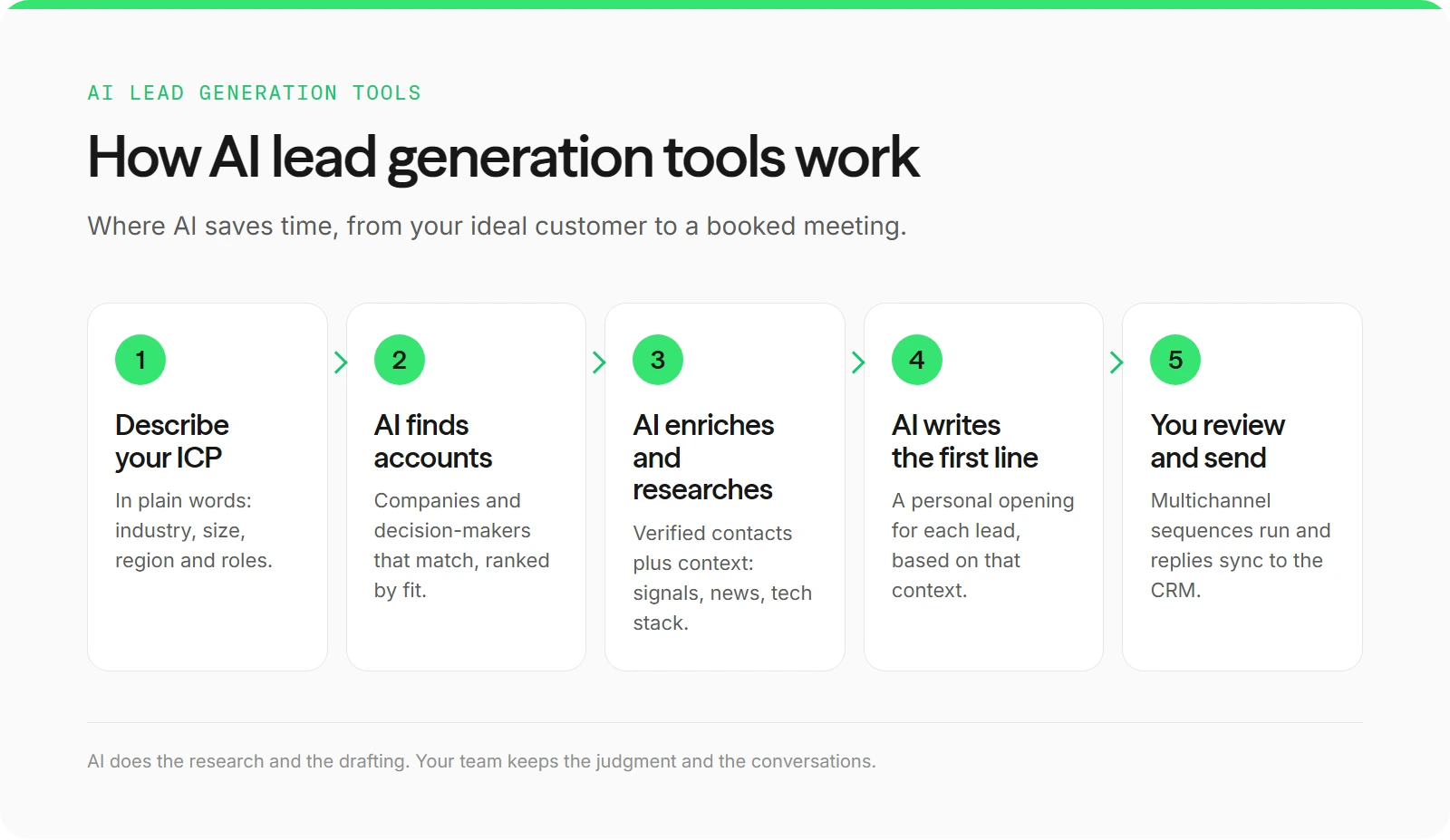
AI search and targeting. Instead of combining dozens of filters, you describe your ideal customer and the AI finds matching companies and people.
Waterfall data enrichment. The tool checks several data providers one after another until it finds a valid email or phone number, which gives more coverage than any single database. Read more in our guide to waterfall data enrichment.
Buying signals. Hiring trends, funding rounds, job changes, technology changes and website visits tell you when an account is ready, so you act on timing, not just fit.
Contextual personalization. AI researches each lead and writes messages based on why the prospect might care right now, not just their name and company.
Adaptive multichannel orchestration and AI replies. Sequences adapt to each lead's behavior across email and social media, and AI agents handle first replies, answer common objections and book meetings, passing full context to your reps.
Data quality is the foundation of all of it: automation amplifies both good and bad data. That is why the best AI lead generation platforms refresh profiles continuously, re-enrich bounced emails and update outdated roles automatically. If data is your main gap, see our guide to data enrichment and our list of the best B2B data providers.
Types of AI tools for lead generation
Not every AI lead generation tool does the same job. Most fall into one of five types:
Type | What it does | Examples |
|---|---|---|
All-in-one AI lead generation platforms | Data, enrichment, signals, outreach and replies in one place | Enginy, Amplemarket |
Data and enrichment tools | Find and complete contact and company data | Clay, ZoomInfo, Cognism, Lusha, Breeze Intelligence |
Database + sequencer tools | A contact database with basic outreach | Apollo |
Cold email tools | Send email at volume with good deliverability | Instantly |
Autonomous AI SDRs | An AI agent that runs outbound for you | 11x |
If you mainly need outreach across several channels, our comparison of the best multichannel outreach tools goes deeper.
Key features to look for in AI lead generation software
1. Data from multiple sources
Great outreach starts with great data. Look for AI lead generation software that enriches profiles with a waterfall of several providers, not a single database, and that verifies emails before you send.
2. Buying signals and lead scoring
The best AI tools for lead generation tell you who to contact now. Intent signals, job changes and engagement should feed a score that ranks your leads automatically.
3. AI research and personalization
Check whether the AI can research each lead (company news, priorities, technology) and turn it into relevant messages, instead of only inserting the first name.
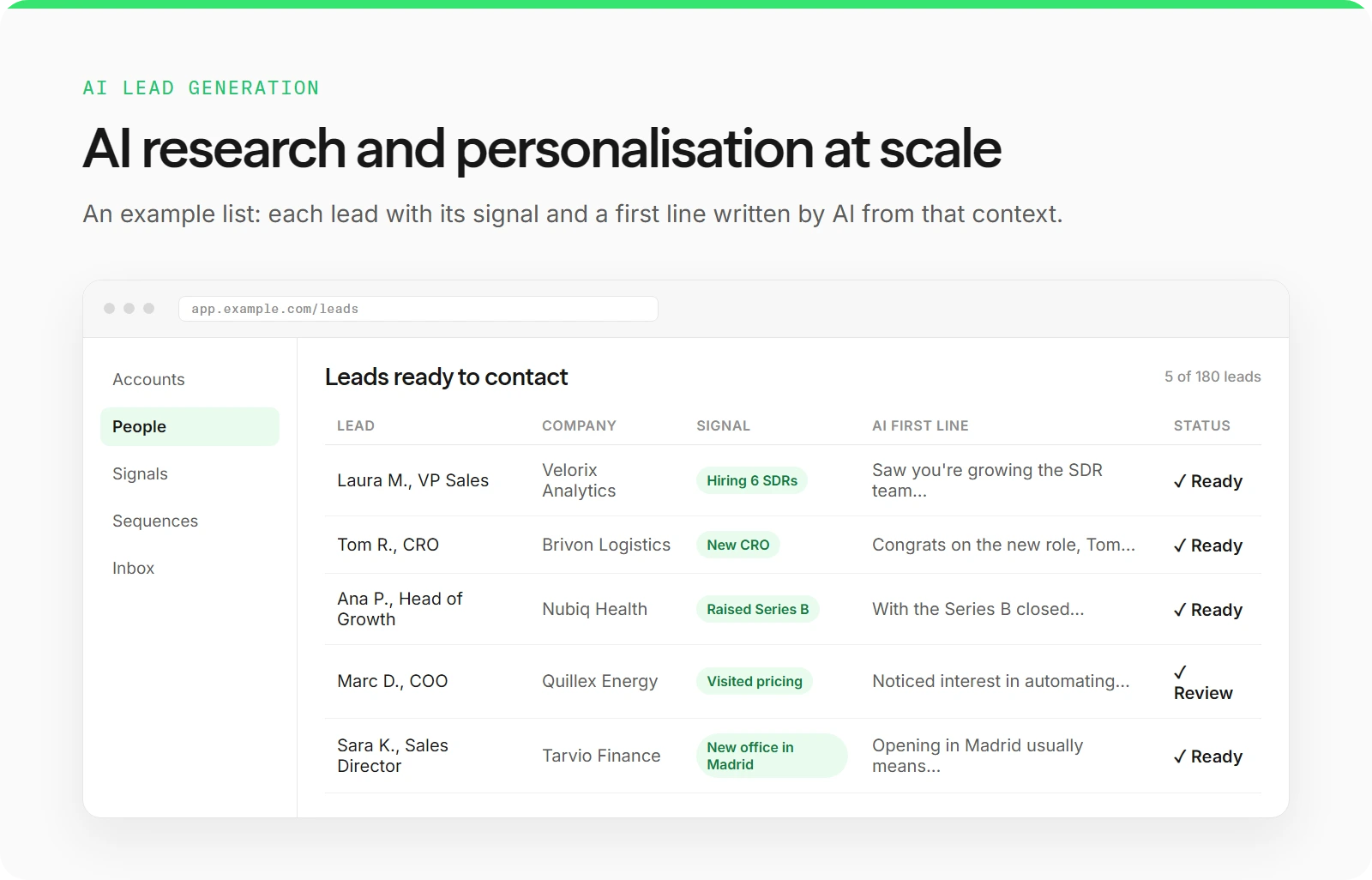
4. Multichannel sequences that adapt
Leads respond on different channels. Behavior-based sequences across email and social media, with clear rules to avoid duplicate touches, raise reply rates without adding more emails.
5. Two-way CRM sync
Your CRM must stay the single source of truth. A good AI lead gen tool syncs contacts, activity and status both ways, with no CSV exports and no manual logging.
Who needs AI lead generation tools?
AI lead generation tools are not only for large SDR teams. These are the profiles that get the most out of them, and why.
Heads of Sales and VPs of Sales
They need predictable, scalable outbound without hiring more reps every time the pipeline target goes up. With AI lead generation tools, the same team covers more accounts, so pipeline grows without headcount having to grow at the same pace.
Sales Ops and RevOps teams
They often manage a data tool, a separate outreach tool and something else to clean the data in between. An AI lead generation platform replaces that fragmented stack with one connected workflow, from list building to the CRM update.
Founders and early-stage teams
Founders who still run their own outbound need a tool they can operate without a dedicated technical profile. A well-designed AI lead gen tool lets them test new markets and build their first pipeline before hiring a GTM engineer.
Sales managers and team leads
Managers running a handful of SDRs need outreach that is consistent across the team, not dependent on each rep's personal process. Shared multichannel sequences and AI research keep quality steady and leave reps more time for calls and less for manual prep.
Agencies and consultancies running outbound for clients
Agencies need to launch new campaigns for each client quickly, without rebuilding the process from scratch. AI lead generation tools give them a repeatable system they can point at a new ICP in days rather than weeks.
How to choose the right AI lead gen tool for your team
The right tool depends on your stage, but three criteria apply to every team:
Ease of use without a technical profile: some tools need a GTM engineer or a RevOps specialist to configure and maintain them; others are built for any rep to run. Decide how much technical work you really want to take on.
Pricing model fit: per-seat pricing can penalize growing teams, while credit- or usage-based pricing grows with your actual outreach volume. Match the model to how much prospecting you expect to run over the next year.
Multichannel and multi-stakeholder capability: a single channel and a single contact per account limit how fast you can book meetings. Check that the tool can run sequences across several channels and reach several stakeholders at the same company.
Early-stage startups
You need quick wins: a tool that helps you find leads fast, test messaging and reach out without draining a small team. A database with simple sequences (such as Apollo) or an all-in-one platform you can grow into (such as Enginy) works well while you refine your ICP.
Mid-sized sales teams
Lead data becomes hard to manage and reps juggle email tools, social media messaging and spreadsheets. Choose an AI lead generation platform that enriches leads, automates multichannel outreach and syncs everything with your CRM, so you stop adding tools.
Scaling sales organizations
With multiple campaigns, regions and personas, the problem is complexity. You need end-to-end automation — sourcing, enrichment, signals, sequencing, AI replies and meeting booking — integrated deeply with your CRM, plus clear rules for ownership and deduplication.
How to measure the ROI of AI lead generation tools
AI lead generation only pays off when meetings, pipeline and revenue go up while manual work goes down. Replace vanity metrics such as emails sent or open rates with a short scorecard:
Meetings per 100 accounts touched: your north star for outreach quality.
Cost per qualified conversation: tool, data and sending costs divided by qualified replies.
Time to first touch: hours from a new lead or buying signal to the first message.
Reply quality rate: the share of replies that are real sales conversations.
Lead data completeness: the share of leads with verified email, phone, title and company size.
A simple model helps finance buy in. With 1,000 accounts a month, a 3.5% reply rate, 40% qualified replies and 45% of those turning into meetings, you get about 6 meetings. If better targeting and timing lift replies to 5.5% and meetings to 55%, the same 1,000 accounts give about 12 meetings — double the pipeline before adding headcount.
Run a 30-day pilot with one ICP and two groups of accounts: one contacted only after a fresh buying signal, one without. Compare meetings per 100 accounts and cost per qualified conversation between the two, keep the sequences that win and then scale.
Why Enginy is a standout AI lead generation platform
Enginy was built to give B2B sales teams one AI lead generation platform instead of a stack of disconnected tools. You ask its AI search for the buyers you want, Enginy finds verified emails and phones across 30+ providers, researches each lead, alerts you to buying signals, runs condition-based sequences across email and social media and helps you answer replies — all in sync with your CRM.
If you are comparing AI lead generation tools for your team, see how Enginy works or book a demo.
Frequently asked questions about AI lead generation tools
What are AI lead generation tools?
AI lead generation tools are software that uses artificial intelligence to find, qualify and engage potential B2B customers. They automate account research, contact enrichment, lead scoring, personalized outreach and follow-ups, so sales teams spend less time on manual work and more time in sales conversations.
What is the best AI lead generation tool in 2026?
It depends on what your team needs. For an all-in-one AI lead generation platform that covers data, enrichment, buying signals, multichannel outreach and replies, Enginy is a strong choice. Clay is best for custom enrichment workflows, Apollo for small teams starting out, ZoomInfo for enterprise data and 11x if you want a fully autonomous AI SDR.
Are there free AI lead generation tools?
Several AI lead gen tools have free plans, including Apollo, Clay and Lusha, and most others offer a free trial or a demo. Free plans usually limit the number of contacts, credits or features, so they are good for testing a tool rather than running outbound at scale.
How does AI improve lead generation?
AI improves lead generation in four ways: it finds better-fit accounts from a plain-language description of your ideal customer, completes contact data from several sources, tells you when a prospect is ready through buying signals, and writes personalized messages based on research about each lead. The result is fewer, better-targeted touches and more meetings.
What is the difference between AI lead generation tools and B2B data providers?
A B2B data provider gives you contact and company data. An AI lead generation tool goes further: it decides which leads to prioritize, researches them, writes and sends personalized outreach and often handles the first replies. Many teams combine both, or choose a platform like Enginy that includes waterfall enrichment across 30+ providers.
What is the difference between an AI SDR and traditional sales automation?
Traditional automation executes rules you define: send this sequence, wait three days, follow up. An AI SDR decides for itself which prospects to contact, what to write and when to follow up, adapting to replies in real time. Tools like 11x are fully autonomous AI SDRs, while platforms like Enginy pair automation with AI so your team keeps control over strategy and voice.
Can AI lead generation tools replace SDRs?
They replace much of an SDR's repetitive work — research, data entry, first drafts and follow-ups — but most teams still get the best results with people setting the strategy and handling real conversations. Think of AI lead generation software as a way to let each rep cover more accounts with better quality.
Which CRMs does Enginy integrate with?
Enginy syncs continuously and in both directions with HubSpot, Salesforce, Pipedrive, Zoho and Microsoft Dynamics, so contacts stay enriched and activity is logged without replacing your current CRM.
How does Enginy compare to Apollo, Clay or ZoomInfo?
Apollo combines a large contact database with built-in email and call sequences, Clay is a flexible enrichment workflow builder, and ZoomInfo is an enterprise data platform. Enginy brings data, waterfall enrichment across 30+ providers, buying signals, AI research, multichannel sequences and AI-assisted replies into one workflow, so teams do not have to connect several tools.
How do I choose the right AI lead gen tool?
Start from your main bottleneck. If you lack data, choose a tool with multi-source enrichment; if you lack timing, look for buying signals; if your reps lose hours on outreach, choose multichannel sequences with AI personalization. Then check CRM integration, ease of setup and the pricing model, and run a 30-day pilot before committing.
Are AI lead generation tools accurate enough to trust without manual checking?
Not blindly. Accuracy varies a lot between tools, and contact data goes out of date as people change jobs and companies change. Tools that verify emails before sending and keep cleaning and re-enriching data, such as those that use waterfall enrichment across several providers, hold up better than static lists; even so, it is worth reviewing a sample before launching a large campaign.
How easy is it to switch to Enginy from another tool?
Switching is straightforward because Enginy works on top of the CRM you already use. It syncs both ways with HubSpot, Salesforce, Pipedrive, Zoho and Microsoft Dynamics, so your contacts and history stay where they are, and our team guides you through connecting your CRM and setting up your first ICP, signals and sequences.
How do I get started with Enginy?
The easiest way is to book a demo. We look at your ICP, your current outbound process and your CRM, show you how Enginy would work in your case and, if it is a fit, help you set up your first campaigns.