Lemlist MCP Alternative: Why Sales Teams Are Switching to Enginy in 2026
Andrea López
Partilhar
Lemlist shipped an MCP server. So did most of the sales tech category. The question worth asking isn't "does this tool have MCP" anymore. It's what your agent can actually do once it's connected, and whether that agent is working from clean, current data or another spreadsheet's worth of guesses.
Sellers spend roughly 70% of their time on work that isn't selling such as cleaning data, building lists, chasing contact details. An MCP server that only manages campaigns doesn't touch most of that 70%. One that reaches prospecting and enrichment does.
If you're comparing Lemlist's MCP server against other options, here's the honest breakdown: what each one exposes to Claude and similar clients, where the two platforms diverge on prospecting and outreach, and which one fits a given team.
Key Takeaways (TL;DR)
Primary Difference: Lemlist's MCP server is built for sequence and campaign actions inside a tool you're already sending from. Enginy's MCP server is generated from its full platform API, so an agent can search, enrich, and launch outreach in the same workspace without switching context.
Best Overall Choice: Enginy, for teams that want prospecting, enrichment, and outreach handled by one connected agent instead of stitched across tools.
MCP & AI Agent Access Winner: Enginy — broader tool surface, one OAuth connection covers the whole workspace instead of just campaign management.
Data & Enrichment Winner: Enginy — waterfall enrichment across 30+ providers with pre- and post-enrichment cleanup, versus Lemlist's single built-in database.
Outreach Strategy Winner: Tie, with different strengths — Lemlist has the more mature social media and calling sequence builder; Enginy wins on multi-stakeholder campaigns that reach several people at one account at once.
Pricing Winner: Depends on team shape — Lemlist's per-seat pricing is transparent and predictable for solo senders. Enginy's credit-based, custom-quoted model tends to work out cheaper once you account for the separate data tool most Lemlist teams end up buying anyway.
Ease of Use Winner: Depends what you're comparing it to. Against a single-function sender like Lemlist, sure, self-serve wins on day one. Against other complete platforms in this category, Enginy is built so any rep can run it without a dedicated GTM engineer — that's the comparison that actually matters once you're past the "just me and a list" stage.
Lemlist vs Enginy in 2026: At a Glance
Criteria | Lemlist | Enginy |
Best For | Solo senders, small teams doing cold email plus a bit of social outreach | SDR/AE teams centralizing prospecting, enrichment, and outreach in one workspace |
MCP Server | Yes — campaign, lead, and reply-management actions | Yes — full-workspace actions generated from the public API |
Data Source | One built-in contact database | 30+ aggregated enrichment providers with waterfall logic |
Multichannel Sequences | Email, social media, calls | Email, social media, calls, with multi-stakeholder and C-level layering |
Free Trial | 14 days | Demo-based; no public trial |
Ease of Use | Self-serve, quick to start | Structured onboarding, built for teams without a dedicated GTM engineer |
Pricing Model | Per-seat, published | Credit-based, custom-quoted |
Overall Rating | ⭐⭐⭐⭐ | ⭐⭐⭐⭐⭐ |
Lemlist and Enginy: The Basics If You're New Around Here
What Is MCP, and Why Does It Matter for a Sales Platform?
MCP, short for Model Context Protocol, is an open standard that lets an AI assistant like Claude connect directly to a tool's data and actions instead of you copying numbers between tabs. A platform with an MCP server exposes a defined set of tools an agent can call: search leads, pull campaign stats, launch a sequence, that kind of thing. Anthropic introduced the standard in late 2024, and by 2026 most serious sales platforms have shipped one.
The part that actually matters isn't whether a tool has MCP. It's what the tool surface covers. A server that only exposes campaign exports gives your agent a narrow lane. A server generated from the full product API gives it the whole workspace.
What Is Lemlist?
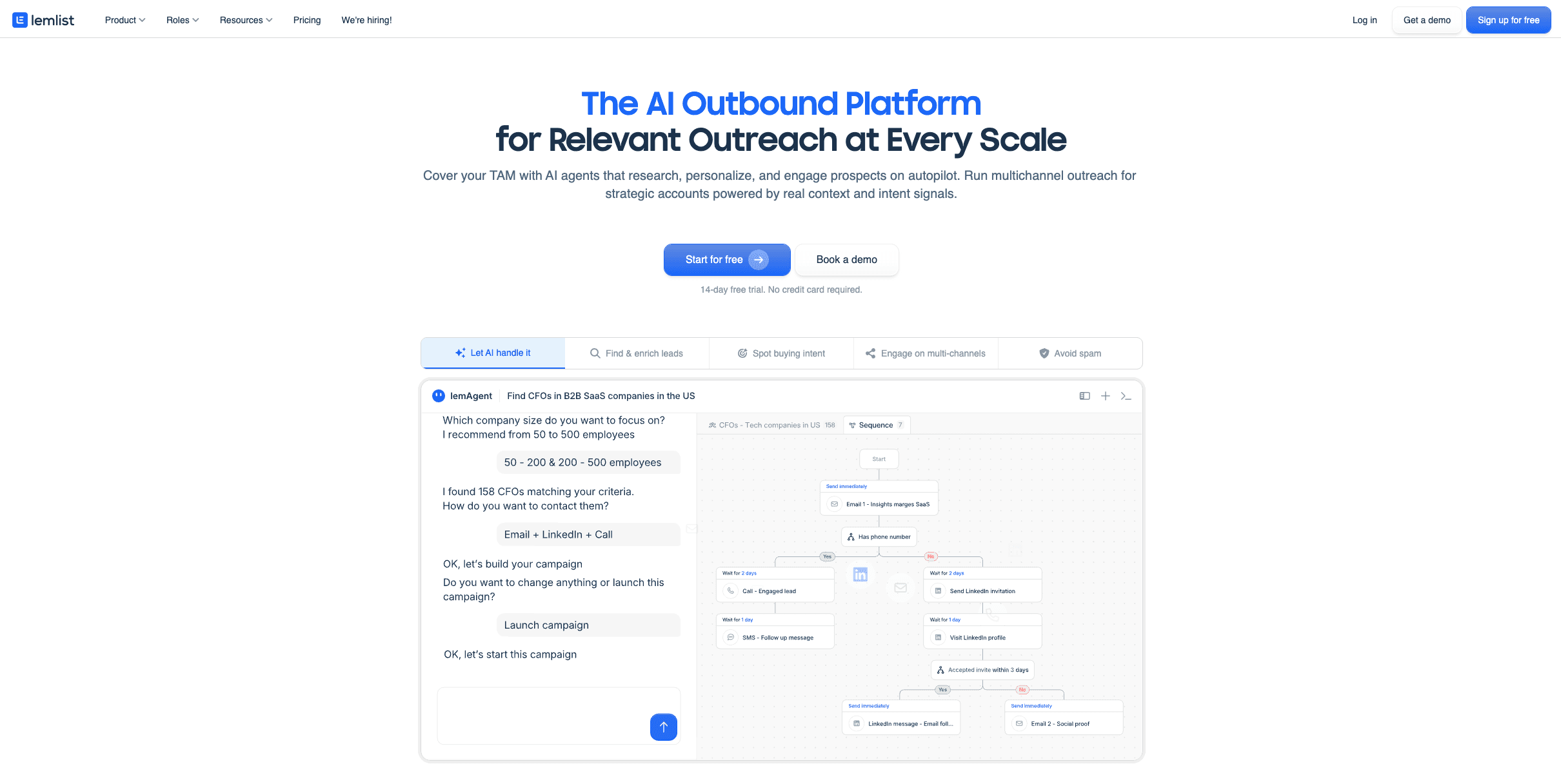
Lemlist started as a cold email tool known for image and video personalization, then grew into a multichannel sequence builder covering email, social media touches, and calls. It ships its own contact database (450M+ profiles), a sequence builder with A/B testing, and a hosted MCP server that lets Claude, Cursor, or another compatible client search leads, build sequences, and pull analytics through natural conversation. It's a strong fit for a rep or small team that already knows exactly who they're targeting and mostly needs a reliable way to send.
What Is Enginy?
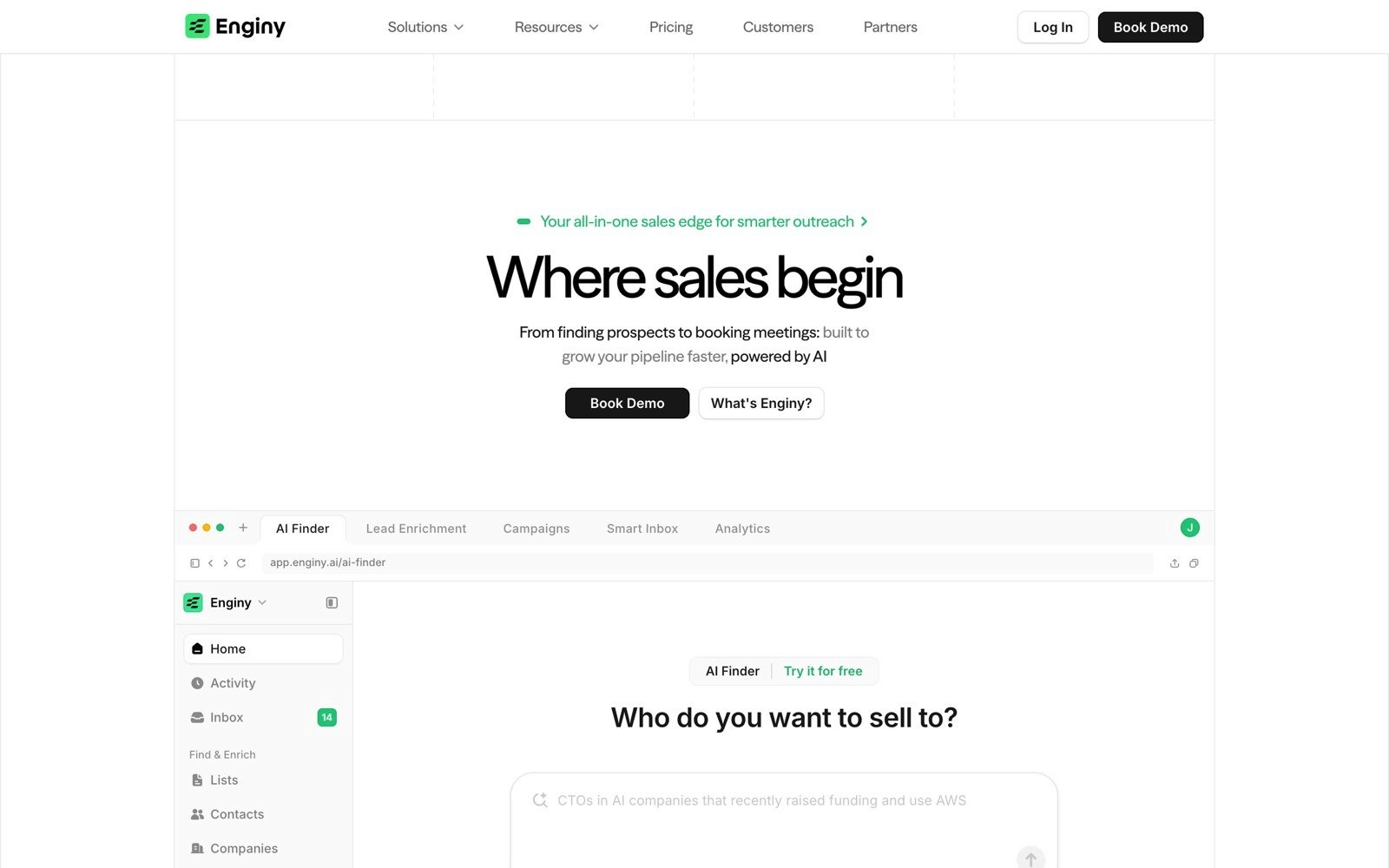
Enginy is an AI-native go-to-market platform built for B2B sales teams that are tired of running Apollo plus a sequencing tool plus a data cleaner plus a CRM sync job. It combines targeted list building, real-time multi-source enrichment, and AI-personalized outreach across email, social media, and calls in one workspace, with AI agents that can operate the whole flow — sourcing, enriching, sequencing, and handling replies — without needing a dedicated GTM engineer to run it. Enginy also publishes a hosted, OAuth-authenticated MCP server at openapi.enginy.ai, with tools generated straight from its API so Claude and similar clients can work inside the platform without a custom integration.
Lemlist vs Enginy: A Detailed Review & Comparison
MCP & AI Agent Access
Lemlist
Lemlist's MCP server covers the actions you'd expect from a sequencing tool: search its lead database, review and audit campaign sequences, start or monitor exports, manage unsubscribes, and pull performance stats. Setup takes about two minutes with an API key or OAuth, and it connects to Claude Desktop, Claude Code, Cursor, and other MCP clients. It's a genuinely useful server. The limitation is scope: your agent can manage what's inside a Lemlist campaign, but anything outside that (enrichment sourced elsewhere, CRM sync, cross-tool reporting) still needs a separate connection or a human doing the stitching.
Enginy
Enginy's MCP server is generated directly from its public API, which covers the same modules a human user works in: list building, enrichment, campaigns, the inbox, analytics, and the AI Playbook. Connect it once through Claude's custom connector settings, run mcp_whoami to confirm scopes, and an agent can move through discovery, enrichment, and campaign setup inside one authenticated session — not just report on a sequence someone already built. Because the tool surface tracks the product API, new modules become available to agents as they ship, rather than waiting on a separate MCP-specific release cycle.
🏆 Winner
Enginy. Lemlist's server is well-built for what it covers, but it covers one product function. A single OAuth connection to Enginy's server reaches the parts of the workflow — sourcing and enrichment — that a sequencing-only MCP server was never meant to touch.
Prospecting & Data Enrichment
Lemlist
Lemlist includes a single contact database with over 450 million profiles, plus credit-metered email finding, verification, and phone lookups. It's a solid starting point for teams that don't already have a list, and having data and sending in one product removes a step. The tradeoff is coverage: one source means gaps in some geographies and niche verticals stay gaps, and there's no waterfall logic to fill them from elsewhere.
Enginy
Enginy aggregates real-time data from 30+ enrichment providers using waterfall logic, so a lookup that misses on the first source tries the next before giving up. It also supports layered intent signals — job changes, technology stack, hiring activity, funding rounds, event attendance — on top of standard firmographic filters, and a built-in cleanup pass runs both before and after enrichment so incomplete or invalid records don't make it into a campaign.
🏆 Winner
Enginy. Aggregating multiple providers with cleanup on both ends produces meaningfully higher match rates than any single-source database, which is the reason most Lemlist teams eventually add a second data tool on top.
Multichannel Outreach & Sequences
Lemlist
Lemlist's sequence builder is mature: branching logic, A/B testing, image and video personalization, and coordinated email, social media, and call steps in a single flow. Its warm-up feature (Lemwarm) protects sender reputation automatically, and the builder is genuinely pleasant to work in.
Enginy
Enginy supports the same core channels, plus a structural difference worth naming: sequences can target several stakeholders at one account at once — a founder, a department head, an SDR-level contact — so a company has usually heard of you before the cold call happens. A C-level identity layer can warm up a prospect ahead of SDR outreach, and reply handling runs through AI agents that tag intent automatically instead of leaving that triage to a human.
🏆 Winner
Tie. Lemlist's builder is the stronger single-sequence tool. Enginy's advantage is at the account level — multi-stakeholder, multi-identity outreach — which matters more for teams selling into companies with more than one decision-maker.
AI Personalization & Reply Management
Lemlist
Lemlist's MCP-connected agent can draft messages using dynamic variables and campaign context, and it integrates with LLM providers for personalization at scale. Reply handling still leans on the human inbox for judgment calls.
Enginy
Enginy's AI Playbook feeds business context, sender data, and ICP definitions to its AI layer once, then reuses that context across every campaign and identity. AI-generated variables (company news, contact summaries) get inserted automatically, and AI agents manage replies autonomously with inbox tagging that improves prompts over time based on what's actually landing. Because the agents run continuously rather than on a rep's schedule, pipeline keeps moving outside working hours — the point being to grow pipeline without growing headcount at the same rate.
🏆 Winner
Enginy, on account of the shared context layer. Feeding business and ICP context once, rather than per campaign, is the difference between "personalized" and "personalized without redoing the setup every time."
Ease of Use
Lemlist
Lemlist is close to self-serve. Sign up, connect a mailbox, build a sequence, and you're sending inside a day. The interface is aimed at a single sender or small team, and it stays intuitive at that scale.
Enginy
Enginy runs new customers through five structured onboarding sessions covering configuration, list building, and campaign building. That's a longer runway than Lemlist's — fair to say. But the comparison that actually matters is against other complete platforms in this category, like Amplemarket or Clay, which typically need a dedicated GTM engineer or ops specialist just to operate day to day. Enginy is built so any rep can run it without that hire. The five sessions aren't there because the product is complicated; they're there because getting a full SDR team aligned on one system takes more than one person clicking around solo.
Pricing
Lemlist
Lemlist publishes its pricing. As of mid-2026, the two headline plans for new customers run roughly $69 to $109 per user per month on monthly billing, with a discount on annual terms and a custom-quoted Enterprise tier above that. It's priced per seat, so cost scales in a straight line with headcount, and email-finding or enrichment beyond the base allotment draws on metered credits.
Enginy
Enginy doesn't publish pricing publicly; plans are quoted after a short call that uncovers what a team actually needs. The structure is credit-based across four tiers — Basic, Smart, Business, and Enterprise — with credits covering everything from contact and company extraction to phone enrichment and AI-generated fields. Because data, enrichment, and outreach all draw from one credit pool instead of separate subscriptions, the total cost usually compares favorably once you count what a Lemlist team spends on a second data source. Factorial's outbound team, for one, cut lead sourcing from one person producing ten leads a day to a centralized system generating 5,000 a month after switching — the kind of throughput a per-seat sequencing tool alone isn't priced to deliver.
🏆 Winner
It depends on team shape. A solo sender with a list already in hand will find Lemlist's transparent per-seat price easier to budget. A team assembling prospecting, enrichment, and outreach from scratch typically pays less all-in with Enginy, once the alternative — a fragmented stack — is priced out honestly.
Lemlist vs Enginy: The Verdict, Feature by Feature
Feature / Criteria | Lemlist | Enginy | Verdict |
MCP & AI Agent Access | ⭐⭐⭐⭐ | ⭐⭐⭐⭐⭐ | Enginy — full-workspace API surface vs. campaign-only actions |
Data & Enrichment | ⭐⭐⭐ | ⭐⭐⭐⭐⭐ | Enginy — waterfall across 30+ sources vs. one database |
Outreach Strategy | ⭐⭐⭐⭐⭐ | ⭐⭐⭐⭐ | Lemlist — more mature single-sequence builder |
Multi-Stakeholder Campaigns | ⭐⭐ | ⭐⭐⭐⭐⭐ | Enginy — built for account-level, not just contact-level, outreach |
AI Personalization | ⭐⭐⭐ | ⭐⭐⭐⭐⭐ | Enginy — shared context layer across campaigns |
Ease of Use (solo sender) | ⭐⭐⭐⭐⭐ | ⭐⭐⭐ | Lemlist — self-serve from day one |
Ease of Use (vs. other complete platforms) | — | ⭐⭐⭐⭐⭐ | Enginy — no GTM engineer required, unlike Amplemarket or Clay |
Total Cost for a Full Stack | ⭐⭐⭐ | ⭐⭐⭐⭐ | Enginy — one credit pool vs. Lemlist plus a separate data tool |
CRM Integration Depth | ⭐⭐⭐ | ⭐⭐⭐⭐⭐ | Enginy — six native CRMs plus automated scrape-to-CRM flow |
Final Verdict: Which Should You Choose?
Choose Lemlist If:
You already have a list built and just need a reliable way to send cold email with occasional social media touches — no prospecting or enrichment gap to fill.
You want to be sending inside a day, with no onboarding calls required.
Predictable, published per-seat pricing matters more to you than total cost of a full stack.
Choose Enginy If:
You're a founder or small team wearing the sales hat yourself, and you need list building, enrichment, and outreach handled without hiring a technical operator to run it.
You're running an SDR or AE team that needs prospecting, enrichment, and outreach connected in one workspace instead of three subscriptions.
Your buying committee usually includes more than one decision-maker, and single-contact sequences aren't converting.
You want an AI agent, connected through MCP, that can search and enrich data as well as manage a sequence — not just report on one.
FAQs About Lemlist vs Enginy
What is a Lemlist MCP alternative?
A Lemlist MCP alternative is a sales platform whose MCP server gives an AI agent access to prospecting and outreach data the way Lemlist's does, but through a different product. Enginy is one such alternative: its MCP server is generated from its full API, so an agent connected through Claude can search leads, run enrichment, and manage campaigns in one session instead of the campaign-only actions Lemlist's server exposes.
Which is better: Lemlist or Enginy?
Neither is universally better; the right pick depends on team size and workflow. Lemlist suits a solo sender or small team that already has a list and wants to start sending fast. Enginy suits an SDR/AE team that wants prospecting, enrichment, and outreach run from one connected workspace instead of stitched-together tools.
What is Lemlist better for?
Lemlist is better for teams that want a self-serve, published-pricing sequencing tool with a mature single-sequence builder. If your main gap is "I need to send personalized email and social messages reliably," Lemlist covers that well on day one.
What is Enginy better for?
Enginy is better for teams replacing a fragmented stack — a data tool, a sequencer, and manual CRM updates — with one platform. It's also the stronger fit for multi-stakeholder outreach, where several contacts at one account get engaged in a coordinated sequence rather than one at a time.
Is Enginy more affordable than Lemlist?
Lemlist's list price is lower on paper for a single seat, running roughly $69 to $109 per user per month. Enginy doesn't publish a comparable number since pricing is custom-quoted and credit-based. Teams that would otherwise pair Lemlist with a separate enrichment tool often find Enginy's all-in-one credit pool comes out cheaper once that second subscription is counted.
Which tool is easier to use: Lemlist or Enginy?
Lemlist is easier to start using without any onboarding, since it's built for a single sender working solo. Enginy takes longer to onboard — five structured sessions — but is built so a full team without a dedicated technical operator can run it day to day once configured.
Does Enginy integrate with Claude the same way Lemlist does?
Both connect to Claude through a hosted MCP server and OAuth. Lemlist's tool set focuses on campaign and lead actions; Enginy's tool set is generated from its full API, covering list building and enrichment as well as outreach, so a Claude-connected agent has a wider set of tasks it can complete inside Enginy without leaving the conversation.
What should I actually check before switching off Lemlist's MCP server?
Check what the alternative's MCP server covers beyond campaign management — specifically whether it reaches prospecting and enrichment, not just sequencing. Most MCP servers that shipped through 2025 and 2026 cover one product module well. Enginy's is built from the full API on purpose, so the switch buys back the sourcing and data work an MCP-connected agent couldn't touch through Lemlist alone.