Best Lead List Builders in 2026 (Top-Rated Tools Reviewed & Compared)

Andrea López
Partilhar
Key Takeaways (TL;DR)
The Best Overall Lead List Builder: We built Enginy to combine list building, data enrichment and multichannel outreach in one workspace, so sales teams stop losing time to tool sprawl. It's the only B2B lead list building tool on this list that takes a contact from ICP filter to a personalised, multichannel sequence without leaving the platform.
Why Do You Need It?: Only 5-7% of your total addressable market (TAM) is in the market at any given point, looking for a solution. A quality lead list is crucial because your sales funnel is as good as the data it is being fed. A proper list building tool gives your sales team access to high-quality data, while enabling them to focus on tasks and activities that actually move the needle.
Who It's For?: This guide is for Heads of Sales, RevOps and GTM Engineers, and founders at SMBs and startups who run outbound and need a reliable list building tool. It also suits sales managers and SDRs who are fed up with chasing bad data.
How to Choose the Right One?: Look at data accuracy and refresh rate, how deep the intent signals go beyond basic firmographics, and whether the tool handles outreach too or just hands you a spreadsheet. Pricing model matters just as much, since credit-based tools can get expensive fast at scale.
Expected Price: We keep Enginy's pricing custom and credit-based, scoped to what each team actually needs rather than a fixed shelf price. Across this list, monthly plans start as low as $20 (LeadIQ) and stretch up to $18,750 a year (Cognism), with most B2B lead list builder tools sitting somewhere between $99 and $450 a month.
Top Lead List Builders in 2026: at a Glance
Tool | Best For | Key Features | Pricing |
Enginy | Teams that want list building, enrichment and outreach in one workspace | AI Finder, layered intent signals, multichannel sequences, email warmup | Custom, credit-based |
Apollo.io | Budget-conscious teams wanting a large contact database | Big database, built-in sequencer, browser extension | Free plan; $49 to $119/seat/month |
ZoomInfo | Enterprise teams needing deep US firmographic and intent data | Org charts, technographics, intent data | Custom; entry plans from around $15,000/year |
Clay | Technical GTM operators building custom enrichment workflows | Data waterfall across 50+ providers, AI research agents | Free plan; $167 to $446/month, custom Enterprise |
Lusha | Small teams needing fast contact lookups | Browser extension, buying intent data | Free plan; $32.45 to $259.95/month |
Prospeo | Teams prioritising data accuracy over raw volume | 300M+ profiles, 30+ filters, 98% accuracy claim | Free plan; $37 to $187/user/month |
Cognism | European and compliance-focused sales teams | Phone-verified mobiles, GDPR-aligned data | $14,000 to $18,750/year, 5 seats included |
Seamless.AI | Teams wanting a straightforward contact finder | Real-time search, browser extension | Free plan; custom Pro and Enterprise |
LeadIQ | Small SDR teams wanting lightweight prospecting | Prospecting extension, job change tracking | Free plan; from $20/month |
UpLead | Teams wanting verified data with transparent monthly pricing | Real-time verification, 50+ filters | $99 to $199/month, custom Professional |
What Are Lead List Builders?
A B2B lead list builder is a tool that helps sales teams find, filter and export contacts and companies that match their 'Ideal Customer Profile' (ICP), ready for outreach. Instead of trawling directories or copying details out of search results by hand, you set your criteria, firmographic filters, job titles, intent signals, and the tool pulls back a list you can act on.
The category has shifted a lot over the past few years. A basic list building tool used to mean a static database export.
The stronger B2B lead list builder tools now layer in buying intent: things like recent hires, funding rounds and technology stack changes - so the list you get reflects who's actually in-market right now, not just who technically fits your criteria on paper.
Some tools in this space stop at the list.
Others, including the platform we've built at Enginy, carry that list straight into enrichment and outreach, so the same workspace handles the whole journey from a raw filter to a sent message.
Why Do You Need a Lead List Builder?
Sellers spend roughly 70% of their time on tasks that aren't selling. That's not a guess, it's the pattern we've seen across every sales team we've worked with.
That time loss shows up in a few consistent ways:
Manual prospecting that eats hours reps could spend talking to prospects
Chasing down phone numbers and emails that turn out to be disconnected or wrong
Cleaning duplicate records out of the CRM instead of working live opportunities
Bounced outreach and falling reply rates caused by bad contact data
Messy, duplicate-ridden CRM data that makes pipeline forecasts a guessing game
A proper B2B lead list building tool fixes the root problem rather than papering over it. Instead of a rep spending an afternoon filtering a spreadsheet, the tool applies your ICP criteria and intent signals automatically, hands back a clean list, and, in the stronger tools, moves that list straight into outreach.
We've seen that gap close first-hand with our own customers.
Factorial, one of the companies we've worked with at Enginy, went from one person manually sourcing 10 leads a day to a centralised system producing 5,000 leads a month – with list building automated using our platform end-to-end.
That's the kind of gap a decent B2B lead list builder closes.
Who Needs Lead List Building Tools?
Different people on a sales team come to this decision for different reasons.
Here's who typically needs a list building tool, and why:
1. Heads of Sales and VPs of Sales
Anyone owning revenue targets and managing a team of SDRs and AEs feels it first when pipeline quality drops. It gives Heads of Sales a way to scale outbound predictably without adding headcount.
This matters when the board is asking why the sales pipeline isn't growing in line with the team's size.
2. Sales Operations, RevOps and GTM Engineers
This is the person who owns list building, CRM hygiene, data enrichment and outreach automation day to day.
They're often already juggling several point solutions, a data provider here, an outreach tool there, and are actively looking to consolidate.
Evaluating a list building tool usually comes down to data quality, integration depth and how much manual work it removes.
3. Founders and CEOs at SMBs and Startups
Founders wearing the sales hat alongside everything else need something that works without a dedicated technical operator.
Startups don't have the luxury of hiring a GTM engineer just to run their prospecting stack.
So the tools that matter most here are the ones that stay usable without specialist setup, while still being powerful enough to test new markets fast.
4. Sales Managers and Team Leads
Anyone managing a handful of SDRs cares about outreach quality and meeting booking rates above all else.
A list building tool that standardises how reps build and prioritise their portfolio means less manual pre-work and more time actually on calls and demos.
5. SDRs and Account Executives
The people doing the outbound work every day are the ones who feel bad data first, a wrong number, a stale title, a contact who left the company months ago.
A reliable list building tool means less time verifying details and more time actually selling, which is the whole point.
Best Lead List Builders: In-Depth Review & Comparison
1. Enginy

Overview
We built Enginy as an AI-native, end-to-end GTM platform for modern B2B sales teams. It combines prospect discovery, data enrichment and multichannel outreach in a single workspace. The core problem we set out to solve is tool sprawl. Most sales teams run a separate data provider, a separate outreach tool and a separate data cleaner, and none of them talk to each other properly.
Enginy's list building supports advanced firmographic filtering alongside layered intent signals: recent hires, job changes, funding rounds, technology stack usage and more. So a search reflects genuine buying intent rather than a static match.
The platform is designed so any sales rep can operate it, not just a dedicated GTM engineer, which matters most for SMBs and startups without a technical operator on the team.
Ideal For
Sales teams tired of juggling separate list building, enrichment and outreach tools
Founders and small teams who need a complete GTM setup without hiring a dedicated GTM engineer
Sales Ops and RevOps leads consolidating several point solutions into one workflow
Top Features
AI Finder for natural-language prospect search, plus AI Recommendations tailored to your defined ICP
Layered intent signals covering recent hires, job changes, funding rounds, technology stack usage, event attendance and social post engagement
Multichannel sequences that combine email, social outreach and cold calling in one campaign
Data enrichment pulling from 30+ providers in real time, with a built-in cleaning workflow before contacts reach your CRM
Why We Stand Out?
Most tools in this space either give you data or give you outreach, not both with real depth.
We built Enginy so a list doesn't stop being useful the moment it's exported. The same workspace takes it straight into a personalised, multichannel sequence.
The platform also supports multi-stakeholder outreach: contacting a CEO, founder and relevant department heads at the same account together. That way, the whole organisation has heard from you before the first call happens.
AI SDR agents handle reply management around the clock, which means pipeline keeps moving without adding headcount.
Pros
One workspace covers list building, enrichment and multichannel outreach end to end
Built-in email warmup protects sender reputation before campaigns launch
Multi-stakeholder outreach contacts several decision-makers at the same account at once
AI SDR agents handle reply management and keep pipeline moving without added headcount
Cons
Pricing isn't published upfront; you'll need a qualification call to get a quote
The breadth of features means new teams benefit from the structured onboarding sessions rather than a self-serve start
Teams testing on a very small budget may want a lighter, single-purpose tool first
Pricing
We keep Enginy's pricing custom-quoted, scoped to what a team actually needs during a qualification call. This avoids unfair comparisons with cheaper data-only tools that don't do nearly as much.
The structure is credit-based: credits cover actions like data extraction, email and phone enrichment, and AI-generated fields, across four tiers from Basic through to a fully customised Enterprise plan.
Final Verdict
If your team is stitching together a data provider, an outreach tool and a data cleaner, and losing hours to the gaps between them, Enginy is built specifically to close that gap.
It won't suit a team that wants to self-serve a plan online in five minutes. But for anyone ready to consolidate their stack, it's one of the more complete B2B lead list builder tools available.
2. Apollo.io
Overview
Apollo.io is one of the most widely used B2B lead list building tool options on the market, largely thanks to its enormous self-serve database and low entry price. It combines a contact and company database with basic sequencing and dialer features, positioning itself as an all-in-one prospecting tool rather than a pure data provider.
The database is Apollo's main draw: a huge volume of contacts covering most industries and company sizes, searchable through firmographic filters and a browser extension for quick lookups.
Apollo.io is a natural starting point for teams that need volume fast and don't yet have a big budget for a more specialised list building tool, though independent testing shows meaningfully higher bounce rates here than among more accuracy-focused competitors.
Ideal For
Budget-conscious teams that need database volume more than depth
High-volume outbound teams running large-scale, lower-touch campaigns
Solo founders and small teams testing outbound for the first time
Top Features
Large self-serve contact and company database covering most industries
Built-in sequencer and dialer for running outreach without a separate tool
Browser extension for quick contact lookups while browsing
Why They Stand Out?
Apollo's biggest strength is accessibility. The free plan is genuinely usable, and the paid tiers stay affordable compared to enterprise data providers.
That's why it's become the default reference point buyers compare every other tool against.
It packs a lot of functionality into one price point: database access, sequencing and a dialer, without asking for a big upfront commitment.
Pros
Generous free plan and low-cost entry tiers
Very large contact database across most verticals
Combines data, sequencing and calling in one tool
Cons
Data accuracy is inconsistent, with independent tests showing bounce rates well above more specialised providers
Filtering and intent signals are relatively shallow compared to more advanced tools
Shared sending infrastructure can create deliverability issues at scale
Pricing
Apollo.io offers a free plan plus paid tiers billed annually: Basic at $49 per seat per month, Professional at $79 per seat per month, and Organization at $119 per seat per month.
Extra credits, advanced email domains and additional integrations are priced separately as add-ons.
Final Verdict
Apollo makes sense for a team that needs a lot of contacts fast and doesn't have the budget for a premium data provider yet.
It's a weaker fit for teams where deliverability and data accuracy matter more than raw volume, since the trade-offs there are well documented.
3. ZoomInfo
Overview
ZoomInfo is one of the longest-standing names in B2B data, known for the depth of its US company and contact database.
It goes beyond basic list building with org charts, technographic data and intent signals, aimed squarely at enterprise sales and marketing teams running complex, multi-touch campaigns.
The platform's strength is coverage depth rather than breadth of use case. While a lighter list building tool gives you names and emails, ZoomInfo layers in company hierarchy, buying committee mapping and technology stack detail.
That suits teams selling into large organisations, where identifying the right stakeholder matters as much as finding a contact at all.
Ideal For
Enterprise teams needing deep US firmographic and org chart data
Teams selling complex products that require mapping a full buying committee
Marketing and sales teams that need intent data alongside contact details
Top Features
Deep US company and contact database with org chart mapping
Technographic data showing which tools a company already uses
Intent signals flagging accounts actively researching relevant topics
Why They Stand Out?
ZoomInfo's database depth is genuinely hard to match, particularly for US-based accounts. Its intent data is also built on a scale most competitors can't replicate.
For enterprise teams that need to map an entire buying committee before outreach even starts, that depth is worth the premium.
Pros
Deepest US database coverage of any tool on this list
Strong intent and technographic data for account prioritisation
Wide range of native integrations for enterprise tech stacks
Cons
Entry pricing puts it out of reach for most small and mid-sized teams
Credit-based costs can climb quickly as usage scales
Steep learning curve for teams without a dedicated Sales Ops function
Pricing
ZoomInfo uses custom, seat- and credit-based pricing, with entry plans starting at around $15,000 a year.
Exact costs depend on seat count, credit volume and which data modules a team needs.
Final Verdict
ZoomInfo is a strong choice for enterprise teams that need US data depth and can justify the price tag.
Smaller teams and startups will likely find the cost disproportionate to what they actually need from a list building tool at this stage.
4. Clay
Overview
Clay has built a strong reputation among technical GTM operators for its flexibility.
Rather than pulling data from a single source, it runs a waterfall across more than 50 data providers, trying each one in sequence until it finds a match. That pushes coverage higher than any single provider could manage alone.
The platform's AI research agents can pull company news, summarise a contact's background, or check a specific data point on demand, making Clay genuinely powerful for custom enrichment.
That power comes at a cost, though: it's built for someone comfortable configuring workflows, not a rep who wants to log in and start prospecting straight away.
Ideal For
Technical GTM operators and RevOps teams building custom enrichment workflows
Teams that want maximum data coverage through a multi-provider waterfall
Companies running highly specific, non-standard enrichment logic
Top Features
Data waterfall across 50+ providers to maximise contact match rates
AI research agents that pull custom data points on demand
Highly configurable workflow builder for non-standard enrichment logic
Why They Stand Out?
Clay's flexibility is unmatched among the tools on this list. Where most providers give you a fixed set of filters, Clay lets a technical operator build almost any enrichment logic they can imagine.
That's exactly why it's become the go-to choice for RevOps and GTM Engineer personas specifically.
Pros
Best-in-class data waterfall across a large number of providers
Highly flexible, custom workflow logic
Strong AI research capability for contextual data points
Cons
Requires genuine GTM engineering skill to operate well
Not designed for direct use by SDRs without technical support
Pricing can scale quickly once usage climbs beyond entry tiers
Pricing
Clay offers a free plan, with paid plans starting at $167 a month (Launch) and $446 a month (Growth), while Enterprise pricing is custom.
Plans scale based on annual actions and data credits, with higher tiers adding CRM sync, automation and dedicated support.
Final Verdict
Clay is a smart pick for a team with a GTM engineer who wants to build something highly specific.
It's a poor fit for a small sales team that just wants to log in and start building a lead list without a configuration project first.
5. Lusha
Overview
Lusha built its reputation on speed: a browser extension that returns a verified email or phone number for a contact in seconds, without needing to open a separate list building tool first.
It's since expanded into full list building with firmographic filters and buying intent data, but the extension remains its most recognised feature.
For SDRs doing account-based prospecting on individual profiles, that quick-lookup workflow removes a lot of the friction that comes with switching between a database and a browser tab.
The database itself sits a level below the larger providers on this list in depth. That makes Lusha a better fit for fast, targeted lookups than for building very large, highly segmented lists.
Ideal For
SDRs needing fast contact lookups while prospecting individual profiles
Small teams starting outbound for the first time
Teams that want buying intent data without an enterprise price tag
Top Features
Browser extension for instant contact lookups
Buying intent data flagging accounts showing purchase signals
List building with standard firmographic filters
Why They Stand Out?
Lusha's browser extension is genuinely fast, which matters for a rep working through profiles one at a time rather than running a bulk export.
Combined with accessible pricing, it's a solid entry point for teams that haven't run structured outbound before.
Pros
Fast, simple browser extension for individual lookups
Affordable entry pricing compared to enterprise providers
Decent free plan for testing before committing budget
Cons
Database depth is thinner than larger providers like ZoomInfo or Apollo
Buying intent data is gated to higher-priced tiers
Automation and outreach features are limited compared to full platforms
Pricing
Lusha offers a free plan, with paid plans starting at $32.45 a month (Starter), $45.45 a month (Pro) and $259.95 a month (Premium), while the Scale plan uses custom pricing.
Plans vary by credits, seats, API access and buying intent data.
Final Verdict
Lusha works well for a small team or solo seller who needs quick, accurate lookups without a big learning curve.
It's a weaker choice for a team that needs deep list building and multichannel outreach in one place.
6. Prospeo
Overview
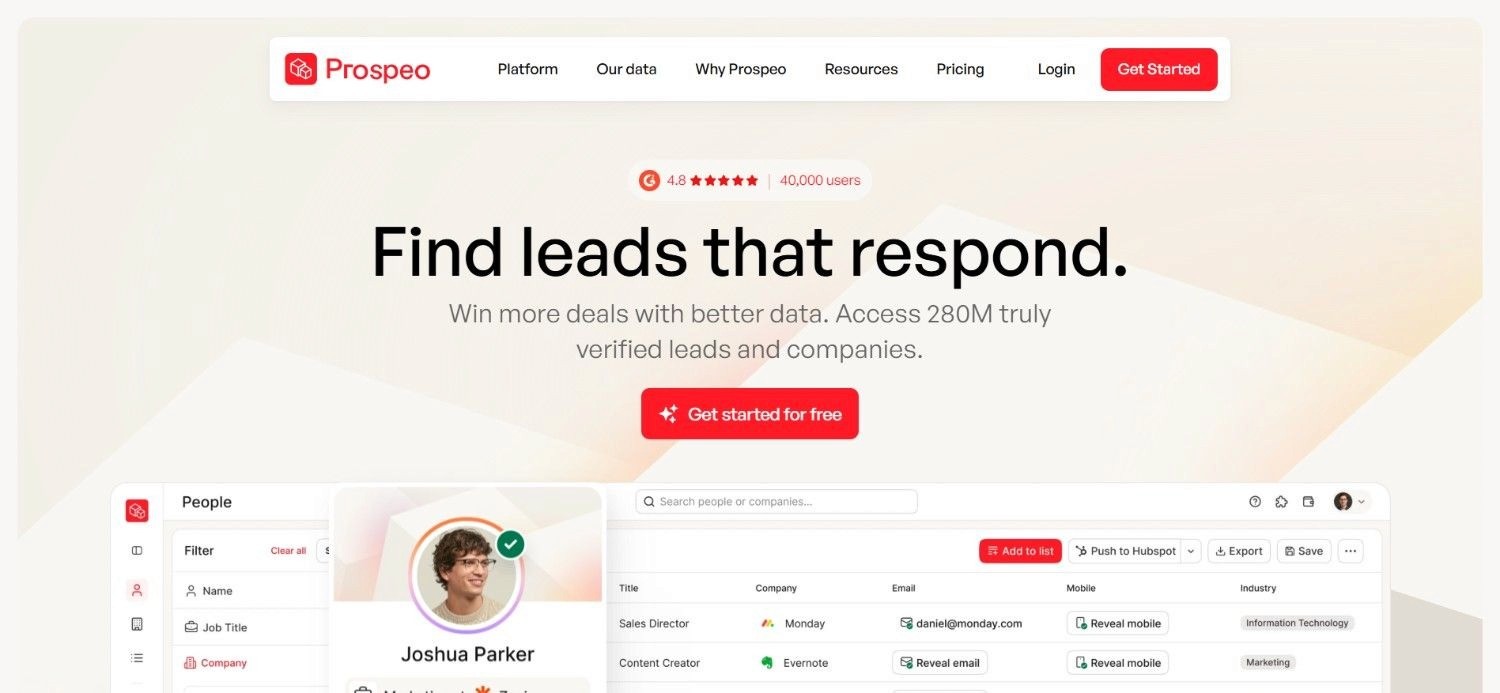
Prospeo has built its positioning almost entirely around data accuracy.
The database covers more than 300 million professional profiles, with over 143 million verified emails and 125 million verified mobile numbers. It's refreshed on a seven-day cycle rather than the four-to-six-week cycle common among competitors.
More than 30 search filters, including buying intent, technographics and job change signals, let a team narrow from a broad company list down to a decision-maker list quickly.
The pitch is straightforward: a list building tool is only as good as the data underneath it.
Stale, low-accuracy records cost teams far more in bounced emails and burnt domain reputation than the subscription itself.
Ideal For
Teams that prioritise data accuracy and refresh rate over sheer volume
Deliverability-focused outbound teams protecting sender reputation
Smaller teams that want to test with a functional free plan first
Top Features
Database of 300M+ profiles with 143M+ verified emails and 125M+ verified mobile numbers
Seven-day data refresh cycle, faster than most competitors
30+ search filters covering buying intent, technographics and job changes
Why They Stand Out?
Prospeo's refresh cycle is the standout detail here. Most B2B lead list builder tools refresh their data every four to six weeks, which means a "verified" contact can already be stale by the time you reach them.
A seven-day cycle keeps accuracy meaningfully higher for fast-moving lists.
Pros
Frequent data refresh keeps contact accuracy higher than most competitors
Large, verified database of emails and mobile numbers
Free tier is generous enough to properly test before paying
Cons
Smaller enterprise footprint and brand recognition than ZoomInfo or Apollo
Fewer built-in outreach automation features compared to full-stack platforms
Per-user pricing can add up for larger teams running high volumes
Pricing
Prospeo offers a tiered pricing model with a free plan, followed by Starter at $37 per user per month, Growth at $74 per user per month, and Pro at $187 per user per month.
Paid plans scale through higher annual credit allowances, additional search filters, CRM features and unused credit rollover.
Final Verdict
Prospeo is a strong pick for a team that has been burnt by bounce rates before and wants accuracy as the priority.
It's less suited to a team that needs outreach automation bundled in, since Prospeo stays focused on the data layer rather than the full outbound workflow.
7. Cognism
Overview
Cognism has built its reputation on phone-verified data, particularly mobile numbers, and a compliance-first approach that resonates with European sales teams navigating GDPR requirements.
Coverage is strongest across EMEA, which makes it a natural fit for teams selling into UK and European markets specifically.
While some list building tools treat compliance as an afterthought, Cognism builds it into the product itself. That matters increasingly as data protection enforcement tightens across Europe.
The platform pairs that compliance with genuinely strong phone data, a category where many competitors still struggle with accuracy.
Ideal For
European and UK sales teams navigating GDPR-compliant prospecting
Teams that rely heavily on cold calling and need accurate mobile numbers
International sales teams needing strong EMEA coverage specifically
Top Features
Phone-verified mobile numbers with stronger accuracy than most competitors
GDPR-aligned data collection built into the product
Strong international coverage, particularly across EMEA
Why They Stand Out?
Cognism's compliance-first approach and phone data accuracy set it apart from data providers that treat GDPR as a checkbox rather than a design principle.
For a team selling into Europe, that combination reduces real legal and reputational risk.
Pros
Strong mobile number accuracy for cold calling
Compliance built into data sourcing, not bolted on
Solid international coverage, especially across EMEA
Cons
Annual contracts only, with a high entry price relative to monthly tools
Cognism Credits for enrichment and reveals are sold separately
Less flexible for teams wanting to test month to month before committing
Pricing
Cognism's pricing plans start at $14,000 a year (Standard) and $18,750 a year (Pro), with five seats included.
Pricing is subscription-based, with additional Cognism Credits available separately for contact reveals, enrichment and exports.
Final Verdict
Cognism suits a European sales team that needs compliant, phone-accurate data and can commit to an annual contract.
It's a harder sell for a small team that wants to test a list building tool for a month before committing a budget.
8. Seamless.AI
Overview
Seamless.AI positions itself as a real-time search engine for B2B contacts. It's built around the idea that a search should return live, verified data, rather than pulling from a static database that goes stale over time.
The browser extension lets reps pull contact details directly while browsing, similar to other tools on this list. The real-time framing is Seamless's central pitch, built to solve the staleness problem that affects static databases.
Reviews are mixed on data quality in practice, which is worth weighing against those real-time claims before leaning on it for high-volume prospecting.
Ideal For
Teams wanting a straightforward contact finder without a big learning curve
Smaller teams testing outbound on a free plan before committing budget
Reps who prefer a browser-based lookup workflow
Top Features
Real-time search claiming live, verified contact data
Browser extension for lookups while researching prospects
Generous free tier for early testing
Why They Stand Out?
Seamless.AI's real-time positioning is a genuine differentiator on paper, aiming to solve the staleness problem that affects most static databases.
The free plan also lowers the barrier to entry more than most competitors on this list.
Pros
Generous free plan with a meaningful number of credits
Simple, low-friction interface for new users
Real-time verification claims aimed at reducing stale data
Cons
Data quality complaints show up consistently in independent reviews
Paid tier pricing isn't published, requiring a sales conversation upfront
Fewer advanced filtering and intent signal options than more specialised tools
Pricing
Seamless.AI offers a free plan with 50 credits for individual users, while Pro and Enterprise plans use custom pricing.
Paid plans include annual credit packages, unlimited exports and enterprise features such as dedicated customer success and support.
Final Verdict
Seamless.AI works as a low-cost entry point for a team just starting outbound.
Teams that have been through a few list building tools already, and care most about consistent data quality, may want to weigh the mixed reviews carefully first.
9. LeadIQ
Overview
LeadIQ is built around lightweight, fast prospecting rather than deep list building at scale.
The core product is a prospecting extension paired with job change tracking, so reps get alerted when a contact moves to a new company. That's a genuinely useful trigger for re-engaging warm relationships at a new employer.
That trade-off shows up in scale. LeadIQ's database is smaller than category leaders, and multichannel outreach is limited, so it works best as a prospecting layer alongside a separate outreach tool rather than a full replacement.
Ideal For
Small SDR teams wanting lightweight prospecting without complex setup
Sales reps who want job change alerts to re-engage warm contacts
Teams on a tight budget needing a low-cost entry point
Top Features
Prospecting extension for quick contact capture while researching
Job change tracking that flags when a contact moves companies
CRM sync to push captured contacts straight into your pipeline
Why They Stand Out?
LeadIQ's job change tracking is a genuinely sharp feature for re-engaging contacts who already know your product from a previous role.
That's a warmer entry point than cold outreach to someone new entirely.
The low-cost Pro tier also makes it one of the more accessible list building tools on this list.
Pros
Affordable entry-level pricing, including a usable free plan
Simple to onboard without a steep learning curve
Useful job change tracking for warm re-engagement
Cons
Credit limits on lower tiers can be restrictive for active prospecting
Smaller database than category leaders like Apollo or ZoomInfo
Limited multichannel outreach features compared to full-stack platforms
Pricing
LeadIQ offers a free plan with 50 credits for one user, while its Pro plan starts at $20 per user per month, for teams of up to five users, with pricing scaling by credit volume.
Enterprise pricing is custom and annual-only, and annual billing provides a 25% discount overall.
Final Verdict
LeadIQ suits a small team that wants an affordable, low-friction way to capture contacts and track job changes.
It's not the right fit for a team that needs deep list building or built-in multichannel sequencing, since that work would need a second tool alongside it.
10. UpLead

Overview
UpLead's core promise is real-time email verification on every contact before it's revealed, aimed at reducing the bounce rates that plague less accuracy-focused databases.
Filtering runs deep too, with more than 50 firmographic and technographic filters available to narrow a search down to a genuinely targeted list.
The trade-off is database size. UpLead's coverage sits behind the largest providers on this list, so teams with very high-volume needs may find the credit allowances tight at the entry tiers.
Ideal For
Teams that want verified data with transparent, published pricing
Small to mid-size teams building targeted lists without a sales call first
Companies that need deep firmographic and technographic filtering
Top Features
Real-time email verification before contact details are revealed
More than 50 firmographic and technographic filters
Transparent monthly pricing published upfront
Why They Stand Out?
UpLead's transparent pricing is unusual in a category where most providers hide costs behind a sales conversation.
Combined with real-time verification, it gives smaller teams a way to evaluate cost and data quality before committing to anything.
Pros
Real-time verification reduces bounce risk on export
Transparent, published monthly pricing
Deep filter set for a mid-market list building tool
Cons
Credit costs per contact can run higher than some competitors
Database size sits behind the largest providers like ZoomInfo or Apollo
Native outreach automation is limited compared to full-stack platforms
Pricing
UpLead's monthly pricing starts at $99 a month for Essentials with 170 credits and $199 a month for Plus with 400 credits.
A seven-day free trial includes 5 credits, while the Professional plan uses custom annual pricing for teams needing advanced features, custom credits and multiple seats.
Final Verdict
UpLead is a sensible choice for a team that wants clear, published pricing and solid data verification without a sales call first.
Teams needing very high contact volumes or built-in multichannel outreach will likely need to pair it with another tool.
How to Choose the Best Lead List Builder (What to Consider)?
Every tool on this list solves a slightly different version of the same problem.
Here's what actually matters when you're choosing a B2B lead list builder for your own team:
1. Data Accuracy and Refresh Rate
A list is only as good as the data behind it.
Ask how often a provider refreshes its database, since a contact verified six weeks ago may already have moved on.
A stale record costs you a bounce, a wasted credit and a dent in your domain reputation.
2. Depth of Intent Signals
Basic firmographic filtering, company size, industry, job title, gets you a list that technically matches your ICP.
Layered intent signals - including recent hires, funding rounds, technology stack and job changes; tell you who's actually in the market right now.
This is a meaningful differentiator when comparing the top lead list builders for your organisation.
3. Whether It Handles Outreach Too
Some tools stop the moment you export a list. Others carry that list straight into multichannel outreach, so the same workspace handles enrichment and the sequence that follows it.
Decide whether you want one connected workflow or a best-of-breed data tool paired with a separate outreach platform.
4. Pricing Model Fit
Credit-based pricing rewards efficient use but can climb fast if your team scales usage quickly.
Fixed seat pricing is more predictable but can feel expensive for a small team that only needs a handful of lists a month.
Match the model to how your team actually works, not just the sticker price.
5. Ease of Use for Non-Technical Reps
Some list building tools, Clay being the clearest example on this list, genuinely require a GTM engineer to operate well.
If your team doesn't have that skill set in-house, a tool built for direct SDR use will get more value out of the same budget.
6. Compliance and Data Sourcing
If you sell into Europe, GDPR-aligned sourcing isn't optional.
Confirm how a provider collects and verifies its data, and whether that process holds up under the compliance standards relevant to the markets you're targeting.
7. Support During Onboarding
A powerful tool with no onboarding support just sits half-used.
Look at what structured onboarding a vendor actually provides, since the gap between buying a list building tool and getting real value from it usually comes down to how well the first few weeks are supported.
Everything You Need to Know About Lead List Builders
Tool | Pros | Cons | Ease of Use | Integrations | Support | Affordability |
Enginy | End-to-end workflow, multi-stakeholder outreach, built-in warmup | Custom pricing only, onboarding needed to unlock full value | ⭐⭐⭐⭐ | ⭐⭐⭐⭐⭐ | ⭐⭐⭐⭐⭐ | ⭐⭐⭐⭐ |
Apollo.io | Large database, low entry price, built-in sequencer | Inconsistent accuracy, shallow intent signals | ⭐⭐⭐⭐⭐ | ⭐⭐⭐⭐ | ⭐⭐⭐ | ⭐⭐⭐⭐⭐ |
ZoomInfo | Deep US data, strong intent signals, wide integrations | High entry price, steep learning curve | ⭐⭐⭐ | ⭐⭐⭐⭐⭐ | ⭐⭐⭐⭐ | ⭐⭐ |
Clay | Best-in-class waterfall, highly flexible, strong AI research | Requires GTM engineering skill, costs scale fast | ⭐⭐ | ⭐⭐⭐⭐ | ⭐⭐⭐ | ⭐⭐⭐ |
Lusha | Fast lookups, affordable entry, decent free plan | Thinner database, limited automation | ⭐⭐⭐⭐⭐ | ⭐⭐⭐ | ⭐⭐⭐ | ⭐⭐⭐⭐ |
Prospeo | Frequent refresh, large verified database, generous free tier | Smaller footprint, fewer outreach features | ⭐⭐⭐⭐ | ⭐⭐⭐ | ⭐⭐⭐ | ⭐⭐⭐⭐ |
Cognism | Strong phone data, GDPR-aligned, solid EMEA coverage | Annual-only, credits sold separately | ⭐⭐⭐ | ⭐⭐⭐⭐ | ⭐⭐⭐⭐ | ⭐⭐ |
Seamless.AI | Generous free plan, simple interface, real-time claims | Mixed data quality reviews, unpublished paid pricing | ⭐⭐⭐⭐ | ⭐⭐⭐ | ⭐⭐⭐ | ⭐⭐⭐⭐ |
LeadIQ | Affordable entry, simple onboarding, job change tracking | Restrictive credits, smaller database | ⭐⭐⭐⭐⭐ | ⭐⭐⭐ | ⭐⭐⭐ | ⭐⭐⭐⭐⭐ |
UpLead | Real-time verification, transparent pricing, deep filters | Higher per-contact cost, limited outreach automation | ⭐⭐⭐⭐ | ⭐⭐⭐ | ⭐⭐⭐ | ⭐⭐⭐⭐ |
Build Sharper Lists with Enginy
We didn't build Enginy to be another data provider you compare on price per credit. We built it as an end-to-end GTM platform that takes a list building tool search all the way through to a sent message, without a rep switching between three separate tools to get there.
The data enrichment layer pulls from 30+ providers so contact details are actually reachable, and multichannel outreach carries that list into a sequence across email, social and calling automatically.
Even the sender side is covered: email warmup protects your domain reputation before a single message goes out.
If your team is done stitching tools together, and is looking for an all-in-one GTM platform, book a demo with the Enginy sales team and see what a connected GTM workflow actually looks like.
FAQs About Lead List Builders
What is the best lead list builder in 2026?
Enginy is the best lead list builder for teams that want list building, enrichment and outreach handled in one workspace rather than three separate tools. Its layered intent signals and multi-stakeholder outreach set it apart from data-only providers like Apollo or ZoomInfo. The right choice for you still depends on whether you need a full workflow or just a data source.
What should I consider when choosing the right lead list builder for me?
Choosing the right lead list builder starts with data accuracy and how often the provider refreshes its database, since stale contacts cost you bounces and reputation. Check how deep the intent signals go beyond basic firmographic filters, and whether the tool carries a list into outreach or stops at the export. Pricing model and in-house technical skill matter just as much.
How does Enginy differ from similar alternatives?
Enginy differs from similar alternatives by combining list building, enrichment and multichannel outreach in one workspace, rather than making you pair a data provider with a separate sequencing tool. Most competitors on this list, Apollo, ZoomInfo, Lusha, focus on the data layer alone. Enginy also supports multi-stakeholder outreach, contacting several decision-makers at one account together, which most point solutions don't offer at all.
How do I get started with Enginy?
Getting started with Enginy begins with a qualification call, where we scope your credit volume, seat count and specific needs before quoting a plan. From there, five structured onboarding sessions configure your AI Playbook, CRM integration and outreach best practices together, rather than leaving the setup entirely to your team. Most teams see their first lists and campaigns live within the onboarding window itself.
How easy is it to switch to Enginy?
Switching to Enginy is designed to be straightforward, since it integrates directly with HubSpot, Salesforce, Pipedrive, Zoho and several other CRMs rather than asking you to migrate data manually. Existing CRM leads with poor enrichment can be re-imported and enriched with fresh contact data rather than discarded. The structured onboarding sessions exist specifically to make that switch faster than doing it alone.
Is a lead list builder worth it if I already pay for a CRM?
A lead list builder is worth it even with a CRM in place, because a CRM stores and manages contacts but doesn't find or verify new ones for you. Most CRMs also don't run outreach sequences or apply intent signals to prioritise who to contact. A CRM manages the pipeline you have; a B2B lead list building tool fills it in the first place.
How do you actually build a B2B lead list from scratch?
Building a B2B lead list from scratch starts with defining your Ideal Customer Profile clearly: company size, industry, region and job titles you're targeting. From there, a list building tool applies those filters alongside intent signals, recent hires, funding rounds, technology changes, to surface companies actively showing buying signals. The final step is data cleaning: verifying emails and phone numbers before outreach.