Enginy vs Amplemarket MCP: An Amplemarket MCP Alternative for 2026

Andrea López
Condividi
Key Takeaways (TL;DR)
Primary Difference: Amplemarket's MCP server exposes a curated set of prospecting and enrichment actions to Claude, ChatGPT, and Cursor. Enginy's MCP server auto-generates tools from its full public API, so an assistant can read and write across contacts, companies, campaigns, and inbox threads, not just search and enrich.
Best Overall Choice: Enginy. It pairs the broader MCP tool surface with the platform Enginy was built to be in the first place – a complete prospecting-to-outreach workspace any rep can run without a dedicated GTM engineer, backed by customers who've seen it work.
Tool Coverage Winner: Enginy – its MCP server mirrors the full Enginy API (GET, POST, PATCH, PUT, DELETE) and inherits AI Finder's natural-language search and AI research, while Amplemarket's server ships a fixed set of read and list-building tools.
Governance Winner: Enginy – workspace admins set redirect URI allowlists, client ID restrictions, and a permission ceiling that individual users cannot exceed, all documented at the account level.
Setup Speed Winner: Amplemarket – an individual user can connect the moment they sign in with OAuth, no admin step required first. Enginy's one-time admin setup is handled inside its five guided onboarding sessions rather than left to the customer alone.
Pricing Winner: Tie, with a caveat – Amplemarket publishes a $600/month Startup price plus per-enrichment credits and a required paid Claude or ChatGPT tier on top; Enginy's plans are credit- and contact-based and quoted after a qualification call, so the two aren't directly comparable on a sticker-price basis.
Ease of Use Winner: Enginy – built so any sales rep can run it without technical expertise, which is the reason customers like Factorial cut lead sourcing from 10 leads a day to 5,000 a month and saved 3–4 hours per SDR per day.
Enginy vs Amplemarket MCP in 2026: At a Glance
Criteria | Enginy MCP | Amplemarket MCP |
Best For | Teams that want reps (not just a GTM engineer) running one AI-native platform for prospecting, enrichment, and outreach, with API-level MCP access | Teams already committed to Amplemarket's data and sequencing stack who want research/enrichment inside a chat |
Tool Source | Auto-generated from Enginy's OpenAPI spec (contacts, companies, campaigns, inbox) | Curated tool set (search, enrich, lists, activity) |
Transport | Remote Streamable HTTP | Remote Streamable HTTP |
Auth | OAuth 2.0 Authorization Code + PKCE | OAuth 2.0 |
Admin Controls | Redirect URI allowlist, client ID pinning, workspace scope ceiling | Per-user account permissions |
Clients Supported | Claude, Claude Code, ChatGPT, Cursor, VS Code | Claude, ChatGPT, Cursor |
Directory Listing | Custom connector (not yet in Claude's official directory) | Custom connector (not yet in Claude's official directory) |
Pricing | Custom quote, credit-based | $600/mo Startup (published), Growth and Elite quoted |
Public Pricing | No | Partial (Startup tier only) |
What Is MCP and Why It Matters for Sales Teams
Model Context Protocol (MCP) is an open standard, created by Anthropic, that lets an AI assistant connect to external tools and data sources in real time instead of relying on whatever a person pastes into the chat window. For a seller, that means asking Claude or ChatGPT to pull an actual prospect list, check a campaign's reply rate, or update a contact record, and getting a live answer instead of a guess.
Before MCP, every one of those actions needed its own custom integration between the AI tool and the sales platform. MCP replaces that with a single protocol: a "server" exposes a defined set of actions, and any MCP-compatible "client" (Claude, ChatGPT, Cursor) can call them once the user authenticates. Sales teams have been quick adopters because the category sits at the intersection of two things reps already do daily – working inside an AI chat and working inside a prospecting tool.
The question worth asking before adopting either connector isn't "does it have MCP," since both do. It's how much of the underlying platform the MCP server actually exposes, who controls that access, and what happens once you've searched for a prospect and want the assistant to take the next step.
What Is Enginy?
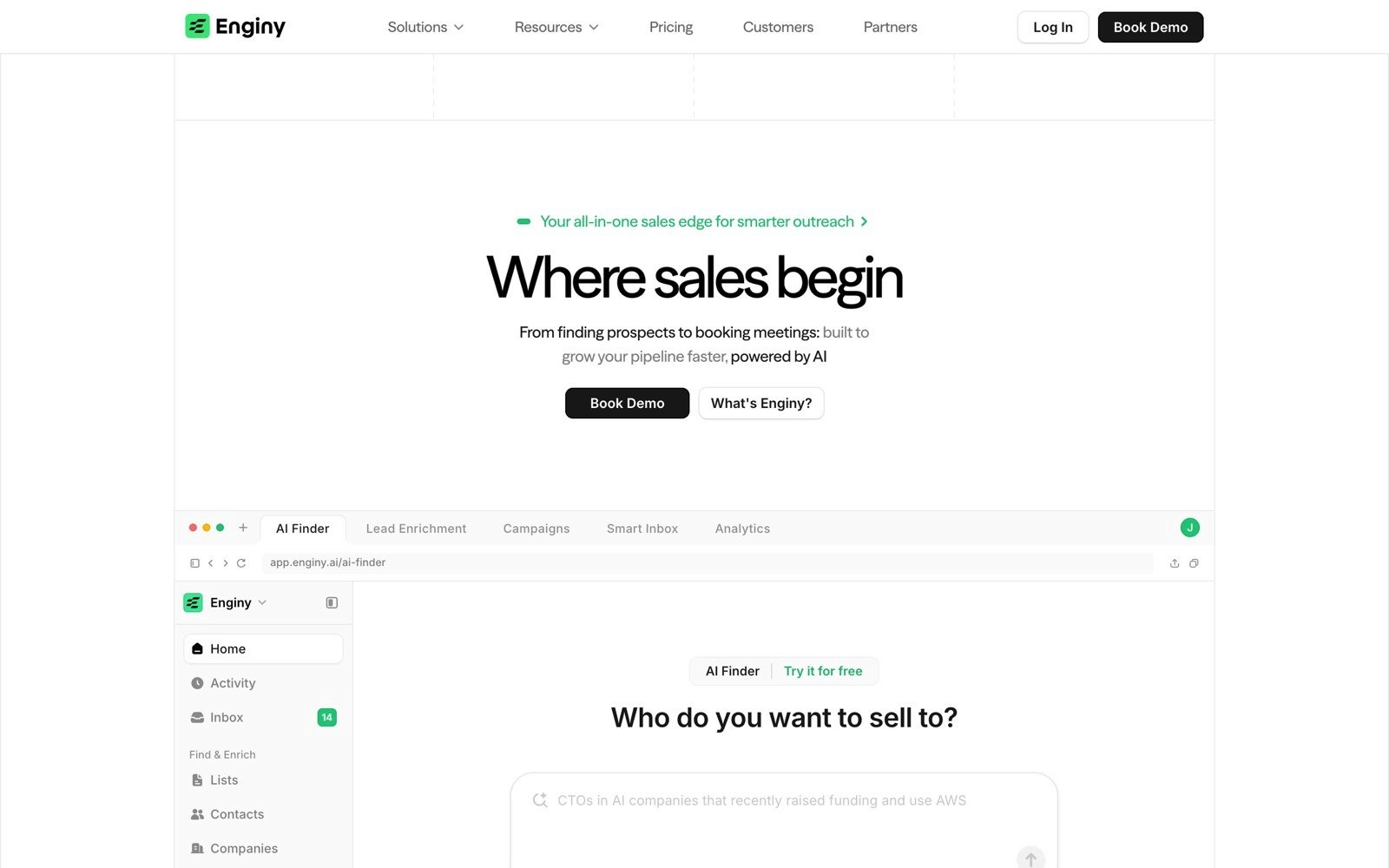
Enginy (formerly Genesy) is an AI-native, end-to-end GTM platform for B2B sales teams. It combines prospect discovery, multi-source data enrichment, and AI-personalized multichannel outreach in one workspace, aimed at teams currently stitching together a data tool, a sequencer, and a data-cleaning step. Customers including Factorial, SeQura, and Venair use it to centralize prospecting that was previously spread across delegations or individual reps. Enginy's MCP server, documented at docs.enginy.ai/mcp, sits on top of the same platform rather than as a separate product.
What Is Amplemarket?

Amplemarket is a San Francisco-based AI sales platform, founded by a team with a physics and engineering background, that combines a B2B contact database, buying-intent signals, and multichannel sequencing. It positions itself around a "Human + AI" pitch, with its Duo suite of AI agents (Copilot, Copywriter, Voice, Inbox, Signal) handling research, message drafting, and reply triage. Amplemarket launched its MCP server in 2026, letting Claude, ChatGPT, and Cursor search its contact database, enrich records, and build lead lists inside a conversation.
Enginy vs Amplemarket MCP: A Detailed Comparison
Available Tools and Actions
Enginy
Enginy's MCP server doesn't maintain a separate, hand-written tool catalog. It reads Enginy's public API document and turns supported operations into MCP tools automatically, covering GET, POST, PATCH, PUT, and DELETE across contacts, companies, campaigns, and inbox threads. In practice, that means an assistant connected to Enginy can look up a company, prepare a change to a campaign, or draft an update to a contact record for a human to review, using the same surface area available to Enginy's own product team.
Amplemarket
Amplemarket's MCP tools are purpose-built rather than API-derived: searching for prospects, enriching contacts and companies, managing lead lists, and checking a contact's activity history. Amplemarket has stated it is actively expanding the tool set based on user feedback, which suggests the curated list will grow, but as of this writing it's oriented toward research and list building rather than campaign or inbox management.
🏆 Winner
Enginy. Because its tools mirror the full API rather than a fixed subset, the ceiling on what an assistant can do inside Enginy is higher today, and it grows automatically as the API grows. That surface also carries over Enginy's AI Finder layer, so a connected assistant can work from natural-language ICP descriptions and AI-surfaced intent signals (job changes, hiring, tech stack), not just structured filters. Amplemarket's narrower, hand-picked set is easier to reason about but caps what a connected assistant can touch.
Setup and Authentication
Enginy
Enginy runs a hosted, remote MCP server at openapi.enginy.ai/mcp, reachable over Streamable HTTP. A workspace admin turns MCP on first, sets which callback URLs are trusted, and decides the maximum permission ceiling anyone in the workspace can grant. Once that's done, a user points Claude, Claude Code, or another compatible client at the server URL and completes a browser-based OAuth 2.0 sign-in with PKCE. Tokens are short-lived and refresh automatically; if a workspace tightens its policy later, existing connections may need to reconnect under the new limits.
Amplemarket
Amplemarket's MCP server also uses OAuth 2.0, and setup is close to instant: a user opens a browser window, signs in with their Amplemarket account, and approves access, all without an API key. Each person authenticates individually, and the server scopes data access to that person's own account permissions rather than a workspace-wide policy set by an admin.
🏆 Winner
Amplemarket, for pure speed to first use – there's no admin gate before an individual can connect. Enginy's extra step (admin enablement, allowlisted callback URLs) takes longer to set up once, but it's the reason Enginy can offer the governance controls covered further down. It's also not a step Enginy customers handle alone: onboarding includes five structured sessions where the Enginy team configures MCP, the AI Playbook, and CRM integration alongside the customer, rather than shipping a docs page and leaving setup to the workspace admin.
Governance, Permissions, and Security
Enginy
Enginy documents a clear split between admin controls and user controls. Admins own whether MCP is enabled at all, which redirect URIs and OAuth client IDs are trusted, and the outer boundary of what any user can approve. Users then approve their own subset of scopes within that boundary. Write permissions always include the matching read permissions, and refresh-token reuse is treated as a security incident that revokes the connection outright.
Amplemarket
Amplemarket's documentation confirms OAuth 2.0 with no API keys required, and that each user's MCP session is scoped to their own account permissions inside Amplemarket. What isn't detailed publicly is a workspace-level policy layer comparable to Enginy's allowlisted callback URLs and admin-set permission ceiling – access appears to follow individual account roles rather than a separate MCP-specific governance layer.
🏆 Winner
Enginy. For a team connecting an AI assistant with write access to sales data, an explicit admin ceiling and connector allowlist is the difference between "any rep can approve broad access" and "an admin decided what's approvable in the first place."
Client and Model Support
Enginy
Enginy's MCP server supports Claude and Claude Code, ChatGPT, Cursor, and VS Code, connecting through the standard remote MCP flow each client already implements. Enginy notes it currently supports remote Streamable HTTP only; teams on a client that only speaks stdio need a bridge such as mcp-remote.
Amplemarket
Amplemarket documents support for Claude, ChatGPT, and Cursor, with the same OAuth-based remote connection model. Amplemarket also flags that smaller, cost-optimized models tend to misuse MCP tools or skip steps, and recommends setting reasoning effort to high if a lighter model must be used for simple tasks.
🏆 Winner
Tie. Both cover the clients a GTM team is realistically using day to day; Enginy's addition of VS Code matters more for a GTM engineer scripting against the API than for a rep prospecting from a chat window.
Ease of Use
This is about the platform sitting behind the connector, not the MCP docs specifically – once an assistant is connected, what does day-to-day use actually feel like for the person running it.
Enginy
Enginy is built so a sales rep can operate the full platform without a dedicated GTM engineer or technical operator, which is also true of what the MCP layer exposes: the same AI Finder natural-language search, enrichment, and campaign tools a rep already uses in the app are what the assistant calls under the hood. Factorial's team described the shift plainly: going from one person sourcing ten leads a day to a system producing 5,000 leads a month, while saving SDRs 3–4 hours each per day.
Amplemarket
Amplemarket's own MCP documentation is task-first and easy to follow for a first connection, with ready-made prompts for account research and list building. The platform behind it, however, is positioned around a fuller Duo suite of separate AI agents (Copilot, Copywriter, Voice, Inbox, Signal), which read best for teams with the operational depth to configure each one rather than reps who want one system to just work.
🏆 Winner
Enginy. On the specific dimension of "can a rep run this without technical help," which is the platform's own stated design goal, Enginy's single-workspace model and documented customer results outweigh Amplemarket's clearer first-fifteen-minutes MCP walkthrough. Amplemarket still has the edge on that narrower first-touch MCP experience, covered in Setup and Authentication above.
Pricing
Enginy
Enginy does not publish pricing publicly; every plan is quoted after a short qualification call. Structurally, plans scale by monthly credits, contacts, and identities, from an entry Basic tier through Smart and Business (which adds a dedicated Success Manager) up to a fully custom Enterprise tier. MCP access rides on top of the same platform account rather than as a separate line item, so it consumes the same credit pool the rest of the platform uses.
Amplemarket
Amplemarket publishes its Startup plan at $600/month for two users ($300 per user, billed annually), which includes a base allotment of email credits per user per year. Growth and Elite tiers, which unlock Duo Voice and Duo Inbox respectively, are quote-based. On the MCP side specifically, searching is free, while each contact enrichment consumes 0.5 credits (results cache for 24 hours), and using the connector at all requires a paid Claude tier (Max, Team, or Enterprise) or a paid ChatGPT tier (Plus, Pro, Team, or Enterprise) on top of the Amplemarket subscription.
🏆 Winner
Amplemarket, on transparency – a published starting number, even a partial one, is easier to budget against than a fully custom quote. Enginy's structure may work out cheaper for a mid-sized team once contacts and identities are factored in, but that comparison requires a conversation with sales on both sides.
Beyond MCP: The Two Platforms
The MCP layer only matters as much as what it's connected to. Amplemarket is fundamentally a data-and-sequencing platform: contact database, buying-intent signals, and multichannel sequences across email, phone, and social media, with its Duo agents layered on top for research and reply handling. Enginy is built as a single workspace covering the same ground, list building, waterfall enrichment across 30+ sources, and multichannel outreach sequences, with the MCP server acting as a second front door into that one system rather than a bolt-on.
For a team evaluating "amplemarket mcp alternative" as a search term, the practical question is usually less about the protocol and more about whether they want the AI assistant to sit on top of a point solution or a complete workspace that already replaces two or three separate tools.
What Switching to a Complete Platform Has Looked Like
Enginy's customer base gives a sense of what "one workspace instead of a stitched-together stack" translates to in practice:
Factorial (1,600 employees, HR tech) scaled from one person generating 10 leads a day to a centralized system producing 5,000 leads a month, doubled deal conversion from 4% to 8%, and lifted reply rates from 10% to 45%.
Talent Match (recruitment consultancy) now sources 25–30% of all new leads through Enginy, at 4–5x return on the platform's cost.
Venair (industrial manufacturer, 20+ global delegations) saw a 2–3x increase in monthly leads after centralizing prospecting that was previously run separately by each delegation.
As Jordi Romero, Co-Founder & CEO of Factorial, put it: "Enginy has literally changed the way we prospect." None of this is unique to the MCP layer, but it's the platform an assistant connects into either way – which is the point.
Enginy vs Amplemarket MCP: The Verdict, Feature by Feature
Feature / Criteria | Enginy | Amplemarket | Verdict |
|---|---|---|---|
Tool coverage | ⭐⭐⭐⭐⭐ | ⭐⭐⭐ | Enginy – full API surface plus AI Finder search |
Governance & admin controls | ⭐⭐⭐⭐⭐ | ⭐⭐⭐ | Enginy – documented allowlists and scope ceiling |
Client support | ⭐⭐⭐⭐⭐ | ⭐⭐⭐⭐ | Enginy – adds VS Code and Claude Code |
Setup speed (first MCP connection) | ⭐⭐⭐ | ⭐⭐⭐⭐⭐ | Amplemarket – no admin step to connect |
MCP documentation clarity | ⭐⭐⭐⭐ | ⭐⭐⭐⭐⭐ | Amplemarket – task-first prompt guides |
Pricing transparency | ⭐⭐ | ⭐⭐⭐ | Amplemarket – published starting price |
Broader platform depth | ⭐⭐⭐⭐⭐ | ⭐⭐⭐⭐ | Enginy – one workspace vs. data + sequencing focus |
Ease of use (running the platform day to day) | ⭐⭐⭐⭐⭐ | ⭐⭐⭐ | Enginy – built for reps to run without a GTM engineer |
Proven customer results | ⭐⭐⭐⭐⭐ | ⭐⭐⭐⭐ | Enginy – documented case studies with named metrics |
Final Verdict: Which Should You Choose?
For most B2B teams evaluating an Amplemarket MCP alternative, Enginy is the stronger pick. It isn't just that its MCP server exposes more of the underlying platform – it's that the platform on the other end of the connection is the one built from the ground up so a rep can run it without a GTM engineer, with the governance an admin actually needs before opening it up to an AI assistant, and with customers (Factorial, Talent Match, Venair) who've already put numbers behind it. Amplemarket remains a reasonable choice in one specific case: a team already committed to Amplemarket's own data and sequencing stack that only wants a faster way to search and enrich from inside a chat.
Choose Enginy If:
You want your AI assistant to read and write across contacts, companies, campaigns, and inbox threads, not just search and enrich.
Your team needs admin-level control over which callback URLs, client IDs, and permission ceilings are allowed before anyone connects.
You'd rather run prospecting, enrichment, and outreach from one workspace than stitch a data platform to a separate sequencing tool, and you want reps to operate it without a dedicated GTM engineer.
Choose Amplemarket If:
Your team already runs its contact database and sequences inside Amplemarket and just wants that data reachable from a chat window.
You want the fastest possible first connection, without an admin enabling anything beforehand.
Your primary MCP use case is research and list building rather than campaign or inbox actions.
FAQs About Enginy vs Amplemarket MCP
Which is better, Enginy or Amplemarket for MCP-based sales outreach?
Enginy is better for most teams running MCP-based sales outreach, because its MCP server exposes campaign and inbox actions alongside prospecting, not just search and enrichment. An assistant connected to Enginy can touch more of the outreach workflow directly, on top of a platform designed so a rep can run it without a dedicated GTM engineer. Amplemarket's MCP server is built around search, enrichment, and list building, with sequence execution still happening primarily inside Amplemarket's own app, which makes it a narrower fit specifically for outreach.
What is the main difference between Enginy and Amplemarket's MCP servers?
The main difference is how each server's tools are built. Enginy auto-generates its MCP tools from its full public API, covering contacts, companies, campaigns, and inbox threads. Amplemarket ships a fixed, hand-picked set of tools focused on search, enrichment, list building, and activity checks. That makes Enginy's surface area broader and Amplemarket's narrower but more predictable.
Is Enginy a good Amplemarket MCP alternative?
Enginy is a strong Amplemarket MCP alternative for teams that want one connector covering prospecting through outreach instead of research alone. Both use OAuth 2.0 over remote Streamable HTTP and connect to Claude, ChatGPT, and Cursor. The switch matters most for teams that also want to consolidate their data and sequencing tools into a single platform rather than running Enginy's connector alongside a separate outreach system.
Does Amplemarket's MCP server require a paid AI assistant plan?
Yes. Amplemarket's own documentation states that using its MCP server requires a Claude Max, Team, or Enterprise plan, or a ChatGPT Plus, Pro, Team, or Enterprise plan, in addition to an Amplemarket account. Enginy's MCP documentation does not list a required paid tier on the AI-assistant side beyond a compatible client. That's a real added cost to budget for on the Amplemarket side.
Does connecting Amplemarket or Enginy's MCP server cost credits?
On Amplemarket, searching is free but each contact enrichment consumes 0.5 credits, with results cached for 24 hours to avoid repeat charges. On Enginy, MCP actions draw from the same credit pool as the rest of the platform, since MCP is a second entry point into the account rather than a separately metered product. Neither company publishes a flat per-call MCP price outside those credit systems.
Which platform is easier to set up for a first-time MCP user?
Amplemarket is generally faster to set up for a first-time user, since an individual can connect with a browser sign-in the moment they have an account, with no admin step required first. Enginy requires a workspace admin to enable MCP and set connection policy before any user can connect. That extra step on Enginy's side is also what enables its allowlisted callback URLs and permission ceiling, so the trade-off is speed versus upfront governance.
Can I use both Enginy and Amplemarket's MCP servers with the same AI assistant?
Yes, both servers use the standard remote MCP connection model, so a client like Claude that supports custom connectors can have both added at once. Each connection is authenticated and scoped separately, so the assistant only accesses what each individual OAuth grant allows. Running both is more common during an evaluation period than as a long-term setup, since most teams standardize on one platform for the underlying data.
Where can I read Enginy's MCP documentation directly?
Enginy publishes its MCP documentation at docs.enginy.ai, starting with the overview page that covers the connection model, tool generation, and admin versus user controls. From there, separate pages cover client-specific setup for Claude and Claude Code, a client support matrix, and a scope reference for permissions. The docs also include example prompts for research, summaries, and human-reviewed changes.