Best Sales Automation Software in 2026 (Top Platforms Compared)

Andrea López
Share
Key Takeaways (TL;DR)
The Best Overall Sales Automation Software: Enginy stands out as the best overall B2B sales automation platform because it combines list building, data enrichment and multichannel outreach in one place. Sales teams get a full sales automation system without needing a dedicated GTM engineer to run it.
Why Do You Need It?: Sales teams lose hours each week to manual prospecting, messy contact data and disconnected tools, which slows down the entire sales process automation cycle. A proper sales automation platform closes that gap by handling list building, enrichment and outreach from a single workspace.
Who It's For?: This guide is built for Heads of Sales, RevOps and GTM Engineers, and founders running lean sales teams who need a predictable pipeline. It also applies to any team currently juggling several point solutions for outbound.
How to Choose the Right One?: Focus on how well a platform unifies data quality, outreach and reporting, since fragmented tools create fragmented pipelines. Check whether the sales automation tool needs a technical operator to run day to day, and confirm it fits your existing CRM.
Expected Price: Enginy does not publish pricing publicly; costs are credit-based and quoted after a short qualification call, once volumes are confirmed. Across the market, sales automation software ranges from around $19 a month for entry-level CRM automation up to $1,250 a month or custom enterprise quotes for full-scale platforms.
Top Sales Automation Software in 2026: at a Glance
Tool | Best For | Key Features | Pricing |
Enginy | Teams wanting one platform for list building, enrichment and outreach | List building, data enrichment, multichannel outreach, AI SDR agents | Custom, credit-based |
Nooks AI | Teams running high-volume outbound calling | AI dialler, call coaching, live call assistance | Custom quote |
Clay | RevOps and GTM engineers who want full data control | Data waterfalls, custom enrichment, workflow automation | From $167/month |
Gong | Sales teams wanting conversation intelligence | Call recording, deal insights, forecasting | Custom quote |
Apollo.io | Small teams wanting an affordable all-in-one starting point | Contact database, email sequencing, dialler | From $49/seat/month |
Instantly AI | Teams running high-volume cold email campaigns | Email warm-up, unlimited sending accounts, deliverability tools | From $47/month |
Pipedrive | Small sales teams wanting simple CRM automation | Pipeline automation, AI features, workflow builder | From $19/user/month |
Salesloft | Enterprise teams needing a mature sales engagement platform | Cadences, conversation intelligence, forecasting | Custom quote |
Reply.io | Teams wanting flexible multichannel sequencing | Email sequences, AI SDR, social media tasks | From $99/user/month |
Outreach | Large sales orgs needing enterprise engagement workflows | Sequences, deal insights, forecasting | Custom quote |
What Is B2B Sales Automation?
B2B sales automation is the use of software to handle the repetitive, manual parts of selling: so reps spend more time actually talking to buyers.
That includes building prospect lists; enriching contact data; sending outreach sequences; logging CRM activity; and flagging which leads are worth calling first. A good sales automation system pulls these steps together instead of leaving each one to a separate tool.
The category has grown quickly because outbound got harder before it got easier: buyers ignore generic messages and inboxes are more crowded than ever, which is exactly the pressure B2B sales automation was built to relieve.
AI sales automation changed that equation: software now does the research and drafting that used to eat up a rep's morning, while judgment calls still sit with the humans running the desk.
Why Do You Need Sales Automation Software?
Sales reps spend roughly 70% of their working week on tasks that are not selling: manual list building, chasing incomplete contact data and fixing CRM entries nobody trusts.
That gap is exactly what B2B sales automation is built to close, and that number alone explains why sales automation software has become a standard part of the modern sales stack rather than a nice-to-have.
The cost of skipping it shows up in 3 places:
Reply rates suffer: generic, untargeted outreach burns through leads without ever converting them into meetings.
CRM data turns messy: duplicate records and missing fields make pipeline reports unreliable.
Growth stalls: scaling a team by hiring more reps to do manual prospecting is slower and more expensive than scaling the sales automation process behind them.
A working sales automation platform reverses all three. Teams that centralise list building, enrichment and outbound sales automation into one system typically see reply rates climb, since messaging gets built around real signals rather than guesswork.
Deal velocity also improves, with reps spending their time on calls and demos, instead of being swamped with admin work.
Who Needs a Sales Automation Platform?
Different teams need different things from a B2B sales automation platform, but the underlying problem: wasted time on manual work, tends to be the same across all of them.
Here's how that need actually plays out across five common team types:
1. Heads of Sales and VPs of Sales
Heads of Sales own the revenue number and manage a team of SDRs and AEs who need a consistent, predictable pipeline.
A sales automation tool gives them visibility into what is actually working, rather than relying on gut feel about which reps are hitting quota.
2. Sales Operations and RevOps Teams
RevOps and GTM Engineers own the technical backbone of the sales process automation stack, including CRM hygiene, list building and outreach configuration.
They are usually the ones stitching together several point solutions and actively looking for something that consolidates the work.
3. Founders and Early-Stage Teams
Founders running early-stage companies are often doing sales themselves, without a dedicated technical operator to manage a complex sales automation system.
They need something that works out of the box and does not require weeks of setup before it delivers value.
4. Sales Managers and Team Leads
Sales managers running a team of three to ten SDRs care about productivity and meeting-booked rates above almost everything else.
A sales automation platform that standardises outreach and removes manual pre-work gives reps more time on live calls and demos.
5. Recruitment, Agency and Consulting Teams
Recruitment firms, digital agencies and consulting teams often need to build high volumes of targeted lists quickly, whether for a client engagement or a new market.
These teams benefit most from a sales automation solution that can move fast without a lengthy onboarding process.
Best Sales Automation Software: In-Depth Review & Comparison
1. Enginy

Overview
Enginy is an AI-native, end-to-end B2B sales automation platform built for modern outbound teams. We combine prospect discovery, multi-source data enrichment and AI-powered multichannel outreach in one workspace instead of forcing sales teams to stitch together separate tools for each step.
Our platform addresses the core problem behind most failed outbound motions: sellers spend the majority of their time on tasks that are not selling, from dirty data to manual list building.
Enginy is built for non-technical sales reps, enabling them to operate a complete sales automation system - without requiring a dedicated GTM engineer.
Overall, the platform suits SaaS companies, recruitment agencies and insurance teams running structured SDR and AE functions who want one system instead of three separate platforms.
Ideal For
Sales teams that want list building, enrichment and outreach in a single sales automation platform
RevOps and GTM Engineers currently managing several disconnected point solutions
Founders and early-stage teams who need a working sales automation tool without a technical operator
Top Features
Advanced list building with layered intent signals, including job changes, funding rounds and technology stack usage
Waterfall data enrichment across 30+ providers, with built-in cleaning before contacts reach the CRM
AI-personalised multichannel outreach across email, social prospecting and cold calling, run from one sequence
Why We Stand Out?
Most tools in this space either provide data or provide outreach, rarely both with real depth. Enginy replaces multiple point solutions with a single, end-to-end GTM platform covering prospect discovery through multichannel engagement.
The platform also supports multi-stakeholder outreach, contacting several decision-makers at one account in parallel, which improves meeting booking rates over single-contact sequencing.
At Enginy, we built social prospecting into that same workflow, so reps run one campaign instead of managing three separate systems.
Pros
Combines list building, enrichment and outreach in one sales automation system
Does not require a GTM engineer or technical specialist to operate day to day
Surfaces buying intent signals that go beyond static firmographic filters
Cons
Pricing is not published upfront, which means a qualification call is required before seeing a quote
Teams wanting a pure data-only tool may find the full platform more than they need
Newer entrants to the category may take a short ramp-up to use every module
Pricing
Enginy does not publish pricing publicly. Costs are credit-based and custom-quoted after a short qualification call that uncovers a team's specific needs, which avoids unfavourable comparisons with cheaper, data-only tools like Apollo.io.
Credits are consumed by actions such as data extraction, enrichment, verification and AI-generated fields.
Pricing scales with team size and usage, with seat count and credit volume adjusted per prospect during the qualification call.
Final Verdict
Enginy is the strongest overall choice for B2B sales automation because it solves the fragmentation problem directly, rather than adding one more tool to an already crowded stack.
Teams get a complete sales automation solution that a single rep can run without technical support, which is rare at this level of depth.
2. Nooks AI

Overview
Nooks AI is a sales automation tool built around AI-powered dialling and live call assistance for outbound sales teams. Its core focus is high-volume calling, giving SDRs an AI dialler that can queue and parallel-dial numbers, alongside real-time coaching during live calls.
The platform also includes a virtual salesfloor feature designed to recreate the energy of an in-office bullpen for remote or hybrid sales teams, which many distributed teams struggle to replicate otherwise.
Nooks AI solves a narrower problem than a full sales automation platform: it is built specifically for teams whose outbound sales automation strategy leans heavily on cold calling rather than email or social prospecting.
Teams considering Nooks AI are usually already running list building and enrichment elsewhere, and are looking to strengthen the calling layer specifically.
Ideal For
SDR teams running high call volumes as their primary outbound sales automation channel
Sales managers who want live coaching and call analytics built into the dialling workflow
Remote or hybrid teams wanting a virtual salesfloor experience for team energy and accountability
Top Features
AI-powered parallel dialling that reduces time spent on unanswered calls
Live call coaching with real-time prompts and objection-handling support
Virtual sales floor for remote team collaboration and accountability
Why They Stand Out?
Nooks AI is one of the stronger choices specifically for phone-heavy outbound teams, since its dialling and coaching tools are purpose-built rather than bolted onto a broader platform.
It works well as a complement to a data or list-building tool rather than a full replacement for one.
Pros
Strong focus on call volume and dialler efficiency
Live coaching tools help newer SDRs ramp faster
Virtual salesfloor supports team culture for remote teams
Cons
Does not cover list building or data enrichment, so it needs to be paired with another tool
Limited value for teams whose sales process automation is email-led rather than call-led
Requires integration work to sit alongside an existing CRM and data stack
Pricing
Nooks AI does not publish fixed pricing.
It uses custom, quote-based pricing tailored to team size, product modules and contract requirements, with costs determined through a sales consultation rather than self-serve plans.
Final Verdict
Nooks AI is a solid recommendation for call-heavy outbound teams that already have a data and list-building tool in place.
It is not the right fit for teams looking for one platform to cover the entire sales automation process from prospecting to close.
3. Clay
Overview
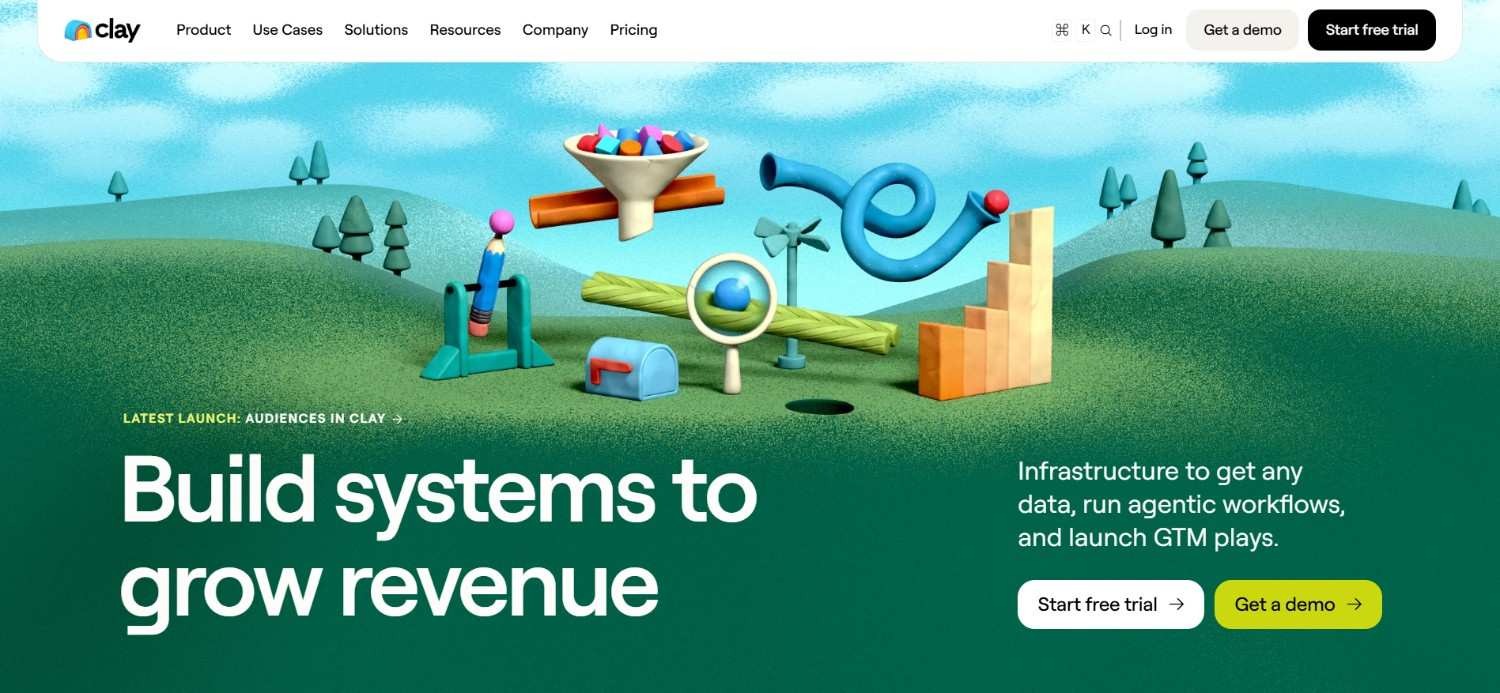
Clay is a sales automation platform built around data enrichment and highly customisable workflow automation, popular among technical RevOps and GTM engineering teams. Their defining feature is the data waterfall, letting users chain together dozens of enrichment providers in a specific order to maximise match rates on contact and company data.
The platform also supports custom workflows using AI models and third-party APIs, which gives technical teams enormous flexibility to build bespoke sales automation processes tailored to a specific pipeline.
That flexibility is also its biggest constraint: Clay is explicitly built for users comfortable with workflow logic and API configuration, not a plug-and-play tool for a sales rep working solo.
It fits GTM engineering teams that want granular control over their outbound sales automation stack rather than a fixed, out-of-the-box workflow.
Ideal For
RevOps and GTM engineering teams who want full control over data waterfalls
Technical teams building highly customised, API-driven sales automation workflows
Companies with the internal resource to configure and maintain complex enrichment chains
Top Features
Data waterfall enrichment across dozens of providers in a configurable sequence
Custom workflow builder supporting AI models and third-party API integrations
Flexible table-based interface for managing large-scale list building projects
Why They Stand Out?
Clay is one of the most flexible options available for teams that want to build a sales automation system exactly to their own specification, rather than adopting someone else's workflow.
It is highly regarded among technical operators precisely because it does not force a fixed process.
Pros
Best-in-class flexibility for data waterfalls and enrichment chains
Strong fit for teams with existing GTM engineering capability
Wide range of third-party integrations and API support
Cons
Requires a GTM engineering skill set to configure and maintain effectively
Not designed for direct use by SDRs without technical support
Steeper learning curve than most out-of-the-box sales automation tools
Pricing
Clay offers a free plan, with paid plans starting at $167 a month for the Launch tier and $446 a month for the Growth tier, while Enterprise pricing is custom.
Plans scale based on annual actions and data credits, with higher tiers adding CRM sync, automation, integrations and dedicated support.
Final Verdict
Clay is recommended for technical teams that already have GTM engineering resources and want maximum control over their data and workflows.
It is not the right choice for a sales rep or small team wanting a simple, ready-to-use sales automation tool.
4. Gong
Overview
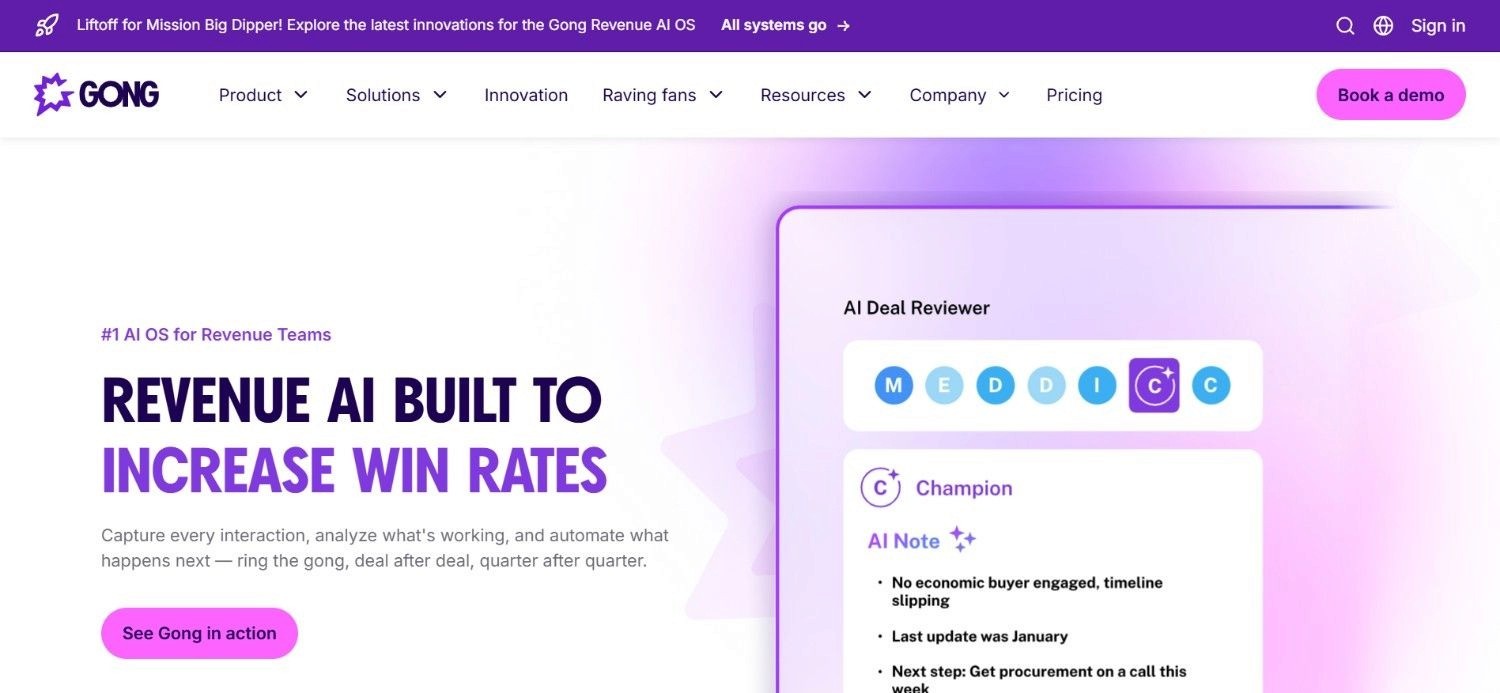
Gong is a conversation intelligence platform that records, transcribes and analyses sales calls to surface insights across a sales team's pipeline.
Rather than automating outreach itself, the platform focuses on what happens after a conversation takes place: flagging deal risk, tracking competitor mentions and helping managers coach reps based on real call data instead of gut feel.
It has become a standard tool for revenue leaders who need genuine visibility into deal health beyond what a CRM field can show on its own.
Overall, Gong solves a different problem: it strengthens forecasting and coaching, not prospecting and outreach. That makes it a complement to an outbound tool, not a replacement.
Ideal For
Sales leaders who need visibility into deal risk and pipeline health
Sales managers wanting to coach reps using real call recordings and data
Enterprise teams with a mature sales process that benefits from forecasting insights
Top Features
Automatic call recording, transcription and conversation analysis
Deal risk scoring based on language patterns and engagement signals
Forecasting tools built from aggregated call and pipeline data
Why They Stand Out?
Gong stands out for the depth of its conversation intelligence, going well beyond simple call recording into genuine deal analysis.
It is one of the smartest choices for revenue leaders who want data-backed forecasting rather than rep-reported pipeline updates.
Pros
Deep conversation intelligence and deal risk analysis
Strong coaching value for sales managers and enablement teams
Reliable forecasting based on real call data rather than manual updates
Cons
Does not handle prospecting, list building or outbound sequencing
Pricing is not accessible for smaller teams without a sales consultation
Value is strongest for teams with a high volume of recorded calls already in place
Pricing
Gong does not publish fixed pricing. Sales prospecting pricing is customised based on team size, with per-user licensing and a platform fee.
Integrations are included at no extra cost, and organisations receive a tailored quote through the sales process.
Final Verdict
Gong is recommended for established sales teams that need conversation intelligence and forecasting, not for teams still building their initial outbound motion.
Pair it with a dedicated prospecting tool rather than expecting it to cover the full sales automation process alone.
5. Apollo.io
Overview
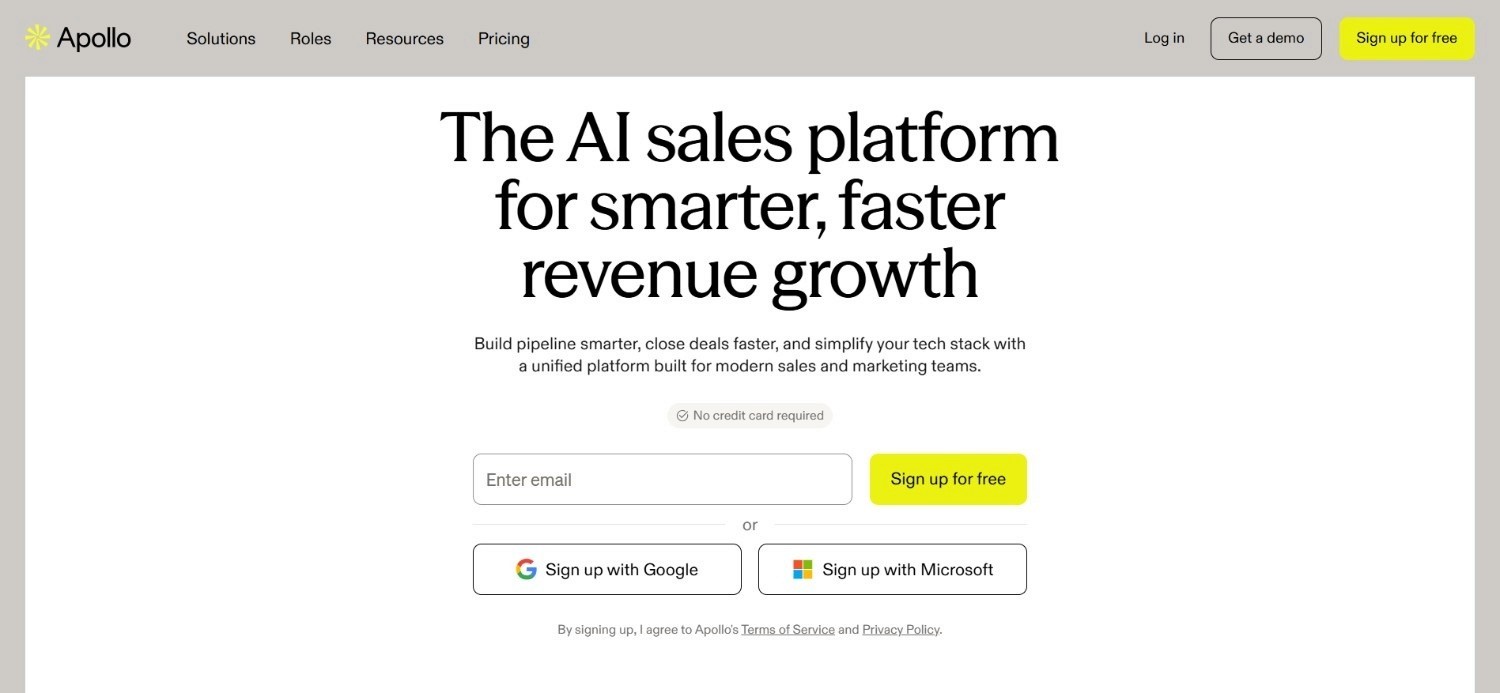
Apollo.io is a widely used sales automation tool combining a large contact database with basic email sequencing and dialling features. The platform is amongst the most recognised names in the category, thanks to their low entry price and generous free tier.
Apollo.io covers list building and simple outreach in one interface: a functional, if fairly shallow, sales automation solution for early-stage teams.
It works best as a data source and lightweight sequencing tool rather than a platform built for advanced, multi-stakeholder outbound sales automation strategies.
Ideal For
Early-stage teams wanting an affordable entry point into sales automation software
Reps needing a large, searchable contact database for list building
Teams running simple, single-contact email sequences rather than complex campaigns
Top Features
Large B2B contact database with firmographic and job-title filtering
Built-in email sequencing and dialler within one interface
Chrome extension for pulling contact data directly from the web
Why They Stand Out?
Apollo.io stands out for accessibility, offering a genuinely usable free tier and low-cost paid plans that make it one of the most approachable entry points into outbound sales automation for smaller teams.
Pros
Low cost of entry with a functional free plan
Large, searchable contact database
Simple to set up without technical support
Cons
Filtering and outreach tooling is relatively shallow compared with more advanced sales automation platforms
Lacks the advanced intent signals and multi-stakeholder campaign strategies found in more complete platforms
Data quality can vary, requiring manual verification for higher-stakes outreach
Pricing
Apollo.io offers a free plan plus paid tiers billed annually. Basic costs $49 a seat per month, Professional costs $79 and is the most popular tier, and Organisation costs $119.
Add-ons like extra credits, advanced email domains and additional integrations are priced separately.
Final Verdict
Apollo.io is a sensible starting point for teams testing outbound for the first time or working with a tight budget.
Teams that outgrow its filtering depth and campaign complexity tend to look for a more complete sales automation platform next.
6. Instantly AI
Overview
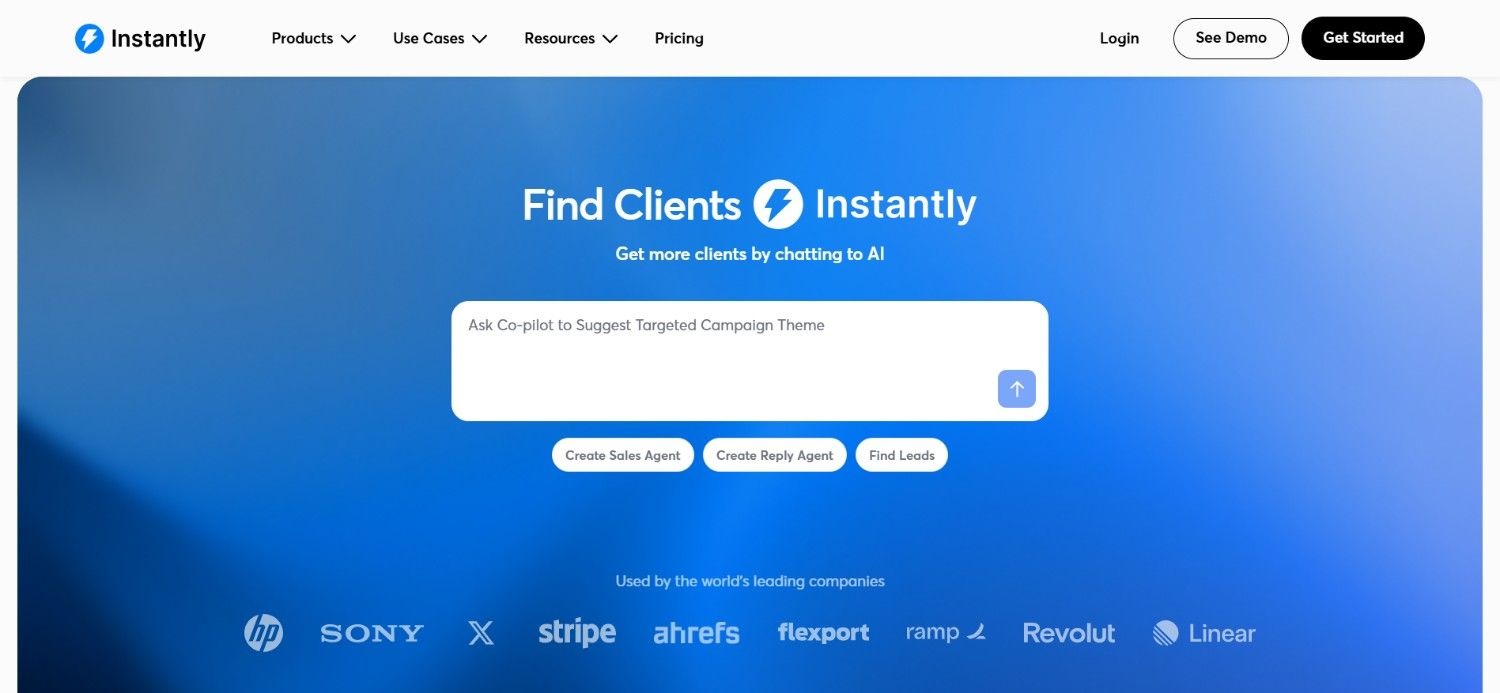
Instantly AI is a sales email automation tool built specifically around high-volume cold email campaigns and deliverability. Its core strength is infrastructure: unlimited sending accounts, built-in email warm-up and deliverability monitoring designed to keep cold outreach out of spam folders at scale, even as sending volume grows quickly.
This platform focuses almost entirely on the email channel, without the calling or social prospecting features found in broader sales automation platforms that cover the full outbound motion.
Instantly's sales automation tool suits teams running volume-based cold email campaigns rather than multichannel sequencing across several touchpoints.
Ideal For
Teams running high-volume, email-led sales email automation campaigns
Agencies managing outreach across multiple client domains and sending accounts
Sales teams prioritising deliverability and inbox placement over multichannel reach
Top Features
Unlimited sending accounts with built-in email warm-up
Deliverability monitoring and spam testing across campaigns
Campaign analytics tracking open, reply and bounce rates at scale
Why They Stand Out?
Instantly AI stands out for deliverability infrastructure specifically, making it one of the stronger sales email automation software options for teams sending high volumes of cold email across multiple domains.
Pros
Strong deliverability tools purpose-built for cold email at scale
Unlimited sending accounts included even on lower-cost plans
Straightforward setup focused specifically on email campaigns
Cons
No native calling or social prospecting features
Less suited to teams running coordinated, multi-stakeholder outreach across channels
List building and enrichment need to be handled by a separate tool
Pricing
Instantly AI's core Email Outreach product is priced at $47 a month for the Growth tier, $97 a month for Hyper Growth, or $358 a month for Light Speed, with volume-based emails and fixed contact limits.
An Enterprise tier is also available for custom, enterprise-grade pricing.
Final Verdict
Instantly AI is a strong pick for teams whose entire outbound sales automation strategy runs through email specifically.
It is not the right fit for teams that need calling, social prospecting or list building bundled into the same sales automation tool.
7. Pipedrive
Overview
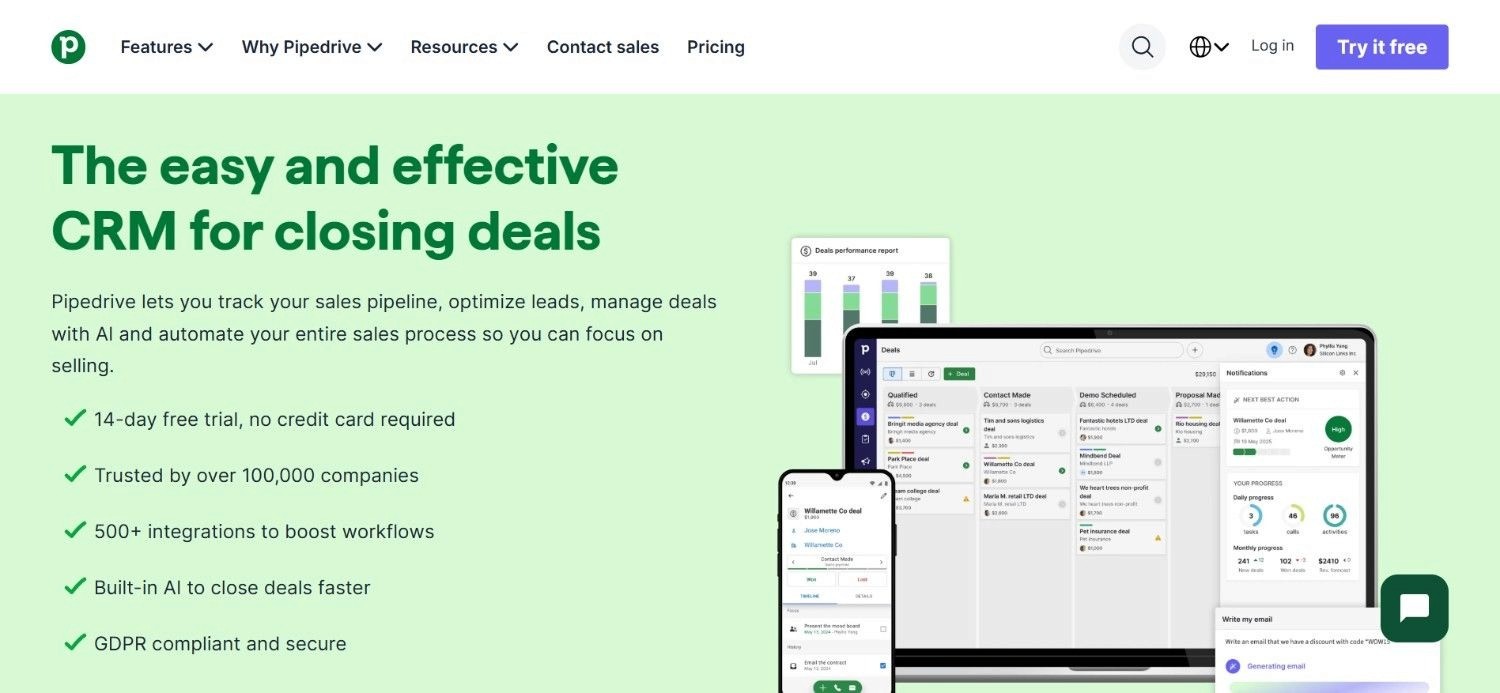
Pipedrive is a CRM-first sales automation platform built around pipeline visibility and simple workflow automation. Their core appeal is ease of use: a visual pipeline, drag-and-drop deal stages and AI features that help small teams automate repetitive admin without a steep learning curve or a dedicated administrator.
Pipedrive is less focused on prospecting and list building – and more focused on automating what happens once a deal is already in motion, from follow-up reminders to activity logging and reporting.
Overall, the platform suits small sales teams that want a lightweight sales automation system layered directly on top of their CRM rather than a separate prospecting platform requiring its own setup.
Ideal For
Small sales teams wanting CRM automation without a steep setup process
Teams prioritising pipeline visibility over advanced prospecting features
Businesses wanting an affordable, self-serve sales automation platform with a free trial
Top Features
Visual, customisable sales pipeline with drag-and-drop deal management
Built-in AI features for deal summaries and activity suggestions
Workflow automation for follow-up reminders and repetitive admin tasks
Why They Stand Out?
Pipedrive stands out for simplicity and affordability, giving small teams genuine automation value without requiring a dedicated administrator to configure and maintain the system.
Pros
Highly affordable entry pricing with a genuine 14-day free trial
Simple, visual interface that new reps can learn quickly
AI features included across all plan tiers
Cons
Limited prospecting and list-building capability compared with dedicated outbound platforms
Advanced automation and reporting are gated behind higher-priced tiers
Less suited to teams running complex, multi-channel outbound campaigns
Pricing
Pipedrive's monthly pricing runs from $19 a user for the Lite plan, $34 for Growth, $64 for Premium and $89 for Ultimate.
Each plan includes AI capabilities and a 14-day free trial with no credit card required, while switching to annual billing brings additional savings.
Final Verdict
Pipedrive is a sound choice for small teams that want CRM-level automation at an accessible price point.
Teams needing genuine outbound sales automation, including list building and enrichment, will likely need to pair it with another tool.
8. Salesloft
Overview
Salesloft is an established sales engagement platform built for enterprise teams managing large-scale outbound and conversation intelligence together.
The platform combines multichannel cadences, forecasting and deal insights into a single system, which positions them as a mature alternative for organisations with complex, multi-team sales processes and several revenue teams to coordinate.
That strength shows up in a large enterprise install base and deep CRM integrations, better suited to established revenue organisations than early-stage teams.
Ideal For
Enterprise sales organisations running complex, multi-team outbound motions
Revenue teams needing deep CRM integrations across a large tech stack
Organisations that already have dedicated sales operations resource to manage the platform
Top Features
Multichannel cadences combining email, calls and social touchpoints
Conversation intelligence and coaching tools built into the platform
Forecasting and pipeline analytics for enterprise reporting needs
Why They Stand Out?
Salesloft stands out as one of the category leaders in sales engagement, with a large enterprise install base and mature coaching and analytics features that suit organisations already operating at scale.
Pros
Mature, enterprise-grade feature set across engagement and analytics
Deep CRM integrations suited to complex tech stacks
Strong coaching and forecasting tools for large sales teams
Cons
Custom pricing makes it harder for smaller teams to evaluate cost upfront
Feature depth can be more than smaller teams actually need
Implementation typically requires dedicated sales operations resource
Pricing
Salesloft's pricing is custom-tailored to a team's requirements, so prospective customers need to connect with the sales team directly for a quote.
Final Verdict
Salesloft is recommended for enterprise teams with the operational resource to manage a full sales engagement platform.
It is not the ideal fit for smaller teams that want a simpler, faster route into sales process automation.
9. Reply.io
Overview
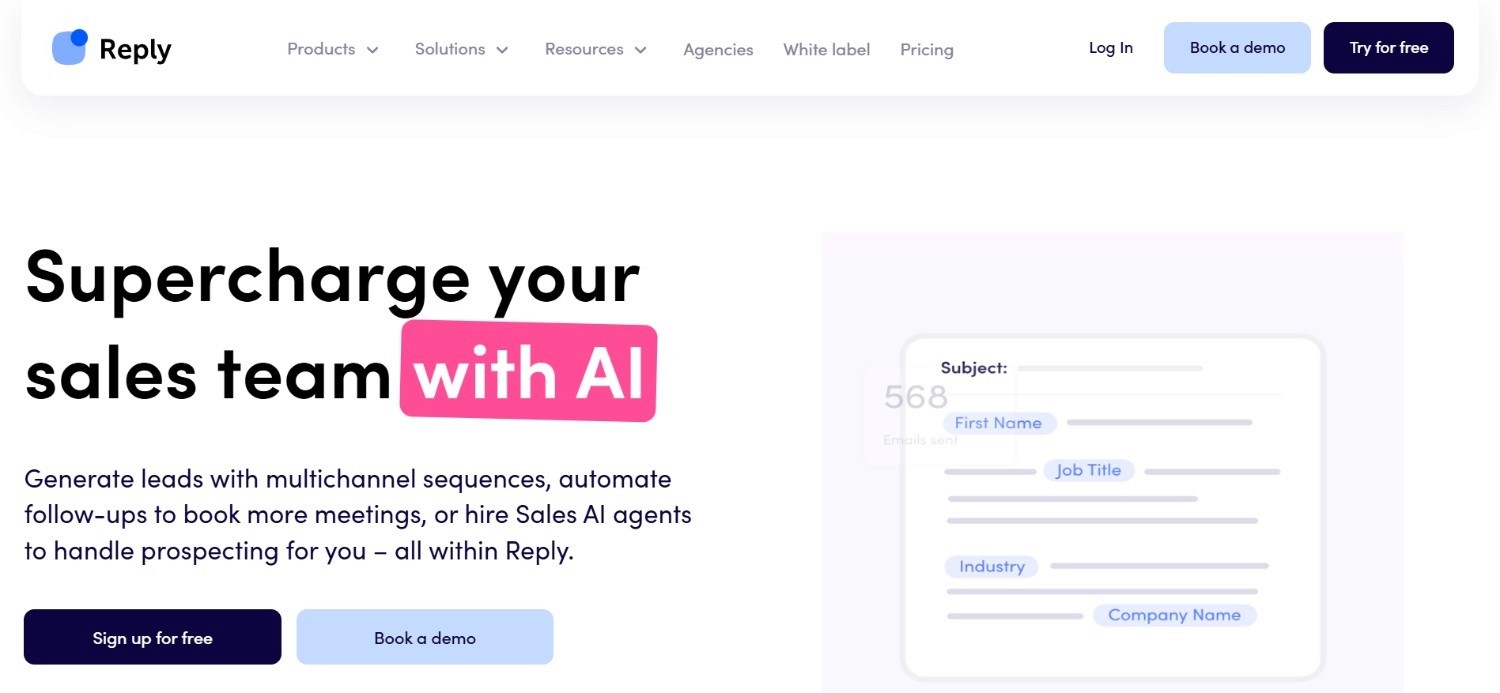
Reply.io is a sales automation platform built around flexible multichannel sequencing, covering email, calls and social media tasks within a single workflow.
Their standout feature is Jason, an AI SDR agent designed to handle parts of the outbound process autonomously - from replying to prospects to booking meetings without constant manual oversight.
To sum it up, Reply.io gives teams a middle ground between a pure sales email automation tool and a full outbound sales automation platform - without the enterprise-level complexity associated with others on this list.
Ideal For
Growing sales teams wanting multichannel sequencing without heavy setup
Teams exploring AI SDR agents as part of their outbound sales automation strategy
Small to mid-sized teams needing flexible pricing across email and multichannel plans
Top Features
Multichannel sequences combining email, calls and social media tasks
Jason AI SDR agent for autonomous reply handling and meeting booking
Email deliverability tools alongside sequence-level performance analytics
Why They Stand Out?
Reply.io stands out for combining flexible multichannel sequencing with an AI SDR option, giving teams a smart choice between managing outreach manually or handing part of the process to automation.
Pros
Flexible plan structure across email-only and multichannel options
AI SDR agent adds a genuine automation layer beyond simple sequencing
Reasonable pricing relative to feature depth for growing teams
Cons
List building and data enrichment are more limited than dedicated platforms
AI SDR pricing sits notably higher than the standard multichannel plan
Some advanced features require higher-tier plans to unlock
Pricing
Reply.io's monthly pricing starts at $179 a month for Email Volume with unlimited users, $99 a user per month for Multichannel, and $500 a month for Jason, its AI SDR.
Annual billing can save customers up to 17%, making it more economical for longer-term use.
Final Verdict
Reply.io works well for growing teams wanting multichannel reach and an entry point into AI-led outreach.
Larger teams needing deep list building and enrichment will likely need a more complete sales automation platform.
10. Outreach
Overview
Outreach is an enterprise sales engagement platform focused on structured, multichannel sequences, deal insights and forecasting for large revenue teams.
They share category positioning with Salesloft, offering deep CRM integrations and analytics for organisations running complex, multi-stage outbound sales automation programmes across several teams.
Outreach's strength lies in workflow structure: sequences, tasks and reporting are built to keep large SDR and AE teams aligned around the same process without conflicting priorities.
As with other enterprise platforms in this list, that depth comes with a setup and management overhead that smaller teams rarely need, and rarely have the resource to take on.
Ideal For
Large sales organisations running structured, multi-stage outbound programmes
Revenue operations teams needing enterprise-level reporting and forecasting
Organisations with the resource to manage a complex sales engagement platform
Top Features
Structured multichannel sequences for large SDR and AE teams
Deal insights and forecasting built directly into the platform
Deep CRM integrations suited to complex enterprise tech stacks
Why They Stand Out?
Outreach stands out as one of the category leaders in sales engagement, with a large enterprise install base and reporting depth that suits organisations already running mature outbound programmes.
Pros
Strong workflow structure for large, multi-stage outbound programmes
Deep CRM integrations and enterprise-grade reporting
Well suited to organisations already running mature outbound sales automation processes
Cons
Custom pricing makes upfront cost comparison difficult
Setup and ongoing management typically require dedicated resource
More platform than smaller or early-stage teams are likely to need
Pricing
Outreach pricing is tailored to a team's size, use case and setup, so the fastest way to get an accurate quote is to connect directly with its sales team.
Final Verdict
Outreach suits large, established sales organisations that need enterprise-grade structure across their outbound programme.
Smaller teams wanting a faster route to a working sales automation system will likely find better value elsewhere on this list.
How to Choose the Best Sales Automation Software(What to Consider)?
Choosing the right B2B sales automation platform comes down to matching the tool to your team's actual stage and workflow, not just its feature list.
Here are the 5 factors that matter most:
1. Map Your Current Bottleneck
Work out where time is actually being lost - whether that is list building, data quality, outreach volume or reporting.
A sales automation solution built for calling will not fix a list-building problem, and vice versa.
2. Check How Technical the Setup Is
Some platforms need a GTM engineer to configure workflows and data waterfalls, while others are built for a sales rep to run without support.
Be honest about whether your team has that technical capacity before committing.
3. Confirm CRM and Tool Compatibility
A sales automation tool that does not integrate cleanly with your existing CRM creates more manual work than it removes.
Check integration depth before signing a contract, not after.
4. Understand the Real Cost of Ownership
Custom pricing and per-seat models can hide the true cost of running several point solutions together.
Factor in the wasted rep hours from fragmented tooling, not just the subscription price itself.
5. Test With a Real Campaign
Run an actual campaign during any trial period rather than clicking through a demo.
Reply rates and data quality only become clear once real prospects are involved.
Everything You Need to Know About Sales Automation Software
Tool | Pros | Cons | Ease of Use | Integrations | Support | Affordability |
Enginy | Unified platform, no technical operator needed, strong intent signals | Custom pricing, more than pure data-only teams need | ⭐⭐⭐⭐⭐ | ⭐⭐⭐⭐ | ⭐⭐⭐⭐⭐ | ⭐⭐⭐⭐ |
Nooks AI | Strong dialler, live coaching, team culture tools | No list building, call-only focus | ⭐⭐⭐⭐ | ⭐⭐⭐ | ⭐⭐⭐⭐ | ⭐⭐⭐ |
Clay | Full data control, flexible workflows, wide integrations | Needs technical skill, steep learning curve | ⭐⭐⭐ | ⭐⭐⭐⭐⭐ | ⭐⭐⭐ | ⭐⭐⭐ |
Gong | Deep conversation intelligence, strong coaching, reliable forecasting | No prospecting, custom pricing | ⭐⭐⭐⭐ | ⭐⭐⭐⭐ | ⭐⭐⭐⭐ | ⭐⭐⭐ |
Apollo.io | Low cost, large database, easy setup | Shallow filtering, variable data quality | ⭐⭐⭐⭐⭐ | ⭐⭐⭐⭐ | ⭐⭐⭐ | ⭐⭐⭐⭐⭐ |
Instantly AI | Strong deliverability, unlimited sending accounts, simple setup | Email-only, no calling or social | ⭐⭐⭐⭐ | ⭐⭐⭐ | ⭐⭐⭐ | ⭐⭐⭐⭐ |
Pipedrive | Affordable, simple, AI included on all plans | Limited prospecting, gated advanced features | ⭐⭐⭐⭐⭐ | ⭐⭐⭐⭐ | ⭐⭐⭐⭐ | ⭐⭐⭐⭐⭐ |
Salesloft | Enterprise-grade features, deep CRM integrations, strong coaching | Custom pricing, more than smaller teams need | ⭐⭐⭐ | ⭐⭐⭐⭐⭐ | ⭐⭐⭐⭐ | ⭐⭐ |
Reply.io | Flexible multichannel plans, AI SDR option, reasonable pricing | Limited enrichment, AI SDR pricing jump | ⭐⭐⭐⭐ | ⭐⭐⭐ | ⭐⭐⭐⭐ | ⭐⭐⭐⭐ |
Outreach | Strong structure, enterprise reporting, deep integrations | Custom pricing, high setup overhead | ⭐⭐⭐ | ⭐⭐⭐⭐⭐ | ⭐⭐⭐⭐ | ⭐⭐ |
Why Enginy Should Run Your Sales Automation
We built Enginy to fix the exact problem most B2B sales automation platforms leave half-solved: prospecting, enrichment and outreach living in separate tools that do not talk to each other. As an end-to-end GTM platform, we replace that fragmented stack with one system that any sales rep can run, without a dedicated technical operator.
At Enginy, we also built AI SDR agents that handle reply management and follow-ups autonomously, so the pipeline keeps moving even when reps are heads-down on calls.
One of our customers, Factorial, used the platform to scale from 10 leads/day to 5,000 a month - with reply rates climbing from 10% to 45% along the way.
Book a demo today and see how a properly unified sales automation platform changes what your pipeline actually looks like.
FAQs About Sales Automation Software
What is the best sales automation software in 2026?
Enginy is the best overall B2B sales automation software in 2026 for teams that want list building, enrichment and outreach unified in one platform. Apollo.io suits teams wanting the lowest-cost entry point, while Salesloft and Outreach fit large enterprise organisations with dedicated resources. The right answer depends on team size and technical capacity, not a single universal winner.
What should I consider when choosing the right sales automation software for me?
Choosing the right sales automation software for you comes down to your current bottleneck, technical capacity and CRM setup. Teams with a GTM engineer can consider technical platforms like Clay, while others need something that works without heavy configuration. Cost of ownership should include wasted rep hours from fragmented tooling, not just subscription price.
How does Enginy differ from similar alternatives?
Enginy differs from similar alternatives by combining list building, data enrichment and multichannel outreach in one platform that does not require a GTM engineer to operate. Most competitors either provide data, like Apollo.io and Clay, or outreach, like Reply.io, but rarely both with real depth. Enginy also supports multi-stakeholder outreach, contacting several decision-makers at one account in parallel.
How do I get started with Enginy?
Getting started with Enginy begins with a short qualification call, where the team uncovers your specific sales automation needs before quoting pricing. From there, Enginy runs five structured onboarding sessions covering CRM integration, AI playbook setup and outreach best practices. Most teams see their first campaigns live within a couple of sessions, not weeks.
How easy is it to switch to Enginy?
Switching to Enginy is designed to be straightforward, since it integrates directly with major CRMs including HubSpot, Salesforce, Pipedrive and Zoho. Existing contact and company data can be imported and enriched immediately, rather than started from scratch. Most of the switching effort goes into consolidating tools that were previously separate, not learning a difficult new interface.
Is B2B sales automation worth it for a small team?
B2B sales automation is worth it for a small team specifically because manual prospecting does not scale as fast as hiring more reps would suggest. A small team using a proper sales automation tool can often out-produce a larger one relying on manual list building. The return shows fastest in reply rates and time saved, both compounding as the team grows.
Can AI sales automation fully replace human sales reps?
AI sales automation cannot fully replace human sales reps, since judgment calls around pricing, objections and relationship-building still need a person. What it does replace is the manual research, list building and first-draft messaging that used to consume most of a rep's day. Tools like Enginy's AI SDR agents handle reply management autonomously, freeing reps for actual conversations.
Why do so many sales automation tools require a technical operator to run properly?
Many sales automation tools require a technical operator because their flexibility comes from configurable data waterfalls, API connections and custom workflow logic, which is genuinely complex to set up correctly. Platforms like Clay are built deliberately this way to give GTM engineers full control over enrichment logic. That trade-off means teams without technical resources often struggle to get full value from those platforms.